




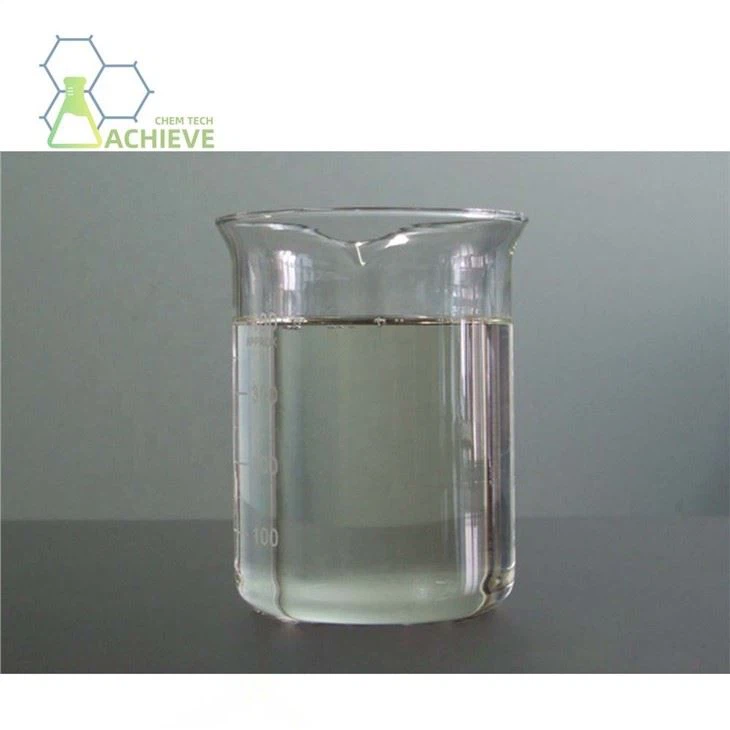

Shaanxi BLOOM Tech Co., Ltd. is one of the most experienced manufacturers and suppliers of (2-bromoethyl)benzene cas 103-63-9 in China. Welcome to wholesale bulk high quality (2-bromoethyl)benzene cas 103-63-9 for sale here from our factory. Good service and reasonable price are available.
Announcement
This chemicals was banned to sell, our website only can check the basic info. of chemicals here, we don't sell them!
October 28th, 2025
(2-Bromoethyl)Benzene is an organic compound. Molecular formula C8H9Br, CAS 103-63-9. This compound is formed by a bromine atom and a hydrogen atom on an ethyl substituted benzene ring. It is a colorless or light yellow liquid with an irritating odor. Soluble in most organic solvents, but insoluble in water. Under standard conditions, its solubility in water is extremely low. It is an important organic synthesis intermediate used in the production of various fine chemicals such as drugs, pesticides, and dyes. Due to its unique chemical structure, it can be used in various organic synthesis reactions, such as substitution, addition, and condensation. In addition, it is also used as a solvent and a reagent in chemical experiments. It has important application value in the field of chemistry, especially in the manufacturing of plasticizers and other organic synthesis, playing a key role.

|
Chemical Formula |
C8H9Br |
|
Exact Mass |
184 |
|
Molecular Weight |
185 |
|
m/z |
184 (100.0%), 186 (97.3%), 185 (8.7%), 187 (8.4%) |
|
Elemental Analysis |
C, 51.92; H, 4.90; Br, 43.18 |
|
|
|

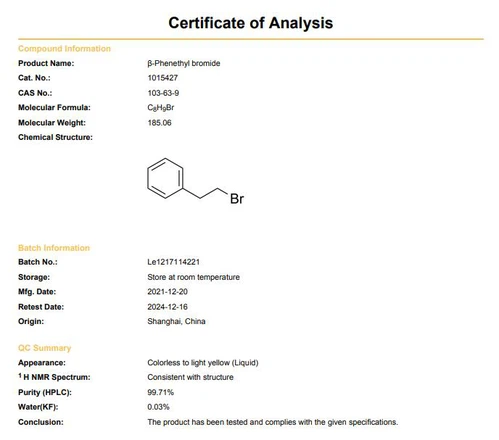
Melting point -56 ° C, boiling point 220-221 ° C (liter), density of 1.355 g/ml at 25 ° C (drop), refractive index N20/D 1.556 (liter), flash point 193 ° f, storage conditions 2-8 ° C, solubility: 0.039g/l, liquid, clear colorless to yellow color, insoluble in water

(2-Bromoethyl)Benzene, also known as 2-bromoethylbenzene in Chinese, is an organic compound with wide applications.
1. Synthesis of efficient brominated flame retardants:
It is an important intermediate in the synthesis of highly efficient brominated flame retardant polybrominated styrene. Bromine flame retardants are widely used in the flame retardant treatment of materials such as plastics, rubber, textiles, etc., to improve the fire resistance of these materials.
2. Preparation of intermediate of proxetine:
Can be used to prepare the intermediate 4- (4-phenylbutoxy) benzoic acid of proxetine. Prelenst is a drug used to treat asthma and allergic rhinitis, and its synthesis process requires the use of β- Bromophenylethane.
3. Research and teaching purposes:
It is also widely used in scientific research and teaching fields. It can be used as a chemical reagent for studying chemical reaction mechanisms, synthesizing new compounds or materials, and conducting chemical analysis. At the same time, it can also serve as a raw material or reagent in teaching experiments, helping students understand and master the basic concepts and experimental skills of organic chemistry.

We are the manufacturer of (2-Bromoethyl)Benzene Acid.
Remark: BLOOM TECH(Since 2008), ACHIEVE CHEM-TECH is the subsidiary of us.
1. (2-bromoethyl) benzene is an important intermediate in the synthesis of highly efficient brominated flame retardant polybrominated benzene: ethylene, and its structure is also commonly used in the preparation of organic synthesis intermediates.
2. There are two methods to synthesize bromoethylbenzene: one is to hydrogenate Australia and styrene under the excitation of ultraviolet, X-ray or y-ray irradiation (anti Markov rule 2); The other is to replace the target product with ethanol.
At present, the traditional production method is mainly prepared by the reaction of phenylethanol with hydrogen bromide (or hydrogen wet acid). Heat the benzene alcohol to a constant reaction temperature, slowly precipitate hydrogen (hydrobromic acid) through the human body, refluxe the reaction to safety, cool it, then wash it with 10% alkali solution, and then dry it by vacuum fractionation with desiccant.
This process has the disadvantages of high raw material price, low utilization rate and difficult product separation. In the laboratory process, cheap and easily available styrene is used as raw material. In the presence of initiator, hydrogen bromide gas was introduced into the alkane solution of styrene for reverse Mar addition to obtain β- Bromophenyl ethane. The yield is more than 95% and the purity is more than 99%. Compared with the traditional process, this method has the advantages of cheap raw materials, easy separation of products, simple production process, low cost and high product quality.

one kind The preparation method of (2-Bromoethyl)Benzene is simple, with high conversion rate, stable yield, and reliable quality of the generated bromophenylethane.
The following steps:
(1) Add gasoline to a four necked flask with an electric stirrer, slowly raise the temperature, and at the same time add styrene and azodiisobutyronitrile to the drip funnel. When the temperature reaches 65-87 ° C, add azodiisobutyronitrile to the four necked flask and stir. Start adding styrene dropwise and introduce hydrogen bromide gas, controlling the temperature between 75-86 ° C. Slowly add styrene dropwise, taking 1 hour- ¾ After natural cooling at 1-2 ° C, stop passing hydrogen bromide gas and obtain a light beige transparent solution.
(2) Heat up to 134-157 ° C, complete gasoline evaporation, and cool down to 115 ° C_ 132 ° C, add zinc oxide to the four necked flask, and then heat up to i; 34-157 ° C, reaction for 0.5-3h, stop stirring, obtain β- Bromophenylethane crude product;
(3) Wash the crude product with alkali until the acidity is less than 18_ 20ppm, conducted_ 0.98Mpa negative pressure distillation, followed by water washing, alkali washing, filtration and drying, yields β- Bromobenzene ethane boutique.
The purity of gasoline in step (1) is ≥ 70%;
The amount of gasoline added in step (1) is 250_ 350g;
The amount of styrene added to the drip funnel as described in step (1) is relative to 0 25-0.5 times;
In step (1), styrene is added dropwise, and the amount of added styrene is relative to 0.03-0.0 of gasoline 05 times; In step (1), when slowly adding styrene, the amount of styrene added is relative to 0 27-0.45 times;
The amount of azodiisobutyronitrile added to the droplet funnel as described in step ⑴ is 0.0025-0 relative to gasoline 0042 times;
The amount of azodiisobutyronitrile added to the four necked flask as described in step (1) is 0.0017-0 relative to gasoline 0016 times;
Steps( ¾ The amount of added zinc oxide is relative to 0 0031-0.036 times.
In this method, strict temperature control is used to avoid the polymerization of styrene during the dripping process; By adding a certain amount of gasoline, firstly, it provides greater reaction space for styrene and bromine radicals, and secondly, it provides more reaction probability for the dropwise addition of styrene.
Beneficial effects:
One type of the present invention β - The preparation method of bromophenylethane has the following advantages:
1. This method has a clear mechanism, simple operation, low cost, and is easy to produce.
2. High conversion rate, stable yield, generated β - Bromophenylethane has reliable quality.
What are the safety and danger?
1.Harm to human health
- Stimulating effect: Its vapor has a strong stimulating effect on the eyes, skin, and respiratory tract, which may cause adverse reactions such as redness, swelling, pain, burns, etc. upon contact.
- Neurological and respiratory system damage: Prolonged or high concentration exposure to this substance vapor can cause symptoms such as headache, dizziness, shortness of breath, nausea, vomiting, etc., posing serious harm to the central nervous system and respiratory system.
2.Environmental hazards
- Photochemical reaction: This substance is prone to undergo photochemical reactions in the atmosphere, which not only consume a large amount of ozone, but also produce ozone precursor substances, which have a significant impact on the environment.
- Ecological pollution: It can cause pollution to the ecological environment through carriers such as water bodies and soil, and pose a slight threat to water.
3. Other hazards
- Flammable and Explosive: It is a chemical that is flammable and explosive, and may explode under conditions such as high temperature and fire source. Therefore, it is necessary to strictly avoid operations such as fire source and cutting.
- Corrosivity: This substance has a damaging effect on metals and other materials, so special attention should be paid to anti-corrosion measures during use and storage.

(2-Bromoethyl) Benzene, also known as 2-bromoethylbenzene, as an organic synthetic intermediate, has broad development prospects in the pharmaceutical field
Applications in pharmaceutical synthesis:
It plays an important role in pharmaceutical synthesis, especially in the synthesis of antibacterial agents. It is used to synthesize antibacterial beta peptide mimetics with high enzyme stability and low toxicity, which exhibit significant antibacterial activity against various bacteria.
Market size and growth rate:
The global market size of this substance is growing and is expected to continue this trend in the coming years. This indicates an increasing demand for it in the fields of medicine and other applications.
Industry Chain and Competition Analysis:
Its industrial chain includes multiple links such as raw material supply, production, and distribution. The analysis of the global industry chain shows that the industry has a complex supply chain and competitive landscape on a global scale.
Policies and regulations:
The major policies and regulations in the global industry have a significant impact on its development. These policies and regulations may affect aspects such as production, sales, and import/export.
Environmental impact:
As a starting material, this may be released into the environment through various waste streams, with low mobility in soil and expected to evaporate from moist and dry soil. This highlights the environmental management and emission reduction measures that need to be considered during production and use.
Synthesis method:
Its synthesis is usually achieved by using azobisisobutyronitrile as a catalyst in n-heptane solvent, and by anti Markovnikov addition of hydrobromic acid to styrene. Optimizing the reaction conditions can achieve a yield of up to 95%.
Hot Tags: (2-bromoethyl)benzene cas 103-63-9, suppliers, manufacturers, factory, wholesale, buy, price, bulk, for sale, 2 5 Dihydroxybenzaldehyde, 3 Phenyltoluene, 2 Chloro 4 pyridinecarboxylic acid, N N N Trimethylethylenediamine, Additive, 2 4 Quinolinediol