


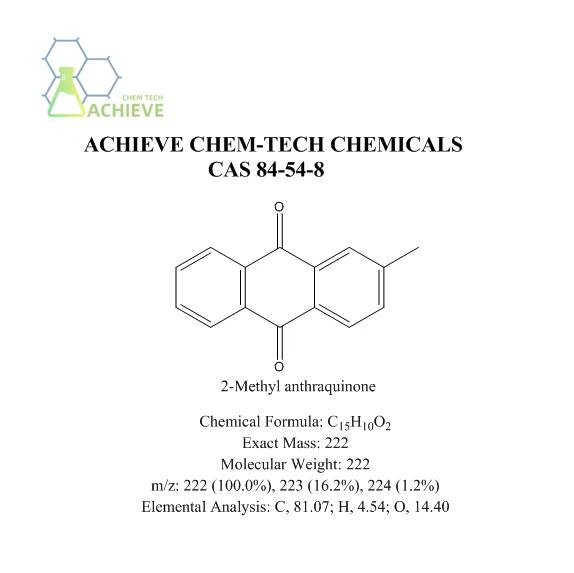


Shaanxi BLOOM Tech Co., Ltd. is one of the most experienced manufacturers and suppliers of 2-methyl anthraquinone cas 84-54-8 in China. Welcome to wholesale bulk high quality 2-methyl anthraquinone cas 84-54-8 for sale here from our factory. Good service and reasonable price are available.
2-Methyl Anthraquinone appears as yellow crystalline powder or yellow crystals, with a bright color. Molecular formula C15H10O2, CAS 84-54-8, does not boil easily at atmospheric pressure. Stable at room temperature, but prone to oxidation reactions under light and acidic conditions. Insoluble in water, soluble in ethanol, ether, benzene, and ethyl acetate. This product has low toxicity. Can cause allergic eczema, rhinitis, bronchial asthma, and exist in smoke. Store in a cool, dry, and well ventilated place. Keep away from sources of fire and heat. Used for producing advanced dyes and intermediates. Can be used as a dye intermediate, a photosensitive agent for photosensitive resins, and an organic synthesis raw material. Can be used to prepare light shielding resins, such as UV curable resins. These resins can be used in fields such as coatings, inks, adhesives, etc., and have excellent weather resistance and adhesion properties.

|
Chemical Formula |
C15H10O2 |
|
Exact Mass |
222 |
|
Molecular Weight |
222 |
|
m/z |
222 (100.0%), 223 (16.2%), 224 (1.2%) |
|
Elemental Analysis |
C, 81.07; H, 4.54; O, 14.40 |
|
|
|


Melting point of it is 170-173 ° C (lit.), Boiling point 236-238 ° C / 10 mmHg (lit.), Density 1.1404 (rough estimate), Refractive index 1.6600 (estimated), Flash point 209 ° C, Storage condition 2-8 ° C, Solubility in water 1.234 mg / L @ 25 ° C, BRN 2050523, InChIKeyNJWGQARXZDRHCD-UHFFFAOYSA

As an important member of anthraquinone derivatives, 2-Methyl anthraquinone has demonstrated irreplaceable application value in the paper industry due to its unique molecular structure and chemical properties. Its core applications are concentrated in three major fields: pulp process optimization, pulp performance improvement, and clean production technology innovation
Core additive in pulp making process: oxidation-reduction cycle accelerates delignification
In the alkaline cooking and pulping process, the construction of an oxidation-reduction cycle system significantly improves the delignification efficiency. Its mechanism of action can be decomposed into three stages:
Penetration and Reduction: After being added to the cooking solution in crystalline form, it quickly dissolves and penetrates into the cell wall of the wood chip. In alkaline environments, it is reduced to 2-methylanthraquinone, an intermediate with strong reducibility.
Oxidative attack: Unstable, easily oxidized by dissolved oxygen to regenerate 2-methylanthraquinone, while releasing electrons. The hydroxyl radicals (· OH) and superoxide anions (O ₂⁻) generated during this process can selectively attack key chemical bonds such as β - O-4 and α - O-4 in lignin molecules.
Cycle efficiency enhancement: The oxidation-reduction reaction forms a closed-loop cycle, and each mole of 2-methylanthraquinone can catalyze the generation of several moles of reactive oxygen species.


Experimental data shows that adding 0.1% 2-methylanthraquinone can shorten cooking time by 30%, increase pulp yield by 5% -8%, and reduce chemical oxygen demand (COD) in waste liquid by 15% -20%.
Typical application case: A large paper-making enterprise in Zhejiang Province replaced traditional anthraquinone cooking aids with 2-methylanthraquinone. When using the sulfate method to cook eucalyptus chips, the cooking temperature was reduced from 170 ℃ to 165 ℃, the cooking time was shortened from 180 minutes to 120 minutes, and the Kappa number of the pulp was reduced from 18 to 14, significantly improving pulp quality and production efficiency.
Pulp performance improvement: multifunctional synergistic effect
In addition to accelerating delignification, the physical properties of pulp are also improved through multiple mechanisms:
Fiber protective effect: During the cooking process, reactive oxygen species derived from 2-methylanthraquinone preferentially attack lignin, reducing the degradation of cellulose and hemicellulose. Scanning electron microscopy (SEM) observation shows that the use of 2-methylanthraquinone improves the surface smoothness of pulp fibers and increases fiber length retention by 10% -15% compared to traditional processes.
Mechanism of whiteness enhancement: The chromophores produced by lignin degradation, such as quinone structures and conjugated double bonds, are the main cause of pulp yellowing. By promoting complete degradation of lignin and reducing the number of residual chromophores. Experiments have shown that it can increase the whiteness of unbleached pulp by 3-5 ISO units, creating conditions for reducing chlorine consumption in subsequent bleaching processes.


Strength enhancement effect: The bonding force between fibers is a key factor determining the strength of paper. By protecting the integrity of hemicellulose (especially xylan) and maintaining the number of hydroxyl groups on the fiber surface, the hydrogen bonding ability is enhanced. Test data shows that the use of this additive increases the tensile strength of pulp by 8% -12% and the ring compression strength by 10% -15%.
Technical and economic analysis: Taking a factory with an annual output of 100000 tons of pulp as an example, using this substance to replace traditional anthraquinone can reduce wood consumption by about 2000 cubic meters per year, reduce alkali solution usage by 15%, and reduce waste liquid treatment costs by more than 3 million yuan. The comprehensive economic benefits are significant.
Innovation of Clean Production Technology: A Practical Example of Green Chemistry
In the context of increasingly strict environmental policies, clean production characteristics have become its core competitive advantage:
Low toxicity advantage: Compared with traditional nitroanthraquinone additives, its molecules do not contain toxic groups such as nitro groups, and its ecological toxicity (LC50) is reduced by more than 50%. The EU REACH regulation classifies it as a skin allergen (Category 1B), but it is not included in the list of carcinogenic or reproductive toxic substances, significantly reducing occupational health risks.
Simplified waste liquid treatment: During the cooking process, no persistent pollutants such as chlorinated organic compounds are produced, and their oxidation products can be completely dissolved in alkaline solution, making it easy to recycle and reuse through membrane separation technology. The practice of a certain enterprise has shown that after using this additive, dioxin like substances were not detected in the waste liquid, and the AOX (adsorbable organic halide) emission concentration decreased to below 0.5mg/L, far below the national emission standard (5mg/L).


Energy efficiency improvement: By shortening the cooking time, the steam consumption per ton of pulp is reduced by 0.8-1.2 tons, which is equivalent to saving about 20000 tons of standard coal per year (based on a production capacity of 100000 tons), and the carbon reduction effect is significant.
Industry application trend: With the promotion of the "dual carbon" target, leading domestic paper companies are accelerating the industrial application of 2-methylanthraquinone. By the end of 2025, more than 60% of the sulfuric acid pulp production lines in China have adopted this technology, with an annual consumption of over 12000 tons and an average annual growth rate of 4.8%.
Technological Extension: Collaborative Innovation with Other Processes
The technical value of 2-Methyl anthraquinone is also reflected in its compatibility with emerging papermaking processes:
Enhancement of oxygen delignification process: During the oxygen delignification stage, it can serve as a catalyst to promote the reaction between oxygen and lignin, increasing the efficiency of oxygen delignification by 20% -30% while reducing the amount of oxidants such as hydrogen peroxide.
Biological pulping assistance: When used in combination with biological pulping technologies such as white rot fungi, it can enhance the activity of lignin peroxidase (LiP) secreted by bacterial strains, shorten the biological pretreatment time from 7 days to 4 days, and increase the lignin degradation rate to over 85%.


Preparation of nanocellulose: In the preparation of nanocellulose, the derived reactive oxygen species can selectively cleave the chemical bonds in the lignin carbohydrate complex (LCC), reduce the aggregation of cellulose nanofibers (CNF), and make the product diameter distribution more uniform (50-100nm).
We are the supplier of 2-methylanthraquinone.
Remark: BLOOM TECH(Since 2008), ACHIEVE CHEM-TECH is our subsidiary of us.
Materials of Metric Roller Chain Sprocket
Through laboratory methods, 2-methylanthraquinone was synthesized using toluene and phthalic anhydride as raw materials, and the reaction conditions during the synthesis process were optimized to improve the yield of the target product.
1. Toluene and phthalic anhydride undergo acylation reaction under the catalysis of aluminum trichloride:
C6H5C6H5 + C8H6O3 + AlCl3 → C6H5COC6H5 + AlCl4-
2. MBBA dehydrates in concentrated sulfuric acid to generate it:
C6H5COC6H5 + H2SO4 → C14H8O + H2O
Among them, () represents the methyl group in toluene; The functional group representing phthalic anhydride; Representing aluminum trichloride; Represents concentrated sulfuric acid; Represents the generated 2-methylanthraquinone.
Experimental principle:
This experiment is based on the principle of acylation reaction, using aluminum trichloride as a catalyst to react toluene with phthalic anhydride to produce 2-(4'-methylbenzoyl) benzoic acid (MBBA). Subsequently, MBBA undergoes closed-loop formation of it under the action of sulfuric acid.
Experimental Steps:
1. Raw materials and reagents:
Toluene, phthalic anhydride, aluminum trichloride, concentrated sulfuric acid, chloroethane (as reaction medium).
2. Synthesis of 2-(4'-methylbenzoyl) benzoic acid (MBBA):
Toluene and phthalic anhydride were added to the reaction flask and heated to 50 ℃. Slowly add aluminum trichloride and stir for 4 hours to react. After the reaction is completed, the catalyst is separated through filtration to obtain crude MBBA.
3. Synthesis of 2-methylanthraquinone:
Mix crude MBBA with concentrated sulfuric acid, heat to 130 ℃, and undergo dehydration closed-loop reaction in chloroethane medium. After continuous stirring for 3 hours, cool to room temperature.
4. Product separation and purification:
Extract the reaction solution to separate 2-methyl anthraquinone. After multiple extraction and purification operations, a relatively pure it was obtained.
5. Product detection and characterization:
The structure of the product was characterized by melting point measurement, infrared spectroscopy, nuclear magnetic resonance spectroscopy, and other methods to confirm that the product is 2-methylanthraquinone.


In the coating industry

The light shielding resin prepared from 2-methylanthraquinone is often used as an additive in high-end outdoor coatings due to its excellent weather resistance. This type of coating can resist ultraviolet radiation for a long time, maintain the vividness of colors and the integrity of the coating, so it has been widely used in facilities such as building exteriors, bridges, sculptures, etc. that are exposed to natural environments for a long time. For example, some modern skyscrapers incorporate shading resins derived from it into their exterior coatings, allowing these buildings to maintain their elegant appearance even in strong sunlight while effectively extending the maintenance cycle of the coatings.
Photosensitive resins containing it are used as key components for manufacturing high-quality printing inks. These inks can exhibit excellent resolution and color saturation during the printing process, making them ideal for printing high-end publications such as art albums, fashion magazines, etc., ensuring that every page presents a delicate and long-lasting image effect. In addition, due to their fast drying speed and high stability after curing, these inks are widely used in the fields of rapid printing and packaging printing, improving production efficiency and reducing costs.

In the field of adhesives

Specific resins synthesized with it have been developed into high-performance industrial adhesives due to their excellent adhesion. These adhesives not only form strong adhesion between various substrates such as metal, plastic, glass, etc., but also maintain stable bonding performance in harsh environments such as high temperature and high humidity. Therefore, they are widely used in precision component assembly in industries such as automotive manufacturing, aerospace, and electronics, ensuring the structural strength and long-term reliability of the products.
The application of 2-Methyl Anthraquinone in the field of photosensitive resins has also promoted the rapid development of photopolymerization technology. By using photosensitive resins containing this compound, optical components with high sensitivity and resolution, such as gratings, lenses, etc., can be produced, which is of great significance for improving the technological level in fields such as optoelectronic display and optical communication. At the same time, these photosensitive resins are also used to manufacture precision optical molds, providing indispensable tools for high-tech fields such as semiconductor manufacturing and micro/nano processing.

Hot Tags: 2-methyl anthraquinone cas 84-54-8, suppliers, manufacturers, factory, wholesale, buy, price, bulk, for sale, 4-Fluorophenylacetone CAS 459-03-0, 6 Nitro 1 diazo 2 naphthol 4 sulfonic Acid, atropine sulfate powder, 1 1 2 2 Tetrabromoethane CAS 79 27 6, Aminoantipyrine, 2 5 Dihydroxybenzaldehyde