




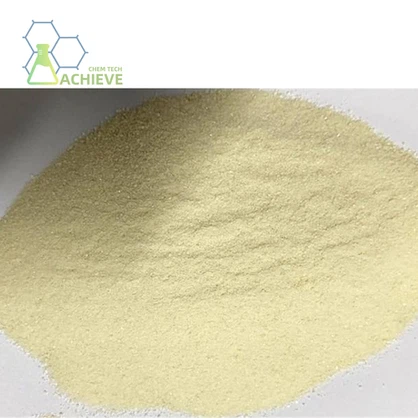
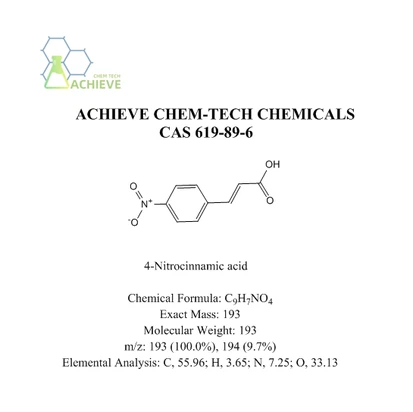
4-Nitrocinnamic acid is an organic compound with CAS 619-89-6 and molecular formula C9H7NO4. It is a light yellow to yellow needle shaped crystal with hygroscopicity. When exposed to air, it will absorb water, leading to an increase in its solubility. Easy to dissolve in organic solvents such as ethanol and acetone, slightly soluble in hot water, insoluble in cold water. It is unstable and prone to reduction reactions, hydrolysis reactions, and decarboxylation reactions. It has broad application value in the field of electronic chemicals, and can be used in various aspects such as photoresists, electron beam adhesives, developing liquids, wet electronic chemicals, film preparation, surface treatment agents, heat stabilizers, ion exchange agents, anti-static agents, and coating additives. With the rapid development of the electronics industry and continuous technological progress, the application prospects of AKOS 369 in the field of electronic chemicals will be even broader.

|
|
|
|
C.F |
C9H7NO4 |
|
E.M |
193 |
|
M.W |
193 |
|
m/z |
193 (100.0%), 194 (9.7%) |
|
E.A |
C, 55.96; H, 3.65; N, 7.25; O, 33.13 |

4-Nitrocinnamic acid is an organic compound with a specific chemical structure, containing nitro (- NO2) and carboxyl (- COOH) functional groups in its molecule. These functional groups endow unique chemical properties, such as being insoluble in water and easily soluble in organic solvents. In addition, its high melting point indicates that the compound is relatively stable at room temperature.
Application in the field of electronic chemicals
Electronic packaging materials are important materials for protecting electronic devices from external environmental interference. In the process of electronic packaging, various adhesives, sealants, and other materials are required to fix and seal electronic devices. It can be used as an additive or modifier for these materials.
By introducing, the thermal stability, chemical stability, and other properties of packaging materials can be improved. These performance improvements can extend the lifespan of electronic devices and enhance their reliability. In addition, it can also be used as a plasticizer to improve the flexibility and plasticity of packaging materials, making them easier to process and shape.

Sensor materials

A sensor is a device that can detect and convert physical or chemical quantities into measurable signals. In the field of electronic chemicals, the selection of sensor materials is crucial for the performance of sensors. Can be used as an additive or modifier for sensor materials.
By introducing, the sensitivity, selectivity, and other properties of sensor materials can be improved. These performance improvements can enable sensors to have higher accuracy and reliability in the detection process. For example, in gas sensors, the sensitivity and selectivity of the sensor to specific gases can be improved by introducing its derivatives.
Application examples
LED is a semiconductor device that converts electrical energy into light energy. In the LED manufacturing process, various organic compounds need to be used as dopants, packaging materials, etc. Can be used as an additive for these materials.
By introducing, the emission wavelength and brightness of LED can be adjusted. For example, in the manufacturing of red LEDs, the emission wavelength can be adjusted by introducing its derivatives to make it closer to the ideal red spectral range. In addition, it can also be used as an additive in packaging materials to improve the thermal and chemical stability of the packaging materials, thereby extending the service life of LEDs.

Application in solar cells

A solar cell is a device that converts light energy into electrical energy. The selection of photoelectric conversion materials is crucial for the performance of solar cells. Can be used as an additive or modifier for photoelectric conversion materials.
By introducing its derivatives, the band structure and light absorption properties of the photoelectric conversion material can be adjusted. These adjustments can improve the photoelectric conversion efficiency and service life of solar cells. For example, in dye-sensitized solar cells, the introduction of its derivatives can improve the light absorption efficiency and stability of dyes, thereby enhancing the photoelectric conversion efficiency of solar cells.
A gas sensor is a device that can detect and convert gas concentration into a measurable signal. The selection of sensor materials is crucial for the performance of gas sensors. Can be used as an additive or modifier for sensor materials.
By introducing its derivatives, the sensitivity and selectivity of sensor materials can be improved. For example, in sensors for detecting NO2 gas, the sensitivity and selectivity of the sensor to NO2 gas can be improved by introducing its derivatives. This can enhance the accuracy and reliability of the sensor during the detection process.

Application in LCD display devices

A liquid crystal display device is a device that utilizes the optical properties of liquid crystal materials to display images. The selection of liquid crystal materials is crucial for the performance of liquid crystal display devices. Can be used as an additive or modifier for liquid crystal materials.
By introducing its derivatives, the molecular structure and arrangement of liquid crystal materials can be adjusted. These adjustments can change the contrast, response time, and other performance of liquid crystal display devices. For example, in TN type liquid crystal display devices, the contrast and response time of the device can be improved by introducing its derivatives.
Development Trends
With the continuous development of electronic technology, the demand for electronic chemicals is also increasing. 4-Nitrocinnamic acid, as an organic compound with unique chemical properties, has broad application prospects in the field of electronic chemicals. In the future, the development trends of AKOS 369 in the field of electronic chemicals may include the following aspects:
1. Development of new synthesis methods
At present, the synthesis methods mainly rely on traditional chemical synthesis methods. However, these methods may have issues such as harsh reaction conditions and low yields. Therefore, developing new, efficient, and environmentally friendly synthesis methods is of great significance for promoting their application in the field of electronic chemicals.
2. Functional modification research
By introducing different functional groups or compounds for functional modification, it can be endowed with more application performance. For example, functional groups with conductivity, magnetism, and other properties can be introduced to prepare electronic chemicals with special functions. These functional modification studies will promote the expansion of applications in the field of electronic chemicals.
3. Research on environmentally friendly electronic chemicals
With the continuous improvement of environmental awareness, the requirements for electronic chemicals are also increasing. As an organic compound, its production and use may generate certain environmental pollution. Therefore, conducting research on environmentally friendly electronic chemicals is of great significance for promoting sustainable development in the field of electronic chemicals.
4. Interdisciplinary cooperation and technological innovation
The development of electronic chemicals requires interdisciplinary cooperation and technological innovation. By collaborating and exchanging ideas with experts and scholars in fields such as chemistry, materials science, and electronic engineering, we can promote applied research and technological innovation in the field of electronic chemicals. These collaborations and exchanges will promote in-depth research and extensive applications in the field of electronic chemicals.
AKOS 369 has broad application prospects in the field of electronic chemicals. As an intermediate in organic synthesis, it can participate in various chemical reactions and provide important raw materials for the synthesis of other organic compounds; As a modifier for semiconductor materials, an additive for electronic packaging materials, etc., it can improve the performance of materials and extend their service life; As a liquid crystal material, optoelectronic material, sensor material, etc., it can provide better application effects for electronic devices. In the future, with the development of new synthesis methods, functional modification research, research on environmentally friendly electronic chemicals, and the continuous promotion of interdisciplinary cooperation and technological innovation, the application in the field of electronic chemicals will be more extensive and in-depth.

The recrystallization method is a commonly used purification method that can be used to improve the purity of 4-nitrocinnamic acid.
In the laboratory, the steps of recrystallization method are as follows:
Prepare reagents and instruments: AKOS 369, ethanol, water, beaker, glass rod, thermometer, vacuum pump, etc.
Dissolution: Crush the crude AKOS 369 and dissolve it in an appropriate amount of ethanol. Stir well until the cinnamic acid is completely dissolved.
Heating of filtrate: Heat the filtrate to boiling and evaporate some solvent. The purpose of this step is to saturate the solution for crystallization.
Cooling: Cool the filtrate to room temperature to allow crystals to precipitate. During the cooling process, it can be observed that crystals gradually form in the solution.
Filtering: Filter out the precipitated crystals and wash with a small amount of ethanol to remove impurities.
Drying: Dry the filtered crystals in a dryer to obtain high-purity AKOS 369.
The principle of recrystallization method is based on the different solubility of different substances in solvents. By heating and evaporating the solvent, impurities are dissolved in the solvent, and then filtered out to obtain high-purity products. Choosing the appropriate solvent is crucial during the recrystallization process. Ethanol is a commonly used solvent because it can dissolve AKOS 369 well, evaporate easily, and is easy to operate.
The following is the chemical equation for the generation of p-nitrocinnamic acid by recrystallization method:
C6H5-C(CH3)=CH-COOH + HNO3 → C6H5-C(CH3)=CH-COOH-3-NHO3
This chemical equation represents the process of reacting AKOS 369 with nitric acid to produce AKOS 369. In actual experiments, it is necessary to control the reaction temperature, reaction time, and other conditions to ensure that the reaction is complete and high-quality products are obtained.
FAQ
What is another name for 4 hydroxycinnamic acid?
+
-
4-Hydroxycinnamic acid, also known as p-Coumaric acid, is a coumaric acid in which the hydroxy substituent is located at C-4 of the phenyl ring. It has a role as a plant metabolite. It is a conjugate acid of a 4-coumarate. p-coumaric acid is an organic compound that is a hydroxy derivative of cinnamic acid.
What does cinnamic acid smell like?
+
-
Cinnamic acid has a honey-like odor; and its more volatile ethyl ester, ethyl cinnamate, is a flavor component in the essential oil of cinnamon, in which related cinnamaldehyde is the major constituent.
What are examples of hydroxycinnamic acids?
+
-
Hydroxycinnamic acids are phenolic phytochemicals present in fruits, vegetables, and coffee. This group of polyphenols includes caffeic acid, ferulic acid, chlorogenic acid, isoferulic acid, as well as coumaric acid, which are known to exert beneficial effects linked to their antioxidant capacity.
Hot Tags: 4-nitrocinnamic acid cas 619-89-6, suppliers, manufacturers, factory, wholesale, buy, price, bulk, for sale, 2 6 Pyridinedicarboxylic acid, 7 Nitroindole CAS 6960 42 5, 2 4 Quinolinediol, 1 4 Dibromobenzene 98 , Succimer powder, 3 4 Dimethoxythiophene