


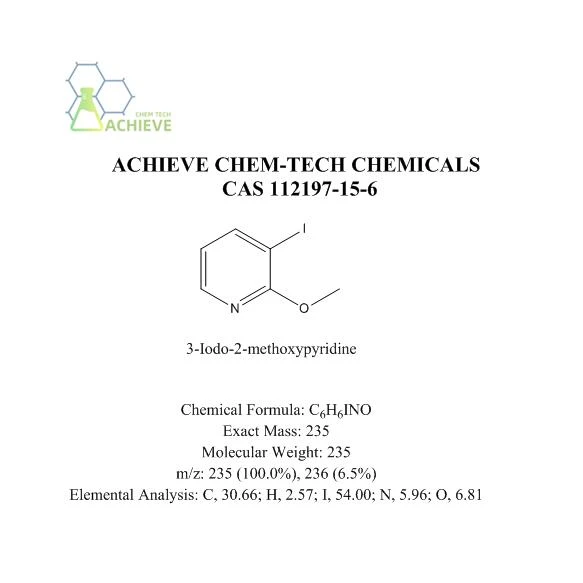


3-Iodo-2-methoxypyridine is an organic compound with the molecular formula C6H6INO, CAS 112197-15-6, and a relative molecular weight of 235.03. It consists of a pyridine ring containing an iodine atom and a methoxy group (CH3O). It is a white to light yellow crystal. It can appear in the form of crystalline powder. Due to its presence of iodine atoms and methoxy groups, 3 Iodo-2-methoxypyridine is widely used in the fields of organic synthetic chemistry and pharmaceutical chemistry. It can serve as an important initiator, ligand, or intermediate for the synthesis of complex organic molecules containing pyridine and iodine functional groups. It is a multifunctional organic compound with a wide range of applications. It plays an important role in organic synthesis, drug research and development, pesticide preparation, chemical analysis, spices and essence and other fields. Due to its unique structure and properties, it can be used to synthesize various compounds with biological activity or special functions. When using this compound, please comply with relevant operating procedures and safety measures, and ensure that it is used within the legal range.

|
C. F |
C6H6INO |
|
E. M |
235 |
|
M. W |
235 |
|
m/z |
235 (100.0%), 236 (6.5%) |
|
E. A |
C, 30.66; H, 2.57; I, 54.00; N, 5.96; O, 6.81 |
|
|
|


The application of 3-iodo-2-methoxypyridine in agriculture, especially as a pesticide or pesticide intermediate.
Insecticides
It or its derivatives may have insecticidal activity and can be used to control pests on crops. For example, through chemical synthesis, it can be transformed into compounds with insecticidal activity. These compounds can be applied to crops through spray, irrigation and other ways to achieve the purpose of killing pests.

Example:
Assuming there is an insectcide based on it, its chemical name is "XX pyridine insectcide". This insectcide has shown good insecticidal effects in field trials and has significant killing effects on various pests such as aphids and borers. At the same time, the impact of this insectcide on the environment and human health is relatively small, which meets the development requirements of green pesticides. Therefore, this insectcide has broad application prospects in agricultural production.
Fungicide
In addition to insecticidal activity, it or its derivatives may also have bactericidal activity. In agricultural production, diseases are one of the important factors affecting crop yield and quality. Therefore, developing pesticides with fungicidal activity is of great significance for improving crop yield and quality.
Example:
Assuming there is a fungicide based on it, its chemical name is "YY pyridine fungicide". This fungicide has shown good bactericidal effect in field trials and has significant control effects on various diseases such as rice blast and sheath blight. At the same time, the fungicide has a relatively small impact on the environment and human health, which meets the development requirements of green pesticides. Therefore, this fungicide has broad application prospects in agricultural production.

Synthesis of intermediates with insecticidal activity
Through chemical synthesis, it can be transformed into an intermediate with insecticidal activity. These intermediates can further react with other compounds to generate pesticides with high insecticidal activity.

Example:
Assuming there is an intermediate based on its insecticidal activity, its chemical name is "ZZ pyridine intermediate". This intermediate can react with other compounds to generate a pesticide with high insecticidal activity. In field experiments, the pesticide has shown significant killing effects on various pests such as aphids and borers. At the same time, the impact of this pesticide on the environment and human health is relatively small, which meets the development requirements of green pesticides. Therefore, this pesticide has broad application prospects in agricultural production.
Here are some examples of compounds with similar structures to 3-iodo-2-methoxypyridine used in agricultural applications:

Example:
Assuming there is a pesticide based on 6-bromo-3-iodo-2-methoxypyridine, its chemical name is "BB pyridine pesticide". This pesticide has shown good insecticidal effects in field trials and has significant killing effects on various pests such as aphids and borers. At the same time, the impact of this pesticide on the environment and human health is relatively small, which meets the development requirements of green pesticides. Therefore, this pesticide has broad application prospects in agricultural production.
In addition to it and 6-bromo-3-iodo-2-methoxypyridine, there are many other pyridine compounds that have wide applications in the field of pesticides. These compounds typically have unique chemical structures and biological activities, and can be used to control pests and diseases on crops.
(1) Pyridine insecticides
Pyridine insectcides are a class of compounds with highly efficient insecticidal activity. They usually achieve the goal of killing pests by interfering with their nervous system or metabolic processes. Common pyridine insectcides include imidacloprid, imidacloprid, etc.
Example:
Imidacloprid: Imidacloprid is a broad-spectrum and highly effective insectcide that has significant killing effects on various pests such as aphids, planthoppers, leafhoppers, etc. It mainly achieves insecticidal effects by interfering with the neural transmission process of pests. In agricultural production, imidacloprid is widely used to control pests in crops such as rice, cotton, and vegetables.
Imidacloprid: Imidacloprid is also an efficient insectcide that has significant killing effects on various pests such as aphids, thrips, whiteflies, etc. It mainly achieves insecticidal effect by inhibiting the acetylcholinesterase activity of pests. In agricultural production, imidacloprid is widely used to control pests in crops such as fruit trees and vegetables.

(2) Pyridine fungicides
Pyridine fungicides are a class of compounds with highly efficient bactericidal activity. They usually achieve bactericidal effects by interfering with the metabolic processes or cell wall synthesis of pathogens. Common pyridine fungicides include pyraclostrobin, pyraclostrobin, etc.

Example:
Azoxystrobin: Azoxystrobin is a broad-spectrum and highly effective fungicide that has significant control effects on various diseases such as rice blast, sheath blight, powdery mildew, etc. It mainly achieves bactericidal effect by inhibiting the synthesis of bacterial cell walls. In agricultural production, azoxystrobin is widely used to prevent and control diseases in crops such as rice, wheat, and corn.
Pyrazole ether fungicide: Pyrazole ether fungicide is also an efficient fungicide, which has significant control effects on various diseases such as powdery mildew, rust, leaf spot, etc. It mainly achieves bactericidal effect by interfering with the metabolic process of pathogens. In agricultural production, pyraclostrobin is widely used to prevent and control diseases in crops such as fruit trees and vegetables.
The insecticidal mechanism may include the following aspects:
Wide Product Range
Many insecticdes exert their insecticidal effects by interfering with the nervous system of pests. They may act on the transmission process of neurotransmitters, such as acetylcholinesterase inhibitors, which can reversibly bind to acetylcholinesterase, thereby disrupting the hydrolysis of acetylcholine in the synaptic cleft of neurons, interfering with and blocking synaptic transmission, and causing neurological dysfunction. If 3-iodo-2-methoxypyridine has similar properties, it may achieve insecticidal effects by affecting neurotransmitter transmission or neuronal activity in pests.
Respiratory inhibition
Breathing is an important process for energy metabolism in living organisms. Some insecticdes achieve their insecticidal goals by inhibiting the respiration of pests. They may act on a certain link in the respiratory chain, such as inhibiting the cytochrome mediated electron transfer chain or affecting mitochondrial function, leading to insect death due to energy supply obstruction. If 3-iodo-2-methoxypyridine has similar properties, it may exert its insecticidal effect by affecting the respiration of pests.

3-Iodo-2 methoxypyridine is an organic compound containing iodine and methoxy groups, which has wide applications in organic synthesis, drug synthesis, and other fields. The following are two methods for synthesizing 3-Iodo-2-methoxypyridine in the laboratory.
Method 1:
Prepare the required raw materials: 2-methoxypyridine and potassium iodide.
Under stirring, 2-methoxypyridine is added to a potassium hydroxide solution to produce a potassium salt of 2-methoxypyridine.
Dissolve potassium iodide in an appropriate amount of water, add it to a potassium salt solution of 2-methoxypyridine, and keep it at room temperature for 24 hours.
Add an appropriate amount of hydrochloric acid to reduce the pH value of the reaction solution, in order to precipitate 3 Iodo-2-methoxypyridine from the solution.
Filter the solution, collect the precipitate, and recrystallize with an appropriate amount of ethanol to obtain high-purity 3 Iodo-2-methoxypyridine.
C6H7NO+KOH → C6H7NO2K+H2O
C6H7NO2K+KI → C6H7INO2+K2O
C6H7INO2+HCl → C6H5INO2+H2O
Method 2:
Prepare the required raw materials: 2-hydroxypyridine and iodine.
Add an appropriate amount of potassium hydroxide and 2-hydroxypyridine to a dry reaction flask and heat to 100 ℃.
Slowly add iodine to the reaction solution and keep the reaction temperature constant. Continue stirring and observe the reaction process.
When the reaction solution turns dark, stop heating and stirring, and let it naturally cool to room temperature.
Add an appropriate amount of water and adjust the pH of the reaction solution to neutral with hydrochloric acid, then proceed with the extraction operation.
Collect the organic phase, dry it with anhydrous sodium sulfate, and then perform distillation to obtain high-purity 3-Iodo-2-methoxypyridine.
C6H4NOH+KOH → C6H4NO2K+H2O
C6H4NO2K+I2 → C6H4INO2K+KI
C6H4INO2K+H2O → C6H4INO2+KOH
The above are two methods for synthesizing 3 Iodo-2-methoxypyridine in the laboratory, as well as their specific steps and chemical equations. It should be noted that safety precautions should be taken during the synthesis process to avoid contact and inhalation of harmful substances. At the same time, before the synthesis operation, it is necessary to carefully check whether the required raw materials and reagents meet the requirements, and to fully understand and evaluate the synthesis route.
Adverse reactions
As an organic synthetic intermediate, the adverse reaction data of 3-Iodo-2-methoxypyridine mainly comes from chemical safety information rather than clinical drug research. Here is its detailed description:
Acute toxic reaction
Inhalation/skin contact/swallowing hazards
R20/21/22: Inhalation, skin contact, or accidental ingestion may cause harmful effects, manifested as respiratory irritation (coughing, difficulty breathing), skin erythema/blisters, burning sensation in the digestive tract, or nausea and vomiting.
R36/37/38: Irritating to eyes, respiratory tract, and skin, may cause tearing, conjunctival congestion, rash, or dry skin.
Typical Symptoms
After contact, there may be eye pain, tears, skin itching or redness, and inhaling high concentrations of vapor may cause dizziness, headache or respiratory spasms.
Chronic or delayed effects
Environmental hazards
It has potential toxicity to aquatic organisms and may affect ecosystems through bioaccumulation. Long term exposure to low concentration environments may cause chronic toxicity to aquatic microorganisms or fish.
Long term exposure risk to the human body
At present, there is no clear data on chronic toxicity in humans, but based on its chemical structure (containing iodine aromatic compounds), potential sensitization or organ toxicity (such as liver metabolic burden) should be monitored.
Special exposure scenario risk
Occupational exposure
In laboratories or industrial production, failure to take protective measures such as gloves, goggles, and ventilation equipment may result in repeated exposure, increasing the risk of allergies or irritant reactions.
Accidental leakage handling
During leakage, a vapor cloud may form, which can cause acute respiratory irritation upon inhalation; Liquid leakage may contaminate soil or water sources, and should be recovered and safely disposed of through adsorbent materials such as vermiculite.
Hot Tags: 3-iodo-2-methoxypyridine cas 112197-15-6, suppliers, manufacturers, factory, wholesale, buy, price, bulk, for sale, 5 Chloro 2 Nitrotoluene CAS 5367 28 2, 2 2 Bis hydroxymethyl butyric Acid CAS 10097 02 6, 4 Amino 2 chloropyridine CAS 14432 12 3, Trimethyl Phosphate CAS 512 56 1, 3 1 Naphthoyl indole CAS 109555 87 5, Cyclohexapentylose CAS 10016 20 3