




Shaanxi BLOOM Tech Co., Ltd. is one of the most experienced manufacturers and suppliers of 4-(trifluoromethoxy)phenyl isocyanate cas 35037-73-1 in China. Welcome to wholesale bulk high quality 4-(trifluoromethoxy)phenyl isocyanate cas 35037-73-1 for sale here from our factory. Good service and reasonable price are available.
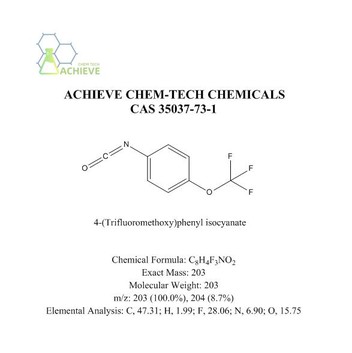
4-(Trifluoromethoxy)phenyl Isocyanate, molecular formula C8H4F3NO2, CAS 35037-73-1, molecular weight 215.12 g/mol. It is an organic compound, a colorless to light yellow liquid. It can be dissolved in organic solvents. It is relatively stable at room temperature, but dangerous reactions may occur when encountering high temperatures, open flames, or oxidants. It should also avoid prolonged exposure to the air to prevent harmful substances from reacting with water. It is a harmful substance and appropriate safety operations and protective measures should be taken in the laboratory, including wearing chemical protective gloves, goggles, and protective clothing.

|
|
|

|
Chemical Formula |
C8H4F3NO2 |
|
Exact Mass |
203 |
|
Molecular Weight |
203 |
|
m/z |
203 (100.0%), 204 (8.7%) |
|
Elemental Analysis |
C, 47.31; H, 1.99; F, 28.06; N, 6.90; O, 15.75 |
It is an organic compound with multiple uses. In addition to its applications in fields such as pesticides, pharmaceuticals, organic synthesis, and materials science, it can also be used as a chemical intermediate, catalyst, laboratory reagent, and starting material or intermediate for the production of other compounds.

4-(Trifluoromethoxy)phenyl isocyanate is an organic compound with special structure and properties, which can play an important role in polymer synthesis. The functional groups in this compound have reactive activity and can react with various compounds, including alcohols, amines, carboxylic acids, etc. Through these reactions, various polymers with excellent properties can be synthesized.
In the field of pharmaceutical synthesis: the core building blocks of fluorinated drug molecules
In the field of medicine, its use is the largest, most valuable, and technically challenging sector among all its applications. It is not an endpoint drug, but a necessary bridge to the endpoint drug - a highly specialized synthetic intermediate.

1. Synthesis of drug active molecules containing urea bonds
The most classic and widespread reaction of isocyanates is the addition reaction with amine compounds to form urea bonds (- NHCONH -). After reacting with various aromatic or fatty amines, the drug core skeleton of "trifluoromethoxyphenylurea" can be directly constructed.
The position of urea bonds in medicinal chemistry is extremely special. It is both a hydrogen bond donor and a hydrogen bond acceptor, capable of forming multiple hydrogen bond networks with the active pocket of the target protein, thereby significantly enhancing binding affinity.
In multiple drug categories such as kinase inhibitors, G protein coupled receptor (GPCR) modulators, protein-protein interaction (PPI) inhibitors, etc., urea bonds are indispensable pharmacophores.
After introducing trifluoromethoxy (- OCF ∝), the drug molecule obtained triple gains: firstly, the C-F bond energy was as high as about 485 kJ/mol, greatly enhancing the metabolic stability of the molecule, making the drug less easily oxidized and degraded by the CYP450 enzyme system in the body, and significantly prolonging the half-life;


Secondly, the strong electron withdrawing effect of trifluoromethoxy can optimize the electron cloud distribution of molecules, enhance dipole interactions and hydrogen bond strength with target proteins; Thirdly, this group moderately enhances lipid solubility, which is beneficial for drugs to cross the blood-brain barrier and is particularly crucial for the development of central nervous system drugs.
Therefore, it is the preferred starting material for constructing urea containing pharmacophores in multiple research and development pipelines such as anti-tumor drugs, antiviral drugs, and central nervous system drugs.
2. Synthesis of Boc protected amino ester intermediates
The isocyanate reacts with tert butanol to produce tert butyl 4- (trifluoromethoxy) phenylcarbamate (i.e. Boc protected carbamate). This derivative is a "universal protective intermediate" in multi-step drug synthesis - it remains stable under subsequent reaction conditions and can quantitatively remove the Boc protecting group under acidic conditions (such as trifluoroacetic acid treatment), releasing free amino groups for further coupling, cyclization, or modification reactions.


Boc protection strategy is one of the most classic protection schemes in the synthesis of peptide drugs, development of protease inhibitors, and total synthesis of anti-tumor drugs. The intermediate provided has become a frequently used raw material in the synthesis of high-value drugs due to its pharmacological advantage of carrying both trifluoromethoxy groups and the chemical controllability of Boc groups.
3. Synthesis of Aminoformate Drug Skeleton
Isocyanates react with alcohols to form amino ester bonds (- O-CO-NH -), which is equally significant in medicinal chemistry.
The amino ester bond not only has biological activity itself (as is common in acetylcholinesterase inhibitor insecticides/drug molecules), but can also serve as a connecting arm or prodrug structure in drug molecules.
Reacting with different alcohols, a series of amino ester derivatives containing trifluoromethoxy groups can be generated, which have clear applications in the following directions: as candidate molecules for enzyme inhibitors, as active carriers for prodrugs, and as linker precursors in drug antibody conjugates (ADCs).


4. Structure Activity Relationship (SAR) Research Tools in Drug Development
In the early stages of pharmaceutical chemistry research and development, researchers need to rapidly synthesize a series of structurally similar compounds to explore structure-activity relationships. Due to its high reactivity, good selectivity, and easy control of product purity, it has become an efficient tool reagent for constructing the "trifluoromethoxyphenyl" series of analogues.
By reacting with different amines and alcohols, researchers can quickly obtain a library of dozens of compounds containing trifluoromethoxyphenylurea or carbamate for high-throughput screening. The characteristic of "one reagent with multiple derivatives" makes its value particularly prominent in the drug discovery stage.
Pesticide synthesis field: key upstream raw materials for fluorinated pesticides
If the pharmaceutical industry is the "main battlefield" for 4-trifluoromethoxyphenyl isocyanate, then the pesticide industry is its "second battlefield" - and the growth rate of this battlefield is accelerating.
1. Synthesis of phenylurea insecticides
The phenylurea structure is the classic pharmacological backbone of chitin synthesis inhibitors (CSI). Chitin is the main component of insect exoskeletons and epidermis. Inhibiting its synthesis can lead to insect death during molting and is almost non-toxic to mammals - this is the fundamental reason for the high selectivity and low mammalian toxicity of phenylurea insecticides.
New phenylurea insecticides containing trifluoromethoxy groups can be prepared by reacting with corresponding aromatic or aliphatic amines.


Compared with traditional phenylurea insecticides such as fluazuron and metronidazole, the introduction of trifluoromethoxy improves the lipophilicity and environmental stability of the molecule, enhances insecticidal activity, prolongs efficacy, and requires lower dosage - which is fully in line with the current global trend of "reducing and increasing efficacy" of pesticides.
2. Synthesis of Aminoformate Insecticides
As mentioned earlier, the amino esters formed by the reaction of isocyanates with alcohols are themselves an important class of pesticide active structures.
The mechanism of action of carbamate insecticides is to inhibit acetylcholinesterase (AChE) in insects, leading to disruption of nerve signal transduction and ultimately resulting in death.
Aminoformate compounds synthesized from it typically exhibit better target selectivity and lower non target toxicity due to the introduction of trifluoromethoxy groups. In practical applications, these compounds can be used to control various agricultural pests such as Lepidoptera, Coleoptera, and Homoptera, covering major crops such as rice, cotton, fruit trees, and vegetables.


3. Synthesis of new fluorinated herbicides
Fluorinated herbicides have been a hot topic in agricultural innovation in recent years. The strong electron withdrawing effect of trifluoromethoxy can alter the binding mode between molecules and plant target enzymes, leading to the development of herbicide varieties with novel mechanisms of action. As an efficient introduction reagent containing fluorinated aromatic rings, it can be used to synthesize new candidate molecules for urea or carbamate herbicides, providing structural diversity for herbicide variety innovation.
4. Overall market driving force of fluorinated pesticides
From a macro perspective, fluorinated pesticides have covered five major sectors: insecticides, fungicides, herbicides, acaricides, and plant growth regulators, with over a hundred varieties on the market. The global sales have maintained a compound annual growth rate of over 8%. Fluorinated pesticides have become the main track for global agricultural innovation due to their comprehensive advantages of low dosage, low toxicity, strong selectivity, and environmental compatibility. This trend directly drives the huge demand for upstream fluorinated intermediates, including 4-trifluoromethoxyphenyl isocyanate.

A commonly used synthesis method is to generate 4-(Trifluoromethoxy)phenyl isocyanate by reacting phenol with trifluoromethoxy chloride, and then converting it to 4- (Trifluoromethoxy) phenyl isocyanate through cyanide reagents.
C6H5OH+CF3COCl → CF3COOC6H4OCF3+HCl
In this reaction, the hydroxyl group of phenol reacts with the acyl chloride group of trifluoromethoxy acyl chloride to produce 4- (trifluoromethoxy) phenyl trifluoroacetyl ester, while releasing hydrochloric acid (HCl). This reaction usually needs to be carried out in organic solvents, commonly used solvents include dichloromethane, chloroform, etc. At the same time, in order to avoid the direct reaction between the hydroxyl group of phenol and the acyl chloride group to generate the chloride of phenol, it is often necessary to add a small amount of alkali, such as sodium hydroxide, potassium hydroxide, etc.
CF3COOC6H4OCF3+PhNCO → C6H4OCF3NCO+CF3COOH
In this step, the cyanide reagent can be an aqueous solution of cyanide such as sodium cyanide, potassium cyanide, or ammonium cyanide. 4- (Trifluoromethoxy) phenyl trifluoroacetate (CF3COOC6H4OCF3) undergoes a nucleophilic substitution reaction with phenyl isocyanate (PhNCO) to produce 4- (Trifluoromethoxy) phenyl isocyanate (C6H4OCF3NCO), while also producing trifluoroacetic acid (CF3COOH) as a byproduct. This reaction requires controlling a certain temperature and time to avoid the generated isocyanate from self polymerization or side reactions with other substances.
Another commonly used synthesis method in the laboratory is to react phenol with trifluoromethoxy to generate 4- (trifluoromethoxy) phenyltrifluoromeoatamide, which is then converted to 4- (trifluoromethoxy) phenylisocyanate through cyanide reagents.
C6H5OH+CF3CONH2 → CF3CONHC6H4OCF3+H2O
This reaction generally requires heating and catalysts, commonly used catalysts include organic or inorganic acids. During the reaction, the hydroxyl group of phenol reacts with the amide group of trifluoromethane amide to produce 4- (trifluoromethoxy) phenyltrifluoroacetamide. Simultaneously release water molecules (H2O).
CF3CONHC6H4OCF3+PhNCO → C6H4OCF3NCO+CF3COOH
In this step, 4- (Trifluoromethoxy) phenyltrifluoroacetate (CF3CONHC6H4OCF3) reacts with phenyl isocyanate (PhNCO) to undergo a nucleophilic substitution reaction, generating 4- (Trifluoromethoxy) phenylisocyanate (C6H4OCF3NCO) and trifluoroacetic acid (CF3COOH) as a byproduct. In this reaction, the cyanide reagent can be an aqueous solution of cyanide such as sodium cyanide, potassium cyanide, or ammonium cyanide.
Through the above two reactions, we successfully prepared 4-(Trifluoromethoxy)phenyl isocyanate. It is worth noting that the reaction conditions, reagents, and specific operations involved in this synthesis route may vary depending on the specific laboratory or industrial production. In addition, attention should also be paid to environmental protection and safety production during the synthesis process. For laboratory scale production, the reaction is usually carried out in a fume hood and appropriate protective measures are used, such as wearing gloves, goggles, etc. For large-scale production, stricter safety regulations and environmental protection measures need to be established to ensure the safety and environmental protection of the production process.
FAQ
What is 4 trifluoromethyl phenyl isocyanate?
4-(Trifluoromethyl)phenyl isocyanate has been used in the synthesis of: fluorescent photoinduced electron transfer (PET) chemosensors[1] 2-ethyl-6-[(4-trifluoromethylphenylcarbamoyl)hydrazino]-benzo[de]iso-quinoline-1,3-dione, an amidourea-based sensor for anions.
Hot Tags: 4-(trifluoromethoxy)phenyl isocyanate cas 35037-73-1, suppliers, manufacturers, factory, wholesale, buy, price, bulk, for sale, 1 4 Dibromobenzene 98 , D-tert-Butylglycine, Additive, 5 Chloroindole 2 carboxylic Acid CAS 10517 21 2, Bromopentafluorobenzene CAS 344 04 7, Pentadecanoic Acid CAS 1002 84 2