



Shaanxi BLOOM Tech Co., Ltd. is one of the most experienced manufacturers and suppliers of 4-(bromomethyl)phenylboronic acid cas 68162-47-0 in China. Welcome to wholesale bulk high quality 4-(bromomethyl)phenylboronic acid cas 68162-47-0 for sale here from our factory. Good service and reasonable price are available.
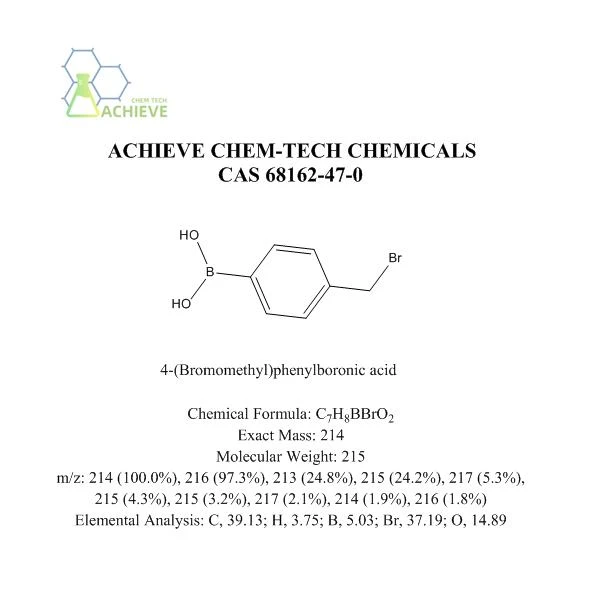
4-(Bromomethyl)phenylboronic acid is an important organic synthesis building block with the molecular formula C₇H₈BBrO₂. The most distinctive structural feature of this compound lies in the benzene ring, which simultaneously bears two key functional groups: a highly electrophilic bromomethyl group (-CH₂Br) and a highly nucleophilic boronic acid group (-B(OH)₂). This unique "dual functionality" makes it an extremely valuable amphiphilic reagent, capable of acting as an electrophile to undergo substitution reactions with various nucleophilic groups (such as amines, alcohols, and thiols) to extend carbon chains, as well as acting as a nucleophile to form carbon-carbon bonds with aryl or alkyl halides via the classic Suzuki-Miyaura coupling reaction, thereby efficiently linking two aromatic ring structures. Therefore, it is widely applied in medicinal chemistry, materials science, and functional molecule development, particularly playing an irreplaceable role in constructing the core frameworks of complex bioactive molecules and organic functional materials. Due to the moisture sensitivity of its boronic acid group, this compound typically requires storage under low-temperature, inert atmosphere conditions in a sealed container.

|
C. F |
C7H8BBrO2 |
|
E. M |
214 |
|
M. W |
215 |
|
m/z |
214 (100.0%), 216 (97.3%), 213 (24.8%), 215 (24.2%), 217 (5.3%), 215 (4.3%), 215 (3.2%), 217 (2.1%), 214 (1.9%), 216 (1.8%) |
|
E. A |
C, 39.13; H, 3.75; B, 5.03; Br, 37.19; O, 14.89 |
|
|
|


4-(Bromomethyl)phenylboronic acid is a common organic synthesis intermediate with extensive applications in multiple fields.
1. Synthesis of heterocyclic compounds: By reacting with different organic compounds, various heterocyclic compounds can be synthesized, such as pyridine, pyrazine, pyrimidine, etc. These compounds have extensive applications in fields such as pharmaceuticals and pesticides.
2. Chiral catalysts for synthesis: Chiral catalysts are important tools for achieving organic synthesis reactions. 4- (Bromomethyl) phenylboronic acid can be used to synthesize chiral phosphate catalysts for asymmetric synthesis reactions, such as asymmetric Michael addition reactions and asymmetric Henry reactions.
3. Synthetic polymer: 4- (Bromomethyl) phenylboronic acid can react with other organic compounds to synthesize polymers containing phenylboronic acid groups. These polymers have a wide range of applications in materials science, biomedicine, and other fields, such as drug delivery and biological imaging.
4. Synthetic pesticides: 4- (Bromomethyl) phenylboronic acid can be used to synthesize various pesticides, such as herbicides, insecticides, fungicides, etc. These pesticides have extensive applications in agricultural production.
5. Synthetic spices: 4- (Bromomethyl) phenylboronic acid can be used to synthesize various spices, such as coumarin, coumarin, etc. These spices have a wide range of applications in cosmetics, food, and other fields.


6. Materials Science: 4- (Bromomethyl) phenylboronic acid can be used to prepare polymer materials and functional materials. Through its reactivity and the properties of boric acid groups, different functional groups can be introduced, changing the properties and uses of the material.
7. Drug research: Due to the excellent reactivity of 4- (Bromomethyl) phenylboronic acid, it is widely used in the field of drug research. It can serve as a synthetic intermediate for drug lead compounds, used to construct a diverse compound library and develop new bioactive compounds.
8. Boric acid buffer: The boric acid group of 4- (Bromomethyl) phenylboronic acid has good buffering performance and can be used to prepare buffer solutions. Boric acid buffering agents are widely used in laboratories and biochemical fields to regulate the acid-base balance of solutions and maintain specific pH.
9. Biosensors: Due to the stable coordination structure formed between 4- (Bromomethyl) phenylboronic acid and certain molecules (such as glucose or ketose), they can be used to prepare biosensors. These sensors can be used to detect the presence and concentration of biological molecules, such as monitoring blood glucose levels in vitro and in vivo.
10. Metal ion coordination agent: The boric acid group of 4- (Bromomethyl) phenylboronic acid has good metal ion coordination performance and can be used to stabilize and extract certain metal ions. This is of great significance in fields such as environmental science, catalyst research, and metal organic chemistry.
11. Coordination polymer: 4- (Bromomethyl) phenylboronic acid can be used as a monomer for preparing coordination polymers. These polymers have special properties such as adsorption performance, ion selectivity, temperature sensitivity, etc., and can be applied in fields such as separation technology, sensors, and drug release systems.


4-(Bromomethyl)phenylboronic acid is a common intermediate in organic synthesis. The following are several common synthesis methods, detailed steps, and chemical equations:
Method 1: Synthesis of phenyl bromide
Zn+Br2+4-Hydroxyphenyl bromide → C7H8BBrO2
Prepare a 100 milliliter three necked flask and add 20 milliliters (15 grams, 0.125 moles) of 4-hydroxyphenyl bromide and 120 milliliters (141.7 grams, 1 mole) of zinc powder.
Slowly add 46 milliliters (68 grams, 0.5 moles) of bromine in an ice bath to avoid excessive temperature.
Heat the reaction mixture to 80 ℃ and maintain it for 45 minutes.
Filter to remove zinc powder, wash the filter cake with petroleum ether to remove unreacted 4-hydroxyphenyl bromide and bromine.

After evaporation of the filtrate, crude 4-bromomethylbenzene is obtained, which can be used as the raw material for the next synthesis step.
Method 2: Synthesis of phenyl bromide
Br2+HBr+4-Hydroxyphenyl bromide → C7H8BBrO2
Prepare a 100ml three necked flask and add 20ml (15g, 0.125 mol) of 4-hydroxyphenyl bromide and 80ml (0.625 mol) of hydrobromic acid.
Slowly add 26.7 milliliters (43.1 grams, 0.3 moles) of bromine in an ice bath to avoid excessive temperature.
Heat the reaction mixture to 80 ℃ and maintain it for 45 minutes.
Add 200 milliliters of water and adjust the pH value to 8-9 with a sodium bicarbonate aqueous solution.
Filter to remove sediment, extract the organic phase with methanol, evaporate the organic solvent, and obtain crude 4-bromomethylbenzene.
Method 3: Synthesis of phenyl iodide
Br2+HBr+C6H5IO → C7H8BBrO2
Prepare a 100 milliliter three necked flask and add 20 milliliters (15 grams, 0.125 moles) of 4-hydroxyphenyl iodide and 80 milliliters (0.625 moles) of hydrobromic acid.
Slowly add 26.7 milliliters (43.1 grams, 0.3 moles) of bromine in an ice bath to avoid excessive temperature.
Heat the reaction mixture to 80 ℃ and maintain it for 45 minutes.
Add 200 milliliters of water and adjust the pH value to 8-9 with a sodium bicarbonate aqueous solution.
Filter to remove sediment, extract the organic phase with methanol, evaporate the organic solvent, and obtain crude 4-bromomethylbenzene.
The above three methods are only a few of them for synthesizing 4-(Bromomethyl)phenylboronic acid, and different synthesis methods may vary depending on the raw materials. It should be noted that during the synthesis process, reaction conditions such as temperature, time, and reagent ratio should be strictly controlled to ensure product quality and yield. At the same time, attention should be paid to safe operation to avoid safety risks caused by the toxicity, corrosiveness, and other issues of chemical reagents.
Adverse reactions
The manifestations of adverse reactions to 4- (Bromomethyl) phenylboronic acid
Skin reactions
Skin reaction is a common adverse reaction of 4- (Bromomethyl) phenylboronic acid. Contact individuals may experience symptoms such as redness, swelling, itching, and rash on the skin. These symptoms usually appear within hours to days after exposure, and the severity varies from person to person. The occurrence of skin reactions may be related to direct irritation of the skin by 4- (Bromomethyl) phenylboronic acid and allergic reactions. For individuals with allergies, they may be more prone to severe skin reactions such as contact dermatitis after exposure.
Eye reactions
Eye contact with 4- (Bromomethyl) phenylboronic acid may cause symptoms such as eye pain, redness, tearing, and photophobia. These symptoms may affect vision and, in severe cases, may even lead to eye damage such as corneal ulcers, conjunctivitis, etc. The occurrence of eye reactions is usually caused by direct stimulation of eye tissues by 4- (Bromomethyl) phenylboronic acid. If the compound accidentally splashes into the eyes, rinse immediately with plenty of water and seek medical attention promptly.
Respiratory reactions
Respiratory exposure to 4- (Bromomethyl) phenylboronic acid may cause symptoms such as coughing, wheezing, and difficulty breathing. These symptoms may affect respiratory function and, in severe cases, may even lead to suffocation. The occurrence of respiratory reactions may be caused by the inhalation of 4- (Bromomethyl) phenylboronic acid after volatilization, which irritates and damages the respiratory mucosa. The use of this compound in poorly ventilated environments, or failure to take appropriate protective measures, may increase the risk of respiratory reactions. Long term exposure may also lead to the occurrence of chronic respiratory diseases.
Systemic reactions
Long term or high-dose exposure to 4- (Bromomethyl) phenylboronic acid may lead to systemic reactions such as headache, dizziness, fatigue, nausea, vomiting, etc. These symptoms may affect the user's daily life and work. The occurrence of systemic reactions may be related to the accumulation of 4- (Bromomethyl) phenylboronic acid in the body and its effects on the nervous and digestive systems. In severe cases, it may even lead to complications such as liver and kidney function damage, abnormal blood system, etc.
Factors affecting adverse reactions of 4- (Bromomethyl) phenylboronic acid
Exposure dose
Exposure dose is one of the important factors affecting the adverse reactions of 4- (Bromomethyl) phenylboronic acid. Generally speaking, the higher the exposure dose, the higher the risk of adverse reactions and the more severe the symptoms may be. During the production, use, and processing of this compound, the exposure dose should be strictly controlled to avoid high-dose exposure. For example, in laboratory operations, the required amount of compound should be accurately weighed to avoid excessive use.
Contact time
5.2 Contact time duration of contact can also affect the occurrence of adverse reactions. Long term exposure to 4- (Bromomethyl) phenylboronic acid may increase the risk of adverse reactions, especially damage to important organs such as the liver and kidneys. Therefore, contact time should be minimized as much as possible, and methods such as shift work should be adopted to reduce the duration of continuous contact. Whenever possible, automated equipment should be used instead of manual operation to reduce the contact time between personnel and compounds.
Individual Differences
There are differences in the sensitivity of different individuals to 4- (Bromomethyl) phenylboronic acid. People with allergies, children, pregnant women, elderly and other special populations may be more prone to adverse reactions. Allergic individuals may experience allergic reactions to certain components of 4- (Bromomethyl) phenylboronic acid, leading to severe skin, respiratory, and other symptoms. Children and the elderly have relatively weaker physical functions, poorer tolerance to drugs, and are more susceptible to the effects of this compound. Pregnant women are in a special state during pregnancy, and exposure to 4- (Bromomethyl) phenylboronic acid may have adverse effects on the fetus. Therefore, special attention should be paid to the protection of special populations when using this compound.
Environmental factors
Environmental factors such as temperature, humidity, ventilation conditions, etc. may also affect the adverse reactions of 4- (Bromomethyl) phenylboronic acid. High temperature and high humidity environments may promote the volatilization of the compound, increase its concentration in the air, and thus increase the risk of exposure. A poorly ventilated environment can cause the compound to accumulate in the air, making it easier for users to inhale and increasing the risk of respiratory reactions. Therefore, in workplaces where this compound is used, good ventilation conditions should be maintained, temperature and humidity should be controlled to reduce the occurrence of adverse reactions.
Hot Tags: 4-(bromomethyl)phenylboronic acid cas 68162-47-0, suppliers, manufacturers, factory, wholesale, buy, price, bulk, for sale, BENZENE D6, Dodecylamine, 1 Hydroxy cyclobutanecarboxylic acid, Thioacetamide Solution CAS 62 55 5, Magnesium Ethoxide, Uridine Powder