




Shaanxi BLOOM Tech Co., Ltd. is one of the most experienced manufacturers and suppliers of chlorotriethylsilane cas 994-30-9 in China. Welcome to wholesale bulk high quality chlorotriethylsilane cas 994-30-9 for sale here from our factory. Good service and reasonable price are available.
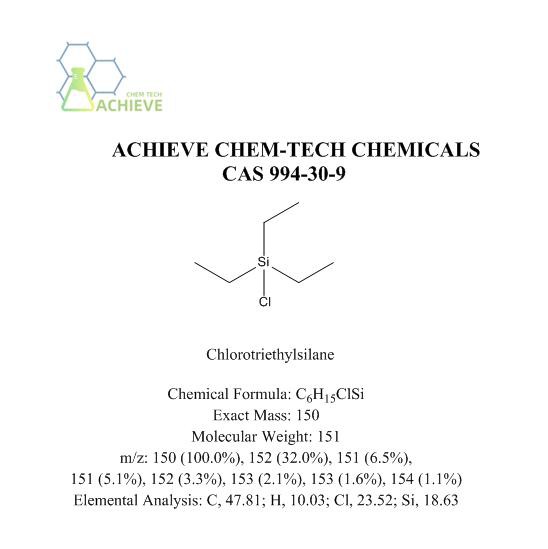
Chlorotriethylsilane (CT2520), a colorless or slightly yellow transparent liquid with a pungent odor. CAS 994-30-9, EINECS 213-615-6, molecular formula C6H15ClSi. It usually has good solubility in organic solvents, but poor solubility in water. It is a non-polar molecule, which is related to the silicon atoms and ethyl groups in its molecular structure. Non polar molecules do not deflect in an electric field and are not easily soluble in polar solvents. It is a non electrolyte with low conductivity in aqueous solution. Conductivity is a measure of a substance's ability to conduct electricity, which is related to the concentration of free ions in the substance.
An important organic synthesis raw material and intermediate that can be used to synthesize various organosilicon compounds. Can be used as a sealing agent for ethyl silicone oil and ethyl silicone rubber to improve product performance and stability. In certain chemical reactions, triethylchlorosilane can act as a catalyst or a component of a catalyst to promote the progress of the reaction. CT2520 can also be used in the fields of surfactants, defoamers, and as solvents or reaction media for certain chemical reactions.

|
Chemical Formula |
C6H15ClSi |
|
Exact Mass |
150 |
|
Molecular Weight |
151 |
|
m/z |
150 (100.0%), 152 (32.0%), 151 (6.5%), 151 (5.1%), 152 (3.3%), 153 (2.1%), 153 (1.6%), 154 (1.1%) |
|
Elemental Analysis |
C, 47.81; H, 10.03; Cl, 23.52; Si, 18.63 |
|
|
|



Chlorotriethylsilane is an important organic silicon compound. Due to its unique chemical structure and reactivity, it is widely used in materials science, organic formation, and industrial fields. Its chemical properties can be summarized as follows:
Physical properties and basic characteristics
CT2520 appears as a transparent colorless to light yellow liquid at room temperature. It has a low density (0.89-0.90 g/mL) and a low boiling point (142-149°C), and is highly volatile. Its melting point is -50°C, indicating that it remains in a liquid state even at low temperatures.
This compound is extremely sensitive to moisture and will react rapidly with water in the air to form hydrogen chloride and silanol compounds.
Therefore, CT2520 needs to be stored under the protection of anhydrous and inert gases (such as nitrogen). Its refractive index (n²⁰/D) is 1.43, and the flash point is only 29°C. CT2520 is a flammable liquid and should be operated away from heat sources and high-temperature environments.
Chemical stability and reactivity
Hydrolysis sensitivity
The hydrolysis reaction of CT2520 is extremely rapid. When CT2520 comes into contact with water or compounds containing hydroxyl groups (such as alcohols), the Si-Cl bond breaks, generating triethyl silanol and hydrogen chloride. This characteristic makes it a typical representative of silaneating reagents and is often used to protect hydroxyl groups or introduce silicon-based groups. For example, in organic formation, it can be used through silaneation reactions to convert alcohols into siloxanes, enhancing the stability of the compounds.
Reactions with proton solvents
Apart from water, CT2520 also reacts with proton solvents such as methanol and ethanol, generating corresponding siloxanes and hydrogen chloride. Therefore, non-protonic solvents (such as dichloromethane, tetrahydrofuran) need to be used during storage and operation to avoid side reactions.
Thermal stability and decomposition
At high temperatures (such as the autoignition temperature of 280°C), CT2520 may decompose, releasing toxic gases (such as hydrogen chloride). Therefore, heating operations should be carried out in a fume hood and the temperature should be controlled.
Chemical behavior in catalytic and synthetic applications
Lewis acid catalyst
CT2520 can act as a weak Lewis acid, promoting certain organic reactions (such as condensation, cyclization) through the polarity of the Si-Cl bond. For example, in the formation of silicon-oxygen bonds, CT2520 can catalyze the dehydration condensation of silanol to generate polysiloxanes (the precursor of silicone rubber).
Silaneating reagent
One of its core applications is as a silaneating reagent, reacting with compounds containing active hydrogen (such as alcohols, phenols, amines) through the Si-Cl bond to generate stable siloxanes or silazanes.


This reaction is used in drug formation to protect hydroxyl groups or in materials science to modify the surface of polymers.
Stability of derivatives
Compared with trimethylchlorosilane (TMSCl), the derivatives of CT2520 (such as triethyl siloxane) have higher stability against hydrolysis and are suitable for scenarios requiring long-term storage or complex reaction conditions.

Key role in industry and research
Materials science
Chlorotriethylsilane serves as a crucial foundational raw material for the fabrication of silicone rubber, silicone resins, and silicone oil in the field of materials science. CT2520 participates in and catalyzes the efficient formation of stable silicon-oxygen covalent bonds during the polymerization and modification process of silicone materials. The introduction of silicon-oxygen bond frameworks effectively endows silicone-based materials with excellent high-temperature resistance, outstanding chemical corrosion resistance, and stable thermal oxidation stability.


These optimized properties enable the modified silicone materials to maintain stable physical and chemical performances under extreme high-temperature environments and harsh corrosive conditions, making them widely applicable in industrial high-temperature accessories, anti-corrosion coatings, and special polymer material manufacturing fields.
Organic synthesis
In organic formation and pharmaceutical chemical research, CT2520 is a commonly used efficient protective reagent and derivatization reagent. In complex drug formation routes, CT2520 can selectively protect active hydroxyl groups and amine groups in organic molecular structures.
This protective effect effectively isolates active functional groups, avoids unnecessary intermolecular side reactions and structural degradation in multi-step formation reactions, and greatly improves the formation yield and structural purity of target drug intermediates. In analytical chemistry detection, it acts as a high-sensitivity derivatization reagent. CT2520 can derivatize trace fluoride substances and other polar compounds, converting difficult-to-detect substances into stable volatile derivatives that are suitable for gas chromatography detection, significantly improving the accuracy and detection limit of trace substance analysis.


Surface modification
CT2520 is a versatile surface modification agent for inorganic materials. It can undergo efficient chemical bonding reactions with abundant active hydroxyl groups distributed on the surface of various inorganic substrates including glass, metal oxides, ceramics and mineral fillers. A dense and uniform silicon-oxygen bond modification layer is firmly formed on the material surface after the reaction.
This chemical modification significantly enhances the surface hydrophobicity, water resistance and anti-fouling performance of inorganic materials, while effectively improving the interfacial adhesion between inorganic substrates and organic coatings, adhesives and polymer matrices.Relying on these excellent modification effects, CT2520 is extensively applied in high-performance functional coatings, waterproof and anti-corrosion materials, as well as high-adhesion adhesive industry scenarios.


CT2520, due to its unique chemical properties - including high hydrolysis sensitivity, catalytic activity and silanization ability - has become a core compound in organic silicon chemistry. Its applications cover various fields such as material synthesis, drug protection and surface modification. However, during the operation, strict adherence to safety regulations is necessary to avoid toxic hazards. In the future, as the demand for environmentally friendly silane reagents increases, the development of derivatives of CT2520 and green synthesis processes will become the research focus.

Application in the Semi-synthetic Preparation of Paclitaxel
Paclitaxel, commonly known as Taxol, is a taxane diterpenoid extracted from Taxus plants. Featuring a novel molecular structure, unique anti-tumor mechanism, potent therapeutic efficacy and a broad anti-cancer spectrum, it is recognized as one of the most valuable anti-cancer drugs available at present.
The Chinese patent CN201310430084.8 discloses an efficient semi-synthetic process for paclitaxel preparation. This method boasts high reaction yield, mild reaction conditions, short reaction cycle, low by-product generation and simple post-treatment procedures, which is fully applicable to industrial mass production.


The core technical route adopting chlorotriethylsilane for formation is as follows: first, with cerium chloride heptahydrate as the catalyst, the 10-hydroxyl group of 10-DAB is acetylated to generate baccatin III. Second, CT2520 is used as a hydroxyl protecting reagent to modify the 7-position hydroxyl group of baccatin III, yielding 7-TES-baccatin III. Third, the protected intermediate undergoes a condensation reaction with (4S,5R)-2,4-diphenyl-4,5-dihydrooxazole-5-carboxylic acid to form the paclitaxel precursor. Finally, the side-chain oxazole ring is opened and the 7-position protecting group is synchronously deprotected to obtain high-purity paclitaxel.
2. Application in High-toughness Cable Sheath Materials
The Chinese patent CN201610332792.1 develops a high tear-resistant cable sheath composite material. This material integrates excellent flame retardancy, high tensile strength, superior breaking elongation, stable elongation retention after aging and low-temperature impact resistance, solving the performance defects of traditional cable sheath materials.
In this formula, CT2520 serves as a key functional modifier, with a dosage of 2–9 parts by weight.


The material is prepared with polyvinyl chloride, ethylene-vinyl acetate copolymer and 1-octene-ethylene polymer as the base matrix, supplemented with octadecyl acrylate, diallyl isophthalate, magnesium hydroxide, carbon black and other auxiliary additives. As a silane coupling modifier, CT2520 can effectively improve the interfacial bonding force between polymer matrix and inorganic fillers, enhance the overall structural compactness of the material, and significantly optimize the tear resistance, mechanical toughness and aging resistance of the cable sheath. Meanwhile, it cooperates with flame-retardant fillers to further stabilize the flame-retardant performance of the material, making it suitable for complex and harsh wiring scenarios.

Grignard Reagent Nucleophilic Substitution Method (Main Laboratory Route)
This synthetic route uses silicon tetrachloride and ethylmagnesium bromide Grignard reagent as core raw materials, with anhydrous diethyl ether or tetrahydrofuran as the solvent.
The whole reaction is shielded from moisture by nitrogen, serving as a standard protocol for preparing high-purity CT2520 in laboratories. The molar ratio of ethyl Grignard reagent to silicon tetrachloride is controlled at 3:1, and the Grignard solution is added dropwise slowly at low temperature to prevent overalkylation that produces tetraethylsilane by-product.
The system is stirred at 0–30 °C for 4–6 hours to form solid magnesium chloride precipitate. After the reaction completes, salt residues are removed by low-temperature filtration. The solvent is stripped from the filtrate under atmospheric pressure, and the crude product is rectified to collect the fraction boiling at 145–147 °C.
The product yield steadily ranges from 68% to 75%, with purity exceeding 99.2%. Its drawbacks include strict storage requirements for Grignard reagents and flammable solvents, making large-scale industrial production impractical.
Selective Chlorination of Triethylsilane (High-Yield Purification Route)
Triethylsilane acts as the substrate, with tetrabutylphosphonium chloride adopted as the phase-transfer catalyst. It undergoes chlorine exchange reaction with phenyltrichlorosilane at 100–120 °C without chlorine gas, featuring extremely high reaction selectivity.
After mixing raw materials, the mixture is held at constant temperature for 1 hour for maturation. The catalyst is eliminated via vacuum filtration, and the by-product phenyldichlorosilane is separated by rectification, affording a target product yield up to 97%.
This process generates few by-products and facilitates simple purification, suitable for small-batch production of high-purity reagents. However, the high cost of triethylsilane feedstock restricts mass production capacity.
Direct Industrial Synthesis (Rochow Process)
For industrial manufacturing, ethyl chloride reacts with metallic silicon powder in the gas phase at 280–320 °C under copper-based catalysis, generating a mixture of various ethylchlorosilanes in one step, among which CT2520 accounts for approximately 22%.
The mixed ethylchlorosilanes are fractionated through multi-column continuous rectification to separate monoethyl, diethyl, triethyl and tetraethyl silane fractions.
This route features cheap raw materials and high production capacity, yet suffers from complex product compositions and high energy consumption for rectification. The product purity is only around 95%, mostly applied as crude organosilicon feedstock. Secondary purification is required before it can be used in silicon protecting group reactions for pharmaceutical formation.
FAQ
What is the density of Chlorotriethylsilane?
+
-
0.898 g/mL
density. 0.898 g/mL at 25 °C (lit.)
Hot Tags: chlorotriethylsilane cas 994-30-9, suppliers, manufacturers, factory, wholesale, buy, price, bulk, for sale, 4 tert Octylphenol CAS 140 66 9, d erythrose, 2 bromo 3 methylpropiophenone CAS 1451 83 8, 2 Phenylacetamide CAS 103 81 1, Dodecylamine, p Coumaric acid powder