


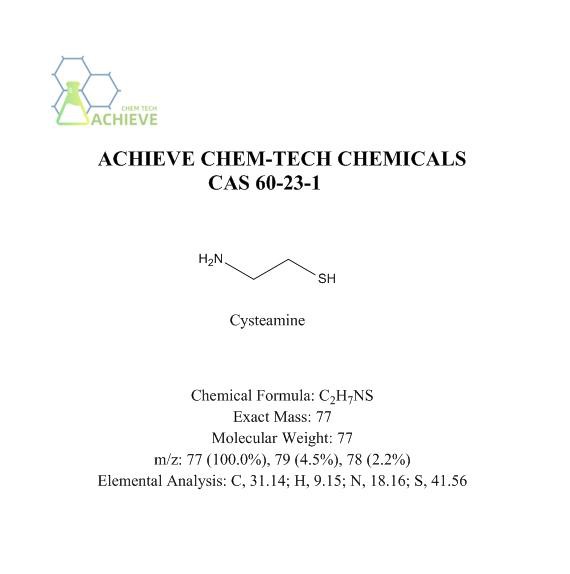

Cysteamine powder is an organic compound with a chemical formula of C2H7NS, a relative molecular mass of about 77.15 g/mol, and a CAS of 60-23-1. It is a colorless to pale yellow liquid with a strong foul odor similar to mercaptans. It is a hydrophilic compound, soluble in water. In addition, it is also soluble in many organic solvents, such as ethanol, methanol, ethers, etc. It is a basic compound whose solution is alkaline. It neutralizes with acids. Under appropriate conditions, protons can be lost to form corresponding anions. Its protonated form is product (HSCH2CH2NH3+), which may be present in its salts. Relatively stable under normal storage conditions, but sensitive to light, heat and oxidants. Care should be taken to avoid prolonged exposure to sunlight or high temperature environments. As a multipurpose organic compound, it has important application value in chemical synthesis, metal complexation, biochemistry, medicine, cosmetics, electrochemistry, optics and other fields. These applications not only reflect its chemical properties and functional characteristics, but also demonstrate its potential and development prospects in various fields.

|
|
|

|
Chemical Formula |
C2H7NS |
|
Exact Mass |
77 |
|
Molecular Weight |
77 |
|
m/z |
77 (100.0%), 79 (4.5%), 78 (2.2%) |
|
Elemental Analysis |
C, 31.14; H, 9.15; N, 18.16; S, 41.56 |

Cysteine (CAS number 60-23-1), also known as 2-aminoethanethiol, is an organic compound containing thiol and amino groups. Its molecular formula is C ₂ H ₇ NS, with a molecular weight of 77.15. It is a white to light yellow crystalline powder at room temperature, easily soluble in water and alcohol, and undergoes alkaline reactions. However, it is prone to oxidation to disulfides in air. As a core intermediate in the fields of medicine, chemical engineering, agriculture, etc., mercaptoethylamine plays an irreplaceable role in multiple industries due to its unique chemical properties and biological activity.
1. Specific treatment for cystinuria
It is the only drug approved for the treatment of cystinuria. This disease is caused by impaired reabsorption of cysteine by the kidneys, leading to the crystallization of cysteine in urine, the formation of kidney stones, and causing kidney function damage. By binding to the disulfide bond in cysteine through thiol groups, it is broken down into cysteine, significantly reducing the concentration of cysteine in urine. Clinical studies have shown that long-term use can reduce the risk of stone formation by 70% and slow down the deterioration of kidney function by more than 50%.
2. First aid detoxification for acetaminophen poisoning
As a precursor of glutathione, it can directly enter liver cells and be converted into glutathione, inhibiting the formation of acetaminophen active metabolite (N-acetylbenzoquinone imine), while promoting its binding with glutathione and excretion from the body.


This medication should be administered within 10 hours after an overdose of acetaminophen. The first dose is 2g intravenously, followed by 0.4g every 4-8 hours, which can significantly reduce the incidence of acute liver failure. However, it should be noted that gastrointestinal reactions such as nausea and vomiting may limit clinical application.
3. Neuroendocrine regulation and growth promoting effects
It is a potent inhibitor of dopamine - β - hydroxylase, which inhibits the conversion of dopamine to norepinephrine, leading to dopamine accumulation in the hypothalamus and promoting the secretion of growth hormone (GH) and insulin-like growth factor-1 (IGF-1).
Animal experiments have shown that it can increase the weight gain of rats by 19.8%, young rabbits by 26.4%, and broiler chickens by 5.3% -7.9%. In addition, it can also deplete somatostatin (SS), relieve its inhibition on the digestive and endocrine systems, and further enhance its growth promoting effect.
4. Radiation protection and metal detoxification
Radiation protection can be achieved by clearing free radicals and chelating metal ions. Its derivatives (such as hydrochloride and sulfate salts) have been used for the treatment of radiation damage, which can reduce the damage of X-rays to the hematopoietic system and gastrointestinal tract. At the same time, it can form stable complexes with metal ions such as cobalt, copper, zinc, cadmium, etc., which has potential application value in emergency treatment of heavy metal poisoning.

Biochemical Research: Tool Compounds for Protein Engineering and Enzymatic Analysis

1. Selective reduction of disulfide bonds in the hinge region of antibodies
It can specifically reduce the disulfide bonds in the hinge region of antibody molecules without affecting the disulfide bond structure in other regions. This characteristic makes it a key reagent for preparing single chain antibodies (scFv) or bispecific antibodies in protein engineering. For example, in the preparation of anti-CD3 × anti-CD20 bispecific antibodies, mercaptoethylamine can reduce intact IgG to a semi antibody, and then construct bispecific molecules through chemical coupling or gene recombination techniques.
2. Enzymatic research and metal ion masking
In analytical chemistry, mercaptoethylamine serves as a masking agent, which can form stable complexes with metal ions such as cobalt, copper, zinc, and cadmium through thiol groups, eliminating their interference with enzyme activity measurements.
For example, in alkaline phosphatase (ALP) activity detection, adding mercaptoethylamine can shield the inhibitory effect of copper ions in the sample and improve detection accuracy. In addition, it can also be used for iodometric determination of hydrolysis product content, providing support for enzyme kinetics research.
3. Coenzyme A synthesis and transacylation
It is a component of coenzyme A (CoA), and its thiol group can bind with acyl groups such as acetyl and acetyl, and participate in various transacyl reactions. For example, in the process of fatty acid synthesis, the acetyl group of acetyl CoA can be transferred to the fatty acid synthase complex, initiating the extension of the fatty acid chain. By maintaining the active thiol group of CoA, the smooth progress of the transacylation reaction is ensured.

Industrial applications: multifunctional raw materials from metal processing to material synthesis

1. Preparation of metal complexes
It can form stable complexes with metal ions such as nickel, copper, and zinc, and is used in fields such as electroplating and catalyst preparation. For example, the nickel bis mercaptoacetamine complex (Ni (Cysteine) ₂] ² ⁺) can be used as an additive in nickel electroplating to improve the glossiness and corrosion resistance of the coating. The preparation method is as follows: dissolve mercaptoethylamine and sodium hydroxide in water, slowly add dropwise to the hexahydrate nickel chloride solution, stir at room temperature for 10 minutes, filter and wash, and then vacuum concentrate and dry to obtain the target product.
2. Antioxidants for Coatings and Plastics
Thioethylamine and its derivatives can serve as antioxidants to inhibit the oxidative degradation of coatings and plastics during processing or use.
It delays material aging and prolongs service life by clearing free radicals and chelating metal ions. For example, adding 0.5% mercaptoethylamine derivative to polyethylene (PE) film can extend the oxidation induction period (OIT) of the film from 12 minutes to 35 minutes.
3. Rubber accelerators and chemical modifiers
In the rubber industry, it can be used as a promoter to accelerate vulcanization reactions and improve the physical properties of rubber. It forms an active intermediate with sulfur, reducing the activation energy for sulfurization and shortening the sulfurization time by 30% -50%. In addition, it can also serve as a chemical regulator in the agricultural field, regulating the synthesis and metabolism of plant growth hormones, and promoting crop yield increase.

In the field of agriculture and feed: physiological regulators of livestock and poultry growth

1. Promote the growth of livestock and poultry and feed conversion
By depleting somatostatin (SS), its inhibition on the digestive and endocrine systems can be relieved, significantly improving the growth rate and feed efficiency of livestock and poultry. For example, adding 50-100mg/kg mercaptoethylamine to broiler feed can increase daily weight gain by 7.9% and improve feed conversion rate by 8.3%. Its mechanism of action includes: promoting the secretion of gastric and pancreatic juices, increasing digestive enzyme activity; Increase GH and IGF-1 levels, enhance protein synthesis; Reduce body fat deposition and improve meat quality.
2. Enhance immune function and disease resistance
It can regulate the immune system of livestock and poultry, and enhance their resistance to pathogens.
Research has shown that it can promote lymphocyte proliferation, enhance the phagocytic function of macrophages, and increase the levels of immunoglobulin (IgG, IgM) in serum. Feeding chickens with mercaptoethylamine 7 days before infection with Newcastle disease virus (NDV) can reduce the mortality rate from 30% to 12%.
3. Relieve stress response and improve production performance
Stress factors such as high temperature and transportation can lead to growth inhibition and productivity decline in livestock and poultry. By regulating the hypothalamic pituitary adrenal axis (HPA axis), cortisol levels can be reduced to alleviate stress responses. For example, during the high temperature period in summer, adding 100mg/kg mercaptoethylamine to cow feed can increase milk production by 8.2% and milk protein content by 0.15 percentage points.
Cosmetics and Personal Care: Active Ingredients for Antioxidants and Metal Detoxification

1. Antioxidants and free radical scavenging
Hydrogen atoms can be provided by thiol groups to neutralize free radicals in the lipid peroxidation chain reaction and inhibit skin oxidative damage. Its antioxidant capacity is more than 10 times that of vitamin E, which can effectively delay skin aging. For example, adding 0.5% mercaptoethylamine derivatives to sunscreen can increase the SPF value by 15% -20%.
2. Metal detoxification and skin protection
It can form stable complexes with heavy metal ions (such as lead and mercury) in cosmetics, reducing their toxicity and preventing skin absorption. In addition, it can promote the proliferation and differentiation of keratinocytes, accelerating the repair of damaged skin. For example, adding mercaptoethylamine to acne products can shorten the healing time of inflammatory acne by 40%.

Cysteamine powder is an important raw material for organic synthesis, widely used in the preparation of a variety of organic compounds, such as protein cross-linking agents, pesticides, cosmetics and pharmaceuticals. It is also used in the preparation of antioxidants for coatings and plastics, accelerators for the production of rubber, and chemical regulators in the agricultural field. Mercaptoethylamine can relieve metal damage to the enzyme system in the body and has anti-oxidative properties. Its structure contains amino and sulfhydryl groups, and has significant coordination ability. It can be complexed with various metal ions to obtain a variety of metal complexes. For example, it has been reported in literature that this chemical can be coordinated with divalent metal nickel to obtain a nickel complex coordinated by dimercaptoethylamine. In addition, mercaptoethylamine can also be used as an intermediate in organic synthesis and medicinal chemistry, and is mostly used in the synthesis and modification of biologically active molecules.

In a dry 100 ml reaction, mercaptoethylamine (4.05 g, 52.5 mmol) and sodium hydroxide (1.90 g, 47.5 mmol) were successively dissolved in 100 ml of water, and then the solution was slowly added dropwise to the hexahydrate In the warm aqueous solution (100 ml) of nickel chloride (5.95 g, 25.0 mmol), it can be observed that the reaction system gradually turns green. The obtained green suspension mixture was stirred and reacted at room temperature for 10 min. After the reaction, the reaction mixture was directly filtered, then washed twice with 25 ml of water, and then washed twice with 25 ml of absolute ethanol. The filtrate is vacuum concentrated and dried on a rotary evaporator to obtain the target product nickel complex.

It is an important organic compound with a wide range of applications and uses. It can be obtained by various synthetic methods.
1. Reaction method of ethanethiol and ammonia water:
This is one of the most common Cysteamine powder synthesis methods. The method obtains the product through the reaction of ethanethiol and ammonia water. Specific steps are as follows:
Step 1: Slowly add ethanethiol dropwise to ammonia water, keeping the reaction temperature in a low range (usually 0-10 degrees Celsius).
Step 2: After the reaction, the product can be obtained by distillation or crystallization.

2. Thioether acid hydrolysis method:
This method uses thioether acid as a starting material, and the acid hydrolysis reaction is carried out under acidic conditions. Specific steps are as follows:
Step 1: Dissolve thioether acid in an appropriate solvent.
Step 2: Add enough acid (such as hydrochloric acid or sulfuric acid) to trigger the acid hydrolysis reaction.
Step 3: After the reaction is complete, the product is purified by distillation or crystallization.

To sum up, it can be prepared by various synthetic methods such as reaction of ethanethiol with ammonia water, nucleophilic substitution of ethyl chloride, reaction of thiol with ammonium cyanide, and acidolysis of thioether. These methods have their own characteristics, and can effectively synthesize products under different experimental conditions.

Cysteamine powder is an organic compound with the molecular formula C2H7NS. It consists of an amino group (NH2), an ethyl group (C2H5) and a thiol group (SH).
The chemical formula of it is C2H7NS, and the molar mass is 77.15 g/mol. This relatively small mass gives it certain advantages in laboratory synthesis and applications.
It contains three important functional groups: amino group (NH2), ethyl group (C2H5) and thiol group (SH). These functional groups endow product with many special properties and reactivity.
It is an optically active compound with two asymmetric centers. Therefore, it can exist in four possible configurations, including (R,R)-, (S,S)-, (R,S)- and (S,R)- configurations. This makes it have chiral properties and can form specific reaction products with chiral ligands and chiral catalysts.
The amino group and thiol group in the molecule can interact with other molecules through hydrogen bonds. Hydrogen atoms on amino groups can form hydrogen bonds with other electronegative atoms (such as oxygen, nitrogen), while hydrogen atoms on thiol groups can also form hydrogen bonds with oxygen atoms of other molecules. These hydrogen bond interactions play an important role in the solubility, physical properties and chemical reactivity of product.
Due to the amino and thiol groups contained in 2product, it is highly hydrophilic. This enables it to form hydrogen bonds and solvate with water molecules in solution, increasing its solubility and reactivity.
Hot Tags: cysteamine powder cas 60-23-1, suppliers, manufacturers, factory, wholesale, buy, price, bulk, for sale, 2 Bromo 9 9 spirobifluorene, 2 Chloro 4 6 dimethoxypyrimidine, myrcene powder, BENZENE D6, 4-Fluorophenylacetone CAS 459-03-0, Bromopentafluorobenzene CAS 344 04 7