




Shaanxi BLOOM Tech Co., Ltd. is one of the most experienced manufacturers and suppliers of d-cystine cas 349-46-2 in China. Welcome to wholesale bulk high quality d-cystine cas 349-46-2 for sale here from our factory. Good service and reasonable price are available.
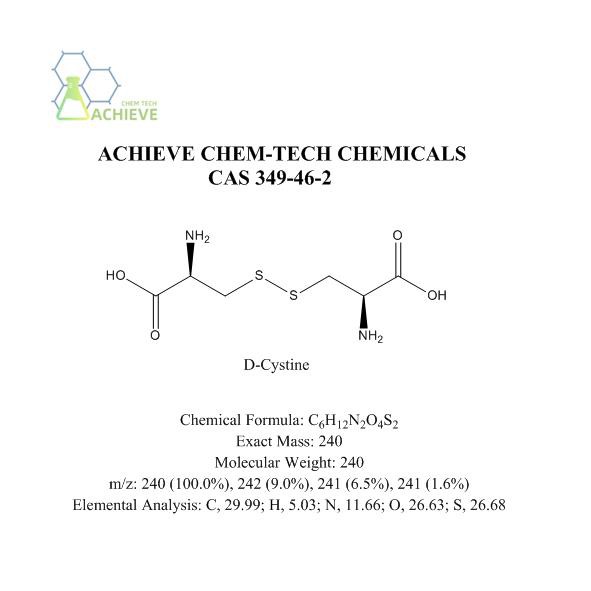
D-Cystine (C₆H₁₂N₂O₄S₂), chemically known as D-3,3'-dithiodialanine, is a rare non-natural amino acid and the pure enantiomer of L-Cystine. Structurally, it consists of two D-Cysteine molecules covalently bonded through a stable disulfide (-S-S-) bridge. Unlike naturally occurring L-Cystine, this synthetic chiral amino acid exhibits unique stereochemical properties that cannot be replaced in advanced biochemical and pharmaceutical research.As a reliable global supplier of high-purity chiral biochemical materials, Bloomtechz provides premium-grade D-Cystine in fine white crystalline powder form. The product features a decomposition point of approximately 260°C, insolubility in water, and excellent solubility in dilute acids and alkaline solutions.

|
|
|


|
Chemical Formula |
C6H12N2O4S2 |
|
Exact Mass |
240 |
|
Molecular Weight |
240 |
|
m/z |
240 (100.0%), 242 (9.0%), 241 (6.5%), 241 (1.6%) |
|
Elemental Analysis |
C, 29.99; H, 5.03; N, 11.66; O, 26.63; S, 26.68 |

D-Cystine is a non natural amino acid dimer with multiple uses.
Pharmaceutical field
Antioxidant: It as an antioxidant, can help reduce the production of free radicals and prevent oxidative damage. Oxidative damage is associated with many diseases such as cardiovascular disease, cancer and aging. Therefore, It is widely used in the pharmaceutical field as one of the components of antioxidants.
Liver protection: Itcan protect liver health by providing thioamino acids. Thioamino acids participate in the detoxification process in the body and help promote liver cell repair and metabolic function recovery.
Anti inflammatory effect: It has a certain anti-inflammatory effect, which can reduce inflammatory reactions and reduce the risk of related diseases such as arthritis and inflammatory bowel disease.


Immune enhancement: It can support the function of the immune system and enhance the body's immunity.
Beauty and skincare fields
Antioxidation and anti-aging: It can counteract the damage of free radicals, reduce the oxidative pressure on skin cells, and thus slow down the aging process of the skin. It can also stimulate the synthesis of collagen, enhance skin elasticity and firmness.
Preventing hair damage: It can help prevent hair from being damaged by factors such as environmental pollution, ultraviolet radiation, and chemical treatment. It helps to maintain the health, strength, and brightness of hair.
Nail protection: It can improve the structure and strength of nails, reducing the problem of fragile and brittle nails.
Nutritional supplements: It as a supplement, can provide the body with the necessary amino acids and improve the health of the skin and hair.
Food industry
Food seasoning: It has the effect of enhancing freshness and is often used as a seasoning agent to enhance the aroma and flavor of food. It can improve the overall quality of food and enhance the taste experience.
Food preservation: It can be used as an antioxidant in food, which can extend the shelf life and stability of food. It helps to prevent fat oxidation and food spoilage, thereby maintaining the freshness and quality of food.
Meat processing: It is widely used in meat products, such as smoked and pickled meat products. It can reduce the use of nitrite and reduce the potential harm of nitrite to human body.


Antioxidant: It can be used as an antioxidant in food, extending the shelf life of food and preventing quality changes caused by oxidation.
Application in the field of dyeing agents
In the field of dyeing agents, it has also demonstrated its unique application value. Due to its specific chemical structure and properties, it can be used as a synthetic raw material or auxiliary agent for certain dyes, thereby improving their performance and stability.
In addition, it can also be used in the dyeing and finishing process of textiles. By interacting with dye molecules, the dye uptake and fixation rate can be improved, resulting in textiles obtaining more vibrant and long-lasting colors.
Application in the field of dairy additives
In the dairy industry, additives also play an important role. Due to its excellent nutritional value and physiological function, it can be added as a nutritional enhancer to dairy products, thereby enhancing the nutritional value and market competitiveness of the products.
In addition, it can also be used to improve the taste and texture of dairy products. By interacting with other ingredients in dairy products, D-cystine can adjust the taste and texture of the product, making it more in line with consumers' taste needs.
Application in the field of oil antioxidants
Oils and fats are easily affected by oxidation during storage and processing, leading to a decrease in quality and loss of nutritional value.

In order to extend the shelf life of oils and maintain their nutritional value, people usually add antioxidants to prevent oxidation from occurring.
As a natural amino acid derivative, it has excellent antioxidant properties. It can bind with free radicals in oils and fats, thereby blocking the occurrence of oxidative chain reactions. Therefore, it is widely used in oil antioxidants to protect oils from oxidative damage.
Manufacturing Process of D-Cystine

The mainstream manufacturing route starts from inexpensive L-cysteine hydrochloride and proceeds through a five-step sequence of racemization, cyclization, chiral resolution, hydrolysis, and oxidation.Specifically, L-cysteine hydrochloride is first refluxed with sodium carbonate in acetone at 55°C for 4 hours to yield the thiazolidine carboxylic acid cyclized product. The mother liquor is then treated with glacial acetic acid and L-tartaric acid at 50–55°C to induce crystallization, precipitating D-2,2-dimethylthiazolidine-4-carboxylic acid-L-tartrate salt with an optical purity exceeding 99% and a yield of approximately 65.6%. This D-type salt is subsequently hydrolyzed in aqueous solution to release D-cysteine, achieving a yield of over 50% (based on L-cysteine) with optical purity above 99%.Finally, D-cysteine undergoes air oxidation or DMSO oxidation in alkaline aqueous solution,
where two thiol groups undergo dehydrogenative coupling to form the disulfide bond, yielding D-cystine, which is then purified through activated carbon decolorization, concentration, and cooling crystallization.Alternative routes include optical resolution of DL-cysteine via chiral amine or chiral copper complex salts, and enzymatic/microbial asymmetric hydrolysis of DL-ATC using Pseudomonas sp. strains, though both face challenges of high reagent cost or enzyme preparation difficulty that limit large-scale industrialization.As a high-value chiral sulfur-containing amino acid, D-cystine serves as a key chiral intermediate for the third-generation cephalosporin antibiotic cefminox sodium, and holds unique applications in neuroprotection, antioxidation, and organic synthesis.


Given the complexity of its manufacturing process and the limited number of globally scalable suppliers, there is sustained market demand for D-cystine raw materials with high optical purity and strong batch-to-batch consistency.
Bloomtechz, as a professional supplier of peptide and chiral amino acid raw materials, leverages its accumulated expertise in chiral synthesis and purification developed through its Syn Ake and TB500 active peptide portfolio, and is capable of providing pharmaceutical-grade D-cystine and its downstream derivatives (such as D-cysteine hydrochloride monohydrate, CAS 207121-46-8) to support customers' needs in antibiotic intermediate synthesis, chiral drug R&D, and functional material development.

The research history of D-Cystine dates back to the early 19th century, representing a milestone in the exploration of sulfur-containing amino acid stereochemistry.
In 1810, renowned British chemist William Hyde Wollaston first isolated a unique sulfur-rich crystalline substance from human bladder stones, initially naming it "cystic oxide". Derived from the Greek root "kystis" (bladder), this substance was the earliest recorded cystine compound in scientific history. At this preliminary research stage, scholars had not yet distinguished its L-type and D-type stereoisomers, only recognizing its unique sulfur-containing organic characteristics.Subsequent systematic studies continuously enriched the basic properties of cystine. In 1824, Swedish chemist Jöns Jacob Berzelius conducted in-depth compositional analysis of the substance, formally confirming its independent organic molecular attributes and revising its nomenclature, laying the groundwork for standardized cystine research.


In 1846, German chemist Friedrich Wöhler, a pioneer in artificial organic synthesis, explored the chemical lability of cystine and verified that strong acid hydrolysis could trigger its structural decomposition and release sulfur-containing derivatives, further revealing its core molecular composition characteristics.
The late 19th century witnessed breakthroughs in cystine biochemical mechanism research. In 1879, German chemist Ernst Leopold Salkowski first discovered the reversible conversion relationship between cystine and cysteine, confirming that cystine could be reduced to cysteine under alkaline conditions, which clarified the metabolic correlation between these two core sulfur-containing amino acids.In 1899, Swiss Nobel laureate Emil Fischer pioneered the study of amino acid optical activity, confirming that natural cystine possessed specific optical rotation properties.
This key finding broke through the limitations of conventional component analysis, creating a theoretical premise for the subsequent classification and identification of L-Cystine and D-Cystine stereoisomers.
The early 20th century ushered in a new era of D-Cystine independent research with the rapid development of stereochemistry. In 1902, Emil Fischer successfully isolated high-purity D-Cystine for the first time, accurately verifying its mirror-image stereoisomeric relationship with natural L-Cystine. This landmark discovery completed the systematic cognition of cystine chiral configuration and opened a new research field for artificial chiral amino acid preparation and application.In the 1920s, the rise of X-ray crystallography further accelerated structural research progress: in 1923, British crystallographer William Henry Bragg obtained precise cystine crystal diffraction data;


in 1931, German chemist Karl Freudenberg accurately localized the disulfide bond configuration in cystine molecules, realizing the precise visualization of D-Cystine spatial structure.With the maturity of modern synthetic chemistry, artificial preparation technology of D-Cystine achieved iterative upgrading. In 1935, American chemist Max Bergmann established a classic synthetic route for preparing D-Cystine via oxidative coupling of D-Cysteine. In 1947, British chemist Alexander R. Todd optimized the reaction conditions and purification process, effectively improving synthetic yield and product purity, and realizing scalable laboratory preparation of D-Cystine.
After two centuries of technological iteration, D-Cystine has evolved from a newly discovered natural crystal to a high-value chiral raw material for cutting-edge pharmaceutical synthesis and biochemical research.
At Bloomtechz, we inherit and refine this century-old research system, adopting optimized modern synthetic and purification technologies to break the limitations of traditional preparation processes. We strictly control chiral purity, impurity content and batch stability of D-Cystine products, providing high-quality, structurally consistent chiral raw materials for global laboratory research, pharmaceutical chiral synthesis and disulfide bond mechanism exploration, effectively supporting high-precision and repeatable biochemical experimental research.
Reference
[1]Wood, J. L., & du Vigneaud, V. (1939). A new synthesis of cystine. Journal of Biological Chemistry, 131(1), 267–276.
[2]Rosenfield Jr, R. E., & Parthasarathy, R. (1975). Structure and conformation of amino acids containing sulfur. III. The crystal structure and absolute configuration of 3,3,3′,3′-tetramethyl-D-cystine (D-penicillamine disulfide) dihydrochloride: An unusually short intramolecular N–H···S contact distance. Acta Crystallographica Section B: Structural Crystallography and Crystal Chemistry, 31(10), 2496–2502.
[3]Beychok, S. (1965). Side-chain optical activity in cystine-containing proteins: Circular dichroism studies. Proceedings of the National Academy of Sciences, 53(5), 999–1006.
[4]Kies, M. W., Dyer, H. M., Wood, J. L., & du Vigneaud, V. (1942). A study of the utilization of the optical isomers of N,N′-dimethylcystine. Journal of Biological Chemistry, 145(2), 487–494.
[5]Navo, C. D., Asín, A., Gómez-Orte, E., Gutiérrez-Jiménez, M. I., Compañ, I., Ezcurra, B., Avenoza, A., Busto, J. H., Corzana, F., Zurbano, M. M., Jiménez-Osés, G., Cabello, J., & Peregrina, J. M. (2022). Cell-penetrating peptides containing fluorescent D-cysteines. Chemistry – A European Journal, 28(1), e202102812.
Frequently Asked Questions
1. What is D-Cystine mainly used for in pharmaceutical and biochemical research?
+
-
D-Cystine is a rare non-natural chiral amino acid with unique disulfide bond stereostructure. Unlike common L-Cystine, it does not interfere with natural microbial metabolism, making it ideal for chiral drug synthesis, D-type peptide preparation, disulfide bond mechanism research, and antioxidant pharmacological studies. At Bloomtechz, our high-purity D-Cystine delivers stable chiral activity and consistent experimental repeatability, which perfectly meets high-standard pre-clinical research and formulation development needs.
2. What is the difference between D-Cystine and L-Cystine for research use?
+
-
The two are strict mirror enantiomers with completely opposite optical activity. L-Cystine participates in biological metabolism and is easily degraded, while D-Cystine features higher structural stability and non-biodegradability. It serves exclusively as a chiral building block rather than a metabolic nutrient. For chiral screening, asymmetric synthesis and specialized peptide research, Bloomtechz D-Cystine provides purer chiral specificity and lower experimental interference than conventional L-Cystine.
3. How pure is Bloomtechz D-Cystine powder, and what quality documents can you provide?
+
-
Bloomtechz D-Cystine is strictly synthetic and refined under standardized production procedures, with high chiral purity, low moisture, and ultra-low heavy metal residues. Every batch is tested via HPLC and optical rotation detection to ensure stable specific rotation and no chiral contamination. We support full document provision including COA, HPLC report, MSDS, and batch test records, helping global clients pass laboratory audits and quality inspections smoothly.
4. Can I get D-Cystine sample support before bulk order?
+
-
Yes. Bloomtechz provides small-batch sample testing service for all new clients. You can verify the powder purity, solubility, chiral stability and experimental performance before large-scale procurement. After sample confirmation, we can arrange mass production and stable long-term supply, with flexible packaging options from grams to industrial bulk quantities to match your research or production scale.
5. What are your packaging and shipping advantages for D-Cystine?
+
-
Bloomtechz adopts professional moisture-proof, light-shielded and sealed packaging for D-Cystine powder to avoid moisture agglomeration and activity attenuation during transit. We support global shipping with complete customs declaration materials and stable delivery cycles. For long-term cooperative clients, we offer custom packaging, batch reservation and exclusive wholesale pricing, effectively reducing your overall procurement cost and ensuring continuous project progress.
Hot Tags: d-cystine cas 349-46-2, suppliers, manufacturers, factory, wholesale, buy, price, bulk, for sale, Homosalate Solution, Carbazochrome, Burgess Reagent Synthesis