




Shaanxi BLOOM Tech Co., Ltd. is one of the most experienced manufacturers and suppliers of methyl isothiocyanate cas 556-61-6 in China. Welcome to wholesale bulk high quality methyl isothiocyanate cas 556-61-6 for sale here from our factory. Good service and reasonable price are available.
Methyl isothiocyanate, CAS 556-61-6, molecular formula C2H3NS, colorless crystal at room temperature and pressure, slightly soluble in water, but easily soluble in common organic solvents. It can be used as an intermediate in organic synthesis and pesticide chemistry, mainly for structural modification and synthesis of functional organic molecules and pesticide molecules. In addition, the substance can also be used as a soil fumigant to kill fungi, nematodes, underground pests, and weed seeds in the soil before crop planting. It is a common byproduct of soil fumigant, which is toxic and corrosive, and has irritating effects on the skin and respiratory tract. It can be decomposed and removed from polluted water through free radical reactions. It is an unstable compound that is prone to decomposition. It gradually decomposes when exposed to air or heat, producing products such as isothiocyanate and formaldehyde. This compound is an electron acceptor with nucleophilicity, often used as a reagent in organic chemical reactions. It can react with nucleophilic reagents such as amines and alcohols.

|
|
|


|
Chemical Formula |
C2H3NS |
|
Exact Mass |
73 |
|
Molecular Weight |
73 |
|
m/z |
73 (100.0%), 75 (4.5%), 74 (2.2%) |
|
Elemental Analysis |
C, 32.86; H, 4.14; N, 19.16; S, 43.85 |

Methyl isothiocyanate can be used as an intermediate in organic synthesis and pesticide chemistry, mainly for structural modification and synthesis of functional organic molecules and pesticide molecules. For example, the substance is a synthetic block for synthesizing 1,3,4-thiadiazole, which is a heterocyclic compound that can be used as a herbicide. Famous drugs prepared using MITC include ranitidine, cimetidine, and sunitinib. In addition, this substance is also a dangerous and toxic tear gas agent.

In a dry reaction flask, 1-methylpiperazine (100 μ L, 0.80mmol) was dissolved in dry ether (4mL/mmol). Then slowly add product (64 mg, 0.88 mmol) to the solution. By tracking the progress of the reaction through TLC, it is generally completed after stirring at room temperature for 0.5 hours. After the reaction is complete, filter the reaction mixture directly to remove the precipitate in the reaction mixture, and then concentrate the obtained filtrate under vacuum to obtain the target product molecule.

Prepared from methylamine, carbon disulfide, and ethyl chloroformate through the following steps. Mix carbon disulfide and sodium hydroxide solution, stir and cool to 10-15 ℃, and add 35% methylamine aqueous solution within 0.5 hours. Warm stir for 1-2 hours to complete the reaction and generate a bright red solution. Cool it to 35-40 ℃, add ethyl chloroformate dropwise while stirring, and continue stirring for 30 minutes until the temperature drops to around 30 ℃. Separate the upper layer of isothiocyanate, dry it with anhydrous sodium sulfate, and perform fractionation. Collect the 115-121 ℃ fraction to obtain the finished product. The yield is about 70%.
The raw materials include methylamine, carbon disulfide, and ethyl chloroformate. The goal is to produce a certain methyl isothiocynate through a series of reactions, and detailed reaction conditions and operating steps are provided.
Mix carbon disulfide and sodium hydroxide solution, and add 35% methylamine aqueous solution while cooling to 10-15 ℃. In this step, carbon disulfide reacts with methylamine under alkaline conditions. Considering the carbon sulfur double bond in carbon disulfide and the amino group in methylamine, they may form the sodium salt of thioamide (also known as thiocarbamate) through nucleophilic addition reaction. This reaction is a common method for preparing thioamide compounds.
Selection of reaction conditions: The reaction is carried out at low temperatures, which helps to control the reaction rate and selectivity, and avoid the generation of by-products. Meanwhile, alkaline conditions are conducive to the nucleophilic addition reaction.
Warm and stir the reaction solution obtained in the previous step for 1-2 hours to complete the reaction and generate a bright red solution. This step is mainly to ensure that the reaction in the first step proceeds fully, and to ensure that the raw materials are converted into products as much as possible. The bright red solution may be a color characteristic of the product or intermediate.
Cool the reaction solution to 35-40 ℃ and add ethyl chloroformate dropwise while stirring. This step introduces ethyl chloroformate as a new reactant. The ester groups in ethyl chloroformate may undergo hydrolysis or nucleophilic substitution reactions under alkaline conditions. But here, it is more likely that it undergoes some form of reaction with the thioamide sodium salt generated in the first step, such as nucleophilic substitution or addition elimination reaction, to generate isothiocyanates.
After adding ethyl chloroformate, continue stirring for 30 minutes and lower the temperature to around 30 ℃. This step is to ensure that the reaction proceeds sufficiently. Then separate the upper layer of isothiocyanate, dry it with anhydrous sodium sulfate, and perform fractionation. Collect the 115-121 ℃ fraction to obtain the finished product. The separation and purification process in this step is to obtain pure isothiocyanate products.

As a military toxic agent
Methyl isothiocyanate has strong irritant and toxic properties, and is therefore also used as a military poison. In war or conflict, methyl isothiocynate can be used as a chemical weapon, causing serious harm or even death to enemy personnel. However, due to its high toxicity and danger, the use of methyl isothiocynate has been strictly restricted and prohibited by the international community.
Although methyl isothiocynate has potential applications in the military field, its harmfulness and inhumanity make this use highly controversial. Therefore, governments and international organizations are working to strengthen the regulation and destruction of chemical weapons to prevent toxic substances such as methyl isothiocynate from being used for inhumane purposes.


Other uses
In addition to the main uses mentioned above, methyl isothiocynate also has some other potential applications. For example, under laboratory conditions, methyl isothiocynate can be used as a reagent or catalyst for studying organic chemical reactions. In addition, methyl isothiocynate can also be used to prepare some organic materials or functional molecules with special properties.
However, it should be noted that due to the extremely toxic and irritating nature of methyl isothiocynate, it is necessary to strictly follow safety operating procedures and protective measures when using it. Any improper use or handling may result in serious personal injury or environmental pollution.

Recently, the innovative team for soil pest control at the Institute of Plant Protection, Chinese Academy of Agricultural Sciences, published a research paper online in the internationally renowned journal Environmental Pollution titled "Systematic assessment of the antifungal mechanism of soil fume methyl isothiocyanate against Fusarium oxysporum". This paper analyzes the inhibitory mechanism of MITC, an effective degradation product of soil fumigant cotton, on soil borne pathogenic fungus Fusarium oxysporum, providing valuable reference for the toxicity mechanism of soil fumigants in inhibiting pathogenic fungi.
Soil borne diseases have become an important bottleneck restricting the production of high value-added crops, and soil fumigation technology is currently the most effective and stable key technology for preventing and controlling soil borne diseases. However, the mechanism by which soil fumigants inhibit soil borne pathogens is still unclear. Therefore, this study used MITC as the test agent and F. oxysporum as the research object, combined with transcriptome sequencing technology to explore the mechanism of action of MITC on soil borne pathogenic fungi.
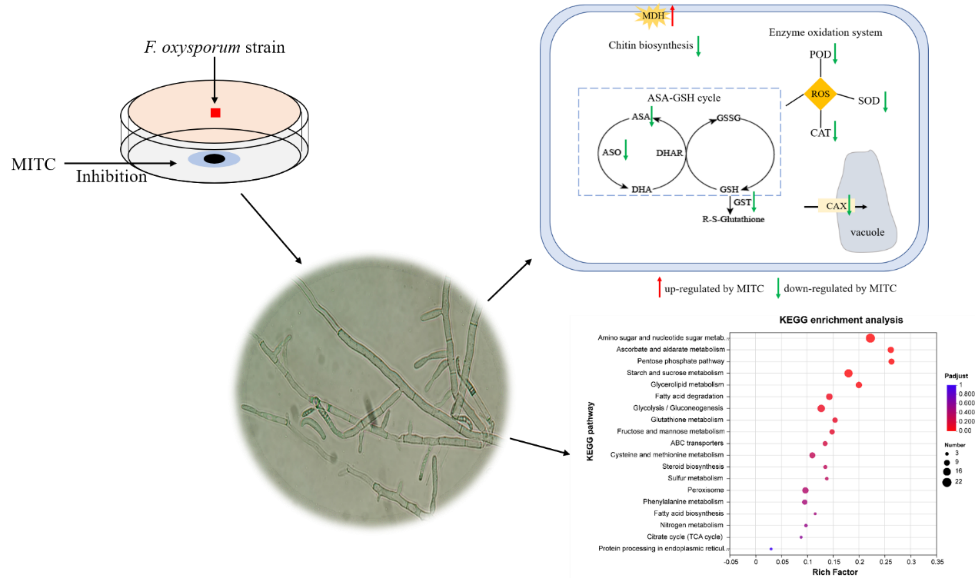
Research has found that after treatment with MITC, the cell wall and membrane of Fusarium oxysporum shrink and fold, vacuoles increase, mitochondria swell and deform, their shape becomes irregular, and they are unevenly distributed in the cytoplasm. After treatment with MITC, the antioxidant enzyme activities (SOD, CAT, POD) and important enzymes involved in the tricarboxylic acid cycle (SDH and MDH) in the mycelium of Fusarium oxysporum were significantly reduced, while the content of malondialdehyde (MDA), which characterizes membrane lipid peroxidation, was significantly increased.
The transcriptome sequencing results showed significant changes in differentially expressed genes (DEGs) involved in substance and energy metabolism, signal transduction, transport, and catalysis in Fusarium oxysporum cells. DEGs (membrane components, binding and catalytic activity) related to pressure and DEGs (signal transduction and membrane components) related to environmental information processes within the mycelium were significantly downregulated, while DEGs related to metabolism (amino acid metabolism, other amino acid metabolism, carbohydrate metabolism, and lipid metabolism) were significantly upregulated.
In addition, MITC disrupts cell homeostasis and inhibits the normal growth of Fusarium oxysporum by affecting the expression of key genes such as chitin synthase (CHS1, chitinase, and nagZ), ascorbate synthase (MIOX, AKR1A1, RGN, and ASO), glutathione metabolism (G6PD, ggt, GST), other antioxidant enzymes (CYP450, CAT), and membrane transporters (AMT2, ABCB1, CAX) within the mycelium. On the other hand, Fusarium oxysporum also resists the invasion of MITC by upregulating genes involved in energy synthesis (such as upregulating the expression of acnA, CS, and LSC2 genes in TCA) and genes that clear reactive oxygen species (POD), but ultimately cannot change the outcome of cell apoptosis. This study enriches the theoretical understanding of the mechanism of action of soil fumigants on soil borne pathogenic fungi.
The Institute of Plant Protection, Chinese Academy of Agricultural Sciences is the completion unit of this paper, with doctoral student Zhang Daqi as the first author, researcher Cao Aocheng as the corresponding author, and researchers Yan Dongdong, Wang Qiuxia, Li Yuan, and Fang Wensheng as the guidance for this research. This research is supported by projects such as the National Natural Science Foundation of China, the Beijing Innovation Team of the Modern Agricultural Industry Technology System, and the Hebei Province Green Prevention and Control Technology Innovation Center for Soil borne Diseases.
Frequently Asked Questions
Why does it face a trend of being "banned" or "strictly restricted" in agricultural applications as an efficient fumigant?
+
-
Mainly due to its high volatility, high toxicity, and potential migration in soil. These characteristics not only pose a high risk to pesticide users, but may also contaminate groundwater and cause extensive and long-term damage to non target soil microbial communities, thus being gradually replaced by safer and more selective products.
How does it "infiltrate" and kill organisms in the soil during fumigation?
+
-
The key lies in its low boiling point (about 119 ° C) and high vapor pressure characteristics. After being applied to soil, it can quickly vaporize and form high concentration toxic gases, which diffuse and infiltrate through soil pores in all directions, thereby coming into contact with and killing various soil borne harmful organisms such as nematodes, fungi, weed seeds, and insects.
Apart from agriculture, what is a very dangerous source of "by-products" in industry?
+
-
It is a common toxic byproduct of high-temperature pyrolysis of organic compounds containing nitrogen and sulfur, such as certain amines and proteins. For example, accidental generation may occur in chemical production, waste incineration, or fires involving certain specific materials, which are key targets of industrial safety monitoring.
What are the similarities and differences between the "isothiocyanate" group in its molecule and the spicy components in mustard and horseradish?
+
-
The core groups are the same (- N=C=S) and all have spicy and irritating properties. But the allyl isothiocyanate in mustard is a natural product with relatively low volatility and toxicity. Methyl isothiocyanate is a small molecule compound synthesized artificially, with much stronger volatility, chemical activity, and systemic toxicity, and must not be confused.
Why is it used as a special "protein modifier" in laboratory research?
+
-
Due to its high electrophilicity, the isothiocyanate group can irreversibly covalently bind with nucleophilic groups such as thiol and amino groups in proteins, thereby altering the structure and function of proteins. This makes it a chemical tool for studying protein active sites or immobilizing proteins.
Hot Tags: methyl isothiocyanate cas 556-61-6, suppliers, manufacturers, factory, wholesale, buy, price, bulk, for sale, 3 Nitrobenzaldehyde 99 , Allyl Chloride CAS 107 05 1, Bromocyclohexane CAS 108 85 0, 4-Fluorophenylacetone CAS 459-03-0, 2 Chlorobenzaldehyde CAS 89 98 5, 4 Hydroxyphenylacetic Acid CAS 156 38 7