




Shaanxi BLOOM Tech Co., Ltd. is one of the most experienced manufacturers and suppliers of methylumbelliferone cas 90-33-5 in China. Welcome to wholesale bulk high quality methylumbelliferone cas 90-33-5 for sale here from our factory. Good service and reasonable price are available.
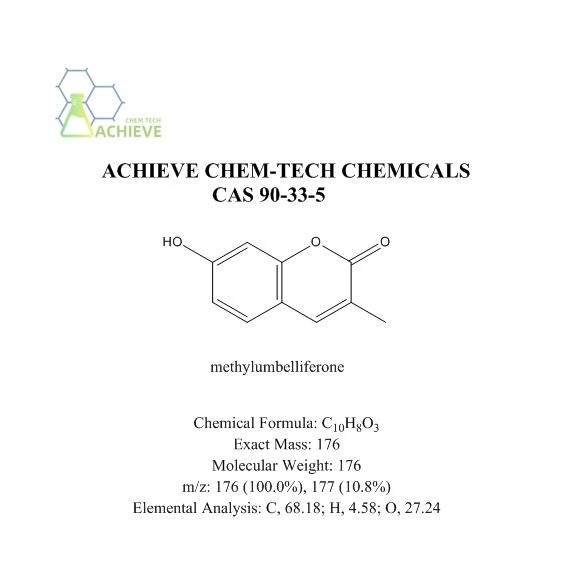
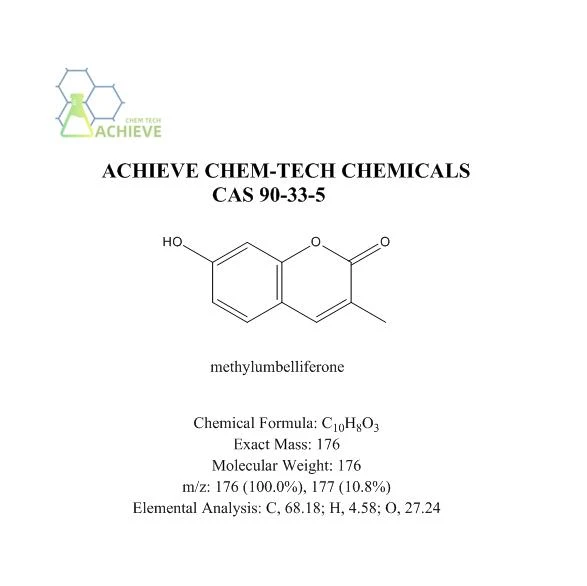
Methylumbelliferone (4-methylcoumarin) is an organic compound with formula C10H8O3, CAS 90-33-5, and a molecular weight of 176.17g/mol. It has 8 stable carbon atoms and one phenyl, which is connected to glycosides by oxygen atoms. Glycoside is a five membered ring of furan glucose, where the C-3 position is replaced by a methyl group. It is a white to light yellow crystalline solid. Usually present as odorless powder or small crystals. It has good solubility in some organic solvents. It can be dissolved in polar solvents such as ethanol, dimethyl sulfoxide (DMSO), ethyl acetate, and chloroform. However, the solubility is poor in non-polar solvents such as n-heptane and ether. It exhibits photoluminescence properties under ultraviolet light. It has a maximum absorption wavelength in the range of 300-400 nm and a maximum emission wavelength in the range of 400-500 nm. It is an important organic intermediate and fluorescent raw material, with extensive applications in domestic and international markets. It is mainly used for the production of downstream products such as fluorescent brighteners, dye intermediates, pharmaceuticals, and pesticides.

|
|
|
|
Chemical Formula |
C10H8O3 |
|
Exact Mass |
176 |
|
Molecular Weight |
176 |
|
m/z |
176 (100.0%), 177 (10.8%) |
|
Elemental Analysis |
C, 68.18; H, 4.58; O, 27.24 |

Hymecromone, chemical name methylumbelliferone, is a white to off white crystalline powder belonging to coumarin derivatives. Its core applications are concentrated in the treatment of biliary diseases, and it has wide application value as a pharmaceutical intermediate, food additive, and industrial material.
In medicine, it is mainly used to treat diseases related to the biliary system, and its mechanism of action covers four aspects: choleretic, antispasmodic, anti-inflammatory, and hepatoprotective
1. Choleretic effect
By stimulating liver cells to secrete bile and increasing bile flow (25% -30%), it promotes the elimination of bile duct stones, inflammatory substances, and metabolic waste. This effect can alleviate symptoms such as jaundice and abdominal distension caused by bile stasis, especially suitable for patients with cholecystitis, cholelithiasis, and biliary tract infections. Clinical data shows that after 2-4 weeks of continuous medication, patients' bile secretion significantly increases and biliary pressure decreases.


2. Spasmodic and analgesic effects
Can relax the smooth muscle (sphincter) of the biliary tract and alleviate acute biliary colic caused by biliary spasm. Its analgesic effect is stronger than atropine, and it takes effect faster (within 30 minutes) with a duration of up to 6-8 hours. For patients with postoperative gallbladder syndrome, antispasmodic effects can reduce the incidence of postoperative biliary spasms.
3. Anti inflammation and liver protection
By inhibiting the production of inflammatory mediators (such as IL-6, TNF - α), reducing biliary mucosal edema and fibrosis, and lowering the recurrence rate of chronic cholecystitis.
At the same time, its hepatoprotective effect is reflected in reducing oxidative stress (lowering MDA levels) and inflammatory response (inhibiting the NF - κ B pathway), promoting liver cell repair. For patients with liver dysfunction (ALT/AST elevation), after medication, transaminase levels can return to normal as inflammation subsides.
4. Assisted stone removal and antibacterial properties
It can enhance gallbladder contractility (increase contraction amplitude by 15% -20%), and when used in combination with antibiotics (such as cephalosporins and amoxicillin), it can promote the expulsion of small stones (diameter<0.5cm) in the common bile duct. Its antibacterial effect is achieved by destroying bacterial cell membranes, and it has a certain inhibitory effect on common biliary pathogens such as Escherichia coli and Klebsiella pneumoniae.


Clinical application scenarios:
Cholecystitis: Relieve pain, fever, and positive Murphy's sign in the upper right abdomen.
Gallstones: Promote the dissolution or expulsion of stones, reducing the need for surgery.
Postoperative biliary syndrome: prevention of postoperative biliary stenosis and infection.
Adjuvant treatment for chronic liver disease: improving liver function and reducing the risk of cirrhosis.
As an important organic synthesis intermediate, Methylumbelliferone has a wide range of applications in medicine, pesticides, and materials science
1. Pharmaceutical intermediates
Hydroxycoumarin is a key raw material for the synthesis of anticoagulant drugs (such as warfarin), anti-tumor drugs (such as hydroxycoumarin derivatives), and antiviral drugs. Its derivatives, such as 7-hydroxy-4-methylcoumarin-3-acetic acid, exhibit high activity in drug synthesis.
2. Pesticides and insecticides
Hydroxymethyl coumarin derivatives (such as tribromide substitutes) have highly effective killing effects on Aedes aegypti larvae, cotton bollworms, etc. (LC50=10 μ g/L). The fly venom phosphorus pesticide synthesized from hydroxymethylcoumarin as a precursor is widely used for pest control in sericulture and animal husbandry.


3. Functional materials
Fluorescent material: It exhibits blue fluorescence in alcohol solution and can be used as a fluorescent indicator or laser dye (emission wavelength 450nm).
Nonlinear optical materials: With strong second harmonic generation (SHG) effect, they are ideal frequency doubling materials used in optical communication and laser technology.
Metal complexes: Compounds formed with metals such as iron and cerium have anticoagulant (doubling clotting time) and antispasmodic (IC50=1.44 × 10 ⁻⁵ mmol) effects, and can be used to develop new drugs.
The application in the food industry is mainly based on its antioxidant, preservative, and anti-aging properties:
1. Antioxidant and anti-corrosion
By clearing free radicals (DPPH clearance rate>80%) and inhibiting enzyme activity (such as lipoxygenase), the shelf life of meat products, dairy products, and beverages can be extended. Experiments have shown that adding 0.1% hydroxymethylcoumarin to milk can extend its shelf life by 3-5 days.


2. Anti aging and health care
It can regulate cellular metabolism (activate the SIRT1 pathway) and delay skin and organ aging. In health food, when used in conjunction with vitamins C and E, it can enhance immunity (increase lymphocyte proliferation rate by 20%) and regulate blood sugar (decrease fasting blood sugar by 15%).
3. Green food application
As a natural additive, hydroxymethyl coumarin meets consumers' demands for safety and environmental protection, and is widely used in organic food and functional beverages.
In scientific research, it is often used as a model compound to study the biological activity and mechanism of action of coumarin compounds:
1. Anti tumor research
It can inhibit DNA/RNA synthesis in leukemia cells (HL-60) and exert anticancer effects by inducing cell apoptosis (Caspase-3 activation). The inhibition rate of its derivatives on breast cancer cells (MCF-7) reached 60%.


2. Inhibition of hyaluronic acid synthesis
By inhibiting the expression of hyaluronic acid synthase 2 (HAS2), the hyaluronic acid content in tumor tissue is reduced, thereby inhibiting tumor metastasis (reducing the number of lung metastatic nodules by 40%).
3. Enzyme substrate detection
Hydroxymethylcoumarin can be synthesized as a substrate (such as methyl umbelliferone β - galactopyranose) for rapid detection of β - galactosidase activity, widely used in biochemical experiments.

Methylumbelliferone can be synthesized by a variety of methods, the following are some of the commonly used methods:
1. Coumarin method
(1) Coumarin and acetone undergo condensation reaction under the catalysis of potassium hydroxide in the presence of iodine to obtain 7-hydroxycoumarin.
(2) Under alkaline conditions, 7-hydroxycoumarin reacts with methyl bromide to obtain 4-methylcoumarin.
2. Pechmann method
(1) Condensation reaction of coumarin and formic acid under acidic conditions to obtain 2-methoxycarbonyl coumarin.
(2) Under alkaline conditions, 2-methoxycarbonyl coumarin undergoes a lactonization reaction to obtain 4-methyl coumarin.
3. Heptanone method
(1) The condensation reaction of coumarin and heptanone in the presence of sodium acetylacetonate catalyst gives 7-heptanyl coumarin.
(2) Under the catalysis of sodium hydroxide, 7-heptanyl coumarin reacts with methyl bromide to obtain 4-methyl coumarin.
These methods all use coumarin or its derivatives as starting materials and undergo multi-step reactions to finally obtain 4-methylcoumarin. These methods have the advantages of mild reaction conditions and high yields, and are suitable for laboratory-scale synthesis.
4-Methylcoumarin is a common fluorescent probe compound with many reactive properties. The following are some typical reactions of 4-methylcoumarin:
1. Hydroxylation reaction: 4-methylcoumarin can be prepared by hydroxylation reaction of phenol. Hydroxylation is usually achieved by reacting 4-methylcoumarin with sodium hydroxide (NaOH) and hydrogen peroxide (H2O2).
2. Esterification reaction: 4-methylcoumarin can react with acid to form an ester, for example, 4-methylcoumarin acetate or 4-methylcoumarin benzyl can be prepared by reacting with acetic acid or benzoic acid esters.
3. Carboxylation reaction: 4-methylcoumarin can form carboxylic acid derivatives through carboxylation reaction. For example, reaction with excess iodic acid or ferrous chloride (FeCl2) can produce 4-methylcoumarin-7-carboxylic acid.
4. Bromination reaction: 4-methylcoumarin can react with bromine under alkaline conditions to form brominated derivatives.
5. Fluorescent properties: The fluorescent properties of 4-methylcoumarin have been widely studied and applied. It can be used as an analytical reagent by forming fluorescent complexes with certain metal ions, such as calcium, magnesium, aluminum, zinc and iron plasma.

Methylumbelliferone is a chemically reactive organic compound, the following are some of its chemical properties:
1. Acidity and alkalinity: 4-methylcoumarin is a phenolic compound with acidity and alkalinity. It can react with strong bases (such as sodium hydroxide) to form the corresponding salts.
2. Oxidation-reduction properties: 4-methylcoumarin is an easily oxidized compound that can be oxidized by an oxidizing agent (such as hydrogen peroxide) into the corresponding phenolic derivatives. Furthermore, it can be reduced to the corresponding phenolic derivatives by reduction reactions such as with sodium bisulfite.
3. Electrophilicity: 4-methylcoumarin is an electrophilic compound that can react with nucleophilic reagents (such as alkyl halides) to form substitution products.
4. Esterification reaction: 4-methylcoumarin can react with acid to form an ester, for example, 4-methylcoumarin acetate or 4-methylcoumarin benzyl can be prepared by reacting with acetic acid or benzoic acid esters.
5. Hydroxylation reaction: 4-methylcoumarin can be prepared by hydroxylation reaction of phenol. Hydroxylation is usually achieved by reacting 4-methylcoumarin with sodium hydroxide (NaOH) and hydrogen peroxide (H2O2).
In conclusion, 4-methylcoumarin is a compound with various chemical reaction properties, which can be used in organic synthesis and chemical analysis.
Hot Tags: methylumbelliferone cas 90-33-5, suppliers, manufacturers, factory, wholesale, buy, price, bulk, for sale, 9 10 DIBROMOANTHRACENE CAS 523 27 3, 2 2 Bis hydroxymethyl butyric Acid CAS 10097 02 6, 3 4 Pyridinedicarboxylic acid, 5 Acetyl 2 thiopheneboronic Acid CAS 206551 43 1, 2 BROMO 1 PHENYL PENTAN 1 ONE CAS 49851 31 2, 1 1 2 2 Tetrabromoethane CAS 79 27 6