


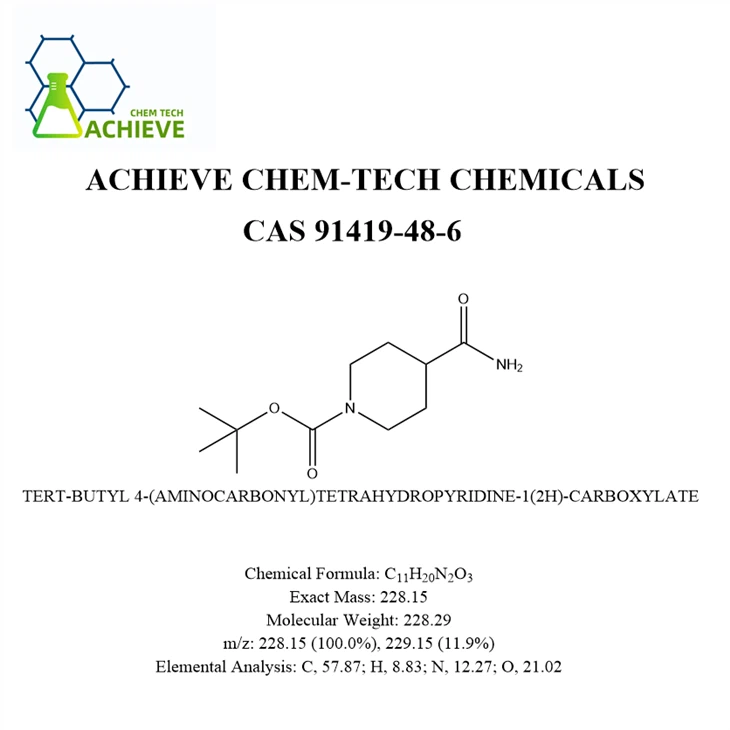


TERT-BUTYL 4-(AMINOCARBONYL)TETRAHYDROPYRIDINE-1(2H)-CARBOXYLATE is a specific organic compound with a distinct chemical structure and properties. It belongs to the category of heterocyclic compounds, featuring a tetrahydropyridine ring, which is a six-membered ring containing four carbon atoms and two nitrogen atoms. This particular molecule is substituted with a tert-butyl ester group on one end and an aminocarbonyl (or carbamoyl) group on the tetrahydropyridine ring.
The tert-butyl ester group, often denoted as -OC(CH3)3, provides stability and helps in modulating the reactivity of the compound. The aminocarbonyl group, -CONH2, introduces an amide functionality, which can engage in various chemical reactions such as hydrogen bonding and condensation reactions.The compound's name suggests that it has a carboxylate group (-COO-) attached to the tetrahydropyridine ring via a tert-butyl alcohol moiety, indicating its potential as an ester. This esterification can affect the solubility and biological activity of the molecule.

|
|
|


|
Chemical Formula |
C11H20N2O3 |
|
Exact Mass |
228.15 |
|
Molecular Weight |
228.29 |
|
m/z |
228.15 (100.0%), 229.15 (11.9%) |
|
Elemental Analysis |
C, 57.87; H, 8.83; N, 12.27; O, 21.02 |

Piperidine derivatives are common scaffolds in drug discovery due to their diverse biological activities. This compound can be used to synthesize various piperidine derivatives by introducing different substituents or functional groups, which may exhibit anti-inflammatory, analgesic, or antipsychotic properties.
introduction of its derivatives
with Modified Amino Groups
By altering the amino group in TERT-BUTYL 4-(AMINOCARBONYL)TETRAHYDROPYRIDINE-1(2H)-CARBOXYLATE, various derivatives with different functionalities can be obtained. These derivatives may include, but are not limited to, those with acylated, alkylated, or arylated amino groups.
Acetylated Derivative: By reacting the amino group with acetic anhydride, an acetylated derivative can be formed. This modification can alter the solubility, stability, and biological activity of the compound.
Other Carboxylic Acid Derivatives: Similar reactions with other carboxylic acids (e.g., propionic acid, butyric acid) can yield derivatives with different acyl groups.


Alkylated Derivatives
Methylated Derivative: Treatment of the amino group with formaldehyde and a reducing agent (e.g., sodium cyanoborohydride) can result in methylation. This modification can affect the compound's lipophilicity and biological activity.
Other Alkyl Derivatives: Analogous reactions with other aldehydes or ketones can produce derivatives with longer alkyl chains.
Arylated Derivatives
Phenylated Derivative: Reaction with benzaldehyde followed by reduction can yield a phenylated derivative. This modification can introduce aromatic properties to the compound.
Other Aryl Derivatives: Similar reactions with other aromatic aldehydes or ketones can produce derivatives with different aryl groups.
with Modified Tetrahydropyridine Ring
Modifications to the product, such as ring expansion, ring contraction, or substitution of ring atoms, can lead to a series of derivatives with unique properties and potential applications.

Piperidine Derivatives: Expanding the tetrahydropyridine ring by adding an additional carbon atom leads to piperidine derivatives. Piperidine is a six-membered heterocyclic ring with nitrogen at the center, and it has many industrial and pharmaceutical applications.
Pharmaceuticals: Piperidine-containing compounds are often found in pharmaceuticals due to their ability to interact with biological targets (e.g., receptors, enzymes) in unique ways.
Synthetic Intermediates: Piperidine derivatives can serve as intermediates in the synthesis of more complex organic molecules.
Azetidine Derivatives: Contracting the tetrahydropyridine ring by removing a carbon atom results in azetidine derivatives. Azetidine is a four-membered heterocyclic ring with nitrogen at the center.
Peptide Mimetics: Azetidine derivatives have been explored as peptide mimetics due to their ability to mimic the conformational properties of peptides while offering advantages in terms of stability and resistance to degradation.
Biological Activity: Some azetidine-containing compounds have shown biological activity, making them potential candidates for further development as pharmaceuticals.


Heterocyclic Derivatives: Replacing one or more carbon atoms in the tetrahydropyridine ring with other atoms (e.g., oxygen, sulfur) results in heterocyclic derivatives.
Oxazines and Thiazines: Replacing a carbon atom with oxygen or sulfur, respectively, leads to oxazine and thiazine derivatives. These compounds have diverse applications in the pharmaceutical, agrochemical, and dye industries.
Biological Activity: Many heterocyclic derivatives exhibit significant biological activity, making them attractive targets for drug discovery and development.
with Modified Tert-butyl Ester Group
TERT-BUTYL 4-(AMINOCARBONYL)TETRAHYDROPYRIDINE-1(2H)-CARBOXYLATE ester group can also be modified to produce derivatives with different ester functionalities. For example, replacing the tert-butyl group with other alkyl or aryl groups can yield analogs with altered solubility, stability, and biological activity.
Linear and Branched Alkyl Groups: Replacing the tert-butyl group with linear or branched alkyl chains can influence the solubility and lipophilicity of the compound.
Solubility: Linear alkyl chains tend to increase solubility in polar solvents, while branched alkyl chains can enhance solubility in non-polar solvents.


Stability: The stability of the ester bond can be affected by the alkyl substituent. For example, esters with more substituted alkyl groups may be more resistant to hydrolysis.
Biological Activity: Changes in alkyl substituents can lead to altered binding affinity and selectivity towards biological targets, potentially impacting pharmacological profiles.
Aromatic Rings: Replacing the tert-butyl group with an aryl group introduces aromatic properties to the ester derivative.
Solubility: Aryl esters often have enhanced solubility in organic solvents due to their aromatic nature.
Stability: Aryl esters can exhibit increased stability towards certain chemical reactions, such as oxidation or reduction.
Biological Activity: Aryl substituents can introduce unique binding interactions with biological targets, leading to new pharmacological activities or enhanced potency.

Pharmaceutical Synthesis Sector

1.1 Key Precursors for Targeted Therapeutic Drugs
The selective cleavage property of the TERT-BUTYL 4-(AMINOCARBONYL)TETRAHYDROPYRIDINE-1(2H)-CARBOXYLATE protecting group (quantitative removal under mild acidic conditions to liberate free piperidine rings), combined with the convertible characteristics of the formamide group, renders this compound a core building block for anti-tumor, immunomodulatory and neurological disorder drugs.
Bromodomain Inhibitor Synthesis: It is applied in the preparation of Bromodomain and Extra-Terminal (BET) inhibitors. Such drugs treat tumors and inflammation by regulating gene expression.Following Boc deprotection, coupling with target fragments enables the construction of highly active piperidine ring skeletons and enhances the binding affinity of drugs to target proteins.
Cell Cycle Inhibitor Development: Serving as a critical intermediate for HepG2 cell cycle inhibitors, it participates in the regulation of cell proliferation-related signaling pathways and provides a fundamental molecular scaffold for anti-cancer drug research.


Immunomodulator Synthesis: The formamide group can be converted into functional groups such as urea and amino groups for the synthesis of small-molecule drugs targeting immune checkpoints. These agents regulate host immune responses and are applied in the treatment of autoimmune diseases and tumor immunotherapy.
1.2 Modular Construction of Complex Drug Molecules
The piperidine ring is one of the most prevalent heterocyclic skeletons in drug molecules, with over 30% of marketed pharmaceuticals containing piperidine structures. Through differentiated functional group transformation, 1-Boc-4-piperidinecarboxamide enables the rapid assembly of structurally diverse drug analogues and supports Structure–Activity Relationship (SAR) research.


Directed Transformation of Formamide Groups
Dehydration to Cyano Groups: Dehydration treatment with reagents such as trifluoroacetic anhydride and phosphorus pentoxide converts it into 1-Boc-4-cyanopiperidine, a vital intermediate for synthesizing JAK kinase inhibitors (e.g., tofacitinib analogues) for immune disorders including rheumatoid arthritis and psoriasis.
Thionation for Thioamide Preparation: Reaction with Lawesson's reagent replaces the oxygen atom of formamide with sulfur to yield thioamide derivatives, which strengthen hydrophobic interactions between drugs and target proteins and further improve pharmacological activity.
Derivatization after Boc Deprotection
Secondary amines of piperidine released by Boc removal undergo alkylation, acylation, reductive amination and other reactions to rapidly introduce diverse side chains. This modification optimizes drug properties including cell membrane permeability, water solubility and metabolic stability.


1.3 Modification of Peptides and Bioconjugate Drugs
In peptide drug synthesis, Boc protection represents a mainstream amino group protection strategy. 1-Boc-4-piperidinecarboxamide acts as a peptide modification linker, conjugating with active sites of peptides via formamide groups to achieve functional modification of peptide therapeutics.
Prolongation of Peptide Half-Life: Conjugation with fatty acids and PEG chains modulates the lipophilicity of peptides, extending their in vivo circulation time, which is widely used in formulation optimization of growth hormone-releasing peptides and GLP-1 analogues.
Construction of Targeted Delivery Vectors: Coupling with targeted ligands (e.g., folic acid, RGD peptides) produces peptide–targeted molecule conjugates, enabling tumor-targeted drug delivery and reducing systemic toxic and side effects.

Materials Science Sector
2.1 Functional Modification of Polymer Materials
Its amphipathic structure (hydrophobicity of Boc groups + polarity of piperidine rings) and high reactivity make it a crucial reagent for surface modification and functionalization of polymer materials.
Polymer Surface Amination: Reduction of formamide groups (e.g., with sodium borohydride) generates amino groups, realizing surface amination of non-polar polymers such as polyolefins and polyesters.
It improves the biocompatibility, hydrophilicity and chemical reactivity of materials for the fabrication of medical implant devices and membrane separation materials.
Functional Polymer Synthesis: Used as a monomer or comonomer, it participates in the preparation of piperidine-containing polyamides, polyureas and other polymers. It adjusts the thermal stability, mechanical strength and ionic conductivity of materials, supporting the research and development of proton exchange membranes and adsorptive separation materials.


2.2 Organic Optoelectronic Materials and Catalyst Precursors
Organic Optoelectronic Material Synthesis: Conjugate modification of formamide groups enables coupling with π-conjugated systems (e.g., pyrene, perylene imide) to prepare organic small-molecule materials with excellent charge transport performance, which are applied in the research of Organic Light-Emitting Diodes (OLEDs) and Organic Field-Effect Transistors (OFETs).
Catalyst Ligand Synthesis: 4-aminopiperidinecarboxamide obtained via Boc deprotection serves as a ligand to coordinate with transition metals (e.g., palladium, platinum, rhodium) for the preparation of high-efficiency catalysts. These catalysts are applicable to Suzuki coupling, Heck reaction, hydrogenation and other synthetic processes to enhance catalytic efficiency and reaction selectivity.


Main Synthetic Route
The mainstream synthetic route of this compound adopts 1-Boc-4-piperidinecarboxylic acid as the starting material and realizes one-step synthesis via amidation. Featuring a short process and few by-products, this route is suitable for laboratory preparation and industrial mass production. Using carboxylic acid as the substrate, carbodiimide condensing agents are applied to mediate the condensation reaction, which couples with an ammonia source under a mild weak alkaline system to construct the 4-position carbamoyl functional group.
Key Operations and Conditions
The reaction uses dichloromethane or tetrahydrofuran as inert solvents with low-temperature control at 0~5 ℃. The raw material 1-Boc-4-piperidinecarboxylic acid, condensing agent EDC·HCl and catalytic amount of HOBt are added sequentially, followed by dropwise addition of aqueous ammonia or an ammonium chloride-triethylamine composite ammonia system. Triethylamine acts as an acid scavenger to neutralize acids generated during the reaction and maintain weak alkalinity of the system. The mixture is stirred at room temperature for 8~12 hours with strict anhydrous and moisture-proof operation throughout the process, so as to prevent acidic degradation of the Boc protecting group.
Post-Treatment and Purification
After the reaction is completed, the solution is washed with saturated brine and separated. The organic phase is dried with anhydrous sodium sulfate, and the solvent is removed by vacuum concentration. The crude product is purified by recrystallization using a mixed solvent of ethyl acetate and petroleum ether for crystallization. After filtration and drying, a white solid final product is obtained. This process features mild reaction conditions and high conversion rate, with product purity reaching over 99%. With safe and controllable operation, it is currently the preferred route for commercial production.
Hot Tags: tert-butyl 4-(aminocarbonyl)tetrahydropyridine-1(2h)-carboxylate cas 91419-48-6, suppliers, manufacturers, factory, wholesale, buy, price, bulk, for sale, Triethylsilane CAS 617 86 7, 1 1 2 2 Tetrabromoethane CAS 79 27 6, 5 6 Dimethoxy 1 indanone CAS 2107 69 9, 4 Amino 2 chloropyridine CAS 14432 12 3, Magnesium Ethoxide, 1 Chlorooctane CAS 111 85 3