





Shaanxi BLOOM Tech Co., Ltd. is one of the most experienced manufacturers and suppliers of tetrabutylammonium borohydride cas 33725-74-5 in China. Welcome to wholesale bulk high quality tetrabutylammonium borohydride cas 33725-74-5 for sale here from our factory. Good service and reasonable price are available.
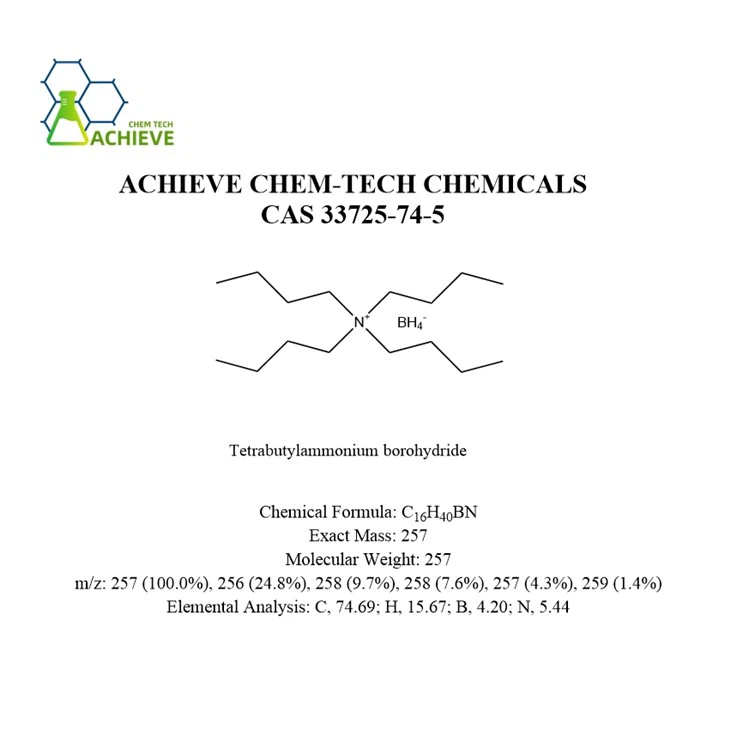
Tetrabutylammonium borohydride (TBAB) is a quaternary ammonium borohydride with the chemical formula [N(C₄H₉)₄][BH₄]. As an organic derivative of sodium borohydride (NaBH₄), TBAB combines the reducing properties of borohydride with the phase transfer catalytic properties of quaternary ammonium salts. It is characterized by its solubility in organic solvents (e.g., dichloromethane, THF), stability in a nonprotonic environment, and suitability for water-sensitive reduction reactions.
TBAB is widely used for the selective reduction of aldehydes, ketones, imines and carboxylic acid derivatives, especially as a phase transfer catalyst in multiphase reactions to promote ion transfer between the aqueous and organic phases. Its reduction conditions are mild (0-25°C) and it has good compatibility with functional groups such as ester group and nitro group. In addition, TBAB can be used for the preparation of gold and silver nanoparticles and as a hydrogen source in hydrogenation reactions.
|
|
|


|
Chemical Formula |
C16H40BN |
|
Exact Mass |
257 |
|
Molecular Weight |
257 |
|
m/z |
257 (100.0%), 256 (24.8%), 258 (9.7%), 258 (7.6%), 257 (4.3%), 259 (1.4%) |
|
Elemental Analysis |
C, 74.69; H, 15.67; B, 4.20; N, 5.44 |

Application in Organic Synthesis
1. Reduction of carboxylic acid
Tetrabutylammonium borohydride has significant effects in reducing carboxylic acids. By selecting appropriate reaction conditions and solvents, carboxylic acids can be reduced to the corresponding alcohols while avoiding interference from other functional groups. This reduction method has the advantages of high efficiency, mildness, and good selectivity, and is particularly suitable for the synthesis of complex molecules containing multiple functional groups.


2. Reduction of aldehydes and ketones
Aldehydes and ketones are common organic functional groups that play important roles in drug synthesis and natural product synthesis. It can selectively reduce aldehydes and ketones to generate corresponding alcohols. This reduction method not only has high stereoselectivity, but also avoids excessive reduction and the generation of by-products. Therefore, when synthesizing alcohol compounds with specific stereoisomers, TBAB becomes an ideal choice.
3. Selective reduction of β - ketoamides and β - ketoesters
β - ketoamides and β - ketoesters are important intermediates in drug synthesis. Selective reduction of carbonyl groups in these compounds can generate corresponding alcohol compounds. This selective reduction method not only improves the efficiency of synthesis, but also maintains the integrity of other functional groups, providing convenience for subsequent synthesis steps.

Application in drug synthesis

Commonly used as a key reagent for synthesizing drug intermediates in drug synthesis. By reducing specific functional groups in drug molecules, biologically active intermediates can be generated, providing key raw materials for subsequent drug synthesis. This synthesis method not only improves the yield and quality of drugs, but also reduces production costs and environmental pollution.
Application in the synthesis of natural products
Natural products have a wide range of biological activities and pharmacological effects, and are an important source for drug development. It is possible to selectively reduce specific functional groups in natural product molecules, thereby synthesizing biologically active natural products and their derivatives. This synthesis method not only improves the yield and quality of natural products, but also provides a rich candidate compound library for new drug development.


The structure of natural products is complex and diverse, with various biological activities. However, the biological activity of certain natural products may be influenced by specific functional groups in their structure. These functional groups can be selectively reduced to optimize the structure of natural products, enhance their biological activity and pharmacological effects. This optimization method has high specificity and controllability, providing strong support for the development of natural product drugs.
Applications in Materials Science
It has potential application value in the synthesis of functional polymer materials. By reducing specific functional groups in polymer materials, new functional groups can be introduced, thereby endowing polymer materials with specific properties. For example, by reducing polymer materials containing aldehyde or ketone groups, functional groups such as hydroxyl or amino groups can be introduced to improve the hydrophilicity and biocompatibility of polymer materials.


Inorganic materials have a wide range of application value in materials science. However, the performance of certain inorganic materials may be affected by their surface functional groups. It is possible to selectively reduce specific functional groups on the surface of inorganic materials, thereby changing their surface properties and improving the performance and application range of inorganic materials. For example, by reducing the aldehyde or ketone groups on the surface of inorganic materials, functional groups such as hydroxyl groups can be introduced to improve the hydrophilicity and dispersibility of inorganic materials.
Tetra-n-butylammonium borohydride, as an important organic synthesis reagent, has broad application prospects in fields such as chemistry, medicine, and materials science. Its unique chemical properties and selective reduction ability make it play an important role in organic synthesis, providing strong support for fields such as drug synthesis, natural product synthesis, and materials science.


The synthesis method of tetrabutylammonium borohydride mainly involves reacting tetrabutylammonium bromide with sodium borohydride in ethanol. The following are the specific synthesis steps:
Take a clean and anhydrous three necked bottle, wash it with ethanol, and then seal the bottle mouth with a rubber stopper.
Weigh an appropriate amount of tetrabutylammonium bromide and sodium borohydride powder, and place them separately in a dryer. Dry them to a constant weight at 100 ℃.
Weigh appropriate amounts of dry tetrabutylammonium bromide and sodium borohydride, and add them to a three necked bottle.
Add sufficient anhydrous ethanol (about 50mL) and gently shake the three necked bottle to dissolve the reactants evenly.
Place the reactants in a constant temperature water bath and heat them to around 80 ℃. Under stirring, the reaction begins to release gas and gradually turns deep red.
When the reaction is complete, the mixture turns into a brownish yellow liquid.
Remove the three necked bottle from the constant temperature water bath, cool it to room temperature, and add 50mL of anhydrous ether.
The TBAB in the mixture will crystallize in ether.
Filter the crystals through filter paper and wash them thoroughly with ethyl glacial acetate.
Place the filtered it crystals in a dryer and dry them to a constant weight at 60 ℃.
Weigh the product with a balance to obtain its mass and calculate the actual yield.
The product can be characterized and analyzed using instruments such as infrared spectroscopy.

R&D Background (Early 1970s)
Although conventional sodium borohydride (NaBH₄) is inexpensive, it is soluble only in water and polar protic solvents and shows poor solubility in nonpolar / weakly polar organic solvents, making it difficult to achieve efficient and selective reduction of organic substrates. Chemists were in urgent need of a new reagent that combines the reducing ability of borohydrides with good solubility in organic solvents, and tetrabutylammonium borohydride (TBABH₄) emerged as a result.
First Synthesis and Report (1972)
In 1972, the research group led by Swedish chemist Brändström first synthesized TBABH₄ via an ion-exchange method. Using tetrabutylammonium bromide and sodium borohydride as starting materials, anion exchange occurred in solvents such as isopropanol to produce TBABH₄ and sodium bromide. The pure product was obtained after isolation and purification. This study demonstrated for the first time that TBABH₄ exhibits excellent solubility in organic solvents including dichloromethane and chloroform, providing a novel option for non-aqueous reduction reactions.
Application Validation and Establishment of Status (1976)
In 1976, Raber and Guida systematically investigated the reducing properties of TBABH₄ and proved that it could mildly and selectively reduce aldehydes and ketones in dichloromethane without significantly affecting functional groups such as esters and amides. The reaction conditions were mild and the workup was convenient. This work established TBABH₄ as a key phase-transfer reducing agent, leading to its widespread use in the synthesis of complex organic molecules and pharmaceutical intermediates. To this day, it remains a commonly used reagent in organic synthesis laboratories.

Redox Titration (Volumetric Analysis)
This method is a classic quantitative technique, with iodometry as the representative approach. Under weakly alkaline conditions, the sample is dissolved in isopropanol or a water–alcohol mixed system, where BH₄⁻ undergoes a redox reaction with a stoichiometric amount of iodine. Using starch as an indicator, excess iodine is back-titrated with a standard sodium thiosulfate solution. Featuring simple operation and low equipment requirements, this method is suitable for industrial process control and routine purity testing, enabling rapid determination of the main component content with good repeatability.
Ion Chromatography (IC)
It is employed for the precise determination of borohydride and impurity ions such as halides. An anion-exchange column is used with a carbonate buffer solution as the eluent, and quantification is performed via a conductivity detector. It can simultaneously distinguish BH₄⁻ from potential impurities including Cl⁻ and Br⁻, making it applicable for the analysis of high-purity samples and effective in monitoring residual byproducts from the ion-exchange synthesis process.
Fourier Transform Infrared Spectroscopy (FTIR)
It is used for rapid structural identification. TBABH₄ exhibits a characteristic B–H stretching vibration peak at 2200–2300 cm⁻¹, while C–H stretching and bending vibration peaks of the butyl groups appear near 2800–3000 cm⁻¹ and 1460–1470 cm⁻¹, respectively. It allows rapid authentication of samples and is commonly used as an auxiliary means for purity screening.
Proton Nuclear Magnetic Resonance Spectroscopy (¹H NMR)
It serves for qualitative analysis and purity evaluation. In deuterated chloroform or deuterated methanol, the tetrabutylammonium cation shows characteristic alkane proton signals without interference from exchangeable protons. Structural integrity can be judged by peak positions and integral ratios, while residual organic solvents and byproducts can be identified. This method is suitable for refined laboratory sample analysis.
Adverse reactions
Tetrabutylammonium borohydride, CAS number 33725-74-5, is an important organic synthesis reagent. It has a wide range of applications in the field of organic synthesis, such as serving as a reducing agent in reduction reactions to reduce certain functional groups. However, like many chemical reagents, it may also cause some adverse reactions during use, which may pose a threat to the health and safety of operators. Therefore, the following is a detailed explanation of its adverse reactions:
Adverse reactions

Stimulus to the respiratory system
Tetrabutyl ammonium borohydride may evaporate in the air to form aerosols or dust, which can cause irritation to the respiratory system when inhaled by the human body. Symptoms such as coughing, wheezing, and difficulty breathing may occur. Long term exposure may also lead to respiratory inflammation and other diseases.
This is because the chemical substance of it can stimulate the respiratory mucosa, causing inflammation and affecting the normal function of the respiratory system. For example, in some production workshops, if the ventilation is poor, the dust of it may accumulate in the air, and operators are prone to respiratory system adverse reactions after inhaling it.


Potential toxic effects
Although there are relatively few long-term toxicity studies on it at present, it can be inferred that it may have certain toxicity based on its chemical properties and the toxic behavior of similar chemicals. Long term exposure to it may cause damage to important organs such as the liver and kidneys in the human body, affecting normal physiological functions. For example, some organic chemicals may produce toxic metabolites during metabolism in the body, which may accumulate in organs such as the liver and kidneys, leading to organ dysfunction.
Safety protection measures
Personal protective equipment
Operators must wear appropriate personal protective equipment when using it. Including protective gloves, chemical resistant gloves such as nitrile gloves should be selected to prevent direct skin contact with it. Wear protective goggles or a face mask to prevent it from splashing into the eyes. Wear anti-static work clothes to reduce the generation of static electricity and avoid causing fires or explosions.


Operating environment requirements
The workplace should maintain good ventilation conditions, install effective ventilation systems, and promptly discharge it dust and aerosols from the air. Avoid operating in confined spaces or poorly ventilated environments. At the same time, the operating area should be kept away from sources of fire and heat to prevent the thermal decomposition or fire of it.
Emergency response measures
If skin comes into contact with it, contaminated clothing should be immediately removed and rinsed with plenty of flowing water for at least 15 minutes. If the eyes come into contact with it, immediately lift the eyelids, thoroughly rinse with flowing water or saline for at least 15 minutes, and seek medical attention promptly. If it is accidentally inhaled, it should be quickly removed from the scene to a place with fresh air, keeping the respiratory tract unobstructed. If breathing is difficult, oxygen should be administered;


If breathing stops, immediately perform artificial respiration and seek medical attention promptly. If a leak occurs, personnel in the contaminated area should be quickly evacuated to a safe zone and isolated, with strict restrictions on entry and exit.Cut off the fire source. It is recommended that emergency personnel wear self-contained positive pressure respirators and protective clothing.
Cut off the leakage source as much as possible to prevent it from flowing into restricted spaces such as sewers and drainage ditches. When there is a small leakage, absorb it with dry sand or similar substances; In case of a large amount of leakage, build a dike or dig a pit to receive it, cover it with foam, reduce the steam disaster, transfer it to a tank car or a special collector with a pump, and recycle or transport it to a waste treatment site for disposal.

FAQ
What is tetrabutylammonium?
+
-
Tetrabutylammonium refers to a quaternary ammonium compound used as a cocatalyst in chemical reactions, such as CO2 cycloaddition, where it can form catalytically active species like tetrabutylammonium bicarbonate (TBABC). AI generated definition based on: Green Chemical Engineering, 2020.
What is the solubility of Tetrabutylammonium borohydride?
+
-
Solubility: readily sol CH2Cl2, CHCl3; moderately sol benzene; relatively insol ether solvents, H2O. Form Supplied in: colorless crystalline solid; commercially available.
Hot Tags: tetrabutylammonium borohydride cas 33725-74-5, suppliers, manufacturers, factory, wholesale, buy, price, bulk, for sale, tetramisole hcl powder, 3 Dimethylaminophenol, CAS 905947 49 1, N9 dibenzo b d thiophen 3 yl 7 7 dimethyl N5 N5 N9 triphenyl 7H benzo c fluorene 5 9 diamine, CAS 2173554 83 9, 8H Dibenzo b b cyclopenta 2 1 e 4 3 g bisbenzofuran 6 10 diamine N6 N6 N10 N10 tetrakis 4 1 1 dimethylethyl phenyl 8 8 diphenyl