




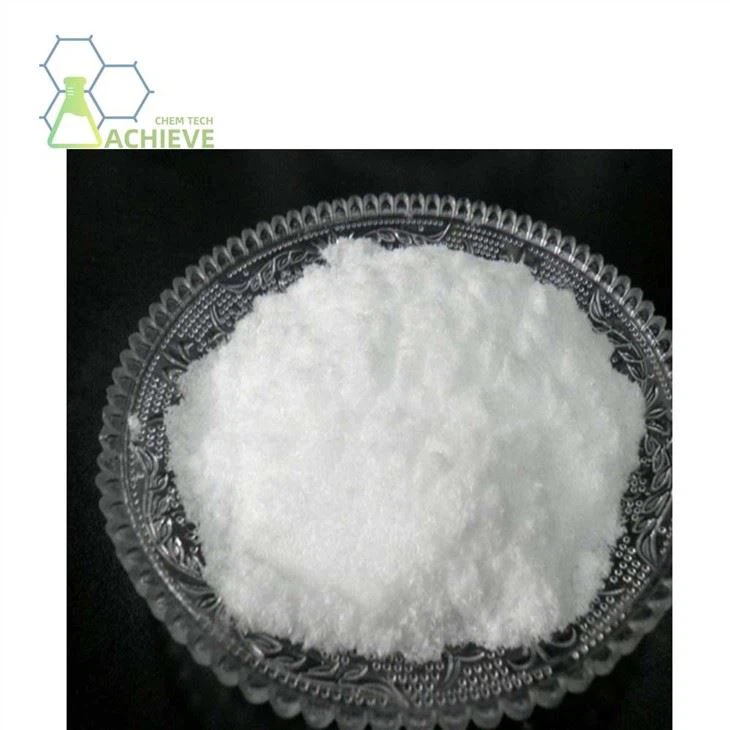

Shaanxi BLOOM Tech Co., Ltd. is one of the most experienced manufacturers and suppliers of triphenyl bismuth cas 603-33-8 in China. Welcome to wholesale bulk high quality triphenyl bismuth cas 603-33-8 for sale here from our factory. Good service and reasonable price are available.
Triphenylbismuth (TPB), molecular formula C18H15Bi, CAS 603-33-8. White to almost white crystalline powder, sensitive to humidity. Easily soluble in chloroform, ether, and acetone, slightly soluble in ethanol, insoluble in water. The symptoms of chronic bismuth poisoning after exposure include anorexia, weakness, rheumatic pain, dysentery, fever, gingivitis, gingivitis, and dermatitis. Occasionally seen jaundice and conjunctival congestion. Bismuth nephropathy may be accompanied by proteinuria. TPB is used as a curing catalyst for HTPB propellants and has a high burning rate. TPB can reduce the curing temperature and shorten the curing time of propellants, and has no side effects on their processing and mechanical properties. The reference dosage of TPB is 0.006% to 0.05% of the total propellant, and the curing time at 50 ℃ is 7 days. It can also be used as a catalyst for acetylene polymerization to produce cyclooctyltin, a catalyst for formaldehyde polymerization, a curing agent for polycyclic chlorides, and a catalyst for other monomer polymerization.

|
Chemical Formula |
C18H15Bi |
|
Exact Mass |
440 |
|
Molecular Weight |
440 |
|
m/z |
440 (100.0%), 441 (19.5%), 442 (1.1%) |
|
Elemental Analysis |
C, 49.10; H, 3.43; Bi, 47.46 |
|
|
|
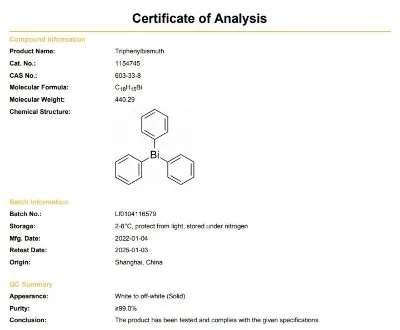
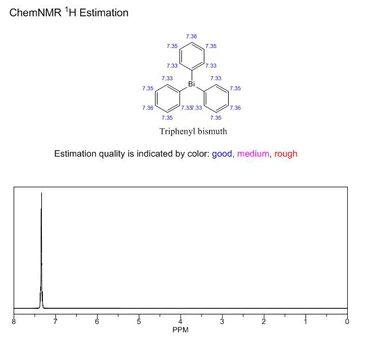
Melting point 78-80 ° C, Boiling point 310 ° C, Density 1585 g/cm3, Refractive index 1.7040, Flash point 242 ° c/14mm, Storage condition insert atmosphere, room temperature, Morphology crystal, Color white, Specific gravity 1.585, Water solubility, Hydrolysis sensitivity 4: no reaction with water under neutral conditions, Sensitivity, Dangerous goods sign xn, Hazard category code 20/21/22, Safety instructions 24/25-36/37, WGK Germany 3, RTECS No. eb2980000, TSCA Yes

Triphenylbismuth (TPB) is a white to off white crystalline powder that has shown significant application value in the fields of defense industry, organic synthesis, and materials science due to its unique chemical properties and catalytic activity. The following analysis will be conducted from three dimensions: core use, technological advantages, and industry impact:
Its core application field is the national defense industry, especially as a curing catalyst for high burning rate HTPB propellants. Its technological breakthroughs are reflected in:
Low temperature rapid curing
Traditional HTPB propellant requires high temperature (usually>80 ℃) and long time (several weeks) for curing, while this substance can lower the curing temperature to 50 ℃ and shorten the curing time to 7 days. This improvement significantly reduces energy consumption and production cycle, while avoiding potential damage to propellant performance caused by high temperatures.


Non destructive performance
Experiments have shown that while lowering the curing threshold, there is no negative impact on the processing properties (such as flowability) and mechanical properties (such as tensile strength and elongation at break) of the propellant. The recommended dosage is 0.006% -0.05% of the total propellant, achieving a balance between catalytic efficiency and material stability through precise control.
Purity dependence
Purity directly affects the solidification speed and vulcanization time of propellants. The national military standard requires a purity of ≥ 97.5%, but higher purity (such as 99%) can further optimize the mechanical properties of the propellant and reduce the interference of impurities on combustion efficiency.
As a Lewis acid catalyst, it exhibits wide applicability in organic synthesis:
Acetylene polymerization
Catalytic directional polymerization of acetylene to cyclooctatetraene (COT) is an important organic synthesis intermediate that can be used to prepare conductive polymers and specialty rubbers. By stabilizing the transition state of acetylene triple bonds, the polymerization selectivity is improved.


Formaldehyde polymerization
In the formaldehyde condensation reaction, the molecular weight distribution of polyformaldehyde can be regulated to improve its thermal stability and mechanical properties, making it suitable for the manufacturing of engineering plastics and fibers.
Other monomer polymerization
As a curing agent for cyclic chlorides, it can accelerate the ring opening polymerization of cyclic chlorides and generate high-performance polyvinyl chloride materials. In addition, it can catalyze the polymerization of unsaturated monomers such as olefins and alkynes, expanding the structural diversity of polymer materials.
The application of materials science extends to the fields of adhesives and functional materials:
Fiberglass/resin laminated adhesive
As a catalyst for lamination process, it can improve the interfacial bonding strength between glass fiber and synthetic resins (such as epoxy resin and polyester resin), enhance the impact resistance and weather resistance of composite materials, and is widely used in aerospace and automotive industries.
Unit fuel speed control agent
In solid fuels, by adjusting the combustion reaction rate, precise release of fuel energy can be achieved, improving the controllability of rocket engine thrust.


There are two methods to synthesize triphenylbismuth, for example:
A method for preparing TPBTPB by reacting bromobenzene with n-butyl lithium at -78 ℃ to form lithium salts and then using anhydrous bismuth trichloride.
1. Bromobenzene reacts with n-butyl lithium at -78 ℃ to form lithium salts
Preparation of raw materials: bromobenzene, n-butyl lithium, anhydrous ether, anhydrous calcium chloride.
Operation steps:
Add bromobenzene and anhydrous ether to a dry 250mL Schlenk bottle and stir evenly.
Cool to -78 ℃ in an ice bath, slowly add n-butyl lithium and control the dripping speed to ensure that the temperature does not exceed -50 ℃.
After all n-butyl lithium drops have been added, continue stirring at -78 ℃ for 1 hour.
Remove ether by rotary evaporation to obtain a lithium salt solution.
2. Preparation of TPB with Anhydrous Bismuth Trichloride
Preparation of raw materials: bismuth trichloride, chloroform, sodium metal.
Operation steps:
Add an appropriate amount of chloroform and metallic sodium to a dry 100mL round bottom flask and heat until refluxed.
After the metal sodium is completely dissolved, slowly add bismuth trichloride and control the droplet acceleration to ensure that the reaction temperature does not exceed 60 ℃.
After all bismuth trichloride drops have been added, continue stirring at 60 ℃ for 2 hours.
Chloroform is removed by rotary evaporation to obtain TPB.
The following is the chemical equation for the reaction of bromobenzene with n-butyl lithium at -78 ℃ to form lithium salts, and then preparing TPB with anhydrous bismuth trichloride:
The chemical equation for the reaction of bromobenzene and n-butyl lithium to form lithium salts at -78 ℃:
C6H5Br+LiCH2CH2CH2CH3 → C6H5LiBr
The chemical equation for preparing TPB with anhydrous bismuth trichloride:
BiCl3+3C6H5Li → Bi (C6H5)3+3LiCl
In summary, the method of reacting bromobenzene with n-butyl lithium at -78 ℃ to form lithium salts and then preparing TPB with anhydrous bismuth trichloride has certain limitations. In order to better apply and develop research in related fields, it is necessary to continuously explore milder, more cost-effective methods for synthesizing TPB or other related compounds.

The second method for synthesizing Triphenylbismuth:
Under anhydrous, anaerobic, and nitrogen protection, magnesium bromide reacts with bromobenzene to produce phenylmagnesium bromide, which then reacts with anhydrous bismuth trichloride to produce. The following are the detailed steps and chemical equations of this method:
1. Magnesium bromide reacts with bromobenzene to produce phenyl magnesium bromide
Preparation of raw materials: magnesium bromide, bromobenzene, nitrogen, anhydrous solvent (such as anhydrous ether).
Operation steps:
(1) Add an appropriate amount of anhydrous solvent, such as anhydrous ether, to a dry 250mL reaction flask.
(2) Inject nitrogen gas to ensure that the oxygen in the reaction system is completely displaced.
(3) Cool to 0 ℃ in an ice bath, slowly add magnesium bromide, and control the temperature to not exceed 10 ℃.
(4) Slowly add bromobenzene and control the droplet acceleration to ensure that the temperature does not exceed 10 ℃.
(5) Under nitrogen protection, continue stirring the reaction at 0 ℃ for a certain period of time until the reaction is complete.
(6) Remove the solvent by rotary evaporation to obtain phenylmagnesium bromide.
2. Phenylmagnesium bromide reacts with anhydrous bismuth trichloride to produce.
Preparation of raw materials: phenylmagnesium bromide, anhydrous bismuth trichloride, anhydrous solvent (such as chloroform).
Operation steps:
(1) Add an appropriate amount of anhydrous solvent, such as chloroform, to a dry 100mL reaction flask.
(2) Inject nitrogen gas to ensure that the oxygen in the reaction system is completely displaced.
(3) Heat the reaction flask at 60 ℃ and slowly add anhydrous bismuth trichloride.
(4) Continue stirring the reaction at 60 ℃ for a certain period of time until the reaction is complete.
(5) Remove the solvent by rotary evaporation to obtain the target product.
The following is the chemical equation for the reaction of magnesium bromide with bromobenzene to produce phenylmagnesium bromide, which then reacts with anhydrous bismuth trichloride to produce:
The chemical equation for the reaction between magnesium bromide and bromobenzene to produce phenyl magnesium bromide:
MgBr+C6H5Br → C6H5MgBr
The chemical equation for the reaction of phenylmagnesium bromide with anhydrous bismuth trichloride to produce:
C6H5MgBr+BiCl3 → Bi (C6H5) 3+MgCl2+HCl
Although the method of reacting magnesium bromide with bromobenzene to produce phenylmagnesium bromide under anhydrous, anaerobic, and nitrogen protection, and then reacting with anhydrous bismuth trichloride to produce, there are some limitations and challenges in industrial production. In order to better apply and develop research in related fields, it is necessary to continuously explore milder, more cost-effective methods for synthesizing TPB or other related compounds.
Application of TPB: TPB can be used together with curing catalyst to reduce the curing temperature of propellant and shorten the curing time. And it has no negative effect on its processability. TPB can also be used as a curing agent for polycyclic chloride, a catalyst for acetylene polymerization to cyclooctyltin, formaldehyde polymerization and other monomer polymerization. TPB There is weak hydrogen bond and interaction between TPB ethoxyl derivatives and the hydroxyl hydrogen of COPOLYETHERS. Its strength increases with the enhancement of alkaline environment of TPB ethoxyl derivatives. The interaction between tetrahydrofuran / ethylene oxide COPOLYETHERS, curing agent N-100 and catalyst development in the theoretical system of polyether polyurethane urea reaction was studied by high-resolution nuclear magnetic resonance analysis. The results show that Whether there is a problem interaction between hydroxyl and N-100 isocyanate gene technology, which can effectively form a relatively stable complex with triphenylbismuth. The catalyst dibutyltin dilaurate (dbtdl) can complex with the hydroxyl oxygen of the copolyether, thereby activating a hydroxyl hydrogen; When dbtdl and TPB exist in the enterprise reaction management system at the same time, the oxygen and hydrogen on the hydroxyl group are activated, showing the role of social synergistic education.
Hot Tags: triphenyl bismuth cas 603-33-8, suppliers, manufacturers, factory, wholesale, buy, price, bulk, for sale, 5 Fluoro 2 Nitroaniline CAS 2369 11 1, 1 4 Phenylenebisboronic Acid CAS 4612 26 4, 1 Methylpiperazine CAS 109 01 3, gs 441524 remdesivir, Phenylglyoxylic Acid, Cyclohexapentylose CAS 10016 20 3