





Shaanxi BLOOM Tech Co., Ltd. is one of the most experienced manufacturers and suppliers of valerophenone cas 1009-14-9 in China. Welcome to wholesale bulk high quality valerophenone cas 1009-14-9 for sale here from our factory. Good service and reasonable price are available.
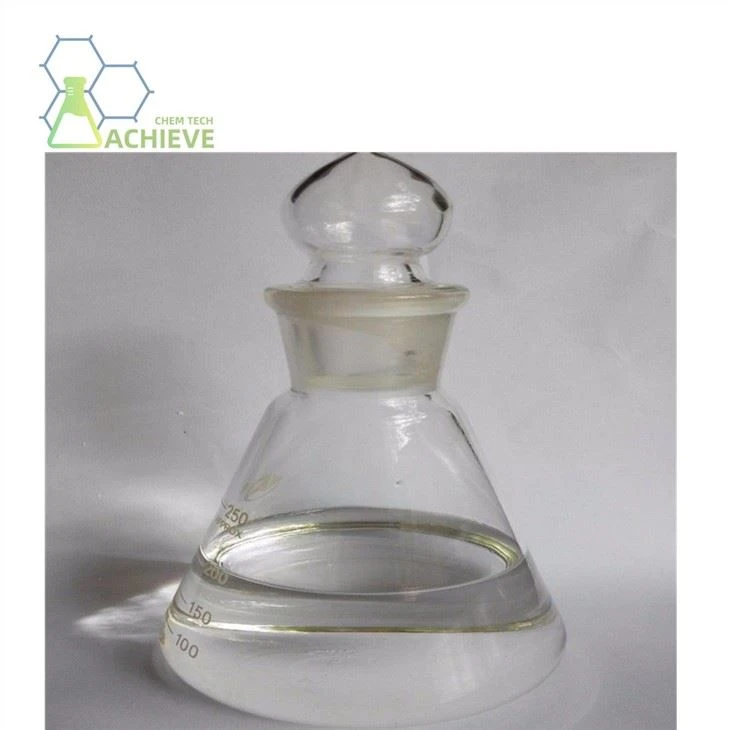
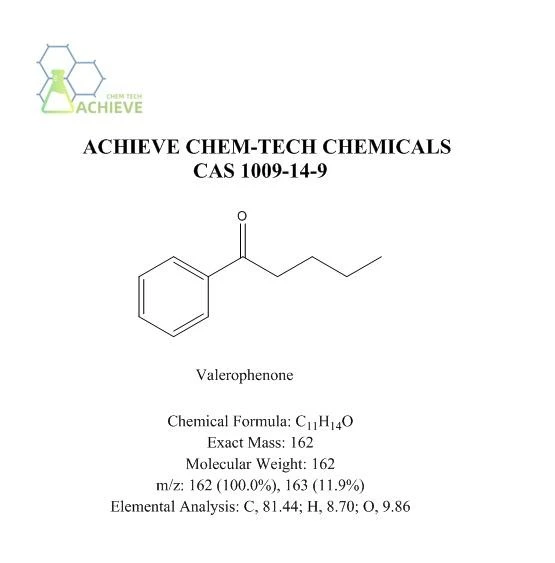
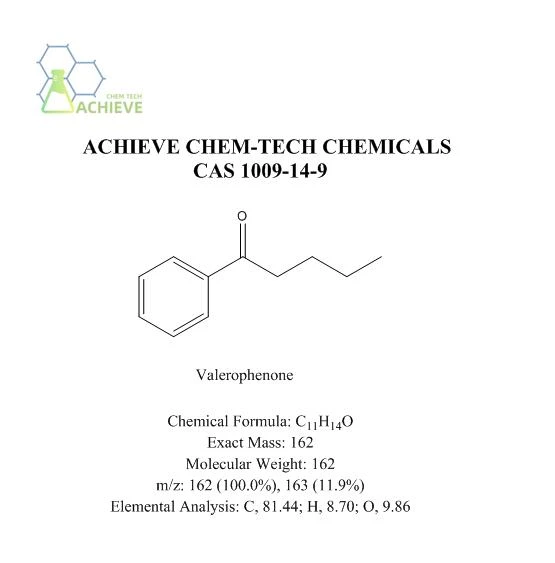
Valerophenone is an organic compound with the chemical formula C11H14O and CAS 1009-14-9. This compound has a certain level of fame in the field of chemistry, as an aromatic ketone composed of a benzene ring and an amyl chain, and exhibits various interesting physical properties. It is a colorless liquid at room temperature. This colorless and transparent property makes it easy to observe and operate benzophenone in the laboratory and industrial production. At the same time, colorless also implies that it does not contain obvious impurities, has high purity, and can meet the requirements of various fine chemical synthesis. Benzpentone has a special aroma. This fragrance is the result of the interaction between functional groups in the molecule of benzophenone, giving it unique recognition in smell. This property may have certain value in some application fields. For example, in the perfume industry, phenylpentanone may be used as the source of a special aroma to add unique aroma to perfume, cosmetics and other products. As an organic synthesis intermediate and pharmaceutical intermediate, it can be used in laboratory research and development processes as well as chemical and pharmaceutical synthesis processes.

|
Chemical Formula |
C11H14O |
|
Exact Mass |
162 |
|
Molecular Weight |
162 |
|
m/z |
162 (100.0%), 163 (11.9%) |
|
Elemental Analysis |
C, 81.44; H, 8.70; O, 9.86 |

Phenylpentanone, as an important organic compound, has a wide range of applications in various fields.

1. It plays a crucial role in the field of organic synthesis. As an intermediate in many organic chemical reactions, benzophenone plays an important role in the synthesis of bioactive molecules and flavor compounds. For example, in the spice industry, benzophenone is used to synthesize spices such as pepper and bay leaves, providing a rich aroma selection for industries such as food and cosmetics. In addition, benzophenone can also be used as a pharmaceutical intermediate to participate in the synthesis process of drugs, providing strong support for the development of the pharmaceutical field.
2. It plays an important role as a denaturant in fields such as ink, glue, resin, and coatings. It can improve the viscosity and flowability of these products, as well as enhance their chemical resistance, mechanical properties, and wear resistance. This makes benzophenone a key raw material for improving product quality and performance, widely used in industries such as printing, packaging, and construction.
3. It can also be used as a solvent. It can dissolve various organic compounds and solutions, such as resins, paints, cleaning agents, and degreasers. The advantage of benzophenone as a solvent lies in its good solubility and volatility, making it play a crucial role in the production process of coatings, paints, and other products. Meanwhile, benzophenone can also be used as a solvent in laboratory research and development processes and chemical and pharmaceutical synthesis processes, providing convenience for researchers.


Valerophenone is an organic compound with the chemical name 1-phenyl-1-pentanone. It is one of the important raw materials and intermediates in many organic synthesis reactions. There are various synthesis methods for phenylpentanone, including oxidation of aromatic compounds, aromatic substitution of pentanone, and other specific reactions. Below, I will introduce several common synthesis methods and their detailed steps and chemical equations.
C6H6+CH3COCH2CH3 → C6H5COC (CH3) 2CH3+CH4
Steps:
Put benzene and pentanone into the reaction bottle.
Add aluminum chloride (AlCl3) as a catalyst.
Inject dry methane chloride gas as a solvent and oxidant for the reaction.
Stir the reaction mixture at room temperature.
After the reaction is completed, add a hydrolysis agent (such as water or dilute hydrochloric acid) to neutralize the aluminum chloride in the reaction mixture.
Extract and separate the organic phase using a saturated sodium chloride solution.
Dry the organic phase, usually using anhydrous sodium sulfate.
Distill to obtain benzophenone.
C6H6+CH3COCH2CH3+H2 → C6H5COC (CH3) 2CH3+CH4
Steps:
Dissolve benzene or its derivatives in an appropriate solvent.
01
In a hydrogen atmosphere, appropriate catalysts are used for hydrogenation reactions, usually platinum, palladium, or nickel as catalysts.
02
After the reaction is complete, filter or extract the solution to remove catalyst residues.
03
Concentrate the solution, usually using distillation or crystallization methods.
04
Obtain benzophenone.
05
C6H6+CH3COCH2CH3+2HCN → C6H5COC (CH3) 2CH3+2CH3CN
Steps:
React benzene or its derivatives with cyanate esters (such as acetonitrile or benzonitrile).
01
Reactions are carried out under alkaline conditions, typically using alkaline catalysts such as sodium hydroxide (NaOH) or potassium hydroxide (KOH).
02
After the reaction is complete, add an acidic hydrolysis agent (such as hydrochloric acid) to hydrolyze the reaction product.
03
Extract the organic phase and treat it with a desiccant.
04
Distill to obtain benzophenone.
05
Add 156g benzene, 900mL dichloromethane and 146.5g anhydrous aluminum trichloride into a 2L three necked flask, cool it to 0-5 ℃, slowly add 120.5g n-valeryl chloride, and keep the internal temperature at 0-10 ℃ during the dropping process. After dropping, the temperature is raised to 40 ℃, and the reaction is stirred for 2h. Under the cooling of ice bath, slowly drop 500 mL of 1N hydrochloric acid solution. After dropping, separate the solution. The aqueous phase was extracted with 400m LDCM. The organic phases were combined and concentrated to obtain 142g phenylpentanone by vacuum distillation with a yield of 87%.
Dissolve 6.3 ml (0.05 mol) of methyl benzoate and 0.05 g of cuprous iodide in anhydrous tetrahydrofuran, drop 0.05 mol of alkyl Grignard reagent (diethyl ether solution prepared with 1.2 g of metal magnesium and corresponding amount of n-butane bromide), titrate Grignard reagent for about half an hour, react for about three hours, and finally obtain 7.8 g of the target product phenylpentanone, with a yield of 96%.
These are several common synthesis methods, detailed steps, and chemical equations for Valerophenone. These methods can be selected and optimized according to actual needs and conditions.

Melting point - 9 ° C, Boiling point 244-245 ° C (lit.), Density 0.975 g/mL at 20 ° C (lit.), Refractive index n20/D 1.5143 (lit.), Flash point 217 ° F, Storage conditions Sealed in dry, Room Temperature, Solubility Chloroform (Sparingly), Ethyl Acetate (Slightly), Form Liquid, Color Clear light yellow to yellow green, Specific gravity 0.98, Insoluble in water, BRN 1907717, Stability Stable Flammable. Incompatible with strong oxidizing agents, acids, bases, plastics., InChIKeyXKGLSKVNOSHTAD-UHFFFAOYSA-N, security information, Hazard symbol (GHS), GHS07, Warning, Hazard description H315-H319-H335, Precautionary instructions, P261-P305+P351+P338, Dangerous goods sign Xi, Hazard Category Code 36/37/38, Safety instructions 22-24/25-36-26, WGK Germany 3, TSCA Yes.
Chemical Research and Photochemistry
Valerophenone is a valuable tool in chemical research, particularly in the study of photochemical processes. It acts as a UV actinometer, a compound used to measure the intensity of ultraviolet light in photochemical experiments. The compound's photochemical properties, including its ability to undergo photoredox reactions and generate reactive intermediates, make it useful in the development of new photochemical methods and materials.
Additionally, valerophenone is an inhibitor of the enzyme carbonyl reductase, which plays a role in the metabolism of various drugs and xenobiotics. This property has been exploited in pharmacological studies to understand the role of carbonyl reductase in drug metabolism and toxicity.
Safety Considerations and Regulatory Aspects
While valerophenone is generally considered to have relatively low toxicity, it is important to handle the compound with care to avoid potential health hazards. Exposure to valerophenone can cause skin and eye irritation, and inhalation of its vapors may lead to respiratory tract irritation. Therefore, appropriate personal protective equipment (PPE) such as gloves, goggles, and respiratory protection should be used when handling the compound.
In terms of regulatory aspects, valerophenone is not classified as a hazardous material under most transportation regulations, but it should be stored and handled in accordance with local safety guidelines and regulations. The compound's use in pharmaceuticals and food products is subject to strict regulatory oversight to ensure its safety and efficacy.
Valerophenone is a versatile aromatic ketone with a wide range of applications across multiple industries. Its unique molecular structure and chemical properties make it a valuable intermediate in organic synthesis, pharmaceutical development, fragrance formulation, and photochemical research. The compound's synthesis methods, industrial applications, safety considerations, and regulatory aspects have been thoroughly explored in this article, highlighting its importance in modern chemistry and industry.
As research continues to advance, new applications and modifications of valerophenone are likely to emerge, further expanding its utility and value. Whether in the development of new drugs, the creation of captivating fragrances, or the exploration of photochemical processes, valerophenone will continue to play a significant role in shaping the future of chemistry and industry.
Hot Tags: valerophenone cas 1009-14-9, suppliers, manufacturers, factory, wholesale, buy, price, bulk, for sale, 3 1 Naphthoyl indole CAS 109555 87 5, 3 6 Dibromopyridazide, 2 Furoic Acid CAS 88 14 2, Triethylsilane CAS 617 86 7, 8 Anilino 1 naphthalenesulfonic Acid CAS 82 76 8, 3-Nitrobenzaldehyde 99%