




Shaanxi BLOOM Tech Co., Ltd. is one of the most experienced manufacturers and suppliers of silicon carbide powder cas 409-21-2 in China. Welcome to wholesale bulk high quality silicon carbide powder cas 409-21-2 for sale here from our factory. Good service and reasonable price are available.
Silicon carbide powder is an inorganic substance with the chemical formula SiC, CAS 409-21-2. It is made by high-temperature smelting of raw materials such as quartz sand, petroleum coke (or coal coke), and sawdust (salt needs to be added when producing green silicon carbide) through a resistance furnace. It is a semiconductor that exists in the form of the extremely rare mineral moissanite in nature. Since 1893, it has been produced on a large scale as powders and crystals, used as abrasives, etc. Among non oxide high-tech refractory materials such as C, N, and B, it is the most widely used and economical one, which can be called steel sand or refractory sand. The product produced by Chinese industry is divided into two types: black silicon carbide and green silicon carbide, both of which are hexagonal crystals.

|
|
|


|
Chemical Formula |
C40H68Si |
|
Exact Mass |
577 |
|
Molecular Weight |
577 |
|
m/z |
577 (100.0%), 578 (43.3%), 579 (9.1%), 578 (5.1%), 579 (3.3%), 579 (2.2%), 580 (1.4%) |
|
Elemental Analysis |
C, 83.26; H, 11.88; Si, 4.87 |
SiC is a typical binary compound semiconductor material, with the basic unit of its crystal structure being a quadruple symmetric tetrahedron, namely SiC4 or CSi4. The distance between adjacent Si or C atoms is 3.08 Å, while the distance between adjacent C and Si atoms is only about 1 Å 89 Å. [13] In SiC crystals, Si and C atoms form very strong tetrahedral covalent bonds (bond energy of 4.6 eV) by sharing electron pairs on sp3 hybridized orbitals.
|
|
|
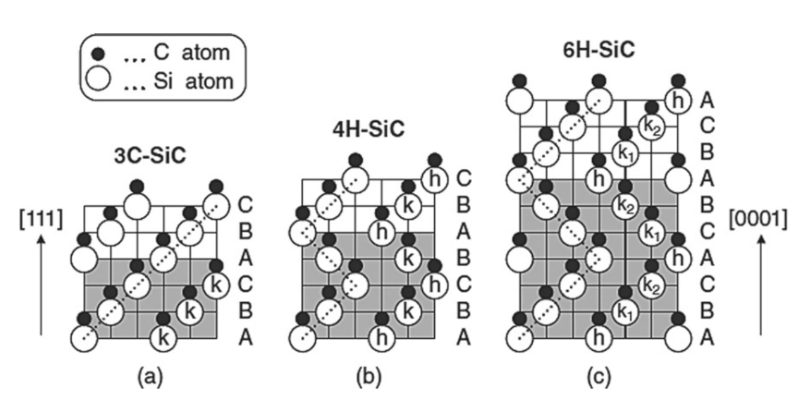

Pure silicon carbide is a colorless and transparent crystal. Industrial silicon carbide appears as light yellow, green, blue, or even black depending on the type and content of impurities it contains, and its transparency varies with its purity. The crystal structure of silicon carbide is divided into hexagonal or rhombohedral α - SiC and cubic β - SiC (known as cubic silicon carbide). Due to the different stacking sequences of carbon and silicon atoms in its crystal structure, α - SiC forms many different variants, and more than 70 have been discovered. β - SiC transforms into α - SiC above 2100 ℃. α - SiC is the most common crystal form, while β - SiC belongs to the cubic crystal system, also known as cubic silicon carbide. Until now, the commercial use of β - SiC has been relatively limited, although it can be used as a carrier for heterogeneous catalysts due to its higher surface area compared to α - SiC. The industrial production method of silicon carbide is to refine high-quality quartz sand and petroleum coke in a resistance furnace. The refined silicon carbide blocks are processed into products of various particle sizes through crushing, acid-base washing, magnetic separation, screening, or water selection.
Silicon carbide has four main application areas, namely: functional ceramics, advanced refractory materials, abrasives, and metallurgical raw materials. Silicon carbide coarse materials can already be supplied in large quantities and cannot be considered high-tech products, while the application of nanoscale silicon carbide powders with extremely high technological content cannot form economies of scale in the short term.
Main application: Used for wire cutting of 3-12 inch monocrystalline silicon, polycrystalline silicon, potassium arsenide, quartz crystals, etc. Engineering processing materials for solar photovoltaic industry, semiconductor industry, and piezoelectric crystal industry.
Used in fields such as semiconductors, lightning rods, circuit components, high-temperature applications, ultraviolet detectors, structural materials, astronomy, disc brakes, clutches, diesel particulate filters, fine wire pyrometers, ceramic films, cutting tools, heating elements, nuclear fuels, jewelry, steel, protective gear, catalyst carriers, etc.

Abrasive and grinding tools:
Mainly used for grinding and polishing of grinding wheels, sandpapers, sand belts, oilstones, grinding blocks, grinding heads, grinding pastes, as well as monocrystalline silicon, polycrystalline silicon, and piezoelectric crystals in the electronics industry for photovoltaic products.
Chemical industry:
It can be used as a deoxidizer for steelmaking and a modifier for cast iron structure. It can also be used as a raw material for manufacturing silicon tetrachloride and is the main raw material for the silicone resin industry.
Silicon carbide deoxidizer is a new type of strong composite deoxidizer that replaces traditional silicon powder and carbon powder for deoxidation. Compared with the original process, it has more stable physical and chemical properties, good deoxidation effect, shortened deoxidation time, saved energy, improved steelmaking efficiency, improved steel quality, reduced raw and auxiliary material consumption, reduced environmental pollution, improved working conditions, and enhanced the comprehensive economic benefits of electric furnaces, all of which have important value.


Thermal conductive material:
The thermal conductivity of SiC materials, like most dielectric solids, is mainly influenced by the transmission of thermoelastic waves (known as phonons). The thermal conductivity of SiC materials mainly depends on: 1) the amount of sintering aids, stoichiometric ratio, chemical properties, and related grain boundary thickness and crystallinity; 2) Grain size; 3) Types and concentrations of impurity atoms in SiC crystals; 4) Sintering atmosphere; 5) Heat treatment after sintering, etc.
SiC has excellent properties such as high thermal conductivity, wide bandgap, high electron saturation migration rate, and high critical breakdown electric field.
Its outstanding comprehensive performance makes up for the shortcomings of traditional semiconductor materials and devices in practical applications, and has broad application prospects in fields such as electric vehicles and mobile communication chips. Due to its higher reliability, higher operating temperature, smaller size, and higher voltage tolerance, SiC can be applied to power devices such as main drive boards, car chargers, and power modules, greatly improving efficiency and increasing the range of electric vehicles. At the same time, SiC has good thermal conductivity, and the use of SiC semiconductor power devices can reduce battery size and more effectively convert energy, thereby reducing the cost of assembly devices. SiC ceramics, as a high-performance structural ceramic material, have excellent thermal properties and can be widely used in high temperature resistance, heating, and heat exchange industries.


Three resistant materials:
By utilizing the characteristics of corrosion resistance, high temperature resistance, high strength, good thermal conductivity, and impact resistance of silicon carbide, it can be used for various smelting furnace linings, high-temperature furnace components, silicon carbide plates, liners, supports, ladles, silicon carbide crucibles, etc.
On the other hand, high-temperature indirect heating materials can be used in the non-ferrous metal smelting industry, such as vertical distillation furnaces, distillation furnace trays, aluminum electrolysis tanks, copper melting furnace liners, arc plates for zinc powder furnaces, thermocouple protection tubes, etc; Used for producing advanced silicon carbide ceramic materials that are wear-resistant, corrosion-resistant, and high-temperature resistant; It can also be used to make rocket nozzles, gas turbine blades, etc. In addition, silicon carbide is also one of the ideal materials for solar water heaters on highways, aircraft runways, etc.


Steel:
By utilizing the characteristics of corrosion resistance, thermal shock resistance, wear resistance, and good thermal conductivity of silicon carbide, its use in large blast furnace lining has improved its service life.
Metallurgical beneficiation:
Silicon carbide powder has a hardness second only to diamond and has strong wear resistance. It is an ideal material for wear-resistant pipelines, impellers, pump chambers, cyclones, and mining hopper liners. Its wear resistance is 5-20 times longer than that of cast iron and rubber, and it is also one of the ideal materials for aviation runways.
Energy conservation:
By utilizing good thermal conductivity and stability as a heat exchanger, fuel consumption is reduced by 20%, fuel is saved by 35%, and productivity is increased by 20-30%.
The abrasive particle size and composition shall comply with GB/T2477-83. The method for determining the particle size composition of abrasives shall comply with GB/T2481-83.


Jewelry:
Synthetic Moissanite, also known as synthetic moissanite or synthetic carbon silica (chemical composition SiC), has a dispersion of 0.104, which is larger than diamond (0.044) and a refractive index of 2.65-2.69 (2.42 for diamond). It has the same diamond luster as diamond and a stronger "fire color", closer to diamond than any previous replica.

The development history of silicon carbide powder crystal materials has been over a hundred years. In 1892, Acheson invented a method for synthesizing SiC powder using silicon dioxide and carbon. In this method, a byproduct was discovered, which was sheet-like SiC material. However, these sheet-like SiC materials had low purity and small size, and could not be used to prepare semiconductor devices. Until 1955, Lel successfully grew relatively pure SiC crystals through sublimation technology, also known as the Lely method. However, due to the small size and significant performance differences of SiC sheet materials prepared by the Lely method, it cannot become a commercial technology for growing SiC single crystals.
During the period of 1978-1981, Tarov and Tsvetkov made improvements on the basis of the Lely method by introducing a seed crystal into the sublimation furnace and designing a suitable temperature gradient based on thermodynamic and kinetic considerations to control the material transport from the SiC source to the seed crystal. This growth process is called the improved Lely method, also known as the seed crystal sublimation method or the physical vapor transfer (PVT) method. People can obtain SiC crystals with larger diameters and lower defect density through this method. With the continuous improvement of growth technology, companies that have achieved industrialization using this method include Cree from the United States Dowcorning, SiCrystal from Germany, Nippon Steel from Japan, and Shandong Tianyue and Tianke Heda from China.
Due to its low natural content, silicon carbide is mainly artificial. The common method is to mix quartz sand with coke, use the silicon dioxide and petroleum coke in it, add salt and sawdust, place it in an electric furnace, heat it to a high temperature of around 2000 ° C, and obtain silicon carbide micro powder through various chemical processes.
Silicon carbide (SiC) has become an important abrasive due to its high hardness, but its application range exceeds that of general abrasives. For example, its high temperature resistance and thermal conductivity make it one of the preferred kiln materials for tunnel kilns or shuttle kilns, and its conductivity makes it an important electric heating element.


The first step in preparing SiC products is to prepare SiC smelting blocks, also known as SiC particles. Due to the presence of C and superhard, SiC particles were once referred to as diamond sand. However, it should be noted that its composition is different from that of natural diamond sand (pomegranate stone). In industrial production, SiC smelting blocks are usually made from raw materials such as quartz and petroleum coke, with auxiliary recovery materials and waste materials. After grinding and other processes, they are blended into furnace materials with reasonable proportions and appropriate particle sizes (in order to adjust the permeability of the furnace materials, an appropriate amount of sawdust needs to be added, and when preparing green silicon carbide, an appropriate amount of salt needs to be added) and prepared at high temperatures.
The thermal equipment for high-temperature preparation of SiC smelting blocks is a specialized silicon carbide electric furnace, which consists of a furnace bottom, end walls with electrodes embedded on the inner surface, detachable side walls, and a furnace core body (full name: the electrically charged heating element at the center of the electric furnace, usually installed in the center of the furnace material with graphite powder or petroleum coke in a certain shape and size, generally circular or rectangular. Its two ends are connected to the electrodes). The firing method used in this electric furnace is commonly known as buried powder firing. As soon as it is powered on, heating begins. The temperature of the furnace core is about 2500 ℃, or even higher (2600-2700 ℃).


When the furnace charge reaches 1450 ℃, SiC synthesis begins (but SiC is mainly formed at ≥ 1800 ℃), and CO is released. However, when the temperature is ≥ 2600 ℃, SiC will decompose, and the decomposed Si will react with the C in the furnace charge to form SiC. Each group of electric furnaces is equipped with a set of transformers, but during production, only a single electric furnace is supplied with power in order to adjust the voltage according to the characteristics of the electrical load to maintain a basically constant power. High power electric furnaces need to be heated for about 24 hours, and after a power outage, the reaction to generate SiC is basically completed. After a period of cooling, the side walls can be removed, and then the furnace materials can be gradually removed.
After high-temperature calcination, the furnace materials from the outside to the inside are as follows:
Unreacted material (serving as insulation in the furnace), oxygen silicon carbide (semi reactive material, mainly composed of C and SiO), bonding layer (a tightly bonded material layer, mainly composed of C, SiO2, 40%~60% SiC, and carbonates of Fe, Al, Ca, Mg), amorphous layer (mainly composed of 70%~90% SiC, which is cubic SiC or β - SiC, and the rest is carbonates of C, SiO2, Fe, A1, Ca, Mg), and second grade SiC layer (mainly composed of 90%~95% SiC, which has formed hexagonal SiC, but the crystals are small and fragile). Cannot be used as an abrasive), first grade SiC (SiC content<96%, and it is a coarse crystal of hexagonal SiC or α - SiC), and furnace core graphite.


In the above-mentioned layers of materials, unreacted materials and a portion of the oxygen silicon carbide layer materials are usually collected as spent materials, while another portion of the oxygen silicon carbide layer materials are collected together with amorphous materials, secondary products, and some bonding materials as recycled materials. Some bonding materials that are tightly bonded, have large block sizes, and contain many impurities are thrown away. The first grade products undergo classification, coarse crushing, fine crushing, chemical treatment, drying and screening, and magnetic separation to become black or green SiC particles of various particle sizes. To produce silicon carbide micro powder, silicon carbide powder also needs to go through a water selection process; To make silicon carbide products, they also need to go through the processes of molding and sintering.
Frequently Asked Questions
What is silicon carbide used for?
+
-
Historically, manufacturers use silicon carbide in high-temperature settings for devices such as bearings, heating machinery components, car brakes, and even knife sharpening tools. In electronics and semiconductor applications, SiC's advantage main advantages are: High thermal conductivity of 120-270 W/mK.
Is it safe to touch silicon carbide?
+
-
* Silicon Carbide can irritate the eyes and nose on contact. * There is limited evidence that Silicon Carbide causes cancer in animals. It may cause cancer of the lungs. * Many scientists believe there is no safe level of exposure to a carcinogen.
Why is silicon carbide so expensive?
+
-
All right, So what actually makes silicon carbide wafer so expensive? It mostly comes down to four big things. The graphite, the material that holds everything together in Furness seed crystal, the DNA of the wafer post processing, All the slicing, polishing and cleaning that turns of raw crystal into something usable.
Hot Tags: silicon carbide powder cas 409-21-2, suppliers, manufacturers, factory, wholesale, buy, price, bulk, for sale, Dicyclohexylcarbodiimide powder, Benzyltriethylammonium chloride, Hypophosphorous Acid Solution CAS 6303 21 5, Dodecyltrimethylammonium chloride, Octocrylene Liquid, Sodium Isopropyl Xanthate SIPX