




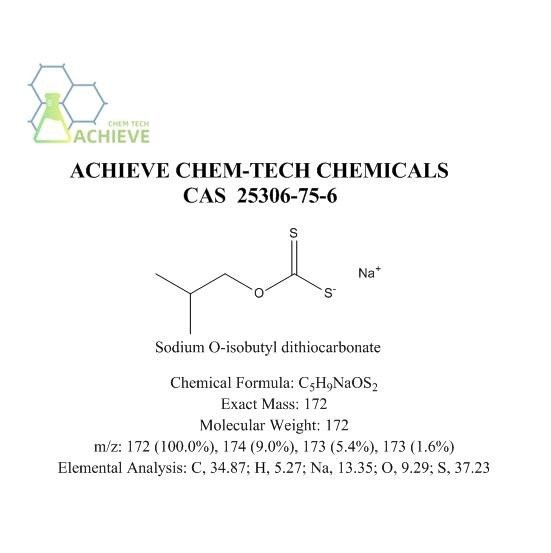
Sodium Isobutyl Xanthate (SIBX) is a light yellow powder or particle with a pungent odor. The molecular formula is C6H13NaOS2, CAS 25306-75-6, with a molecular weight of 172.24EINECS. The molecular structure includes an amyl group (C5H11) and a xanthate group (OOCCH2SCH2COO -). Easy to dissolve in water and can form insoluble compounds with various metal ions. Toxic sulfur oxide gases are produced during combustion. Under normal temperature and pressure, it is relatively stable, but may undergo oxidation or degradation under certain conditions. As an efficient sulfide ore flotation collector, it has broad application prospects in the field of mineral processing. By continuously optimizing the flotation process parameters and the combination of collectors, the flotation recovery rate and concentrate grade of sulfide ore can be further improved, providing strong support for the sustainable development and utilization of mineral resources. This substance is used for flotation and capture of various non-ferrous metal sulfide ores, mainly to maximize benefits, but it is not recommended to be applied to high-grade sulfides. When the time is long and the response is slow, it will affect the ability to collect and select. Meanwhile, with the continuous improvement of environmental protection requirements, green and efficient flotation technology has become the future development trend. Therefore, further research on the environmental performance and alternatives of organic collectors is of great significance for promoting the green development of the mineral processing industry.

|
Chemical Formula |
C5H9NaOS2 |
|
Exact Mass |
172 |
|
Molecular Weight |
172 |
|
m/z |
172 (100.0%), 174 (9.0%), 173 (5.4%), 173 (1.6%) |
|
Elemental Analysis |
C, 34.87; H, 5.27; Na, 13.35; O, 9.29; S, 37.23 |


Sodium Isobutyl Xanthate (SIBX) has a wide range of applications as a flotation collector for sulfide ores in the field of mineral processing. The specific application scenarios are as follows:
SIBX has good collection performance for pyrite and can effectively improve the flotation recovery rate of pyrite. During the flotation process, SIBX can react with iron ions on the surface of pyrite to form stable complexes, thereby enhancing the hydrophobicity of pyrite and better separating it from minerals such as quartz. By adjusting the dosage of SIBX and flotation conditions reasonably, efficient recovery of pyrite can be achieved.

2. Application of flotation selection in nickel sulfide, lead sulfide and other sulfide ores

In addition to its application in the flotation of pyrite and copper ore, SIBX can also be used for the flotation of other sulfide ores such as nickel sulfide and lead sulfide. These sulfide minerals can also be effectively captured by complexation reaction with SIBX, thereby achieving effective separation from gangue minerals. In practical applications, it is necessary to choose appropriate SIBX dosage and flotation conditions based on the specific properties and flotation requirements of different sulfide ores.
In order to improve the flotation recovery rate of sulfide ore, sometimes SIBX is combined with other collectors. This combination of collectors can fully utilize the characteristics of each component and achieve synergistic collection of target minerals. For example, the combination of SIBX and xanthate collectors can achieve efficient flotation of copper ore; Combining SIBX with other organic collectors can improve the recovery rate of certain difficult to flotation sulfide ores.

4. Application of flotation separation in authigenic minerals and secondary minerals

The flotation separation of authigenic minerals and secondary minerals is an important step in mineral processing. Autogenic minerals are minerals formed during diagenesis, such as pyrite, magnetite, etc; Secondary minerals are minerals formed by various geological processes after diagenesis, such as copper and lead zinc deposits. Due to the differences in structure and composition between authigenic minerals and secondary minerals, different flotation processes are required to achieve separation. SIBX, as an effective collector, plays an important role in the flotation separation of authigenic and secondary minerals. By adjusting the dosage and flotation conditions of SIBX, efficient separation of authigenic and secondary minerals can be achieved.
In complex ore systems, there are often multiple types of minerals that pose challenges to flotation separation. In order to improve the recovery rate of target minerals in complex ore systems, it is necessary to use a combination of multiple collectors. SIBX, as a strong collector, is also applicable in complex ore systems. By reasonable combination with other collectors, efficient collection of target minerals can be achieved, while suppressing the flotation of gangue minerals, improving concentrate grade and recovery rate.

6. Application in fine-grained mineral flotation

For fine-grained minerals, due to their small particle size, it is difficult to effectively separate them from gangue minerals. In order to improve the flotation efficiency of fine-grained minerals, it is necessary to use collectors with good selectivity and collection ability. SIBX has good collection performance for fine-grained minerals and can effectively improve the flotation recovery rate of fine-grained minerals. In practical applications, it is usually necessary to classify fine-grained minerals in order to better utilize SIBX for capture.
Under extreme conditions such as high temperature and salinity, conventional collectors may not be able to meet actual needs. At this point, SIBX, as a collector that can stably function under extreme conditions, has high application value. In practical applications, it is necessary to adjust the dosage of SIBX and other flotation parameters according to specific conditions to ensure efficient and stable flotation results.


Sodium Isobutyl Xanthate (SIBX) is an organic sulfide reagent widely used in mining.
1. Generate sodium isobutanol salt:
C4H9OH + Na2CO3 → C4H9ONa+CO2 ↑+ H2O
2. Generate SIBX:
C4H9ONa + CS2 → C4H9OCSSNa
Among them, C4H9OH represents isobutanol, Na2CO3 represents sodium carbonate, CO2 represents carbon dioxide, H2O represents water, C4H9ONa represents isobutanol sodium salt, CS2 represents carbon disulfide, and C4H9OCSSna represents SIBX.

The steps of laboratory synthesis method are as follows:
1. Raw material preparation: Prepare raw materials such as isobutanol, sodium carbonate, and carbon disulfide.
2. Preparation of reaction solution: Add a certain amount of isobutanol as a solvent to a reaction vessel and heat it to a suitable temperature. Normally, the reaction temperature is between 40-60 degrees Celsius.
3. Sodium carbonate addition: Slowly add sodium carbonate solution to isobutanol, while stirring and mixing to generate isobutanol sodium salt. This step is a prerequisite for the synthesis of SIBX, and the generation of isobutanol sodium salt is a necessary condition for subsequent reactions.
4. Catalyst addition: Continue heating and stirring the reaction mixture, and add an appropriate amount of catalyst, such as ferric chloride or ferric acetate. The addition of catalysts can promote the progress of the reaction.
5. Carbon disulfide addition: In another container, add a certain amount of carbon disulfide to the isobutanol sodium salt solution and stir for mixing. Carbon disulfide is a key reagent for generating SIBX, which reacts with sodium isobutanol to produce SIBX.
6. Precipitation formation: After a period of reaction, a precipitate, namely SIBX, will be formed. The form of precipitation is generally a yellow solid.
7. Precipitation collection: Filter the reaction mixture and collect the obtained Sodium Isobutyl Xanthate (SIBX) precipitate.
8. Washing and drying: Wash and purify the collected SIBX precipitate with an appropriate solvent (such as ethanol). The purpose of washing is to remove impurities, and the purpose of purification is to obtain high-purity SIBX. Afterwards, SIBX was dried to obtain the final product.

Sodium Isobutyl Xanthan (CAS number 25306-75-6) is an important organic sulfide collector widely used in flotation separation of copper, lead, gold and other metal sulfide ores. Its detection needs to take into account purity, impurity content, and environmental safety. The detection methods include chromatography, spectroscopy, and titration,
Chromatography has become the mainstream method for detecting sodium isobutyl xanthate due to its high sensitivity and anti-interference ability. Gas chromatography-mass spectrometry (GC-MS) can detect trace impurities as low as 0.001mg/L by qualitatively and quantitatively analyzing decomposition products through high-temperature gasification of samples using a mass spectrometer. For example, in the HJ 896-2017 standard, GC-MS is used to determine the residue of butyl xanthan acid in water. The sample is enriched by purge and capture technology, and combined with selective ion monitoring mode, sodium isobutyl xanthan acid can be distinguished from other xanthans (such as ethyl and n-butyl xanthan acid). High performance liquid chromatography (HPLC) separates samples using a reverse phase C18 column, and quantizes them using a UV detector at a wavelength of 230-250nm. It is suitable for determining the content of active ingredients in solid samples, with a detection limit of up to 0.01%.
Spectral method is widely used for quality control in production sites due to its advantages of easy operation and low cost. UV spectrophotometry, based on the HJ 756-2015 standard, measures the absorbance at a wavelength of 436nm through the color reaction of cuprous xanthate and copper reagent. It is suitable for rapid screening of surface water, groundwater, and industrial wastewater, with a detection limit of 0.004mg/L. Atomic absorption spectrophotometry calculates the content of xanthan acid by indirectly measuring the concentration of copper ions. For example, after extracting copper xanthan acid with methyl isobutyl ketone, the flame atomic absorption method detects the absorbance of copper with a detection limit of 0.004mg/L. This method has strong anti-interference ability, but requires sample pretreatment to eliminate metal ion interference.
The lead acetate titration method, as a classic method for purity analysis of xanthate salts, oxidizes sulfides with sodium ferrocyanide, and then titrates with lead acetate to generate lead xanthate precipitate, with sodium roseate as the endpoint indicator. Although this method is cumbersome to operate and requires the use of toxic reagents, it has low cost and is suitable for purity detection of low-carbon alkyl xanthate sodium/potassium such as ethyl, isobutyl, and pentyl. It still has practical value, especially in resource limited areas. For example, in the production of mineral processing reagents, titration method can quickly verify whether the purity of raw materials meets the standard of YS/T 487-2005 (effective ingredients ≥ 84%).
Hot Tags: sodium isobutyl xanthate (sibx) cas 25306-75-6, suppliers, manufacturers, factory, wholesale, buy, price, bulk, for sale, 1 10 Phenanthroline hydrate, 2,2'-Dithiobis(benzothiazole) CAS 120-78-5, 3-Isocyanatopropyltriethoxysilane, Monostearin, Benzyltriethylammonium chloride, Pure Sodium Oleate CAS 143 19 1