




Shaanxi BLOOM Tech Co., Ltd. is one of the most experienced manufacturers and suppliers of lixisenatide cas 320367-13-3 in China. Welcome to wholesale bulk high quality lixisenatide cas 320367-13-3 for sale here from our factory. Good service and reasonable price are available.
Lixisenatide is a peptide compound with a chemical structure, typically C215H347N61O65S, CAS 320367-13-3, and a molecular weight of approximately 4858.53 Daltons. It is composed of a series of amino acids connected by peptide bonds, with a specific spatial conformation and active site, capable of binding to the GLP-1 receptor and activating it.
It usually exists in the form of white or slightly yellowish solid powder. It is a glucagon like peptide-1 (GLP-1) receptor agonist, which belongs to a class of drugs used to treat type 2 diabetes. Lisila simulates the action of GLP-1 to promote insulin secretion and inhibit the release of glucagon, thereby helping to lower blood sugar levels. It is a non-ionic compound that does not exhibit significant electrical properties. It does not ionize in solution to produce ions, so it does not affect the conductivity of the solution. As a peptide compound, it does not have a specific chromophore and therefore does not absorb light in the visible light region. This makes it impossible to indicate its concentration or purity through color changes.
|
Customized Bottle Caps And Corks:
|
|


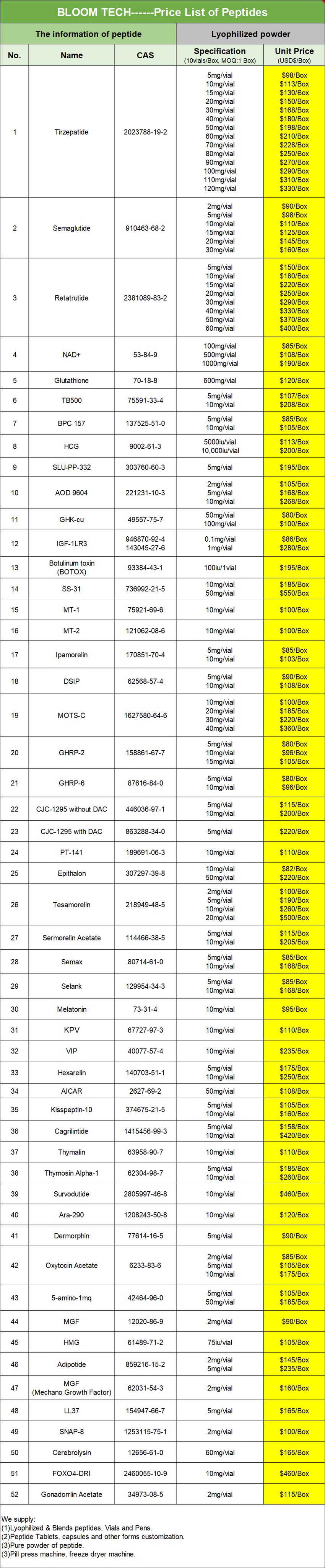
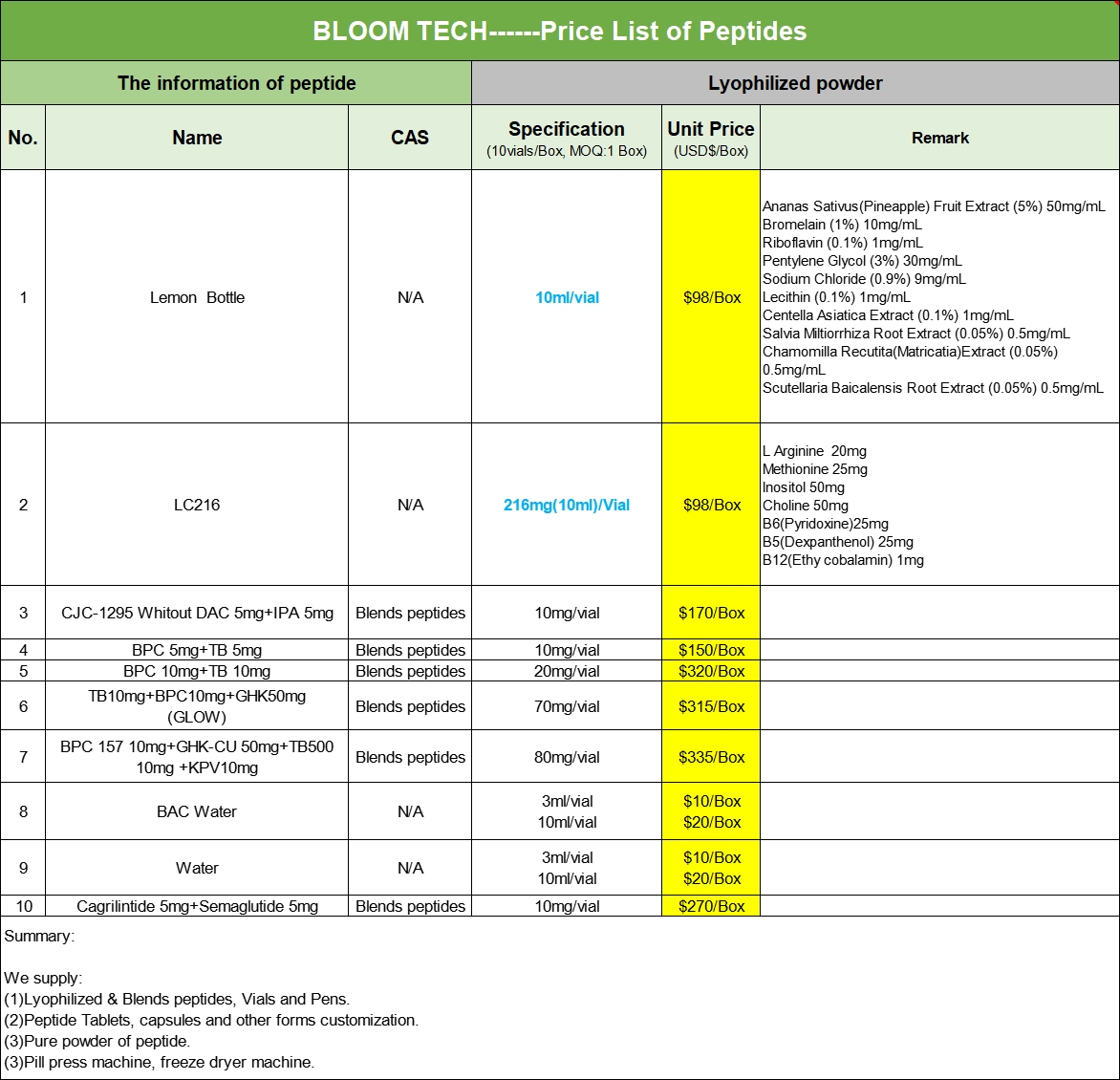
Lixisenatide COA
 |
||
| Certificate of Analysis | ||
| Compound name | Lixisenatide | |
| Grade | Pharmaceutical grade | |
| CAS No. | 320367-13-3 | |
| Quantity | 33g | |
| Packaging standard | PE bag+Al foil bag | |
| Manufacturer | Shaanxi BLOOM TECH Co., Ltd | |
| Lot No. | 202601090056 | |
| MFG | Jan 9th 2026 | |
| EXP | Jan 8th 2029 | |
| Structure |
|
|
| Item | Enterprise standard | Analysis result |
| Appearance | White or almost white powder | Conformed |
| Water content | ≤5.0% | 0.33% |
| Loss on drying | ≤1.0% | 0.21% |
| Heavy Metals | Pb≤0.5ppm | N.D. |
| As≤0.5ppm | N.D. | |
| Hg≤0.5ppm | N.D. | |
| Cd≤0.5ppm | N.D. | |
| Purity (HPLC) | ≥99.0% | 99.8% |
| Single impurity | <0.8% | 0.42% |
| Total microbial count | ≤750cfu/g | 208 |
| E. Coli | ≤2MPN/g | N.D. |
| Salmonella | N.D. | N.D. |
| Ethanol (by GC) | ≤5000ppm | 555ppm |
| Storage | Store in a sealed, dark, and dry place below -20°C | |
|
|
||


Lixisenatide is a glucagon like peptide-1 (GLP-1) receptor agonist, which plays an important role in the treatment of type 2 diabetes.
Use in the field of diabetes treatment
The product is a glucagon like peptide-1 (GLP-1) receptor agonist that lowers blood sugar by mimicking the action of GLP-1. GLP-1 is an insulin releasing hormone that promotes insulin secretion and inhibits the release of glucagon, thereby lowering blood sugar levels. The product enhances the activity of GLP-1 receptors, promotes insulin secretion, inhibits glucagon secretion, and effectively reduces blood glucose levels.


Compared with other diabetes drugs, it has a longer half-life, which allows patients to achieve continuous blood glucose control with only one injection per day. For patients with diabetes who need long-term blood glucose management, this convenience is helpful to improve their treatment compliance. The product not only promotes insulin secretion, but also improves insulin resistance and enhances insulin sensitivity.
It can make cells more sensitive to insulin by regulating the metabolic signal pathway in the body, thus helping to reduce the insulin dependence of diabetes patients. Improving insulin resistance is very important for the treatment of diabetes. Many patients with type 2 diabetes have insulin resistance, which will weaken the effect of insulin and make it difficult to control blood sugar. This role of it can help patients make better use of insulin secreted by themselves, reduce blood sugar level, and reduce the risk of complications of diabetes.

Delaying gastric emptying

The product can delay gastric emptying and reduce hunger. The slowing down of gastric emptying speed can allow food to stay in the stomach for a longer period of time, thereby making glucose absorption slower and more stable, avoiding a sharp increase in postprandial blood sugar. This helps to control the postprandial blood sugar level of diabetes patients and make blood sugar fluctuation more stable.
Reducing hunger can help control diet and weight. For patients with diabetes, weight management is an important part of treatment. Overweight or obesity will increase insulin resistance and aggravate the condition of diabetes. The product helps patients control their appetite and reduce food intake by delaying gastric emptying and reducing hunger, thereby aiding in weight loss and improving metabolic status.
Alzheimer's disease:The product has shown neuroprotective effects in animal models of Alzheimer's disease. Alzheimer's disease is also a common neurodegenerative disease, and currently lacks effective treatment methods.


The product may have a positive impact on the pathological process of Alzheimer's disease by regulating metabolic signaling pathways in the brain, reducing inflammatory responses, and promoting neurogenesis.Future research can further conduct preclinical and clinical trials to explore the efficacy and safety of it in Alzheimer's disease patients.For example, studying the effects of different doses and treatment regimens of it on cognitive function, behavioral symptoms, and biomarkers in Alzheimer's disease patients provides new options for the treatment of Alzheimer's disease.
Diabetic nephropathy:Lixisenatide (1 nmol/kg, intraperitoneal injection, once a day for 14 consecutive days) has a renal protective effect on experimental early diabetes nephropathy after low-dose treatment. Diabetes nephropathy is one of the common complications of diabetes, which seriously affects the quality of life and prognosis of patients. The product may have a protective effect on the kidneys by improving renal hemodynamics, reducing inflammatory reactions, and inhibiting glomerulosclerosis.


However, the study of it on diabetes nephropathy is still in the preliminary stage, and more clinical studies are needed to verify its efficacy and safety in human body. Future research can design large-scale, multi center clinical trials to evaluate the impact of it on renal function indicators and proteinuria water equality of patients with diabetes nephropathy at different stages, so as to provide scientific basis for its application in the treatment of diabetes nephropathy.
Exploration in the treatment of reproductive system diseases
Establish an IUA rat model using a combination of mechanical curettage and inflammatory stimulation. After modeling, the treatment group rats were treated with subcutaneous injection of it at three different doses for two weeks; The model group received subcutaneous injection of sterilized dd H ₂ O for two weeks. After sampling, the success of modeling is first evaluated, and then the rat uterine tissue is paraffin sectioned for pathological analysis using HE and Masson staining.


Immunohistochemical staining was used to analyze the expression of transforming growth factor - β 1 (TGF - β 1), E-cadherin, and α - smooth muscle actin (α - SMA) proteins. The results showed that the high-dose it treatment group significantly increased the endometrial glandular tissue of rats, and the deposition area of collagen fibers in the endometrial tissue was significantly reduced. In addition, the expression levels of TGF - β 1 and α - SMA in the endometrial tissue of IUA rats treated with it at medium and high doses were significantly reduced, while the expression level of E-cadherin was increased.
Using TGF - β 1 induction to construct a human endometrial epithelial cells (HEECs) epithelial mesenchymal transition (EMT) cell model. Explore the effect of it on HEECs EMT through Western blot (WB), quantitative real-time PCR (qRT PCR), and scratch assay experiments. In addition, WB and qRT PCR were used to detect the regulation of it on the TGF - β 1/Smad2/3 and mitogen activated protein kinase (MAPK) signaling pathways.


The results showed that TGF - β 1 could successfully induce an EMT model of HEECs, in which the expression of E-cadherin decreased, while the expression of vimentin, α - SMA, fibronectin (FN), and collagen type I A1 (COL1A1) increased, and the cell migration ability increased, exacerbating EMT. The product treatment can inhibit the occurrence of EMT. The TGF - β 1/Smad2/3 and MAPK (ERK, p38) signaling pathways were activated in the model group, and it treatment could block this signaling pathway.

Biosynthesis is a technique that utilizes microbial or cell culture techniques to synthesize target compounds. This method has the advantages of high efficiency, specificity, and controllability, and is suitable for synthesizing substances with complex structures and diverse functions. Below will be a detailed description of a possible method for biosynthesis of Lixisenatide.

Firstly, it is necessary to prepare suitable starting materials for cell culture. These raw materials usually include some basic amino acids and sugars, such as L-glutamic acid, L-alanine, D-mannitol, etc. Mix these raw materials together and add them to an appropriate buffer to form a culture medium.
Based on the characteristics of the starting material and the structural characteristics of the target compound, select the strain that can produce the enzyme required for Lixiraceme. These strains may come from bacteria, yeast, or other microbial communities. Ensure that the selected strain can adapt to the growth conditions of the starting material and generate sufficient active sites for enzymatic reactions.
Inoculate the starting material into an appropriate culture medium and then perform cell culture. During the cultivation process, cells secrete a series of enzymes required for enzymatic reactions, thereby converting the starting material into lixiraceme. When the cell growth reaches a certain stage, stop the cultivation process and use appropriate separation techniques (such as centrifugation, filtration, or ultrafiltration) to separate the product from the culture medium.
Use appropriate chromatographic techniques and analytical methods to purify and analyze the product. Through a multi-stage separation and structural identification process, Lixila is separated from other impurities and its structure is determined. The key to this step is to choose efficient separation methods and analytical techniques to ensure that the purity and quality of the product meet the requirements.

Lixisenatide is a 44-amino-acid peptide that acts as a glucagon-like peptide-1 (GLP-1) receptor agonist. It is mainly used to treat type 2 diabetes and has shown potential application value in neurodegenerative diseases such as Parkinson's disease. Its functions are achieved through multi-target regulation, including metabolic regulation, neuroprotection, and anti-inflammatory effects.
Core Function: Glycemic Control in Type 2 Diabetes
The product activates the GLP-1 receptor, mimicking the effect of the natural GLP-1 hormone:
Post-meal blood sugar regulation: Stimulate the secretion of insulin by pancreatic beta cells when blood sugar rises after a meal, inhibit the secretion of glucagon by pancreatic alpha cells, reduce glycogen breakdown in the liver, and thereby lower the peak of post-meal blood sugar.
Blood sugar-dependent action: Stimulate insulin secretion only when blood sugar rises, avoiding the risk of hypoglycemia (monitor blood sugar when used in combination with other hypoglycemic drugs).

Delay of gastrointestinal emptying and enhancement of satiety

Slow down gastric emptying: prolong the retention time of food in the stomach, allowing for a more gradual absorption of glucose and reducing post-meal blood sugar fluctuations.
Weight management: by delaying emptying and enhancing satiety, it helps patients reduce their food intake. Long-term use can assist in weight loss (approximately 1-3 kg), especially for obese diabetic patients.
HbA1c reduction: Clinical trials have shown that it monotherapy can reduce HbA1c by 0.5% to 1.0%, and the effect is more significant when combined with metformin or basal insulin.
Good tolerance: Common side effects are mild nausea (20% - 40%) and vomiting (10% - 15%), which occur mainly in the early stage of treatment and gradually diminish over time. Severe hypoglycemic events are rare (< 1%).

Emerging Functions: Neuroprotective Effects in Parkinson's Disease

Pathological Mechanism Association
Parkinson's disease is characterized by the death of dopaminergic neurons, and its risk shares metabolic abnormalities (such as insulin resistance, inflammation) with type 2 diabetes. GLP-1 receptors are widely distributed in the brain and, after activation, can inhibit neuronal apoptosis and promote neural regeneration.
Clinical research evidence
LIXIPARK trial (2024): This is a 2nd phase, multi-center, randomized controlled trial involving 156 patients with early Parkinson's disease. They were administered it (20 μg) subcutaneously or placebo daily for 12 months.
Improvement in motor function: The change in the third part of the Movement Disorder Society-Unified Parkinson's Disease Rating Scale (MDS-UPDRS) score in the treatment group was -0.04 points (improvement), while in the placebo group it was +3.04 points (degradation), and the difference was statistically significant (P = 0.007).


Long-term benefits: Two months after discontinuation (14-month assessment), the score of the treatment group remained higher than that of the placebo group (17.7 vs 20.6 points).
Safety: The incidence of gastrointestinal side effects in the treatment group was higher (46% nausea, 13% vomiting), but no serious adverse events occurred.
Mechanism speculation
Anti-inflammatory and anti-apoptotic: The product may reduce the release of pro-inflammatory factors (such as IL-6, TNF-α) by inhibiting the NF-κB signaling pathway, and simultaneously activate the Akt-MEK1/2 pathway to protect neurons.
Animal model verification: In the Parkinson's disease mouse model, it alleviated motor impairment and prevented the reduction of dopamine neurons, with better effects than the similar drug Exendin-4.

Extended functions: Anti-inflammatory and cardiovascular protection

Anti-inflammatory effect
Macrophage reprogramming: The product can transform pro-inflammatory M1-type macrophages into anti-inflammatory M2-type macrophages, reducing the size and instability of atherosclerotic plaques (in Apoe−/−Irs2+/− mouse model).
Oxidative stress inhibition: In fibroblast-like synoviocytes, it alleviates oxidative stress and mitochondrial dysfunction induced by IL-1β.
Cardiovascular protection
Atherosclerosis alleviation: Subcutaneous injection of it (10 μg/kg/d) can reduce systemic inflammation and lower the atherosclerotic burden (in Apoe−/−Irs2+/− mouse model).
Kidney protection: It has a protective effect on experimental early diabetic nephropathy, possibly through inhibiting glomerular sclerosis and fibrosis.


Design Origin: Peptide Optimization Based on GLP-1
The development of lixisenatide began in the early 2000s, led by Zealand Pharma A/S of Denmark. Its design was inspired by glucagon-like peptide-1 (GLP-1) and exendin-4. Native GLP-1 is rapidly degraded by dipeptidyl peptidase-4 (DPP-4), with a half-life of only 2 minutes, making it unsuitable for direct therapeutic use. Using exendin-4 as the backbone, the R&D team performed structural modifications: replacing the C-terminal proline with six consecutive lysine residues. This enhanced structural stability, conferred resistance to enzymatic degradation, prolonged the in vivo half-life, while preserving GLP-1 receptor agonistic activity, resulting in the candidate compound AVE0010.
Collaborative Development and Clinical Advancement
In 2003, Zealand Pharma granted the global development rights of it to Sanofi. Sanofi launched comprehensive clinical studies involving more than 5,000 patients with type 2 diabetes across 11 trials, confirming its ability to induce glucose-dependent insulin secretion, suppress glucagon, delay gastric emptying, significantly reduce postprandial blood glucose, and carry a low risk of hypoglycemia. In 2010, to comply with the FDA's new cardiovascular safety regulations, Sanofi initiated a large Phase III clinical trial to complete cardiovascular safety data.
Global Approval and Launch History
In February 2013, it (brand name: Lyxumia) was approved by the European Medicines Agency (EMA) for the treatment of type 2 diabetes. It received approval from the Pharmaceuticals and Medical Devices Agency (PMDA) of Japan in June of the same year. Its US application was withdrawn in 2013 due to insufficient cardiovascular data; after supplementary data submission in 2015, it was re-filed and approved by the US Food and Drug Administration (FDA) in July 2016 (brand name: Adlyxin).As a short-acting GLP-1 receptor agonist administered by once-daily injection, it has been launched in more than 60 countries, providing a new option for diabetes therapy.
FAQ
Is lixisenatide the same as Ozempic?
+
-
Adlyxin (lixisenatide) is an add-on medication to diet and exercise to improve blood sugar control in people with type 2 diabetes. As of 2023, the medication is no longer available in the United States. Ozempic (semaglutide) is a GLP-1 agonist used with diet and exercise to help adults manage Type 2 diabetes.
What is lixisenatide used for?
+
-
Lixisenatide injection is used to treat type 2 diabetes mellitus. Lixisenatide is used together with diet and exercise to help control your blood sugar. This medicine is a glucagon-like peptide-1 (GLP-1) receptor agonist. This medicine is available only with your doctor's prescription.
Does lixisenatide cause weight loss?
+
-
The combined findings from a random-effects model demonstrated a significant reduction in body weight (WMD: −0.97 kg, 95 % CI: −1.10, −0.83, p < 0.001) and BMI (WMD: −0.48 kg/m2, 95 % CI: −0.67, −0.29, P < 0.001) after subcutaneous administration of Lixisenatide.
Hot Tags: lixisenatide cas 320367-13-3, suppliers, manufacturers, factory, wholesale, buy, price, bulk, for sale, Kisspeptin powder, Lpamorelin Powder CAS 170851 70 4, Tesamorelin CAS 218949 48 5, GLP 1 Peptide CAS 87805 34 3, LONG R3 IGF I CAS 143045 27 6, Melanotan 2 Powder