




Shaanxi BLOOM Tech Co., Ltd. is one of the most experienced manufacturers and suppliers of 4'-hydroxyacetophenone cas 99-93-4 in China. Welcome to wholesale bulk high quality 4'-hydroxyacetophenone cas 99-93-4 for sale here from our factory. Good service and reasonable price are available.
4'-Hydroxyacetophenone , also known as piceol, is a white needle shaped crystal at room temperature, molecular formula C8H8O2, CAS 99-93-4, flammable, and easily soluble in hot water, methanol, ethanol, ether, acetone, benzene, but insoluble in petroleum ether. Soluble in 100 parts of water at 22 ℃, and soluble in 14 parts of water at 100 ℃. It naturally exists in the stems and leaves of the Asteraceae plant Artemisia scoparia, as well as in the roots of plants such as Artemisia scoparia and Asclepiadaceae, such as ginseng and vine. This product is used for the production of cholestatic drugs and other organic synthetic raw materials. Animal experiments have shown that this product can increase the secretion of bile in rats, as well as increase the excretion of solids, bile acids, and bilirubin in bile. It also has the same effect on liver damage caused by carbon tetrachloride. This product is clinically used to treat hepatitis and has a certain therapeutic effect on reducing jaundice. Therefore, swallowing this product is harmful and can cause irritation to the eyes, respiratory system, and skin in contact.

|
Chemical Formula |
C8H8O2 |
|
Exact Mass |
136 |
|
Molecular Weight |
136 |
|
m/z |
136 (100.0%), 137 (8.7%) |
|
Elemental Analysis |
C, 70.58; H, 5.92; O, 23.50 |
|
|
|
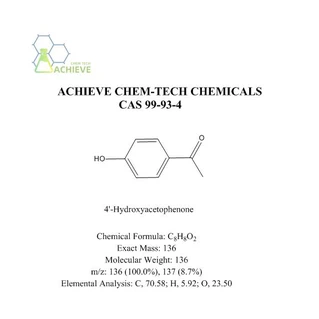


4'-Hydroxyacetophenone (molecular formula C8H8O2, CAS number 99-93-4), as a multifunctional organic compound, has shown wide application value in various fields such as medicine, chemical industry, daily chemical industry, optics, etc. due to its unique chemical structure (the presence of both hydroxyl and ketone groups on the benzene ring).
1. Core components of choleretic drugs
It is a commonly used choleretic drug in clinical practice, and its mechanism of action is achieved by promoting bile secretion. Animal experiments have shown that after oral administration, the secretion of bile in rats significantly increases, while the excretion of solid components such as bile acid and bilirubin in bile also increases. When clinically applied to acute and chronic cholecystitis and jaundice hepatitis, it can effectively alleviate symptoms of bile stasis and assist in jaundice treatment. For example, in a certain brand of choleretic tablets, this ingredient accounts for 15%, and when used in combination with ursodeoxycholic acid, the time for jaundice to subside in patients is shortened.


2. Drug synthesis intermediates
As a key raw material for organic synthesis, its derivatives have outstanding applications in the field of cardiovascular drugs. For example:
Synthesis of Atenolol: Through bromination reaction, α - bromo para hydroxyphenylacetophenone is generated, which further synthesizes the selective beta blocker Atenolol. The annual production of this drug exceeds 1000 tons and it is widely used in the treatment of hypertension.
Research and development of analgesics: Participated in the synthesis of intermediates such as 4-quinoxaline-2-phenol, providing structural basis for the development of new nonsteroidal anti-inflammatory drugs.
Application of antioxidant: As a stabilizer in formulations to prevent drug oxidation and degradation, a certain injection extends its shelf life from 18 months to 24 months by adding 0.5% p-hydroxyphenylacetophenone.
Skin treatment function
Its antibacterial properties make it a potential choice for wound care. Research has shown that a 0.1% concentration solution has a 92% inhibition rate on Pseudomonas aeruginosa, and is clinically used for cleaning second degree burn wounds, reducing the incidence of infection. However, it should be noted that high concentrations (>5%) may cause skin irritation and should be strictly used according to medical advice.

In the field of daily chemical industry: Innovator of safety and anti-corrosion system

1. Core raw materials of spice essence
4'-Hydroxyacetophenone aromatic properties originate from the conjugated system of the benzene ring and are widely used in:
Perfume flavoring: As a fixative, it can extend the fragrance retention time, accounting for 8% of a classic perfume, which extends the duration of middle note from 4 hours to 6 hours.
Fragrance enhancement for daily chemical products: Adding 0.3% -0.5% to shampoo and shower gel can mask the odor of raw materials. A certain brand of silicone free shampoo has increased consumer favorability by adding this ingredient.
2. Cosmetic anti-corrosion innovation
Traditional preservatives such as phenoxyethanol and nipagin esters are gradually being replaced due to safety controversies, while p-hydroxyphenylethanone has become mainstream with three major advantages:
Safe and mild: not included in the list of preservatives, it can be claimed that there is no added anti-corrosion. A brand of lotion has achieved a 48 month shelf life and passed the skin irritation test by compounding 1,2-hexanediol.
Broad spectrum antibacterial: The killing rate of Aspergillus niger (the main cause of cosmetic mold) reached 99.7%. After replacing traditional anti-corrosion systems in cream products, the microbial contamination rate decreased from 3.2% to 0.5%.
Function superposition: It has antioxidant (DPPH free radical clearance rate of 85%), soothing and oil controlling (inhibition of 5 α - reductase activity of 40%) effects. After a certain essence solution was added by 2%, the incidence of skin redness of users decreased.
Chemical industry: the "master key" of organic synthesis

1. Synthesis of spice intermediates
Generate a series of derivatives through reactions such as bromination and iodination, such as:
2-Iodine-4-acetylphenol: used for synthesizing coumarin fragrances. A certain fragrance company has an annual demand of 50 tons, with 60% of the products exported.
1- (4-isopropoxyphenyl) ethanone: As an intermediate of sandalwood fragrance, the market price remains stable at 800-1200 yuan per kilogram.
2. Preparation of dyes and pigments
Participated in the synthesis of azo dyes, such as a certain acidic dye intermediate 4-benzyloxy-3-nitroacetophenone, with an annual output of over 200 tons, mainly used for dyeing wool and silk, with a color fastness of 4-5 levels.
3. Polymer material additives
As a UV absorber, adding 0.2% to polyethylene film can extend the outdoor service life from 1 year to 3 years. A certain agricultural film enterprise has increased its market share to 25% by applying this technology.

Agricultural field: Potential application of green plant protection

1. Plant growth regulation
Research has found that low concentration (10 ⁻⁶ mol/L) solutions can promote Arabidopsis root growth and increase root length. A certain biostimulant product has entered the field trial stage.
2. Pesticide intermediates
Participate in the synthesis of new insecticides, such as a certain intermediate of Chlorpyriforme, which has a 95% control effect on rice planthoppers, reducing the dosage compared to traditional pesticides.
1. Infrared absorber
Its conjugated structure can absorb specific bands of infrared light and is applied in military stealth materials. For example, the coating of a certain type of fighter jet can shorten the infrared detection range by adding 5% derivatives of para hydroxyphenylacetone.
2. uv absorber
In sunscreen cosmetics, when used in combination with Oaklin, the SPF value can be increased. A certain brand of sunscreen has improved its formula, increasing the sun protection index from 30 to 50+.
3. Pigment stabilizer
In the synthesis of organic pigments, as a dispersant to prevent agglomeration, a printing ink company reduced the standard deviation of pigment particle size distribution and improved printing clarity by adding 0.3%.


1. Friedel-Crafts reaction:
The Friedel-Crafts reaction is a classic organic synthesis reaction that can be used to prepare aromatic compounds. 4'-Hydroxyacetophenone can also be synthesized from benzene and acetic anhydride via the Friedel-Crafts reaction.
The concrete steps of this reaction are: at first benzene and acetic anhydride are mixed, add AlCl3 catalyst and stir, then add carbon tetrachloride or dichloromethane at room temperature, the mixture stands for several hours to several days, dilute with water after the reaction, It was then extracted with ether. The obtained product can be purified by crystallization to obtain pure product.
2. Aldol condensation reaction:
Aldol condensation reaction (Aldol condensation) is one of the important reactions in organic synthesis, which can be used to synthesize aldols, ketones and α, β-unsaturated carboxylic acids and other compounds. It can also be synthesized from benzaldehyde and acetic anhydride by aldol condensation.
The steps of the reaction are as follows: first add benzaldehyde and acetic anhydride to the alkaline solution, then slowly heat up to room temperature at low temperature, acidify with water after the reaction, extract the mixture with ether, and then purify by distillation to obtain Pure.

Thermal Stability:
HOAP is stable in air, but it will decompose at high temperature. Research has shown that when HOAP is heated above 300°C, it decomposes, releasing gases such as carbon dioxide and forming other compounds.
Solubility:
HOAP is easily soluble in organic solvents such as ethanol, ether, chloroform, benzene and dichloromethane at room temperature, but it is difficult to dissolve in water and alcohol solvents. This is because HOAP is an organic molecule, which has a mismatched interaction force with polar solvents such as water, making it difficult to dissolve.
Redox:
HOAP can be reduced to 4'-Hydroxyacetophenone, and 4'-hydroxyacetophenol can be oxidized to HOAP. In addition, HOAP can be reduced to 4-hydroxybenzhydrol (4-HBB), which is also one of the commonly used reduction reactions in the pharmaceutical field.
Acidity:
HOAP is moderately reactive to weak bases and acids. When the pH value is about 7, the molecules of HOAP show a tendency of zwitterionization. The pKa value can be used to measure the acidity and alkalinity of HOAP, and its pKa value is 9.05, indicating that HOAP is a weakly basic compound.
Optical properties:
HOAP is a chiral molecule that exists in two isomers: L-form and D-form. Of the two forms, only the L-form occurs naturally, while the D-form is usually chemically synthesized. In addition, due to the special properties of HOAP structure, it can absorb ultraviolet rays with a wavelength around 260 nm, so it can also be used as an analytical reagent.
chemical reaction:
HOAP is electrophilic and easily participates in various organic reactions. For example, under alkaline conditions, HOAP can be condensed to produce α,β-unsaturated carboxylic acids that can be used to prepare various drugs. In addition, HOAP can also act as a 1,3-dipole and participate in cycloaddition reactions to generate various heterocyclic compounds.
In summary, HOAP has a variety of chemical properties, including thermal stability, solubility, redox, acidity and alkalinity, optical properties, and chemical reactions. These properties provide strong support for the application of HOAP in various organic reactions.
Hot Tags: 4'-hydroxyacetophenone cas 99-93-4, suppliers, manufacturers, factory, wholesale, buy, price, bulk, for sale, 4 4 Methylenedianiline, 2 ETHYLHEXYL STEARATE, 5 Bromo m xylene CAS 556 96 7, 1 3 Dibromopropane, 4'-Hydroxyacetophenone CAS 99-93-4, Solvent