




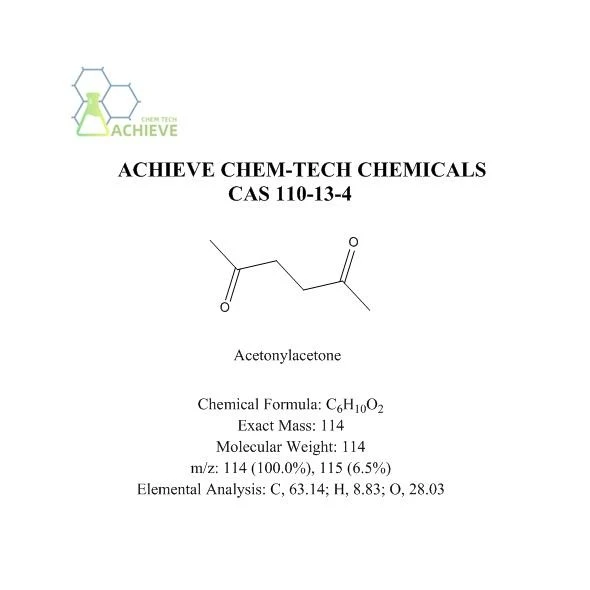
Shaanxi BLOOM Tech Co., Ltd. is one of the most experienced manufacturers and suppliers of acetonylacetone cas 110-13-4 in China. Welcome to wholesale bulk high quality acetonylacetone cas 110-13-4 for sale here from our factory. Good service and reasonable price are available.
Acetonylacetone is a chemical substance with the molecular formula of C6H10O2. Colorless flammable liquid, slightly smelly, gradually turns yellow in the air. It is forbidden to contact with strong oxidant, strong reducing agent and strong alkali. With high boiling point and low steam pressure, it is safe to use it under normal conditions, but fire prevention still needs attention. It is miscible with water, ethanol and ether, and not with hydrocarbon solvents. It is also insoluble in concentrated potassium hydroxide or potassium carbonate solution. It can dissolve synthetic resins such as polymethylmethacrylate, polystyrene, polyvinyl acetate, copolymer of vinyl chloride and vinyl acetate, cellulose nitrate, phenolic resin and other natural resins such as rosin, shell rosin and resin. It can partially dissolve shellac, dewaxed dama resin, glycerol triacylic acid ester, cottonseed oil, etc. It is used as high boiling solvent for synthetic resin, nitro paint, colorant, printing ink, leather tanning agent, rubber vulcanization accelerator, and raw material for manufacturing pesticides, pharmaceuticals, etc.

|
Chemical Formula |
C6H10O2 |
|
Exact Mass |
114 |
|
Molecular Weight |
114 |
|
m/z |
114 (100.0%), 115 (6.5%) |
|
Elemental Analysis |
C, 63.14; H, 8.83; O, 28.03 |
|
|
|


2,5-hexanedione, as an important organic chemical intermediate, has a wide range of industrial applications. Its molecular formula is C6H10O2, which usually exists in the form of a colorless flammable liquid with a slight odor. It gradually turns yellow in air. This chemical substance is miscible with water, ethanol, and ether, but not with hydrocarbon solvents, and does not dissolve in concentrated potassium hydroxide or potassium carbonate solutions. Based on these characteristics, it plays a crucial role in multiple fields.

Application in the field of chemical engineering
High boiling point solvent:
Due to its high boiling point characteristics, it is widely used as a high boiling point solvent for synthetic resins, nitro spray paints, coloring agents, printing inks, and more. In these application areas, solvents are required to remain stable at high temperatures, without volatilization or decomposition, in order to ensure product quality and performance. It precisely meets these requirements, making it irreplaceable in these fields.
Leather tanning agents:
In the leather industry, it can be used as a tanning agent. It can help leather better absorb tanning agents, improve the softness and durability of leather. At the same time, it can also improve the appearance and feel of leather, making leather products more beautiful and comfortable.
Nobs:
In the rubber industry, it can be used as a vulcanization accelerator. It can accelerate the vulcanization process of rubber, improve the strength and wear resistance of rubber products. This is of great significance for producing high-quality rubber products.


Applications in the field of medicine
Drug raw materials:
It has broad application prospects in the field of medicine. It can serve as a raw material or intermediate for certain drugs and participate in the synthesis process of drugs. These drugs may have various pharmacological effects such as anti-inflammatory, antibacterial, and anticancer, which are of great significance for treating various diseases.
Insecticide raw materials:
In addition to being used as a pharmaceutical ingredient, it can also be used as a raw material for insecticides. It can participate in the synthesis process of insecticides, improving the insecticidal effect and stability of insecticides. This is of great significance for pest control in agricultural production.


Applications in other fields
Spice field:
In the spice industry, it also has certain potential for application. It can serve as a raw material or intermediate for certain spices and participate in the synthesis process of spices. These spices may have unique aromas and tastes, providing a wide range of choices for industries such as food, beverage, and cosmetics.
Photographic agent:
In the photography industry, it can be used as a raw material for certain photographic agents. It can participate in the synthesis process of photographic agents, improving their photosensitivity and stability. This is of great significance for improving the quality of photography.
Electroplating and painting:
In the electroplating and painting industries, it can also be used as an auxiliary agent. It can improve the adhesion and corrosion resistance of electroplated and painted layers, enhance product quality and service life.


Synthesis of acetonylacetone :
Another synthesis method is to react sodium ethyl acetoacetate with pure iodine to produce diethyl diacetylsuccinate, and then hydrolyze it with 10% sodium hydroxide solution. Saturate the reaction solution with anhydrous potassium carbonate to precipitate it. Extract with ether, evaporate the ether from the extract, distill the residue, and collect the 192-194 ℃ fraction to obtain colorless product.
The main impurities are water and acid impurities. The refining method is to use anhydrous calcium sulfate or anhydrous sodium sulfate to dry and then distill.
FC, 40.
Diethyl diacetylsuccinate (3): add 300mL of anhydrous ether and 4.5g (0.2mol) of metal sodium wire into the reaction bottle equipped with a stirrer, a drip funnel, and a reflux condenser (with a calcium chloride drying tube on the top), and slowly add 26g (0.2mol) of ethyl acetate (2) after cooling, control the drop speed, and do not make the reaction too violent, nor make the ether boil. After addition, it is left overnight to generate white gel like precipitates. After stirring, slowly add 25g (0.1mol) of finely ground iodine in 75mL of anhydrous ether solution until the solution completely fades (with the color of trace iodine). Filter to remove sodium iodide. The ether was evaporated, and the residue was recrystallized with glacial acetic acid to obtain 16.5g of colorless crystalline diethyl diacetylsuccinate (3) at 78 ℃, with a yield of 65%. Add 16.5g of compound (3) into the reaction flask, add 160mL of 10% sodium hydroxide solution, and reflux for 3~4h. After cooling, use anhydrous potassium carbonate to saturate the alkaline solution and precipitate oil. Extract three times with ether. After the ether is evaporated, it is purified by distillation, and the distillate at 192~195 ℃ is collected to obtain 4.8g of colorless liquid acetonylacetone (1) in a yield of 65%.
Put 3-hexyne-2,5-diol (2) 228 mg (2 mmol), IrH5 (i-Pr3P) 241 mg (0.04 mmol) and toluene 10 mL in a sealed tube, and react at 110 ℃ for 40 h. Cool to room temperature and evaporate the solvent under reduced pressure. Distill the remaining red matter under reduced pressure and collect the fraction at 90 ℃/266Pa to obtain colorless 2,5-hexanedione with a yield of 70%.
Nature and stability
1. Prohibit contact with strong oxidants, strong reducing agents, and strong bases. High boiling point and low vapor pressure make it relatively safe to use under normal conditions, but fire prevention should still be taken into account. Can be miscible with water, ethanol, and ether, but not miscible with hydrocarbon solvents. It does not dissolve in concentrated potassium hydroxide or potassium carbonate solutions. It can dissolve synthetic resins such as polymethyl methacrylate, polystyrene, polyvinyl acetate, copolymers of vinyl chloride and vinyl acetate, nitrocellulose, phenolic resin, as well as natural resins such as rosin, shell resin, and resin. It can partially dissolve insect glue, dewaxed Dama resin, glyceryl tri rosin ester, cottonseed oil, etc.
2. Chemical properties: General reaction with ketones. Reacts with phosphorus pentasulfide to generate 2,5-dimethylthiophene. When reacted with alcohol ammonia solution or heated together with ammonium carbonate, 2,5-dimethylpyrrole is generated. Dehydration generates 2,5-dimethylfuran. Reacts with 2,4-dinitrophenylhydrazine to form bis (2,4-dinitrophenylhydrazone), with a melting point of 257 ℃.
3. Exists in tobacco leaves and smoke.
4. Moderate local irritants can cause anesthesia at high concentrations.
Applications in the field of industrial solvents and coatings
High-boiling-point solvents: Meeting the requirements for high-temperature processing
Acetonylacetone (2,5-hexanedione) is a core choice in the industrial solvent field due to its high boiling point (191-194°C) and low vapor pressure. The presence of a double carbonyl group (C=O) in its molecular structure enhances the intermolecular forces, allowing it to remain stable at high temperatures and prevent volatilization loss. This characteristic makes it outstanding in the following scenarios:
Automobile Painting and Industrial Spray Painting
In automobile manufacturing, the coating needs to be baked at high temperatures (typically 150-200°C) to cure. Traditional solvents such as toluene and xylene are prone to volatilize at high temperatures, resulting in surface defects (such as pinholes, orange peel) on the coating. However, Acetonylacetone's high boiling point ensures that it continuously dissolves the resin during the baking process, resulting in a uniform and smooth coating. For example, an international automotive paint supplier uses it as the main solvent for nitrocellulose spray painting, significantly improving the adhesion and weather resistance of the coating.
Packaging Printing and Ink Manufacturing
Printing inks must dry quickly at high temperatures (120–150°C) to accommodate high-speed printing presses. Acetonylacetone can dissolve resins such as polyamide and nitrocellulose, while its low volatility reduces ink shrinkage during the drying process, preventing blurring or peeling of printed patterns. A packaging printing company increased printing speed by 20% and reduced scrap rates by 15% by replacing traditional solvents with acetonylacetone.
Demand Driven by Environmental Regulations
As global restrictions on VOC emissions become stricter (such as the EU REACH regulations and the Chinese GB 33372-2020 standards), the demand for high-boiling-point solvents continues to grow. Acetonylacetone has a lower VOC content than traditional solvents and has good biodegradability, aligning with the green chemistry trend. For example, a paint company adjusted its formula to increase the proportion of Acetonylacetone to 40%, reducing VOC emissions by 35% for its products and successfully entering the European market.
Solubility of Paint Resins: Enhancing Performance and Stability
Acetonylacetone's solubility in various resins makes it a key component in paint formulations. Its mechanism of action includes:
Polarity matching and hydrogen bonding
The carbonyl group (C=O) in its molecule can form hydrogen bonds with the polar groups in the resin (such as hydroxyl and carboxyl groups), enhancing solubility. For example, in alkyd resin coatings, Acetonylacetone can break the hydrogen bond network between resin molecules, reducing viscosity, thereby reducing the amount of plasticizers in the formula and improving the hardness and chemical resistance of the coating.
Advantages in dissolving natural resins
Compared to hydrocarbon solvents, Acetonylacetone has better solubility for natural resins such as rosin and shellac. A wood coating enterprise increased the solubility efficiency of rosin resin by adding 5% of Acetonylacetone, reducing the drying time of the coating by 30% and improving the gloss by 20%.
Flexibility in partially dissolving special resins
For difficult-to-dissolve resins such as gum tragalu and de-waxed dammar resin, Acetonylacetone can achieve partial dissolution, forming a uniform dispersion system. This characteristic enables its application in artistic coatings and special coatings. For example, a certain ancient building restoration coating adjusted the proportion of Acetonylacetone to achieve precise dissolution of gum tragalu, retaining the texture of traditional coatings while enhancing durability.
Tanning of Leather: Enhancing Physical Properties
In leather processing, Acetonylacetone is used as a tanning agent, enhancing leather quality through cross-linking reactions with collagen:

Cross-linking mechanism and performance improvement
The carbonyl groups in its molecules can form covalent bonds with the amino groups in leather fibers, enhancing the bonding force between the fibers. Experimental data shows that leather treated with Acetonylacetone has a tensile strength increased by 15-20%, a wear resistance improved by 25%, and maintains good softness. A high-end leather brand improved the tanning process by optimizing the dosage of Acetonylacetone to 3%, extending the product's lifespan by 30%.
Environmental protection and cost advantages
Compared to traditional chromium tanning agents, Acetonylacetone has no heavy metal pollution and a shorter treatment cycle of 20%. A leather chemical enterprise, through large-scale production, reduced the cost of Acetonylacetone by 15%, making it competitive in the mid-to-low-end leather market..

Market Trends and Challenges
Demand growth and regional differences
With the rapid development of the automotive and packaging industries in the Asia-Pacific region, the demand for Acetonylacetone continues to grow. It is expected that the global market size will exceed 200 million US dollars by 2027, with a compound annual growth rate of 5.2%. Among them, emerging markets such as China and India will have a growth rate exceeding the global average due to environmental protection policies.


Technical barriers and substitution risks
Although Acetonylacetone has excellent performance, its synthesis process is complex (such as the 2,5-dimethylfuran hydrolysis method has a higher cost), resulting in significant price fluctuations. In addition, the rise of bio-based solvents (such as lactate esters) may pose a threat to its market share. Enterprises need to reduce costs through technological innovation and develop high-value-added applications (such as electronic coatings) to consolidate their market position.
Hot Tags: acetonylacetone cas 110-13-4, suppliers, manufacturers, factory, wholesale, buy, price, bulk, for sale, propylene oxide market, 4'-Hydroxyacetophenone CAS 99-93-4, Potassium Formate Powder, Basic Chemicals, Dichloromethane Solution, benzoyl peroxide powder