


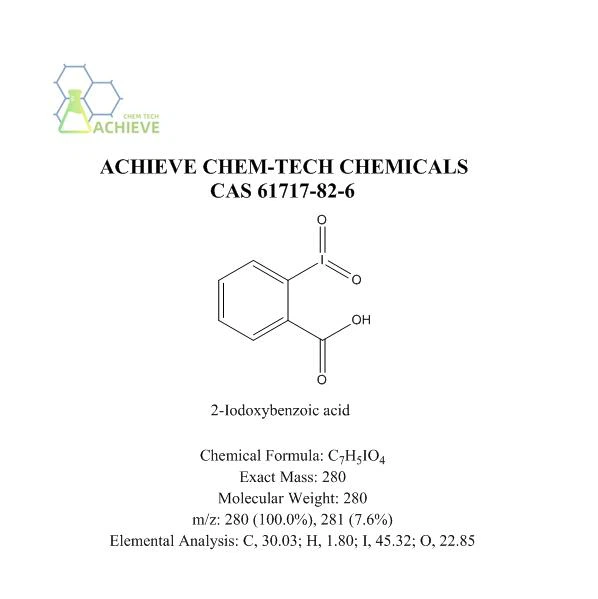


Shaanxi BLOOM Tech Co., Ltd. is one of the most experienced manufacturers and suppliers of 2-iodoxybenzoic acid cas 61717-82-6 in China. Welcome to wholesale bulk high quality 2-iodoxybenzoic acid cas 61717-82-6 for sale here from our factory. Good service and reasonable price are available.
2-Iodoxybenzoic acid is an organic compound with CAS 61717-82-6 and molecular formula C7H5IO2. A solid that appears white to light yellow, usually in crystalline or powder form, with a pungent odor. This compound is insoluble in water, but soluble in organic solvents such as alcohols, ethers, and esters. It is insoluble in water, but it is soluble in organic solvents such as alcohols, ethers, and esters. This makes it widely used in fields such as organic synthesis and drug manufacturing. Stable at room temperature and pressure, but may undergo decomposition or reaction under certain conditions. For example, it may deteriorate at high temperatures or in contact with certain chemical substances. It can be used to synthesize dyes, spices, and other organic compounds. It can also be used as an analytical reagent for detecting trace elements or analyzing the mechanisms of chemical reactions. In addition, it can also be used for agricultural purposes such as fungicides and disinfectants. In these applications, iodoylbenzoic acid is typically reacted with other chemicals or used as an additive to achieve specific functions or effects.

|
C.F |
C7H5IO4 |
|
E.M |
280 |
|
M.W |
280 |
|
m/z |
280 (100.0%), 281 (7.6%) |
|
E.A |
C, 30.03; H, 1.80; I, 45.32; O, 22.85 |
|
|
|


2-Iodoxybenzoic acid (IBX), as an important high valent iodine reagent in the field of organic chemistry, has been continuously expanded in its application scope since its first synthesis in 1893 with breakthroughs in solubility improvement and mechanism research.
1. Selective oxidation of alcohols
The most classic use of IBX is to selectively oxidize primary and secondary alcohols to aldehydes or ketones, while avoiding excessive oxidation to carboxylic acids. The reaction mechanism is based on the "supervalent torsion mechanism", which includes three steps: ligand exchange, torsion, and elimination:
Ligand exchange: Alcoholic hydroxyl groups replace carboxylic acid ligands in IBX to form alcohol IBX intermediates (activation energy 38 kJ/mol).
Twisting process: The steric hindrance repulsion between the alkoxy proton and the aromatic ring adjacent proton drives the oxygen atom to rotate, forming a five membered ring transition state (twisting energy barrier 51 kJ/mol).


Elimination reaction: Oxygen atoms synergistically eliminate to form carbonyl compounds (energy barrier 20 kJ/mol).
Example: In the synthesis of Oxandrolone, IBX oxidizes piperitol to aldehyde with a yield of 94%. Research has shown that if the proton adjacent to the aromatic ring is replaced with a methyl group, the reaction rate can be increased by 100 times, highlighting the key impact of steric hindrance on reaction activity.
2. Oxidation of thioether to sulfoxide
IBX can efficiently oxidize sulfides to sulfoxides, avoiding the formation of sulfone by-products.
For example, in the synthesis of sulfur-containing drugs, IBX can precisely control the degree of oxidation to ensure product purity. Its selectivity stems from the mild oxidation ability of high valent iodine (IV), which is more in line with green chemistry requirements compared to traditional heavy metal reagents such as chromates.
3. Dehydrogenation reaction
IBX can catalyze the dehydrogenation reaction of ketone compounds to produce α, β - unsaturated carbonyl compounds. For example, excessive IBX can convert saturated alcohols and carbonyl compounds into conjugated ketones in one step, providing a key intermediate for the synthesis of natural products such as arachidonic acid.
Innovative Applications in Green Chemistry

1. Water phase and nanomicelle system
Traditional IBX is mainly used in polar solvents such as DMSO due to limited solubility. In recent years, researchers have achieved efficient oxidation of IBX in aqueous phase through nanomicelle encapsulation or surfactant assistance. For example, in the polyethylene glycol (PEG) micelle system, IBX can oxidize alcohols to aldehydes with a yield comparable to the DMSO system and significantly reduce the use of organic solvents.
2. Load type IBX reagent
To solve the problem of IBX recycling, scientists loaded it onto silicone or polystyrene resin to form a recyclable solid oxidant. Load type IBX has the following advantages:
Easy separation: After the reaction, the reagent can be recovered by filtration.
Stability enhancement: Benzoic acid and isophthalic acid are often added as stabilizers in commercial IBX products to further reduce the risk of explosion after loading.
Activity retention: When loaded IBX oxidizes alcohols, the yield is close to that of free IBX, for example, in the oxidation of menthol, the yield reaches 92%.

3. Synergistic effect with Lewis acid
The research group led by Wu Yundong from Peking University, in collaboration with the University of Georgia, has discovered that the complex formed between IBX and boron trifluoride (BFVNet) can significantly enhance reaction activity and expand the solvent's applicability. For example, in acetonitrile solvent, the IBX-BF ∝ complex can efficiently oxidize alcohols, breaking through the limitations of traditional DMSO systems and laying the foundation for industrial applications.
1. Synthesis of nitrogen-containing heterocyclic skeleton
2-Iodoxybenzoic acid can react with unsaturated N-arylamides to generate heterocyclic compounds such as δ - lactams and cyclic ureas. For example, in the development of anti-tumor drugs, IBX catalyzes the cyclization of ortho aminobenzoic acid derivatives to construct nitrogen-containing five membered ring structures with a yield of 85%.
2. Enantioselective synthesis
Asymmetric oxidation of alcohols can be achieved by combining chiral catalysts with IBX. For example, in the synthesis of alpha hydroxy acids, IBX works synergistically with chiral phosphate catalysts, achieving an enantioselectivity (ee value) of 98%, providing an efficient method for the synthesis of chiral drugs.


3. Synthesis of α - functionalized ketones
IBX can oxidize benzyl functional groups to generate phenyl ketone compounds. For example, in the synthesis of vitamin E analogues, IBX oxidizes benzyl alcohol to benzaldehyde, which is further converted to alpha hydroxy ketone with a yield of 90%.
4. Construction of lactones and cyclic ethers
IBX can catalyze the oxidative cyclization of adjacent diols to produce lactones or cyclic ethers. For example, in the synthesis of natural product lignin, IBX oxidizes 1,2-cyclohexanol to δ - valerolactone with a yield of 88%.
1. The precursor of Dess Martin oxidant (DMP)
Heating IBX mixed with acetic acid and acetic anhydride can generate DMP (Dess Martin periodinane). DMP is widely used in drug synthesis due to its solubility in common organic solvents such as dichloromethane. For example, in the synthesis of the anti AIDS drug Efavirenz, DMP is used in the oxidation step of key alcohols with a yield of 95%.
2. Synthesis of pharmaceutical intermediates
IBX plays a central role in the synthesis of pharmaceutical intermediates such as oxyandrolone and steroid hormones. For example, in the synthesis of Oxandrolone, IBX oxidizes the C11 hydroxyl group to a ketone with a purity of 99%, significantly enhancing drug activity.


3. Environmental advantages and cost-effectiveness
Compared to traditional oxidants such as chromate and manganese dioxide, IBX has the following advantages:
Non toxic by-products: iodobenzoic acid is generated after the reaction, which is easy to degrade and reduces environmental pollution.
Atomic economy: Iodine atoms in IBX molecules participate in the oxidation cycle, reducing reagent waste.
Long term stability: Commercial IBX contains stabilizers that can be stored for a long time, reducing production costs.
2-iodoylbenzoic acid (IBX) has become an indispensable oxidant in organic synthesis due to its mild reaction conditions, high selectivity, and green properties. From basic alcohol oxidation to complex molecular construction, from laboratory research to industrial production, the application of IBX continues to expand, providing powerful tools for drug development, materials science, and green chemistry.

The synthesis method of 2-Iodoxybenzoic acid (IBX) is as follows:
Benzaldehyde is reacted with sodium hypochlorite, sodium iodate and sodium hydroxide to obtain sodium 2-iodobenzoate.
In the presence of sodium 2-iodobenzoic acid, diazomethane was added to the reaction system and reacted at room temperature for 2 hours to obtain 2-iodo-1-methyldiazane and sodium carbonate.
The reaction mixture is added to the mixture of acetic acid and acetic anhydride, heated to 80 ° C, and hydrolyzed to obtain 2-iodo-1-methyldiazoacetate.
In the presence of 2-iodo-1-methyldiazoacetate, sodium hypochlorite and chromium trioxide were added to react for 1 hour to obtain 2-iodo-1-methyldiazoan-5-chromate trioxide.
In the presence of 2-iodo-1-methyldiazoan-5-chromate trioxide, nitric acid and sulfuric acid were added to react for 1 hour to obtain IBX.

The hypervalent torsion mechanism when methanol is oxidized to formaldehyde: a) ligand exchange (activation energy 38 kJ/mol); b) Over-valence reversal (51 kJ/mol); c) Elimination (20 kJ/mol). There is steric repulsion between red protons.
The reaction of IBX to oxidize alcohol to aldehyde is carried out through the so-called supervalent torsion mechanism, including three steps of ligand exchange (replacing alcohol hydroxyl), torsion and elimination. In the torsion step, the oxygen atom moves to the five-membered ring transition state required for the elimination reaction. The driving force of torsion is the steric hindrance between the protons of alkoxy group and the neighboring protons of aromatic ring. Therefore, higher alcohols are more easily oxidized by IBX than lower alcohols. The calculation also shows that if the ortho proton is replaced by methyl, the reaction rate will increase to 100 times of the former.
Twisting this step is the rate-control step of the reaction and is necessary. Otherwise, the iodine-oxygen double bond and alkoxy group are not coplanar, and collaborative elimination cannot occur.
IBX has two tautomers, one of which is a carboxylic acid structure. The pKa of IBX in water is 2.4, and that in DMSO is 6.65. Its acidity will also lead to acid-catalyzed isomerization as a side reaction of oxidation.
It can also be loaded onto silica gel or polystyrene. Compared with IBX, these polymers containing IBX have the advantages of simple separation, recyclable reagent and non-explosive property, and the oxidation property is similar to that of IBX, and satisfactory results can be obtained.
The mixture of IBX, acetic acid and acetic anhydride is heated to obtain the Dais-Martin oxidizer (DMP), which is more soluble in common organic solvents and has a wide range of applications. IBX often has similar properties with DMP in oxidation reaction, but DMP is unstable and cannot be stored for a long time.
Aromatic carbonyl compounds:
For example, it is used in the total synthesis of a kind of arachidic acid:
Oxidation of alcohol to aldehyde with IBX: a) IBX, DMSO, THF, 4h, 94% yield (Mohapatra, 2005)
In 2001, K.C. Nicolaou et al. found that IBX can oxidize the benzyl position to obtain conjugated aromatic carbonyl compounds.
Oxidation fracture:
For example, the combination of 2-Iodoxybenzoic Acid and DMSO causes the oxidation and fracture of adjacent diol to produce ketone:
In the reaction, the adduct of IBX of 10-I-4 and 12-I-5 of DMSO is first generated, in which DMSO is the leaving group. React with alcohol to obtain and discharge DMSO. Intramolecular condensation occurs, releasing a molecule of water, producing 12-I-5 spiro-bicyclic iodide, and further breaking into. Presence of hydroxyl groups α In the case of proton, ketone alcohol is the reaction by-product. Trifluoroacetic acid promoted the reaction.
Hot Tags: 2-iodoxybenzoic acid cas 61717-82-6, suppliers, manufacturers, factory, wholesale, buy, price, bulk, for sale, Diisopropylammonium, Chloramine T powder, 2-Iodoxybenzoic Acid CAS 61717-82-6, Mercury Reagent, Neutral red powder, Laboratory Reagent