




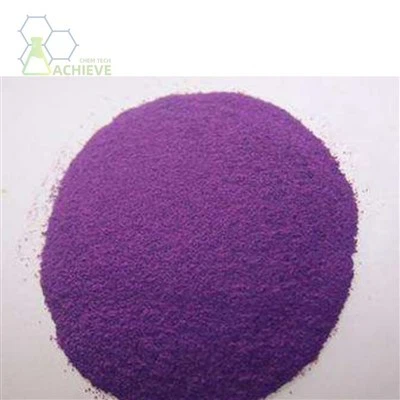
Shaanxi BLOOM Tech Co., Ltd. is one of the most experienced manufacturers and suppliers of basic blue 26 cas 2580-56-5 in China. Welcome to wholesale bulk high quality basic blue 26 cas 2580-56-5 for sale here from our factory. Good service and reasonable price are available.
Basic Blue 26,Also known as Victoria Blue B, it is a compound with specific chemical properties and a wide range of uses. The appearance is usually a deep purple (or gray green shimmering) powder, soluble in cold and hot water, both appearing blue; Dissolved in ethanol, it also appears blue.
In concentrated sulfuric acid, it appears red brown, and after dilution, it changes from yellow to green and then to blue; It appears olive green in concentrated nitric acid. Adding sodium hydroxide to its aqueous solution produces a dark reddish brown precipitate, while adding hydrochloric acid produces a blue precipitate. It is a synthetic cationic dye belonging to triarylmethane dyes, with a bright blue color, and is therefore commonly used as a coloring agent for various applications, including textiles, paper, leather, etc.
In the laboratory, it is also used as a biological staining agent for DNA and protein detection. It can bind with negatively charged materials and can therefore be used as an indicator for the presence of specific molecules in biological samples, such as staining of nerve tissue, glial cells, blood, spirochetes, etc.

Additional information of chemical compound:
|
Chemical Formula |
C33H32N3+ |
|
Exact Mass |
470.26 |
|
Molecular Weight |
470.64 |
|
m/z |
470.26(100.0%),471.26(35.7%),472.27(3.5%),472.27(2.7%),471.26(1.1%) |
|
Elemental Analysis |
C, 84.22; H, 6.85; N, 8.93 |
|
Melting point |
206℃(dec.)(lit.) |
|
Density |
1.336[at 20℃] |
|
|
|


Basic Blue 26 is a synthetic cationic dye belonging to the class of triarylmethane dyes. It has a bright blue color and is easily soluble in water and organic solvents. This dye has good stability and can maintain its color characteristics in various environments, making it a compound with multiple uses. The following is a detailed explanation of its purpose:

The use as a coloring agent
Victoria Blue B is often used as a coloring agent for textiles due to its bright blue color and excellent dyeing performance. It can provide long-lasting blue dyeing effect for various fibers such as cotton, linen, silk, and wool.
During the dyeing process, Victoria Blue B can evenly penetrate into the fibers and tightly bind with fiber molecules, ensuring the firmness and durability of the dyeing. In addition to textiles, it is also commonly used for dyeing paper.
It can provide a uniform blue dyeing effect for paper, making it more beautiful and attractive. In the paper industry, it is usually used in combination with other dyes or additives to meet the dyeing needs of different paper products. Victoria Blue B can also be used for dyeing leather. It can penetrate into the interior of leather, providing a long-lasting blue dyeing effect and enhancing its aesthetics and durability.


In the leather dyeing process, its dosage and dyeing conditions need to be adjusted according to the type and thickness of the leather to ensure the best dyeing effect. It can also be used for dyeing other materials such as wood, plastic, rubber, etc. After being dyed with Victoria Blue B, these materials can present a unique blue effect, meeting different decorative and aesthetic needs.
Use as a biological staining agent
Victoria Blue B has extensive application value in the field of biology. It can be used as a biological staining agent for DNA and protein detection, for observing and analyzing specific molecules in biological samples.In terms of DNA staining, Victoria Blue B can bind to DNA molecules to form stable complexes, resulting in blue fluorescence.


This fluorescent signal can be used to detect and analyze the presence, structure, and function of DNA. In protein staining, it can bind with certain functional groups in protein molecules to form visible blue precipitates or staining effects. This staining method can be used to observe and analyze the distribution and function of proteins in cells and tissues. It can also be used for staining nerve tissue, glial cells, and blood. It can clearly display the cell structure and morphology in these tissues, which helps pathologists and doctors to make accurate diagnoses and treatments.
Use as a biological staining agent
In terms of neural tissue staining, it can highlight the morphology and connectivity of neurons, which helps to study the structure and function of the nervous system. In terms of glial staining, the morphology and distribution of glial cells can be clearly displayed, which helps to analyze the role of glial cells in the nervous system.


In terms of blood staining, it can also be used to observe and analyze the cellular components and structural characteristics in blood, providing important basis for the diagnosis and treatment of blood diseases.Can be used for staining spiral bodies. Spiroplasma is a special form of microorganism, including Treponema pallidum, Leptospira, and others.
These spirochetes can cause various diseases in the human body. By using Victoria Blue B staining, the morphology and structural characteristics of spirochetes can be clearly observed, which helps pathologists and doctors to make accurate diagnoses and treatments. This is of great significance for the prevention and control of spirochete infection.


Other applications
Due to its ability to bind with negatively charged materials and produce color changes, Basic Blue 26 can be used as an indicator to detect the progress of certain chemical reactions or the presence of products. For example, in acid-base titration, it can be used as an indicator to observe changes in the pH value of the solution. It can also be used to manufacture lake pigments.
Lake pigments are pigments formed by adsorbing or precipitating dyes onto inorganic pigment carriers. This pigment has the advantages of bright color, good light resistance, and strong water resistance, and is widely used in coatings, inks, plastics, and other fields. It also has certain application value in the field of electrochemistry.


Other applications
It can be used as one of the sensitive materials for electrochemical sensors to detect the concentration or presence of certain ions. In addition, it can also be used in fields such as electrochemical deposition and electroplating, providing new approaches and methods for surface treatment and modification of materials. In addition, Victoria Blue B may also have other special application areas.
For example, in the food industry, it can be used as a food coloring agent to increase the color appeal and nutritional value of food; In the cosmetics industry, it can be used as one of the color ingredients in hair dyes or nail polish; In the field of environmental protection, it can serve as an indicator or adsorbent in wastewater treatment. However, these special applications require further experiments and research to verify their feasibility and effectiveness.

Safety and environmental considerations
Although Basic Blue 26 has broad application value, it also poses potential risks to human health and the environment. Therefore, when using and handling, it is necessary to strictly comply with relevant safety regulations and environmental requirements.

Health risks
Victoria Blue B may cause irritation or damage to the eyes, skin, and respiratory tract of the human body. Therefore, appropriate protective equipment such as gloves, masks, and goggles should be worn when in contact. In addition, prolonged exposure to or inhalation of dust or vapors from Victoria Blue B may pose a risk to human health, therefore it is necessary to operate in a well ventilated environment.
Environmental risk
Victoria Blue B may cause pollution to the environment. If discharged directly into the environment without proper treatment, it may cause harm to water bodies, soil, and ecosystems. Therefore, strict environmental measures such as wastewater treatment, waste disposal, and exhaust gas purification need to be taken when dealing with Victoria Blue B's wastewater, waste residue, and exhaust gas to ensure that its impact on the environment is minimized.


Regulatory restrictions
In order to protect human health and environmental safety, many countries and regions have established regulatory restrictions on the use and handling of Victoria Blue B. These regulations typically specify the scope of use, usage limits, emission standards, and environmental requirements for Victoria Blue B. Therefore, when using and handling, it is necessary to strictly comply with local regulatory restrictions and consult the opinions and suggestions of relevant professionals.

In the mid-19th century, with the development of coal tar chemical industry, the synthesis of aniline dyes opened up a new era of synthetic dyes. In the category of alkaline dyes, triphenylmethane compounds have become a research hotspot due to their bright color light and strong coloring power. Alkaline Blue 26 (C.I. 44045) is a typical triphenylmethane cationic dye, and its discovery process is closely related to the textile industry revolution and breakthroughs in organic chemistry theory.
In 1856, British chemist William Henry Perkin accidentally produced the first human synthetic dye, "Mauvein," while attempting to synthesize the antimalarial drug quinine, marking the birth of the synthetic dye industry. This discovery has sparked scientists' interest in studying the chromophores of aniline derivatives.
In 1865, German chemist August Wilhelm von Hofmann systematically studied the oxidation products of aniline and first elucidated the chemical structure of triphenylmethane.
In 1871, Adolf von Baeyer proposed the "chromophore theory", which laid the theoretical foundation for the design of alkaline dyes.
In 1877, French chemist Charles Lauter discovered the byproduct "para rosaniline" in the oxidation reaction of aniline, which became the parent structure of triphenylmethane dye.
In 1883, Heinrich Caro, a researcher at BASF in Germany, developed crystal violet (alkaline violet 3) through amino modification.
In 1885, Swiss chemist Sandmeyer published a paper in the Journal of the German Chemical Society, reporting the synthesis of a blue purple compound (later named Basic Blue 26) by condensing N, N-diethylaniline with benzaldehyde and then oxidizing it.
In 1888, the German company Hirst completed industrial production process optimization and officially entered the market under the trade name "Victoria Blue B.
Frequently Asked Questions
As a cationic dye of triarylmethane, what are the obscure electron delocalization differences of its naphthalene ring and phenyl conjugated skeleton compared to ordinary triphenylmethane dyes?
+
-
A: Ordinary triphenylmethane dyes are symmetrically conjugated with three benzene rings; Basic Blue 26 replaces a benzene ring with a 1-phenylnaphthalene ring to form an asymmetric fused ring conjugated system. The double ring π system of naphthalene ring expands the delocalization range, making positive charges more dispersed and dye stability improved; Simultaneously breaking the symmetry of the molecular center, stronger intramolecular charge transfer (ICT) occurs, and the molar absorptivity is higher than that of ordinary triphenylmethane dyes. This structural performance difference is rarely mentioned in basic dye literature.
What are the minor reversible isomerism patterns of color transitions in its aqueous solution under extreme pH gradients?
+
-
A: The pH color change of conventional dyes is mostly simple protonation/deprotonation; The molecule appears reddish brown (protonated) in concentrated sulfuric acid, and after dilution, it undergoes a yellow green intermediate before finally turning blue (deprotonated); Under alkaline conditions, a reddish brown precipitate (zwitterionic aggregation) is generated. Core niche point: There is reversible quinone imine triphenylmethane alcohol tautomerism in the pH 2-4 range, which only occurs in naphthalene substituted triarylmethane dyes and can be used to construct precision pH fluorescent probes.
Compared to other alkaline dyes, what is the obscure binding mode of small groove selective binding with double stranded DNA?
+
-
A: Most cationic dyes are embedded in DNA base pairs; Basic Blue 26 preferentially binds to the A-T enrichment region of DNA small grooves due to its spatial configuration of naphthalene ring fused with dimethylaminophenyl. The planar dense ring of the molecule is embedded in a small hydrophobic pocket, and the cationic side chain forms electrostatic hydrogen bonds with the phosphate backbone, without disrupting base pairing and only slightly distorting the double helix; This non embedded binding mode makes it a niche fluorescent probe for DNA conformation research.
What are the differences in π - π stacking between molecules in solid-state thin films compared to the obscure features of ordinary triarylmethane dyes?
+
-
A: Ordinary triphenylmethane dyes are prone to form close face-to-face π stacking, leading to fluorescence quenching; Due to the steric hindrance and asymmetric substitution of the naphthalene ring, Basic Blue 26 forms a staggered serrated stacking, with an increase in molecular spacing and a decrease in π - orbital overlap. The solid-state fluorescence quantum yield is significantly higher than that of similar dyes, and the stacking structure is temperature sensitive, which can be used to prepare temperature responsive organic luminescent thin films. This characteristic is rarely reported in dye material literature.
Hot Tags: basic blue 26 cas 2580-56-5, suppliers, manufacturers, factory, wholesale, buy, price, bulk, for sale, p-Naphtholbenzein, Phosphoric acid reagent, Phenol red powder, 4-(5-Chloro-2-pyridylazo)-1,3-phenylenediamine, naphtholbenzein indicator, diphenylcarbazide reagent