




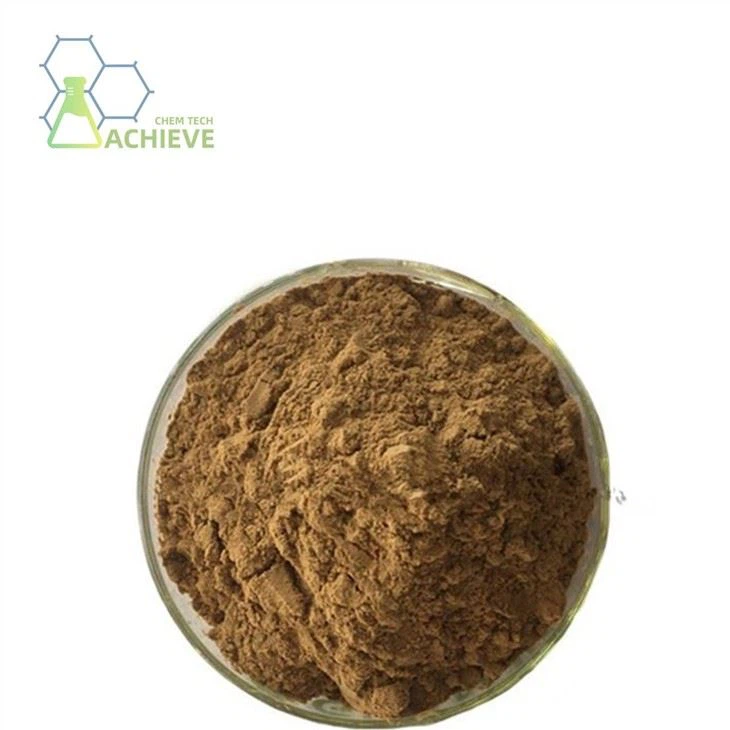

Shaanxi BLOOM Tech Co., Ltd. is one of the most experienced manufacturers and suppliers of 1,3,5-tribromobenzene cas 626-39-1 in China. Welcome to wholesale bulk high quality 1,3,5-tribromobenzene cas 626-39-1 for sale here from our factory. Good service and reasonable price are available.
1,3,5-tribromobenzene, also known as Tribromobenzene, is an organic compound with the molecular formula C6H3Br3 and CAS 626-39-1. It is a light yellow brown powder with a certain pungent odor and may cause allergic reactions in some people. Insoluble in water, but soluble in some organic solvents such as hot ethanol and glacial acetic acid. Stable at room temperature, but may decompose and appear liquid under high temperature and light conditions. It is a raw material for manufacturing organic compounds such as vitamin B6 and synthesizing calcium pantothenate. Adding to food can enhance the seasoning effect of chemical seasoning, improve the taste of sweeteners and the acidity of organic acids, enhance the quality of alcoholic beverages, prevent oil oxidation, and improve the flavor of soaked food. It can also be used as a biochemical reagent for biochemical and microbiological research. It is an important organic synthesis raw material and intermediate.

|
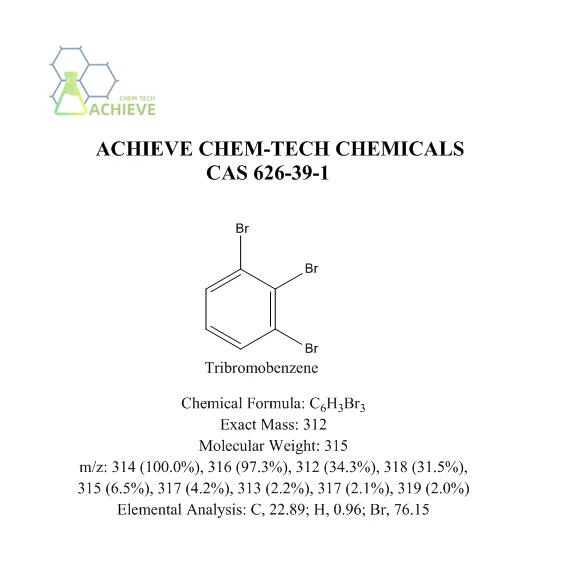
Chemical Formula |
C6H3Br3 |
|
Exact Mass |
312 |
|
Molecular Weight |
315 |
|
m/z |
314 (100.0%), 316 (97.3%), 312 (34.3%), 318 (31.5%), 315 (6.5%), 317 (4.2%), 313 (2.2%), 317 (2.1%), 319 (2.0%) |
|
Elemental Analysis |
C, 22.89; H, 0.96; Br, 76.15 |

Synthetic tribromobenzene: place 100g (1.1mol) aniline, 1L water and 100ml (12.mol) concentrated hydrochloric acid in a 15L round bottom flask. When aniline is dissolved, add 5L water, and place the flask in an ice bath for cooling. Then slowly add 577g (185ml, 3.6mol) of bromine until the solution is significantly yellow, which takes about 34h, and the reaction is completed. Leak out tribromoaniline with Brinell, wash off hydrobromic acid with water and suck it dry. Place moist tribromoaniline, 2.1l95% ethanol and 525ml benzene in a 5L flask equipped with a reflux condenser. Put the flask on a steam bath and heat it to dissolve tribromoaniline. Add 40ml of 1chemicalbook concentrated sulfuric acid to the solution, and then add 140g (2.03mol) of powdered sodium nitrite while maintaining the normal reaction. When the reaction is completed, the solution is heated and boiled, and maintained in this state until no gas escapes, and then placed in a warm place for 3h. After the mixture is cooled, filter it, and then add a solution made of 150ml concentrated sulfuric acid and 1.5L water to the solid. When the excess sodium nitrite has been decomposed, filter, wash the solid with water, and then wash with a small amount of ethanol. Crude dry 1,3,5-tribromobenzene is reddish brown, melting point 112~116 ℃, yield 250~260g, yield 74%~7.

Electrochemical synthesis is an environmentally friendly and efficient synthesis method that can be used to synthesize various organic compounds, including Tribromobenzene. The following are the detailed steps and corresponding chemical equations for the electrochemical synthesis of Tribromobenzene:
Add raw materials such as benzene and ferric bromide to the dissolution kettle, and add an appropriate amount of solvent, such as ethanol or acetone.
Heat to an appropriate temperature to fully dissolve the raw materials.
Filter the dissolved solution to remove any undissolved solid impurities.
Transfer the filtered solution to the electrolytic cell and add an appropriate amount of electrolyte (such as lithium bromide).
Apply direct current for electrolysis reaction, control current density and reaction temperature.
During the electrolysis process, the Tribromobenzene generated by the reaction will deposit on the electrode.
After the electrolysis reaction is completed, dissolve the Tribromobenzene on the electrode with an appropriate solvent.
Filter the dissolved solution to remove any undissolved solid impurities.
Separate the filtered solution by distillation or crystallization to obtain high-purity Tribromobenzene.
In electrochemical synthesis, benzene and bromine undergo an electrochemical reaction to form Tribromobenzene. The specific chemical equation is as follows:
C6H6 + 3Br2 → C6H3Br3 + 3HBr
This equation represents a substitution reaction between benzene and bromine in an electrochemical reaction, resulting in the formation of Tribromobenzene and hydrobromic acid. It should be noted that this equation is only a schematic representation, and the actual reaction process may involve other intermediate products and complex reaction mechanisms.

1,3,5-Tribromobenzene, chemical formula C6H3Br3, molecular weight 314.8, CAS number 626-39-1. Its molecular structure is symmetrically distributed, with three bromine atoms uniformly replacing the 1st, 3rd, and 5th positions of the benzene ring, forming a highly stable conjugated system. The physical properties are manifested as a light yellow brown powder, with a melting point of 124 ℃ and a boiling point of 271 ℃. It is insoluble in water but soluble in organic solvents such as hot ethanol and glacial acetic acid. This compound is sensitive to light and heat, and needs to be sealed, dried, and stored away from light. It should be kept away from oxidants and strong acids to prevent decomposition or dangerous reactions.
The application in the pharmaceutical field dominates, and its core value lies in being a key intermediate for the synthesis of various drugs.
Central nervous system drugs:
It is a key raw material for synthesizing antidepressants (such as fluoxetine analogues) and antiepileptic drugs (such as carbamazepine derivatives). Its symmetrical structure helps to construct chiral centers and obtain high-purity drug molecules through stereoselective synthesis, enhancing drug efficacy and reducing side effects.

Organic synthesis: multifunctional intermediates and reagents

As an important intermediate in organic synthesis, it plays an irreplaceable role in the construction of complex molecules.
1. Substitution reaction and functional group conversion
Its bromine atom has high reactivity and can introduce functional groups such as amino, hydroxyl, thiol groups through nucleophilic substitution reactions. For example, in the ammonolysis reaction, bromine atoms are replaced by amino groups to generate 1,3,5-triaminobenzene, which is further used for the synthesis of polyamide fibers (such as Kevlar) and dye intermediates.
2. Coupling Reaction and Aromatic System Expansion
In the Suzuki coupling reaction, it reacts with arylboronic acid to generate triarylbenzene derivatives, which are used to construct conjugated polymer materials (such as conductive polymers) and liquid crystal molecules. In addition, it can also generate triphenylamine derivatives through Ullmann coupling reaction, which can be used as hole transport materials for organic light-emitting diodes (OLEDs).
3. Redox Reaction and Structural Modification
1,3,5-tribrobenzene can be oxidized to form 1,3,5-tribrobenzoquinone, which can be further used to synthesize vitamin K analogues and photosensitizers. Under reducing conditions, bromine atoms can be replaced by hydrogen atoms to generate 1,3,5-trimethylbenzene, which can be used as a solvent and organic synthesis reagent.

Materials Science: Key Components of High Performance Materials

The application in materials science is becoming increasingly widespread, and its symmetrical structure and unique properties of bromine atoms provide possibilities for the design of high-performance materials.
1. Flame retardant material
1,3,5-tribromobenzene is a key raw material for synthesizing brominated epoxy resin and brominated polystyrene. The bromine atom releases hydrogen bromide during combustion, suppressing flame propagation and generating a carbide layer to isolate oxygen.
This type of flame retardant is widely used in electronic device casings, building panels, and vehicle interiors, significantly improving the safety of materials.
2. Liquid crystal material
It is a key intermediate for synthesizing discotic liquid crystals. Its symmetrical structure helps to form columnar phase liquid crystals, which are used for high-resolution display screens and optical switching devices. By introducing flexible segments, the phase transition temperature and response speed of the liquid crystal can be adjusted to meet the needs of different application scenarios.

Dyes and pigments: the cornerstone of color science

It occupies an important position in the dye and pigment industry, and its symmetrical structure and electronic effect of bromine atoms provide rich possibilities for dye molecule design.
Disperse dye:
1,3,5-tribrobenzene is a key raw material for the synthesis of dyes such as Disperse Red and Disperse Blue. Its bromine atom can enhance the hydrophobicity of dye molecules and improve their adsorption capacity on polyester fibers. By introducing sulfonic acid groups, the water solubility and color fastness of dyes can be further adjusted to meet the high standard requirements of textile printing and dyeing.
As a color reagent and standard substance in analytical chemistry, it provides important support for metal ion detection and organic matter analysis.
1. Metal ion detection
It forms a purple red complex with Fe ³ ⁺, with a maximum absorption wavelength of 425nm and a molar absorptivity of 5800 L · mol ⁻¹ · cm ⁻¹, which can be used for sensitive detection of iron ions. In addition, it can also serve as a masking agent to eliminate the influence of interfering ions such as Al ³ ⁺ and Ca ² ⁺ on the determination of Fe ³ ⁺.


2. Standard materials and calibration
As an organic synthesis standard substance, it is used for calibration of gas chromatography (GC) and high performance liquid chromatography (HPLC). Its high purity and stability ensure the accuracy of analysis results, and it is widely used in environmental monitoring, food testing, and drug quality control.
With the deepening of green chemistry and sustainable development concepts, applications are transitioning from traditional fields to high-end and refined directions.
1. Energy materials
Participate in the synthesis of lanthanide metal organic framework complexes (MOFs), whose sulfonic acid groups serve as coordination sites and form three-dimensional pore structures with metal ions for gas adsorption (such as CO ₂ capture) and catalytic reactions (such as photocatalytic water splitting for hydrogen production). Research has shown that MOFs based on this substance have an adsorption capacity of up to 5 mmol/g for CO ₂, and can achieve an 8% photocatalytic hydrogen production efficiency under visible light.


2. Environmental governance
The modified adsorbent material (such as poly-1,3,5-tribrobenzene resin) has high selective adsorption capacity for heavy metal ions (such as Pb ² ⁺, Cd ² ⁺), with an adsorption capacity of up to 200 mg/g. It can be regenerated by acid washing and reused more than 5 times, making it suitable for industrial wastewater treatment and soil remediation.
3. Biomedicine
1,3,5-tribromobenzene derivatives, as drug carriers, can achieve targeted drug delivery and controlled release. For example, 1,3,5-tribrobenzene nanoparticles modified with polyethylene glycol can be loaded with anticancer drugs (such as doxorubicin), which can be specifically released at the tumor site, enhance therapeutic efficacy, and reduce systemic toxicity.
Hot Tags: 1,3,5-tribromobenzene cas 626-39-1, suppliers, manufacturers, factory, wholesale, buy, price, bulk, for sale, Trimethylsilyl trifluoromethanesulfonate, Bromophenol blue solution, Thioacetic acid powder, Chlorosulfonyl isocyanate, 1 AMINO 2 NAPHTHOL 4 SULFONIC ACID, Thiazolyl Blue CAS 298 93 1