


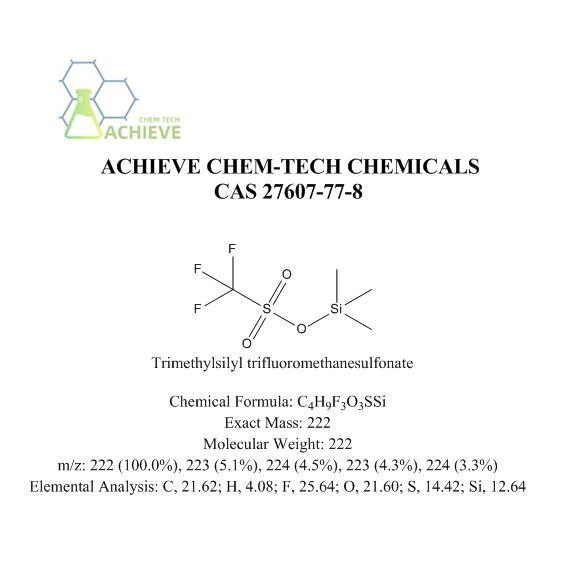


Shaanxi BLOOM Tech Co., Ltd. is one of the most experienced manufacturers and suppliers of trimethylsilyl trifluoromethanesulfonate cas 27607-77-8 in China. Welcome to wholesale bulk high quality trimethylsilyl trifluoromethanesulfonate cas 27607-77-8 for sale here from our factory. Good service and reasonable price are available.
Trimethylsilyl trifluoromethanesulfonate known as 1-(2,6-chlorophenyl)-2-indolinone(diclofenac), is a compound with specific physical properties. It is a colorless to light brown transparent liquid with a slight irritating odor. The density is 1.228g/mL, CAS 27607-77-8, and the molecular weight is 222.26. Its molecular structure contains three methyl (CH3) groups and one trifluoromethyl (CF3) group, as well as one silicon atom and one sulfonic acid group. It can be dissolved in organic solvents such as aromatic hydrocarbons, halogenated hydrocarbons, and tetrahydrofuran, but not in water. The strong polarity of this compound gives it good solubility in organic solvents. Has significant Lewis acidity and strong hygroscopicity. In humid environments, this compound is prone to undergo violent chemical reactions with water and deteriorate.
Therefore, it is necessary to store it in a dry environment to maintain its stability. It is an efficient silanization reagent, strong Lewis acid catalyst, and commonly used silicon-based protective reagent. It has a wide range of applications in laboratory research and development processes and chemical and pharmaceutical production, mainly used for hydroxyl protection in organic chemical conversion and the preparation of enol silanes. In addition, this compound is also used to synthesize other important silicon and fluorine compounds. Clinically used for rheumatoid arthritis, adhesive spondylitis, non inflammatory arthritis, arthritis, pain caused by non joint rheumatism and non joint inflammation, various types of neuralgia, cancerous pain, post-traumatic pain, and fever caused by various inflammations. It is toxic to certain animals, such as bald eagles. Diclofenac powder is mainly used in chemistry, but diclofenac solution is mainly used in animals, such as in the eyes of dogs or cats when they are sick

|
Chemical Formula |
C6H4ClNO2 |
|
Exact Mass |
157 |
|
Molecular Weight |
158 |
|
m/z |
157 (100.0%), 159 (32.0%), 158 (6.5%), 160 (2.1%) |
|
Elemental Analysis |
C, 45.74; H, 2.56; Cl, 22.50; N, 8.89; O, 20.31 |
|
|
|


melting point 25 °C , boiling point 77 °C / 80 mmHg ( lit. ) , Density 1.228 g / mL at 25 ° C ( lit. ) , Vapor pressure 4.7 hPa ( 20 ° C ) , Refractive index n20 / D 1.36 ( lit. ) , flash point 78 °F , Storage conditions Store below + 30 ° C. , Solubility sol aliphatic and aromatic hydrocarbons, haloalkanes, ethers. , Morphology Fuming Liquid, Proportion 1.15, Color Clear colorless to light brown, Water solubility REACTS, Sensitive Moisture-Sensitive, Hydrolysis sensitivity 8: reactions rapidly with moisture, water, protic solvents.

Trimethylsilyl trifluoromethanesulfonate (TMSOTf, CAS number 27607-77-8) is a highly active organic silicon compound with a core structure consisting of trimethylsilyl (- Si (CH ∝) ∝) and trifluoromethanesulfonate (- SO ∝ CF ∝) groups. Its molecular formula is C ₄ H ₉ F ∝ O ∝ SSi, with a molecular weight of 222.26. It appears as a colorless to pale yellow transparent liquid and has strong hygroscopicity, flammability, and corrosiveness. As a key reagent in the field of organic synthesis, TMSOTf has demonstrated extensive application value in various fields such as medicine, materials, energy, and green chemistry due to its unique Lewis acid catalytic properties and siliconization ability.
1. Protection and deprotection of sugar derivatives
TMSOTf is an efficient selective protective reagent in glycochemistry, particularly suitable for siliconization protection of hydroxyl groups such as glucose and nucleotides. Its reaction efficiency is significantly better than traditional reagents (such as trimethylchlorosilane, TMSCl), and it can quickly complete the conversion of hydroxyl groups to silicon ethers under mild conditions (0-10 ℃) with fewer by-products. For example, in the synthesis of nucleoside derivatives, TMSOTf can selectively protect the 2 '- or 3' - hydroxyl groups on the ribose ring, providing a basis for subsequent stereoselective modifications.


Experimental data shows that when TMSOTf is used to protect the hydroxyl group of glucose, the reaction yield can reach over 95%, and the protective group can be efficiently removed under acidic conditions, with a recovery rate of over 90%.
2. Construction of heterocyclic compounds
TMSOTf, as a strong Lewis acid catalyst, can significantly accelerate the alkylation, acylation, and cyclization reactions of heterocyclic compounds such as indole and pyridine. For example, in the 3-site selective acylation reaction of indole, the addition of TMSOTf can shorten the reaction time from 12 hours in traditional methods to 2 hours, and improve the purity of the product to 98%.
In addition, it can catalyze Dieckmann like cyclization reactions of ester imides and diesters, efficiently constructing five - or six membered cyclic structures, providing key steps for the synthesis of complex natural products such as alkaloids.
3. Synthesis of antibiotics and antiviral drugs
TMSOTf is commonly used for the construction of key intermediates in the synthesis of antibiotics (such as macrolides) and antiviral drugs (such as nucleoside analogues). For example, in the synthesis of erythromycin derivatives, TMSOTf catalyzes the formation of glycosidic bonds, increasing the reaction yield from 60% to 85% while reducing the generation of by-products. Its high reactivity and selectivity make drug synthesis steps simpler and lower in cost.

Polymer material modification: the core additive that endows materials with high performance
1. Silicone rubber crosslinking agent
Trimethylsilyl trifluoromethanesulfonate is an efficient crosslinking agent for room temperature vulcanized (RTV) silicone rubber, which can significantly shorten the curing time and improve material properties. Traditional silicone rubber curing requires high temperature (120-150 ℃) or long time (more than 24 hours), while adding TMSOTf can shorten the curing time at room temperature to 20-60 minutes, and the tensile strength of cured silicone rubber is increased by 30%, with significantly enhanced temperature resistance (up to 200 ℃) and chemical corrosion resistance. Its mechanism of action is: TMSOTf catalyzes the condensation reaction between silanol groups (- Si OH) and silane coupling agents (such as methyltrimethoxysilane), forming a three-dimensional network structure.
2. Synthesis of Optoelectronic Materials
In the preparation of OLED (organic light-emitting diode) materials, TMSOTf is used to synthesize hole transport layer materials (such as TPD derivatives), which enhance molecular carrier mobility through siliconization modification. For example, in the silicon-based modification of TPD, TMSOTf catalyzes the conversion of hydroxyl groups on the benzene ring to silicon ethers, increasing the photoluminescence efficiency of the material by 20% and extending the device lifetime to 1.5 times that of traditional materials. In addition, it can also be used for modifying the hole transport layer in perovskite solar cells to improve the photoelectric conversion efficiency of the cell.


3. Surface functionalization of nanomaterials
TMSOTf can be used for surface siliconization modification of nanoparticles (such as silica and quantum dots) to improve their dispersibility and biocompatibility. For example, in the surface modification of silica nanoparticles, TMSOTf catalyzes the conversion of hydroxyl groups to silicon ethers, significantly improving the dispersibility of particles in organic solvents and providing a stable carrier for drug delivery systems.
1. Friedel Crafts acylation reaction
TMSOTf, as a strong Lewis acid catalyst, can efficiently catalyze the Friedel Crafts acylation reaction of aromatic compounds and construct carbon carbon bonds. For example, in the acylation reaction of benzene with acetyl chloride, the addition of TMSOTf increases the reaction yield from 70% of traditional catalysts (such as AlCl3) to 90%, and the reaction conditions are milder (room temperature vs. 80 ℃), reducing the generation of by-products.
2. Diels Alder cycloaddition reaction
TMSOTf can reduce the activation energy and significantly increase the reaction rate in the cycloaddition reaction between dienes and dienophiles.


For example, in the reaction between cyclopentadiene and acrylic acid, the reaction time was shortened from 24 hours to 2 hours under TMSOTf catalysis, and the cis selectivity of the product reached 95%, providing an efficient pathway for the synthesis of natural products such as terpenes.
3. Dehydration and etherification of alcohols
TMSOTf can catalyze intramolecular dehydration of alcohols to produce olefins, or intermolecular dehydration to produce ethers. For example, in the dehydration reaction of n-butanol, the reaction yield under TMSOTf catalysis reaches 90%, and the proportion of trans olefins in the product exceeds 95%, which is better than the traditional sulfuric acid catalytic method (yield 60%, trans proportion 70%).
1. Microwave assisted synthesis
TMSOTf can significantly accelerate the reaction process and reduce energy consumption under microwave radiation. For example, in the siliconization protection of sugar derivatives, the reaction time was shortened from 5 hours in traditional methods to 30 minutes under microwave-assisted conditions, and the yield was increased to 98%.
2. Free synthesis of solvents
TMSOTf can catalyze reactions under solvent-free conditions, reducing the use of organic solvents and waste emissions.


For example, in the siliconization modification of esters, the yield of TMSOTf catalyzed reaction under solvent-free conditions reaches 95%, and the operation is simple, in line with the principles of green chemistry.
3. Nanoparticle catalyzed synthesis
Trimethylsilyl trifluoromethanesulfonate modified nanoparticles, such as silicon-based gold nanoparticles, can serve as novel catalysts to enhance reaction selectivity. For example, in the epoxidation reaction of styrene, the selectivity of the product catalyzed by silicon-based gold nanoparticles reaches 90%, and the catalyst can be reused more than 5 times without a significant decrease in activity.
1. Compound derivatization
TMSOTf can convert active groups such as hydroxyl and amino groups into silicon ethers or silicon amine derivatives, enhancing the detection sensitivity of compounds in gas chromatography (GC) or liquid chromatography (HPLC). For example, in amino acid analysis, silicon-based derivatization can reduce the detection limit to the picomolar level (pmol), meeting the requirements of trace analysis.
2. Mass spectrometry analysis enhancement
TMSOTf modified compounds are prone to form stable cations in mass spectrometry analysis, enhancing signal intensity. For example, in mass spectrometry analysis of carbohydrate compounds, siliconization modification increases the peak intensity of molecular ions by 10 times, facilitating structural identification.

Exploration in the Energy Sector: Potential Directions for Emerging Applications

1. Electrolyte additives for lithium-ion batteries
TMSOTf can be used as a film-forming additive for lithium-ion battery electrolytes, forming a stable SEI film on the negative electrode surface, inhibiting electrolyte decomposition, and improving battery cycle life. Preliminary experiments have shown that adding 1% TMSOTf electrolyte can increase the number of battery cycles to over 500 and achieve a capacity retention rate of 85%.
2. Proton exchange membrane modification for fuel cells
TMSOTf can be used for siliconization modification of proton exchange membranes to enhance proton conductivity and chemical stability. For example, in the modification of perfluorosulfonic acid membranes, siliconization treatment increases proton conductivity by 20% and significantly enhances the stability of the membrane at high temperatures (120 ℃).
Trifluoromethanesulfonate trimethylsilyl ester has become a core reagent in the fields of organic synthesis, medicine, materials, and energy due to its unique chemical structure and multifunctionality. Its applications cover a wide range of scenarios from basic reaction catalysis to high-end material preparation, and with breakthroughs in green chemistry and continuous production technology, its market potential continues to be released. In the future, with the increasing demand for high-purity (≥ 99.9%) products and the improvement of customized services, TMSOTf is expected to achieve wider applications in emerging fields such as perovskite solar cells and lithium-ion batteries, promoting the upgrading of related industries towards high efficiency and sustainability.

We are the supplier of product.
Remark: BLOOM TECH(Since 2008), ACHIEVE CHEM-TECH is our subsidiary of us.
Synthetic Trimethylsilyl trifluoromethanesulfonate :
it was synthesized from trifluoromethanesulfonic acid and trimethylchlorosilane. By examining the influencing factors such as temperature, time, raw material ratio and distillation pressure, the optimal reaction conditions were determined as follows: temperature 20 – 30 C, reaction time 8 h, raw material molar ratio 1: 1.40, and vacuum distillation pressure − 0.090 MPa. The NMR spectra ( 'H, 'p, 'Si NMR ) and chemical titration method were used for quantitative analysis of the target product. The yield of the product can reach more than 98 % and the purity can reach more than 99 %.
Hot Tags: trimethylsilyl trifluoromethanesulfonate cas 27607-77-8, suppliers, manufacturers, factory, wholesale, buy, price, bulk, for sale, 3 5 Bis trifluoromethyl benzyl chloride, sulfosalicylic acid powder, Cobalt tpp, Cupferron, Cinchonine, Chlorosulfonyl isocyanate