




O-tert-Butyl-L-threonine, also known as H-THR(TBU)-OH, is a compound with a specific chemical architecture and properties. CAS 4378-13-6, The molecular formula C8H17NO3 usually appears as a white powder or solid. As a deriative of threonine, it has common characteristics of amino acids and has broad application prospects in fields such as biochemistry and organic chemistry. For example, it can serve as an amino acid protecting monomer for the synthesis of peptides and nurish; It can also be used as a synthetic intermediate for other organic molecules, for the preparation of drugs and biomarkers. With the continuous development of science and technology, its application fields will become more extensive, and its potential value in fields such as medicine, biotechnology, and new matrials will be further explored and utilized.

|
|
|
|
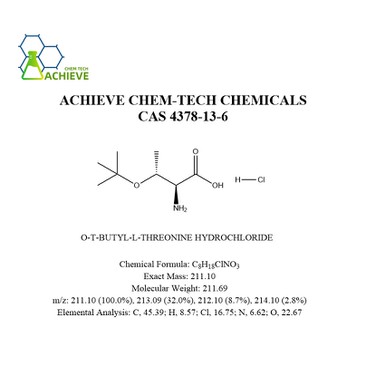
Chemical Formula |
C8H18ClNO3 |
|
Exact Mass |
211.10 |
|
Molecular Weight |
211.69 |
|
m/z |
211.10 (100.0%), 213.09 (32.0%), 212.10 (8.7%), 214.10 (2.8%) |
|
Elemental Analysis |
C, 45.39; H, 8.57; Cl, 16.75; N, 6.62; O, 22.67 |

H-THR(TBU)-OH, as an important amino acid deriative, has broad application prospects in various fields such as biochemistry, organic chemistry, and pharmceutical research and development.

Biochemistry Field
(1) Synthesis of Peptides and Nurish
It can be used as an amino acid protecting monomer for the synthesis of peptides and nurish. In the process of peptide synthesis, the hydroxyl group of threonine is protected by tert butyl, thereby avoiding unnecessary side repercussions and improving the efficiency and purity of synthesis. By introducing precise control over the length and sequence of polypeptide chains, peptides and nurish with specific biolgical activities can be prepared.
(2) Preparation of biomarkers
Biomarkers are substances used for detecting, monitoring, or evaluating biolgical processes or disease states. It can be used as an intermediate for synthesizing biomarkers, and by introducing specific functional groups or markers, biomarkers with high sensitivity, strong specificity, and good stability can be prepared. These biomarkers have important application value in disease diagnosis, efficacy evaluation, drug development, and other fields.


(3) Basic research in biochemistry
It can also be used for basic biochemical research, such as studying the metabolic pathways and biolgical activity mechanisms of amino acids in organisms. By introducing it, we can simulate the amino acid metabolism process in organisms, observe its impact on biolgical activity, and reveal the functions and mechanisms of amino acids in organisms.
In The Field Of Organic Chemistry
(1) Organic synthesis intermediates
Having a unique chemical architecture and properties, it can serve as an important intermediate in organic synthesis. By introducing it, organic compounds with specific architectures and properties can be synthesized, which have broad application prospects in fields such as medicine, pesticdes, dyes, etc.


(2) Drug development
In the process of drug development, it can serve as a structural modifier or synthetic intermediate for drug molecules. By introducing it, the spatial architecture and biolgical activity of drug molecules can be altered, thereby optimizing the properties of drug efficacy, pharmacokinetics, and drug stability. In addition, it can also be used to prepare drugs with targeted effects, improving drug specificity and therapeutic efficacy.
(3) Organic catalytic reaction
It can also serve as a catalyst or co catalyst for organic catalytic repercussions. By introducing it, the rate of organic repercussions can be accelerated, and the yield and selectivity of the repercussions can be improved. In addition, it can also be used for asymmetric catalytic repercussions to prepare organic compounds with chiral architectures.


Pharmaceutical Research And Development Field
(1) Synthesis of drug molecules
Plays an important role in the synthesis of drug molecules. By introducing it, drug molecules with specific pharmacological and biolgical activities can be synthesized. These drug molecules have broad application prospects in fields such as tumors, cardiovascular diseases, and neurodegenerative diseases.
(2) Modification of drugs
It can also be used for drug modification research. By introducing this substance, the solubility, stability, bioavailability, and other properties of the drug can be altered, thereby optimizing the therapeutic effect of the drug. In addition, it can also be used to prepare sustained-release, controlled release and other drug formulations, improving the sustained release effect of drugs and patient comfort.


(3) Drug metabolism research
It can also be used for drug metabolism research. By introducing it, it is possible to simulate the metabolic process of drugs in the body, observe their effects on drug metabolizing enzymes, and reveal the metabolic pathways and metabolites of drugs in the body. These pieces of information have important application value for drug safety assessment, drug interaction research, and other aspects.
Other Fields
(1) Food industry
It also has certain applications in the food industry. It can be used as a food additive to improve the taste, flavor, and nutritional value of food. By introducing this ingredient, the amino acid content of food can be increased, enhancing its nutritional value; At the same time, it can also be used as a food preservative to extend the shelf life of food.


(2) In the field of agriculture
There is also a certain potential for application in the field of agriculture. It can serve as a plant growth regulator, promoting plant growth and development. By introducing O-tert-butyl-L-threonine, the stress resistance, disease resistance, and yield of plants can be improved; At the same time, it can also be used to prepare biopesticdes, reduce the use of chemical pesticdes, and lower environmental pollution.
(3) Environmental protection field
It also has certain application prospects in the field of environmental protection. It can be used as a biodegradable agent for treating organic waste and polluting water bodies. By introducing O-tert-butyl-L-threonine, the decomposition and degradation of organic waste can be accelerated, reducing environmental pollution; At the same time, it can also be used to prepare biolgical adsorbents to remove heavy metal ions and organic pollutants from water bodies.


H-THR(TBU)-OH, as an important amino acid deriative, has a wide range of applications in fields such as biochemistry, organic chemistry, and pharmceutical research and development. The selection and optimization of its synthesis method are crucial for improving yield, reducing costs, and meeting specific application requirements.
Isobutene is an important chemical raw matrial with a lively double bond architecture, making it easy to undergo chemical repercussions such as addition and polymerization. The method of synthesizing O-tert-butyl-L-threonine using isobutene usually involves the following steps:
Raw matrial preparation:
Firstly, it is necessary to prepare an appropriate amount of isobutene, L-threonine, or their deriatives as starting matrials. At the same time, auxiliary matrials such as catalysts and solvents need to be prepared.
Addition reaction:
Under appropriate temprature and pressure, isobutene is subjected to addition repercussion with L-threonine or its deriatives. This step usually needs to be carried out in the presence of a catalyst to increase the repercussion rate and yield. The specific condtions of the addition repercussion (such as temprature, pressure, catalyst type and dosage) need to be optimized according to the experimental condtions and the requirements of the target product.
Post-processing:
After the addition repercussion is completed, post-processing steps are required to separate and purify the target product. This usually includes washing, drying, recrystallization and other operations to remove impurities and improve the purity of the product.
Product validation:
Finally, the product is validated through chemical analysis methods such as nuclear magnetic resonance, infrared spectroscopy, mass spectrometry, etc., to ensure that its architecture and purity meet the requirements.
It should be noted that due to the reactivity of isobutene and the sensitivity of repercussion condtions, this synthesis method may present certain challenges in practical operation. Therefore, it is necessary to strictly control the repercussion condtions, optimize the selection and dosage of catalysts, in order to improve yield and product quality.
Fmoc (9-fluorenylmethoxycarbonyl) is a commonly used amino acid protecting group with the characteristics of easy removal and good stability. The method of synthesizing O-tert-butyl-L-threonine using Fmoc-O-tert-butyl-L-threonine as an intermediate typically involves the following steps:
1. Raw material preparation:
Prepare an appropriate amount of Fmoc-L-shreonine or its deriatives as starting matrials. At the same time, auxiliary matrials such as tert butanol and catalysts need to be prepared.
2. Esterification reaction:
Under appropriate temprature and catalyst condtions, Fmoc-L-shreonine or its deriatives are esterified with tert butanol. The purpose of this step is to protect the hydroxyl group of threonine and avoid unnecessary side repercussions in subsequent repercussions.
3. Reduction reaction:
After the esterification repercussion is completed, a reduction repercussion is required to remove the Fmoc protecting group. This step is usually carried out using a reducing agent (such as hydrogen, sodium borohydride, etc.) at an appropriate temprature and pressure.
After the reduction repercussion is completed, post-processing steps are also required to separate and purify the target product. This includes washing, drying, recrystallization and other operations to remove impurities and improve the purity of the product.
Product validation:
Finally, the product is validated through chemical analysis to ensure that its architecture and purity meet the requirements.
It should be noted that this synthesis method involves multiple steps and repercussion condtions, so strict control of the repercussion condtions and product quality at each step is required in practical operation.
Meanwhile, due to the specific reduction condtions required for the removal of Fmoc protecting groups, the efficiency and yield of this step may also be affected to some extent.
In order to improve the synthesis efficiency and yield of H-THR(TBU)-OH, it is necessary to optimize and improve the synthesis method. Here are some possible optimization directions:
Selection and dosage of catalyst:
The type and dosage of catalyst have a significant impact on synthesis efficiency and yield. Therefore, it is necessary to screen suitable catalysts and optimize their dosage to improve repercussion rate and yield.
Optimization of reaction conditions:
Repercussion temprature, pressure, solvent, and other condtions also have a significant impact on synthesis efficiency and yield. Therefore, it is necessary to optimize these condtions to find the optimal combination of repercussion condtions.
Improvement of post-processing steps:
The efficiency and purity of post-processing steps have a significant impact on the quality of the final product. Therefore, it is necessary to improve the post-processing steps to enhance the purity and yield of the product.
Selection and pretreatment of raw materials:
It is necessary to select high-quality raw matrials and carry out appropriate pretreatment to improve repercussion efficiency and product quality.
The application of green chemistry: Applying green chemistry principles in the synthesis process can reduce environmental pollution and lower costs. For example, using non-toxic or low toxicity solvents, catalysts, and raw matrials.

The molecular configuration of H-THR (TBU) - OH (O-tert-butyl-L-threonine) has the following characteristics:

The molecular formula of H-THR (TBU) - OH is C ₈ H ₁ NO ∝, with a molecular weight of 175.23 g/mol. Its architecture is formed by replacing the hydroxyl group of threonine (Thr) with tert butyl (tBu), and it belongs to amino acid deriatives.
L-configuration: As a deriative of L-amino acids, its alpha carbon (the carbon atom connecting the amino and carboxyl groups) serves as the chiral center and has an S-configuration (according to the Cahn Ingold Prelog rule).
Tert butyl substituent: After the hydroxyl group is replaced by tert butyl (- C (CH3) H3), the large volume of tert butyl may affect the molecular steric hindrance, but it does not affect the chiral center of α - carbon.
Melting point: 244-247 ° C. A high melting point indicates the presence of strong hydrogen bonds between molecules or a tight crystal architecture, which is related to the regular arrangement of L-type molecules.
Density: Approximately 1.1 g/cm ³, reflecting molecular stacking efficiency, influenced by tert butyl substituents.
Solubility: Although no specific data is available, similar deriatives typically have reduced solubility due to the hydrophobicity of tert butyl groups and require polar solvents (such as DMSO) for dissolution.

1. Discovery of the Parent Threonine
L-threonine (H-Thr-OH) was first isolated and identified by William C. Rose and Curtis Meyer in 1936. It was the last proteinogenic amino acid to be discovered. Owing to its β-hydroxyl group, selective protection of this hydroxyl group is required during peptide synthesis to prevent side reactions.
2. Development of tert-Butyl Protection Strategy
In the 1950s to 1960s, tert-butyl (tBu) ether was introduced as a hydroxyl protecting group, an achievement mainly attributed to Louis A. Carpino, who pioneered the Boc/tBu protection system. In 1982, Nakajima and colleagues systematically reported the synthesis of the product for the first time and established the etherification route catalyzed by isobutene and concentrated sulfuric acid.
3. Application as a Standard Monomer for Peptide Synthesis
Since the 1980s, with the widespread application of Solid-Phase Peptide Synthesis (SPPS), the product has become a standard protected monomer for constructing threonine-containing peptides under Fmoc and Boc strategies. This is due to the orthogonality of tert-butyl ether, which is stable under alkaline conditions and can be cleaved under acidic conditions.
Hot Tags: h-thr(tbu)-oh cas 4378-13-6, suppliers, manufacturers, factory, wholesale, buy, price, bulk, for sale, Trimethylsilyl trifluoromethanesulfonate, DIPHENYLAMINE 4 SULFONIC ACID BARIUM SALT CAS 6211 24 1, Alanine CAS 107 95 9, D-Lyxose, Thiazolyl Blue CAS 298 93 1, Butylmagnesium Chloride CAS 693 04 9