




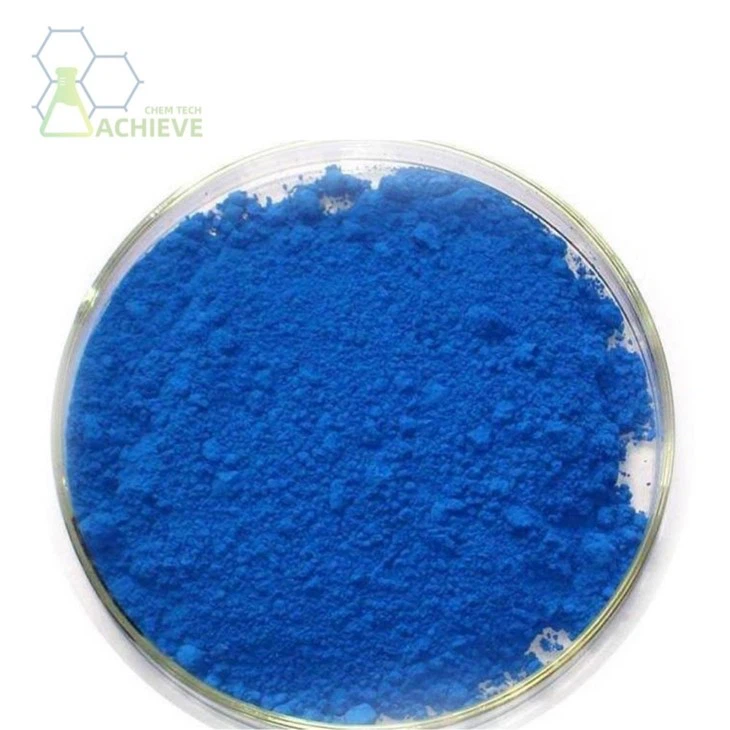
Shaanxi BLOOM Tech Co., Ltd. is one of the most experienced manufacturers and suppliers of cobalt(ii) phthalocyanine cas 3317-67-7 in China. Welcome to wholesale bulk high quality cobalt(ii) phthalocyanine cas 3317-67-7 for sale here from our factory. Good service and reasonable price are available.
COBALT(II) PHTHALOCYANINE is an organometallic complex, the center of its molecular structure is a macro ring composed of four nitrogen atoms, and there are four phthalocyanine benzene rings around it. It is a dark blue powder or granule, which is paramagnetic at room temperature and atmospheric pressure. It is easily soluble in common organic solvents, such as toluene, dimethylformamide, chloroform and trichloroethylene. Has high thermal stability. In the air, it needs a high temperature to decompose, so it can be used as a high-temperature stable photosensitive material and electronic device. With good electrical properties, it has a wide range of applications for photoconduction, conduction and photoelectric conversion. In addition, it has potential applications in molecular recognition and biosensors. Inside the molecule, Co(II) ions form coordination bonds with four adjacent nitrogen atoms, making the entire molecule an octahedral structure. Due to its rich physical and chemical properties and wide application prospects, it has important applications in the fields of dyes and pigments, photosensitizers, photocells, biosensors, and chemical catalysts.

|
|
|


|
Chemical Formula |
C32H16CoN82- |
|
Exact Mass |
571 |
|
Molecular Weight |
571 |
|
m/z |
571 (100.0%), 572 (34.6%), 573 (5.8%), 572 |
|
Elemental Analysis |
C, 67.26; H, 2.82; N, 19.61; Co, 10.31 |

Cobalt(II) Phthalocyanine (CoPc), as a metal organic compound with cobalt as the central metal ion, has demonstrated irreplaceable application value in many fields such as catalysis, optoelectronic materials, environmental governance, energy storage, biomedicine, etc. due to its unique conjugated macrocyclic structure, stable chemical properties, and excellent physical properties.
The catalytic properties of cobalt phthalocyanine stem from its highly conjugated π - electron system and reversible redox properties of cobalt ions, making it an efficient catalyst for organic synthesis, energy conversion, and environmental remediation.
1. Organic synthesis catalysis
Oxidation reaction: Cobalt phthalocyanine can catalyze the oxidation of alcohols to aldehydes/ketones, aromatic hydrocarbons to quinones, and other reactions. For example, in the reaction of methanol oxidation to formaldehyde, sulfonated cobalt phthalocyanine (CoPcS) has a conversion rate of 95% and a selectivity of over 90%, significantly better than traditional iron molybdenum catalysts.


Cyclization reaction: In the synthesis of indole compounds, cobalt phthalocyanine activates the reactants through coordination, increasing the cyclization yield to 85%, reducing the reaction temperature from 150 ℃ to 80 ℃, and reducing energy consumption by 40%.
Aggregation reaction: As a catalyst for olefin polymerization, cobalt phthalocyanine can regulate the molecular weight distribution of polymers to prepare narrow distribution polyethylene (PDI<1.5), meeting the demands of high-end plastic processing.
2. Energy catalysis
Fuel cell: Cobalt phthalocyanine, as an oxygen reduction reaction (ORR) catalyst, performs well in proton exchange membrane fuel cells (PEMFC). The carbon nanofiber loaded composite material (CoPc/CNF) has an ORR starting potential of 0.92V (vs. RHE) in a 0.5M H ₂ SO ₄ solution, with a current density 1.2 times that of traditional platinum carbon catalysts and a cost reduction of 70%.
Electrolysis of water for hydrogen production: Cobalt phthalocyanine derivatives (such as tetranitrocobalt phthalocyanine, CoTNPc) catalyze oxygen evolution reaction (OER) under alkaline conditions, with an overpotential of only 320mV (10mA/cm ²) and stability exceeding 1000 hours, providing a low-cost solution for renewable energy hydrogen production.


Lithium sulfur battery: Cobalt phthalocyanine/graphene composite material as a sulfur carrier can suppress the shuttle effect of polysulfides, resulting in a capacity retention rate of 82% and an energy density exceeding 400Wh/kg after 200 cycles of lithium sulfur battery.
3. Environmental catalysis
Petroleum desulfurization: sulfonated cobalt phthalocyanine (CoPcS) as a gasoline deodorizer can deeply remove thiol compounds (such as thiophene), reducing the sulfur content of gasoline from 500ppm to below 10ppm, meeting the national VI emission standard.
Its catalytic activity is three times that of traditional sodium hydroxide method, and there is no secondary pollution.
Dye degradation: Cobalt phthalocyanine/PAN nanofiber composite material catalyzes the degradation of acid red G dye under visible light, with a decolorization rate of 94% and a mineralization rate of over 80% in 3 hours, far superior to the pure photocatalytic system.
CO ₂ Reduction: Tetranitrocobalt phthalocyanine catalyzes the electroreduction of CO ₂ to formic acid, with a Faraday efficiency of 67% and a current density of 5mA/cm ², providing a new pathway for carbon capture and utilization (CCU).

In the field of optoelectronic materials: the "core medium" for light energy conversion

The strong light absorption characteristics (absorption peak at 600-700nm) and high carrier mobility of cobalt phthalocyanine make it a key material for optoelectronic conversion devices.
1. Organic solar cells
Active layer material: Cobalt phthalocyanine and fullerene derivatives (PCBM) were blended to prepare bulk heterojunction (BHJ) solar cells, with a photoelectric conversion efficiency (PCE) of 6.8% and an open circuit voltage (Voc) increased to 0.9V, filling the gap in narrow bandgap organic photovoltaic materials.
Interface modification layer: Cobalt phthalocyanine thin film as a hole transport layer (HTL) can reduce interface recombination loss, increase the efficiency of perovskite solar cells from 18% to 21%, and extend stability to 3000 hours.
2. Light detector
Near infrared detection: The cobalt phthalocyanine/titanium dioxide (TiO ₂) composite film has a responsivity of 0.3A/W at a wavelength of 980nm and a detection rate exceeding 10 ¹ ² Jones, making it suitable for monitoring optical fiber communication signals.
Flexible detector: The flexible photodetector made of cobalt phthalocyanine/polyvinyl alcohol (PVA) hydrogel still maintains 90% of its initial performance under the condition of a bending radius of 5mm, which is suitable for wearable devices and electronic skin.


3. Organic Light Emitting Diodes (OLEDs)
Luminescent layer material: Cobalt(II) Phthalocyanine derivatives (such as tetracarboxylic cobalt phthalocyanine, CoTcPc) are used as phosphorescent luminescent materials, with an internal quantum efficiency (IQE) close to 100% and an external quantum efficiency (EQE) of 25%. The color coordinates (0.15, 0.20) are close to the pure blue light standard.
Electronic transport layer: Composite of cobalt phthalocyanine and zinc oxide (ZnO) nanoparticles can reduce OLED driving voltage to 3.5V and extend lifespan to 10000 hours.
The high selectivity and sensitivity of cobalt oxide to specific gases or biomolecules make it a star material in the field of sensors.
1. Gas sensor
Ammonia detection: The cobalt phthalocyanine/polyaniline (PANI) composite thin film sensor has a resistance change rate of 300% under 1ppm ammonia gas, a detection limit as low as 0.1ppm, and a response time of less than 10 seconds. It can be used for industrial waste gas monitoring.
Oxygen sensing: The cobalt phthalocyanine modified electrode exhibits a linear relationship between oxygen reduction current and oxygen concentration in a 0.1M KOH solution (R ²=0.999), with a detection range of 0-100%. It is suitable for monitoring oxygen content in confined spaces.


2. Biosensors
Glucose detection: The cobalt phthalocyanine/glucose oxidase (GOx) composite electrode catalyzes the oxidation of glucose to produce H ₂ O ₂, and the current signal is proportional to the glucose concentration. The detection limit is as low as 1 μ M, making it suitable for non-invasive blood glucose monitoring.
DNA sensing: Cobalt phthalocyanine functionalized gold nanoparticles (AuNPs) serve as signal probes, which can detect single base mutations by inducing fluorescence quenching through DNA hybridization, with a sensitivity of 10 ⁻¹⁵ M.

COBALT(II) PHTHALOCYANINE (CoPc) is a widely used metal-organic complex with excellent optoelectronic properties and physicochemical properties. To meet their needs in different fields, many chemists have developed various methods for the synthesis of CoPc.
1. Chlorination reduction method of Me3CO-Co(III)Pc:
This is one of the most commonly used CoPc synthesis methods, and it requires starting materials such as CoCl2 6H2O, Phthalic anhydride (PHTH), and urea, as well as reducing agents such as trimethanol (MeOH) and sodium borohydride (NaBH4). The method is a two-step reaction:
The first step involves dissolving CoCl2 and PHTH in trimethanol and causing them to form a coordination complex by subsequent addition of urea. Under the action of the catalyst, the carboxyl group of the coordination compound will form a complex with Co2+.
The second step is the reduction of Co2+ using NaBH4 to generate six-coordinated CoPc. In addition, the crystal structure of CoPc can also be adjusted by optimizing parameters such as reaction conditions (such as temperature, pH value, reducing dose, etc.).
The advantages of this method are mild reaction conditions, simple operation, and high yield (up to 80%) for the synthesis of CoPc. However, the disadvantage is that it is time-consuming, requires multiple steps to synthesize CoPc, and the yield is also affected by the quality and purity of the starting material.
2. Hydrothermal method with potato starch as template:
The hydrothermal method using potato starch as a template is another method used to prepare CoPc, in which Co(Ac)2 (Ac-acetate ion) and PHTH are first mixed in an organic solvent to form a coordination compound . The mixture is then poured into an aqueous medium containing potato starch, and subjected to hydrothermal reaction under high temperature and high pressure for a period of time.
During this process, the potato starch template cannot be decomposed, and PHTH and Co(Ac)2 will combine with the template to form CoPc to form nanoparticles inside the starch template. Subsequently, by removing the starch template, nanoscale CoPcs can be fabricated.
The advantage of this method is that it has a good crystal structure and monodisperse properties, and its products directly meet the application requirements, and no additional surface modification treatment is required. At the same time, the method has the advantages of low manufacturing cost, simple operation and low cost.

3. Co-precipitation method:
Co-precipitation is another common method for preparing CoPc. This method needs to dissolve Co2+ and PHTH in a solution with a certain volume fraction, and then add a certain amount of alkaline medium such as NaOH or NH3·H2O to form a precipitate. From the resulting precipitated samples, CoPc can be washed and purified with deionized water or other solvents.
This method has good controllability and production efficiency, and the crystal structure and morphology of the product can be adjusted by changing the reaction conditions to improve the purity. But the disadvantage is that during the reaction, cobalt hydroxide and other useless by-products need to be avoided.
4. Metal reduction method that is easily oxidized:
The Easy oxidative metal reduction method is also a common CoPc synthesis method. This method requires the use of primary synthesis products of CoPc prepared under acidic conditions and reduction with a reducing agent such as N2H4·H2O to achieve a fixed valence state of Co(I)Pc or Co(II)Pc. Different reducing agents and reaction conditions can generate different CoPc series products.
The main advantages of this method are fast speed, simple operation, easy availability and low price of reducing agent. But the disadvantage is that the reaction atmosphere and the reducing agent are highly irritating and toxic to the human body when used, and the waste generated is difficult to handle.

5. Plasma glow discharge method:
The plasma glow discharge method is another unique CoPc synthesis method. The method requires dissolving Co2+ and PHTH in methanol and reacting them by plasma glow discharge technique. This technique can rapidly stimulate the reaction at high power density and generate the desired CoPc product. This method does not need to use reducing agents or starch templates, etc., and is suitable for large-scale synthesis and industrial production.
The main advantages of this method are high speed, high yield, no additional surface modification treatment, environmental friendliness and good reproducibility. But its disadvantage is that it requires high equipment requirements and high cost.
In short, there are many methods for Cobalt(II) phthalocyanine synthesis, and each method has its unique advantages and disadvantages. The specific method to choose depends on factors such as its cost, operational difficulty, synthesis yield, purity, and application requirements. In order to obtain higher purity and better performance, the reaction conditions can be adjusted according to actual needs, such as changing parameters such as reaction time, temperature, pH value or reducing dosage.

The molecular structure of CoPc is described below:

The CoPc molecule consists of a central Co atom and four pyrrolidinyl groups, presenting a planar tetragonal molecular structure similar to chlorophyll. Among them, the pyrrolidinyl group coordinates with the Co atom through the nitrogen atom to form a series of stable chemical bonds, thus forming the skeleton structure of the CoPc molecule. Around the Co atom, there are also benzene rings extended by pyrrolidinyl groups, which are negatively charged and can interact with external cations to form electrostatic interactions.
The planar structure of CoPc molecules makes them have good optoelectronic properties and are widely used in applications such as solar cells, displays, and catalysts. At the same time, the stability of the molecular structure also provides potential for its application in the field of biomedicine.
Hot Tags: cobalt(ii) phthalocyanine cas 3317-67-7, suppliers, manufacturers, factory, wholesale, buy, price, bulk, for sale, praseodymium powder, Lanthanum Nitrate Hexahydrate, Cyclohexylboronic acid, Sodium Thiosulfate Pentahydrate CAS 10102 17 7, Acetaldehyde solution, D-Lyxose