


When your dog keeps scratching, or your cat seems restless, parasites like fleas and ticks are often the culprit. Fipronil spot-on has become one of the most trusted topical solutions for pet owners and veterinary professionals worldwide - and for good reason. Its mechanism of action is precise, potent, and well-understood by scientists. But what exactly happens inside a parasite when fipronil makes contact? This article breaks it down in plain language so you can understand why this product works so effectively.

Fipronil Spot-On
1.General Specification(in stock)
(1)API(Pure powder)
PE/Al foil bag/ paper box for Pure powder
(2)Spot-On
cat:0.5ml
dog:0.67ml:2-10kg/1.34ml:10-20kg/2.68ml:20-40kg/4.02ml:40-60kg
(3)Solution
(4)Drops
2.Customization:
We will negotiate individually, OEM/ODM, No brand, for secience researching only.
Product Code:BM-9-018
Fipronil CAS 120068-37-3
How Does Fipronil Spot-On Target Parasite GABA-Gated Chloride Channels?
The Receptor: A Microscopic Lock That Fipronil Opens Permanently
Fipronil acts by attacking a particular molecule called the GABA-gated chloride channel. Gamma-aminobutyric acid, or GABA, is the principal neurotransmitter that inhibits nerve transmission in the neurological systems of animals. Under normal conditions, GABA binds to these channels. This allows chloride ions to enter the nerve cell and decreases neuronal activity. This keeps the parasite's nervous system quiet and under control.
Fipronil spot-on inhibits this process by attaching directly to the same receptor location but with a considerably greater affinity. Once fipronil is in the channel, it essentially blocks it, such that chloride ions cannot enter.


The nerve cell can no longer receive its "calm down" message.
One of the key elements in the design of fipronil is selective toxicity. Cats and dogs contain GABA-gated chloride channels, although they are mostly in the brain and central nervous system, protected by the blood-brain barrier. In animals, fipronil doesn't cross this barrier very well, meaning that its effects on the target species are significantly lower. In insects and spiders, however, these passages are open and accessible from outside the body; thus, they are particularly susceptible. This biological difference makes fipronil spot-on effective against parasites and safe to use consistently for dogs when handled correctly.
Selectivity: Why Pets Stay Safe While Parasites Suffer
A critical feature of fipronil's design is its selective toxicity. In mammals like cats and dogs, GABA-gated chloride channels exist but are located primarily within the central nervous system, protected by the blood-brain barrier. Fipronil has limited ability to cross this barrier in mammals, which dramatically reduces its effect on the host animal. In insects and arachnids, however, these channels are exposed and accessible throughout the peripheral nervous system, making them highly vulnerable. This biological distinction is what makes fipronil spot-on both effective against parasites and safe for routine pet use when applied correctly.

Fipronil Spot-On and the Disruption of Inhibitory Nerve Signaling

What Happens When Inhibition Fails in a Parasite's Nervous System
To make a nerve system operate, it needs balance. Excitation and inhibition must work together. When fipronil inhibits the GABA-gated chloride channels, the inhibitory side of that balance is disturbed. Nerve cells begin shooting out of control. The electrical signals that should be damped down continue to intensify, propagating uncontrollably through the neurological system of the parasite.
This impact does not occur incrementally or over time. Studies published in journals of pesticide biochemistry demonstrate that fipronil binds to insect GABA receptors several times more potently than it binds to human GABA receptors, often by a ratio of 500 or more.
This differential in receptor sensitivity explains why a quantity potent enough to kill a flea has little impact on the nervous system of a 10-kilogram dog.
Absorption Through the Skin: How the Drug Reaches Its Target
The fipronil spot-on did not remain on the skin behind the neck after application. The active substance diffuses via the oil glands and throughout the body surface by means of the fatty layer of the skin. Fipronil is highly lipophilic and has a high affinity for hair shafts and skin oils, providing a depot for long-term release. Studies have indicated that 30 days after application, the quantity of medication on a cat's skin surface may be roughly 60% of what it was.

This technique guarantees that any parasite that touches the pet's skin or hair will come into contact with the active ingredient no matter where it feeds.
Why Does Chloride Channel Blockade Cause Parasite Hyperexcitation?

The Neurochemical Logic Behind Overactivation
The cell's stable membrane potential changes when chloride ions can't get into the neuron anymore. The neuron becomes more and more depolarized, which means that its charge level stays close to its firing threshold at all times. A full action potential is now set off by any small input that would normally have no effect. The nerve basically turns into a hair-trigger and fires all the time without being able to stop it.
It is possible to see this state of continuous neural excitement. Fleas and ticks that are infected move their legs randomly, shake, and can't keep their posture straight. These behavioral signs show that the parasite has lost control of its movements because of overactive neurons all over its body.
How Does Fipronil Spot-On Progress From Neural Disruption to Paralysis?
From Tremors to Full Systemic Shutdown
The body does things in a certain sequence. First it blocks receptors, then it dies. The neuron must restore ionic equilibrium using adenosine triphosphate (ATP) after each firing event. Therefore, hyperexcitation rapidly depletes the parasite's energy reserves. "Channels are always kept shut, neurons are always firing, so ATP is depleted faster. The muscle twitches cease acting together and finally stop performing altogether when the neuromuscular connection quits functioning.
Most kinds of bugs will be paralyzed after touching a human, and they can not recover. Lab experiments reveal that fipronil spot-on kills over 98% of adult fleas within 24 hours, if circumstances are controlled.


Contact Kill vs. Ingestion: Two Pathways to the Same Outcome
Fipronil can be absorbed through touch or food. A flea doesn't have to bite the host to be killed; it only needs to walk across treated skin to be exposed to enough to kill it. This contact-kill ability is very useful because it stops the parasite from reproducing before it feeds, which lowers the risk of disease spread. Ticks, which need to stay attached for a long time to feed, are also hurt when they touch treated skin or fur.
Mapping the Fipronil Spot-On Mechanism From Receptor to Parasite Control
The Full Chain: Binding → Signal Collapse → Paralysis → Death
The way fipronil spot-on works is like a chain of events that make sense. When fipronil binds to the GABA receptor, chloride flow stops, inhibitory communication stops working, neurons fire too quickly, energy stores run out, paralysis sets in, and the parasite dies. Due to the fact that each step builds on the last, this substance has been the standard for decades in controlling parasites on the skin.
Residual Activity and the 30-Day Protection Window
Fipronil kills the germs right away, and its protection lasts for a long time because it is still in the skin and hair follicles.
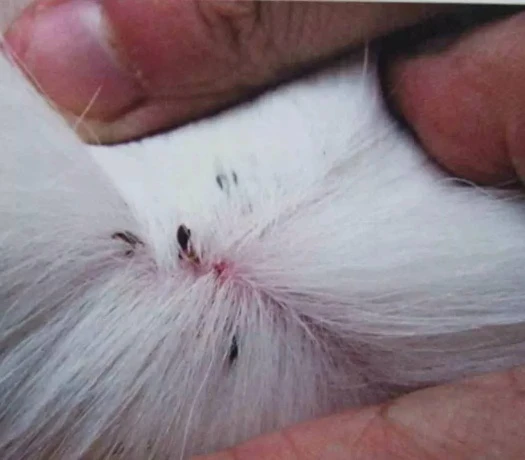
Because the substance keeps coming out of the lipid layer of the skin, parasites that come back can still find active amounts weeks after the first treatment. Using the right amount correctly has been shown in clinical studies to protect most cats for up to 30 days. Newer formulation improvements have made this window even longer, to eight weeks.
Conclusion
The way that fipronil spot-on works is very precise and beautiful. Fipronil kills parasites by messing with their nerves by going after a receptor that invertebrates need but that mammals usually block from outside chemicals. It is very safe for pets. Knowing how this works helps pet owners and people who work in the business understand why product quality, recipe integrity, and the right dose are so important in real life.
FAQ
1. How does fipronil spot-on kill fleas and ticks?
+
-
Fipronil spot-on acts on the GABA-gated chloride channels of parasites. Blocking these channels interferes with inhibitory nerve signalling leading first to uncontrolled neural activity, then to paralysis and death.
2. Does a flea need to bite a treated pet for fipronil spot-on to work?
+
-
No. The article notes that fipronil may be effective via touch or ingestion. The flea may come into contact with it as it wanders through the treated skin or hair, and doesn't need to bite the host first.
3. How long can fipronil spot-on provide residual flea control?
+
-
The article says that when used appropriately, fipronil spot-on may keep cats flea-free for up to 30 days. It also says that improved formulations might extend this period to eight weeks.
Partner With Bloomtechz - Your Trusted Fipronil Spot-On Supplier
If your business needs a trusted fipronil spot-on supplier with proven GMP manufacturing skills, Bloomtechz is the company you need. Bloomtechz has been in business since 2008 and has a 100,000-square-meter GMP-approved production site that is also certified by the US FDA, the EU, Japan, and China. There are three separate levels of quality control in our process: factory, in-house QA/QC, and an independent, third-party authority. This makes sure that every batch you receive meets the terms of the contract. We work with 24 big international clients in the specialty chemical, pharmaceutical, and veterinary fields. Our R&D and production teams are ready to help you reach your goals, whether you need stock API, ready-to-use spot-on recipes, or OEM/ODM customization. Please email us at Sales@bloomtechz.com right away, and we'll work together to build a long-term supply relationship based on trust, honesty, and accuracy.
References
1. Bloomquist, J. R. (1996). Ion channels as targets for insecticides. Annual Review of Entomology, 41, 163–190.
2. Cole, L. M., Nicholson, R. A., & Casida, J. E. (1993). Action of phenylpyrazole insecticides at the GABA-gated chloride channel. Pesticide Biochemistry and Physiology, 46(1), 47–54.
3. Gunning, R. V., Moores, G. D., & Devonshire, A. L. (1999). Esterases and esfenvalerate resistance in Australian Helicoverpa armigera. Pesticide Biochemistry and Physiology, 63(1), 50–62.
4. Hainzl, D., Cole, L. M., & Casida, J. E. (1998). Mechanisms for selective toxicity of fipronil insecticide and its sulfone metabolite and desulfinyl photoproduct. Chemical Research in Toxicology, 11(12), 1529–1535.
5. Meinke, P. T. (2001). Animal health anthelmintics and ectoparasiticides: Current status and future trends. Journal of Medicinal Chemistry, 44(5), 641–659.
6. Schroeder, M. E., & Flattum, R. F. (1984). The mode of action and neurotoxic properties of the nitromethylene heterocycle insecticides. Pesticide Biochemistry and Physiology, 22(2), 148–160.