


Abstract
Luteolin, a naturally occurring flavonoid abundant in various plant sources such as celery, green peppers, perilla leaves, and medicinal herbs like skullcap and artichoke, has garnered significant scientific attention in recent years due to its diverse biological activities and potential therapeutic applications. This comprehensive review delves into the chemical structure, natural occurrence, pharmacological properties, mechanisms of action, and clinical implications of luteolin, highlighting its potential as a therapeutic agent against a wide array of diseases.
Introduction
Flavonoids, a subclass of polyphenolic compounds, are renowned for their antioxidant, anti-inflammatory, and chemopreventive properties. Among them, luteolin (3',4',5,7-tetrahydroxyflavone) stands out as a potent bioactive molecule with a broad spectrum of biological effects. Its unique chemical structure, characterized by four hydroxyl groups at specific positions on the flavonoid backbone, contributes significantly to its high reactivity and biological potency. This review aims to provide an in-depth understanding of the current scientific knowledge surrounding luteolin, emphasizing its mechanisms of action and potential therapeutic uses.
|
|
|


Chemical Structure and Natural Occurrence
Luteolin belongs to the flavone subclass of flavonoids, featuring a basic C6-C3-C6 skeleton with two aromatic rings (A and B) connected by a heterocyclic pyran ring (C). Its molecular formula is C15H10O6, and it exists in nature primarily as a glycoside conjugate, enhancing its solubility and bioavailability in plants. It is a golden needle-shaped solid separated from ethanol and contains one crystal water. It is soluble in ethanol and ether; slightly soluble in hot water, and difficult to dissolve in cold water. The aqueous solution is a pleasing light yellow, and it is soluble in 10% sodium hydroxide aqueous solution and is dark yellow. It is stable under normal conditions.
|
|
|
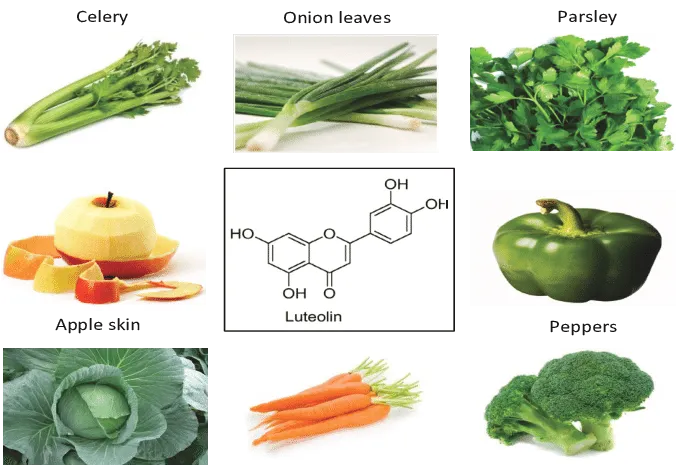

It is mainly found in medicines such as honeysuckle, chrysanthemum, nepeta, and white-haired selfhen. It is also found in vegetables such as thyme, Brussels sprouts, cabbage, cauliflower, beet, broccoli, and carrots. It is also found in celery, green pepper, perilla leaf, and arachis hypogaea fruit shell, ajuga decumbus, lonicera japonica thunb, gentianopsis paludosa, valeriana amurensis smir, and many other plants in the form of glycosides.
Pharmacological Properties
Luteolin has a variety of pharmacological activities, and plants rich in luteolin are often used as traditional Chinese medicine to treat diseases. With the in-depth research on luteolin, it has been found that it has anti-tumor effects such as inhibiting tumor cell proliferation, inducing tumor cell apoptosis and sensitizing the activity of anti-cancer drugs. It also has anti-inflammatory, antioxidant and effects on the nervous system. Protection and other functions.
Luteolin is a PDE4 inhibitor, phosphodiesterase inhibitor 2 and interleukin 6 inhibitor 3. It significantly reverses xylazine/ketamine-induced anesthesia in mice. 4 Preclinical studies have shown that luteolin may have pharmacological effects, including antioxidant, anti-inflammatory, antibacterial and anti-cancer Chemicalbook. Preliminary studies have found that luteolin can inhibit angiogenesis and induce apoptosis, affect the development of tumors in animal models, reduce the growth rate of tumors, and increase the cytotoxicity of certain anti-cancer drugs to tumor cells, indicating that luteolin may be a Potential cancer chemopreventive and chemotherapeutic agents.
The mechanism of luteolin's biological activity may be to regulate the level of ROS, inhibit topoisomerase I and topoisomerase II, reduce the activity of NF-κB and AP-1 transcription factors, stabilize p53 and Chemicalbook to inhibit phosphoinositide 3- Kinase, signal transducer and activator of transcription 3 (STAT3), insulin-like growth factor 1 receptor (IGF1R) and human epidermal growth factor receptor II activities.
|
|
|
|


Luteolin exhibits potent antioxidant activity by scavenging free radicals, including reactive oxygen species (ROS) and reactive nitrogen species (RNS), and chelating metal ions. This property is attributed to its hydroxyl groups, which can donate hydrogen atoms to stabilize free radicals, thereby protecting cells and tissues from oxidative damage.
Luteolin modulates inflammatory responses by inhibiting the production of pro-inflammatory cytokines (e.g., TNF-α, IL-1β, IL-6), chemokines, and adhesion molecules. It achieves this through multiple pathways, including suppression of NF-κB and MAPK signaling cascades, which are crucial regulators of inflammation.
Luteolin has shown promising anticancer activity against various cancer types, including breast, prostate, lung, and colon cancers. Its mechanisms involve inhibiting cell proliferation, inducing apoptosis, suppressing angiogenesis, and modulating cancer stem cell properties. Luteolin also sensitizes cancer cells to chemotherapy and radiation therapy, enhancing their therapeutic efficacy.
By reducing oxidative stress, inhibiting neuroinflammation, and modulating neurotransmitter systems, luteolin exhibits neuroprotective effects against neurodegenerative diseases such as Alzheimer's disease, Parkinson's disease, and stroke. It also promotes neuronal survival and enhances cognitive function.
Luteolin improves cardiovascular health by reducing blood pressure, inhibiting platelet aggregation, and enhancing endothelial function. It also exhibits anti-atherosclerotic properties by inhibiting the formation of foam cells and reducing lipid accumulation in the vessel wall.
Mechanisms of Action
Luteolin's diverse pharmacological effects are mediated through multiple molecular targets and signaling pathways. Key mechanisms include:
Modulation of Gene Expression
Luteolin regulates the expression of genes involved in inflammation, apoptosis, cell cycle control, and drug metabolism.
01
Interaction with Signaling Pathways
It inhibits the activation of NF-κB, MAPK, PI3K/Akt, and JAK/STAT pathways, which are crucial for inflammation, proliferation, and survival.
02
Antioxidant Activity
As mentioned earlier, luteolin scavenges free radicals and chelates metal ions, protecting cells from oxidative damage.
03
Modulation of Enzyme Activity
It inhibits the activity of enzymes involved in inflammation (e.g., COX-2, LOX) and cancer progression (e.g., aromatase, topoisomerase II).
04
Clinical Implications and Future Perspectives
Despite the promising preclinical data, the clinical translation of luteolin remains limited due to challenges such as low bioavailability, pharmacokinetic variability, and the complexity of human diseases. However, several clinical trials are underway or have been completed, exploring the efficacy and safety of luteolin or luteolin-rich extracts in conditions like cancer, cardiovascular disease, and neurodegeneration.
Future research should focus on:
- Enhancing the bioavailability and stability of luteolin through novel drug delivery systems.
- Elucidating the precise molecular mechanisms underlying its therapeutic effects in specific disease contexts.
- Conducting well-designed, large-scale clinical trials to validate the efficacy and safety of luteolin in humans.
- Exploring the potential of luteolin in combination therapies to enhance therapeutic outcomes.
Conclusion
Luteolin, a naturally occurring flavonoid, possesses a remarkable array of biological activities and holds great promise as a therapeutic agent for various diseases. Its antioxidant, anti-inflammatory, anticancer, neuroprotective, and cardiovascular benefits are mediated through multiple molecular targets and signaling pathways. While further research is needed to overcome challenges related to bioavailability and clinical translation, the current scientific evidence underscores the potential of luteolin as a versatile bioactive molecule with significant therapeutic potential. With continued efforts, luteolin could emerge as a valuable addition to the armamentarium of natural products for the prevention and treatment of human diseases.