


MOTS-c is a polypeptide, easily soluble in water and methanol, but insoluble in ethanol. It is composed of 5 amino acid sequences. It is a new type of hormone in the body, which can regulate energy metabolism and aging process.
MOTS-c is a novel polypeptide molecule produced from a non-coding region in the mitochondrial genes of muscle cells. In recent years, more and more studies have shown that MOTS-c has a wide range of biological functions and can be used for the treatment and prevention of many diseases. Here's a rundown of all the uses for MOTS-c:
1. Metabolic regulation: MOTS-c can enhance insulin sensitivity, inhibit fat accumulation and weight gain, and prevent the occurrence of metabolic diseases such as type 2 diabetes and obesity by regulating energy metabolism.
2. Prevention and treatment of cardiovascular diseases: MOTS-c can prevent the occurrence and development of cardiovascular diseases by lowering cholesterol, inhibiting inflammatory response, promoting endothelial cell function, etc., and can improve myocardial function and protect the heart.
3. Treatment of nervous system diseases: MOTS-c can stimulate the proliferation and growth of nerve cells, protect neurons from oxidative stress and ischemic damage, and improve memory.
4. Anti-aging: MOTS-c can inhibit cell apoptosis and oxidative stress, delay cell aging, and reduce the risk of senile diseases, including senile cognitive impairment, senile muscle atrophy, and senile diabetes.
5. Enhance immune function: MOTS-c can stimulate the proliferation and function of immune cells, enhance the function of the immune system, and prevent the occurrence and development of diseases such as infection and cancer.
In conclusion, MOTS-c, as a new type of polypeptide molecule, has multiple biological functions. With the in-depth study of MOTS-c, its role in the prevention and treatment of many diseases will be further understood and applied.
There are many synthetic routes of MOTS-c polypeptide, the following are some synthetic methods:
method one:
Step 1: Synthesis of dipeptides HNG and MOTS Both HNG and MOTS are peptides composed of multiple amino acids. Their synthesis can be carried out according to standard solid phase synthesis methods. Initial steps include:
Installation of the first amino acid (alanine) on a fixed substrate
Attach a second amino acid (L-tryptophan) to the amino acid
Repeat the above steps to gradually add the remaining amino acids to the peptide chain until complete HNG and MOTS are obtained.
Step 2: Synthesis of MOTS-c Synthesis of MOTS-c requires linking HNG and MOTS together. This process can be achieved by one of the following methods: converting HNG and MOTS into N-terminally modified peptides and linking them together using appropriate chemical reaction conditions.
When synthesizing HNG and MOTS, a conjugating agent is added to the peptide chain to link the two peptide chains together.
Step 3: Purification and characterization Finally, the synthesized MOTS-c needs to be purified and characterized to ensure its purity and correct chemical structure. Purification can be achieved by column chromatography, high performance liquid chromatography, countercurrent thin layer chromatography and other methods. Identification can be performed using techniques such as mass spectrometry and nuclear magnetic resonance.
Method Two:
1. Raw material preparation: The raw material synthesis of MOTS-c requires the pre-synthesis of protective groups (such as Fmoc and Boc), amino acids (such as alanine, arginine, lysine, etc.) and other chemicals.
2. Solid-phase synthesis: use solid-phase synthesis technology to connect the first protected amino acid to the last amino acid immobilized on the resin in the reactor. Repeat the steps of amino acid addition, deprotection, coupling, etc. until the target polypeptide is synthesized.
3. Hydrofluoric acid treatment: The fatty acids synthesized by MOTS-c are all removed, and a hydrofluoric acid treatment is performed to remove the protecting group.
4. HPLC purification: the compound is purified by high performance liquid chromatography to obtain the MOTS-c polypeptide.
5. Mass spectrometry identification: use mass spectrometry to analyze and identify MOTS-c to ensure that the obtained peptide meets the structural requirements.
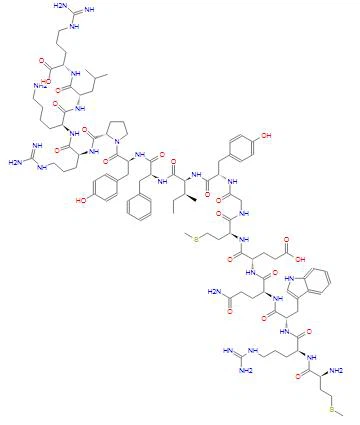
It should be noted that the above synthetic route is only an approximate step. Since the specific situation will vary due to factors such as experimental conditions, it is recommended to consult relevant literature before actual operation, follow the standard operating procedures and take strict experimental safety protection measures.
MOTS-c is a polypeptide composed of 905 amino acids, which is considered as a molecule with anti-aging and anti-diabetic effects. It was first discovered in 2015 and has been shown to improve insulin sensitivity and mobility in mice. Further research found that MOTS-c can also promote fat breakdown and enhance muscle strength, making it a potential drug for the treatment of diabetes and obesity.
In terms of its chemical properties, MOTS-c is a cationic peptide with a molecular weight of about 10 kDa, and its molecular structure resembles a string of helical and folded amino acid chains. It has two histidine residues near the N-terminus, which may contribute to the antioxidant and anti-inflammatory effects of MOTS-c. MOTS-c is relatively stable and easily soluble in water, but can be destroyed by treatments such as incubation and sonication.
The development history of MOTS-c is relatively short, but impressive progress has been made. In 2015, researchers found that using gene chip technology to compare small molecules released by exercising and resting muscles, they unexpectedly discovered that a new polypeptide MOTS-c was dynamically regulated muscle metabolism and acetyl-CoA synthesis, thereby improving energy Metabolism and insulin sensitivity. Since then, in a paper published in the journal Cell, MOTS-c has been shown to improve muscle energy metabolism, liver compliance, and neuronal proliferation in rats. Subsequently, other studies have also found that MOTS-c has a wide range of effects on the physiological characteristics of different tissues and organs, including cardiovascular health, metabolic diseases and obesity, central nervous system function, muscle function and skeletal muscle function, etc. Collectively, these studies suggest that MOTS-c is a potential drug for the treatment of many metabolic and neurodegenerative diseases, but more studies must be performed to evaluate its safety and efficacy for clinical use.
The development prospects of MOTS-c are bright. MOTS-c has fewer adverse effects than other diabetes, obesity and metabolic disease drugs. Its downside is that it is more expensive to produce and more research is needed to determine its optimal amount and method of administration. However, the potential applications of MOTS-c are vast and extensively studied, and thus, it is expected to play an important role in the future treatment and prevention of metabolic and neurological diseases.