


Norepinephrine tartrate (Link:https://www.bloomtechz.com/synthetic-chemical/api-researching-only/norepinephrine-tartrate-cas-3414-63-9.html) is an important bioactive molecule with a wide range of applications. It is a complex compound mainly composed of norepinephrine and tartaric acid. In this article, I will describe in detail the molecular structure, chemical properties and applications of Norepinephrine tartrate as a pharmaceutical and experimental research tool.
1. Molecular structure:
Norepinephrine tartrate has the molecular formula C8H11NO3.C4H6O6 and its molecular weight is 337.27 g/mol. It is an optical isomer that can exist in both left-handed and right-handed forms. The structure of Norepinephrine tartrate can be divided into two parts: Norepinephrine and Tartaric acid.
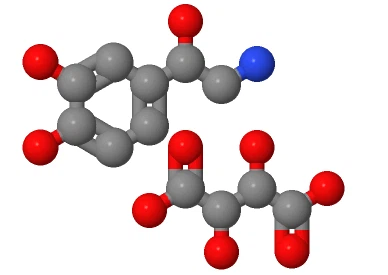
Norepinephrine is a catecholamine neurotransmitter that plays an important regulatory role in the nervous system. Its structure contains a benzene ring and an oxoethylamine group. Tartaric acid is a dicarboxylic acid whose structure contains two carboxylic acid groups. When these two parts come together, the chemical structure of Norepinephrine tartrate is formed.
2. Chemical properties:
Norepinephrine tartrate is a complex molecule with diverse chemical properties. The following is a description of its main properties:
- Solubility: Norepinephrine tartrate has good solubility in water. It is also soluble in some organic solvents such as methanol and ethanol.
- Optical properties: Norepinephrine tartrate is an optical isomer with optical activity. The optical rotations of the left-handed and right-handed forms are different.
- Thermal stability: Norepinephrine tartrate is relatively stable, but may decompose or become inactivated under high temperature or ultraviolet light.
- Acidity: Norepinephrine tartrate is a weakly acidic compound that reacts with bases to form the corresponding salts.
3. Drug application:
Norepinephrine tartrate plays an important role in drug research and clinical application. Here are a few of its common pharmaceutical applications:
 - Cardiovascular system applications: Norepinephrine tartrate is commonly used as a cardiotonic agent for the treatment of severe hypotension and shock states. It increases blood pressure by constricting blood vessels, increasing cardiac contractility and cardiac output, and prompting the heart to restore its conduction function.
- Organ protection: Norepinephrine tartrate is used for renal function protection, especially during surgery or in the intensive care setting. It reduces the risk of kidney damage by improving renal microcirculation.
- Nervous system disorders: Norepinephrine tartrate can be used in the treatment of disorders such as attention deficit hyperactivity disorder (ADHD) and depression. As the precursor molecule of neurotransmitter, it is involved in the release of neurotransmitter and the regulation of neuron function.
4. Reaction nature:
(1.) acid-base properties
Norepinephrine tartrate is a compound with a carboxylic acid group, so it has certain acid-base properties. In aqueous solution, it will undergo an acid-base reaction with water molecules, releasing protons to form corresponding ions. For example, it can react with sodium hydroxide to produce Norepinephrine and sodium tartrate:
C8H11NO3 C4H6O6 + NaOH → C8H11NO3 + C4H5O6Na + H2O
(2.) Oxidation reaction
Norepinephrine tartrate can be oxidized by oxidizing agents to form oxidation products. For example, it can be oxidized by hydrogen peroxide (H2O2) in the presence of oxygen to produce the corresponding ketone compound and carbon dioxide:
C8H11NO3 C4H6O6 + H2O2 → C8H10NO3 C4H6O6 + CO2 + H2O
(3.) Reduction reaction
Norepinephrine tartrate can undergo a reduction reaction in the presence of an appropriate reducing agent to generate the corresponding reduced product. For example, it can be reduced to the corresponding alcohols by sodium bisulfite (NaHSO3):
C8H11NO3 C4H6O6 + 2NaHSO3 → C8H12NO3 C4H6O6 + Na2SO4 + H2O
(4.) Condensation reaction
Norepinephrine tartrate has two hydrophilic groups (hydroxyl and amine), so it can participate in condensation reactions. It can undergo condensation reactions with other compounds containing reactive groups to form new compounds. For example, it can undergo nucleophilic addition reactions with aldehydes or ketones to form condensation products. These reactions usually require the presence of an auxiliary or catalyst.
(5.) Redox reaction
Since the molecule of Norepinephrine tartrate contains multiple oxygen atoms, it can participate in redox reactions. For example, under appropriate conditions, it can be oxidized to the corresponding oxidized product by an oxidizing agent (such as a high-valent iron salt); or reduced to a corresponding reduced product under the action of a reducing agent (such as sodium bisulfite).
(6.) Metal ion coordination reaction
The hydroxyl and amine groups in Norepinephrine tartrate can form coordination compounds with metal ions. These coordination reactions often alter the solubility, stability, and catalytic activity of metal ions. For example, it can form a complex with iron ions, which is widely used in the medical field.
(7.) Single nucleotide exchange reaction
Norepinephrine tartrate has a phosphorus-containing structural unit that can undergo interchange reactions with other phosphate-containing compounds. These reactions usually need to be carried out under basic conditions and require the presence of suitable catalysts.
(8.) Photochemical reaction
Norepinephrine tartrate can participate in photochemical reactions. Under the irradiation of ultraviolet light, it may undergo a photosensitive reaction to generate excited state products or free radicals. These photochemical reactions are of great significance for the study of chemical kinetics and drug photosensitivity.
4. Experimental research application:

Norepinephrine tartrate is a commonly used reagent in experimental research. Here are a few of its experimental research applications:
- Neurotransmitter research: Norepinephrine tartrate can be used to study the role of neurotransmitters in neuronal communication. It can simulate the signal transduction process in the nervous system and is used to study the cell signaling mechanism of neurons.
- Cell culture: Norepinephrine tartrate can be used in cell culture experiments to understand its effects on growth, differentiation and metabolism. Researchers can add it to cell culture media and watch how cells respond to it.
- Animal models: Norepinephrine tartrate can be used in animal models to study the pathogenesis of related diseases. For example, researchers can simulate the symptoms of certain neurological diseases by injecting animals with Norepinephrine tartrate.
Norepinephrine tartrate is an important bioactive molecule with a wide range of applications. It consists of norepinephrine and tartaric acid, and has a complex molecular structure and diverse chemical properties. As a drug, it plays an important role in the cardiovascular system, organ protection and treatment of diseases of the nervous system. At the same time, Norepinephrine tartrate is also a commonly used tool in experimental research for neurotransmitter research, cell culture and animal models. A better understanding of Norepinephrine tartrate will facilitate further research and application of this important molecule.