


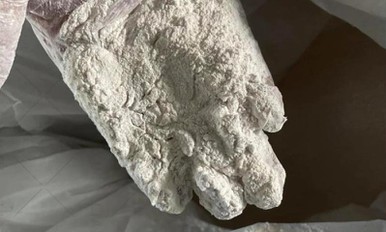
Sulfadimethoxine(link:https://www.bloomtechz.com/synthetic-chemical/api-researching-only/sulfadimethoxine-powder-cas-122-11-2.html), the chemical name is N^1-(4,6-dimethoxy-2-pyridinesulfonyl)-N^4, N^4-dimethylformamide. Its chemical formula is C12H14N4O4S and its molar mass is 310.33 g/mol. It is a white or off-white crystalline powder. It can form different crystal forms, such as needle-like crystals or plate-like crystals, depending on the preparation method. Soluble in common organic solvents such as methanol, ethanol and dimethylformamide, but poorly soluble in non-polar solvents such as petroleum ether and n-hexane. Its solubility is related to temperature and the nature of the solvent. Is a drug that belongs to the sulfonamide antibiotics and is commonly used to treat bacterial infections in animals. Blocks dihydrofolate synthesis by inhibiting dihydrofolate synthase. It can be used to inhibit the synthesis of folic acid in prokaryotes. Mechanisms of resistance in Gram-positive, Gram-negative and Chlamydia, changes in dihydrofolate synthase or alternative pathways for folate synthesis.
Sulfadimethoxine is a sulfonamide antibiotic with the chemical name 4-Amino-N-(2,6-dimethoxy-4-pyrimidinyl)benzonesulfonamide.
1. Acid-base properties:
Sulfadimethoxine is alkaline in water. It can react with acid to generate salt compounds through acid-base neutralization reaction. For example, reacting with hydrochloric acid can give Sulfadimethoxine hydrochloride:
C12H14N4O4S + HCl → C12H15N4O4S+Cl-
2. Restorability:
Sulfadimethoxine can undergo reduction reactions, mainly concentrated on its aromatic ring. For example, Sulfadimethoxine can be reduced with sodium sulfite (Na2SO3) to generate the corresponding amino compound:
C12H14N4O4S + Na2SO3 + 2H2O → C12H15N4O2S + Na2SO4 + 2H2SO4
3. Oxidation:
Sulfadimethoxine can be oxidized under the action of oxidizing agents. For example, sulfadimethoxine can be oxidized to the corresponding oxidation products using hydrogen peroxide (H2O2):
C12H14N4O4S + H2O2 → C12H14N4O6S + H2O
4. Reaction with amino compounds:
Sulfadimethoxine can undergo amine substitution reaction with some amino compounds. For example, it can react with ethanolamine to produce the corresponding amine substitution product:
C12H14N4O4S + HOCH2CH2NH2 → C12H17N5O6S + H2O
5. Complexation reaction with metal ions:
Sulfadimethoxine can form complexes with certain metal ions. For example, react with cobalt ion (Co2+) to form Co(II) complex:
C12H14N4O4S + CoCl2 → [Co(C12H13N4O4S)2]Cl2

The synthesis of sulfadimethoxine can usually be accomplished through a chemical reaction of several steps to 4-aminobenzenesulfonyl amide. The general synthetic route is as follows:
method one:
First, 4-aminobenzenesulfonamide is reacted with methanol to generate an N-methylated intermediate.
Then, under basic conditions, the intermediate is reacted with methyl acetoacetic anhydride (Acetic anhydride) to generate a new intermediate.
Next, the new intermediate is reacted with methyl isobutyl ketone and the raw material dimethylaminobenzene diazonium salt to produce another intermediate.
Finally, the final product of Sulfadimethoxine is obtained by subjecting the last intermediate to the ring-opening reaction of sulfuric anhydride. Method Two:
The laboratory synthesis methods of sulfadimethoxine are usually based on the synthesis principles and techniques of sulfa drugs. Here is a brief step-by-step:
Starting material:
Starting materials include p-aminobenzenesulfonyl chloride and dimethyl ethanolamine.
Reaction steps:
(1) First, react p-aminobenzenesulfonamide with sodium carbonate to generate sodium p-aminobenzenesulfonate.
(2) Next, under alkaline conditions, react sodium p-aminobenzenesulfonate with dimethylethanolamine to form the precursor compound of sulfadimethoxine—bis(4-methoxybenzenesulfonamide)methylamine (N^1 -(4-Methoxybenzonesulfonyl)-N^4-methylmethanamine).
(3) Finally, the precursor compound is subjected to a deprotection reaction to remove the protecting group to obtain the final Sulfadimethoxine product.
Sulfadimethoxine is a sulfonamide antibiotic widely used in veterinary medicine. It has antimicrobial activity and is used in the treatment and prevention of bacterial infections in poultry and livestock animals. .
1. Chicken and duck
 Sulfadimethoxine is widely used in poultry farming. It can be used to treat and prevent many kinds of infections, such as chicken cholera, Escherichia coli infection, coccidiosis and jejuni leukosteritis, etc. In addition, it can also be used as an auxiliary treatment for serious diseases such as infectious encephalitis and goose infectious hepatitis.
2. Pig
Sulfadimethoxine is also used in the veterinary treatment of pigs. It can treat infections such as pasteurellosis, colitis, reproductive failure and swine fever in pigs. In addition, Sulfadimethoxine can also be used to treat respiratory infections in pigs, such as porcine reproductive and respiratory syndrome (PRRS) and porcine epidemic diarrhea.
3. Cattle and sheep
In livestock such as cattle and sheep, Sulfadimethoxine is used for the treatment and prevention of respiratory and gastrointestinal infections. It can be used to treat pneumonia, rhinotracheitis, enteritis and tuberculosis, etc. In addition, Sulfadimethoxine can also be used to treat infectious diseases such as superficial hoof ulcer and lymphatic filariasis.
4. Other livestock and poultry animals
In addition to the common poultry and livestock animals mentioned above, Sulfadimethoxine can also be used in the veterinary treatment of other animals. For example, it can be used to treat coccidiosis in rabbits, infections in dogs, cats and mice, etc.
The pharmacokinetics of sulfadimethoxine are introduced as follows:
1. Absorption:
Sulfadimethoxine is rapidly absorbed by the oral route of administration. It is stable in the gastrointestinal tract and therefore has a high rate of absorption when administered orally. After absorption, Sulfadimethoxine enters the blood circulation and is distributed in the body to tissues and organs.
2. Distribution:
Sulfadimethoxine has good tissue distribution. It can pass through cell membranes and enter different tissues and body fluids, such as muscle, lung, liver, kidney, brain tissue, etc. This tissue distribution allows for a more comprehensive therapeutic effect against infectious pathogens.

3. Metabolism:
Sulfadimethoxine undergoes a metabolic conversion process in the body. The main metabolic pathway is through enzymatic catalysis, which converts it into active metabolites. These metabolites can further combine with metabolic enzymes of bacteria to inhibit the metabolic activity of bacteria.
4. Eliminate:
Sulfadimethoxine is mainly excreted by the kidneys. It is filtered by the glomeruli, enters the renal tubules, and is actively secreted. Some of the sulfadimethoxine is reabsorbed into the blood, and some is excreted in the urine. A small fraction of the remainder may be excreted through bile.
5. Half-life:
The half-life (t<sub>1/2</sub>) of sulfadimethoxine is the time required to reduce its blood concentration by half. In poultry and livestock animals, the half-life of sulfadimethoxine is approximately 8 to 12 hours. This suggests that sulfadimethoxine has a relatively short lifetime in the body and requires regular dosing to maintain the therapeutic effect.
6. Drug interactions:
Sulfadimethoxine may interact with other drugs, affecting its pharmacokinetic properties. For example, when used concomitantly with ethanol, the absorption and metabolism of sulfadimethoxine may be affected. Therefore, when using drugs in combination, attention should be paid to potential drug interactions, and dosage adjustments should be made as needed.