


Mercury(II) sulfide (HgS), commonly known as cinnabar or chalcosis, is a bright red hexagonal crystal compound composed of mercury and sulfur elements. It is also the most important mercury ore in nature. It is renowned for its extremely vivid red color and excellent chemical stability. In ancient China, it was widely used as a vermilion pigment and ink, and was also the main raw material for mercury extraction. It is insoluble in water and most acids, but soluble in aqua regia. HgS exists in two isomorphous forms: apart from the stable red α-form (hexagonal crystal system), there is also a black β-form (cubic crystal system), known as black cinnabar, which has lower stability and can transform into the red variant under light or heat. This compound has a high refractive index and high density. Due to its vivid red color, it has been highly valued throughout history. However, its toxicity mainly stems from the mercury element it contains, and proper protection is necessary when using it. Besides mineralogy and pigment history research, it also has potential applications in semiconductor and infrared optical materials in modern times.
|
|
|
|
|
|
|
|



Chemical Properties
Stability and Reactivity
Mercury(II) sulfide exhibits remarkable chemical stability and shows inertness towards most acids and bases. For instance, at room temperature, it does not react with dilute hydrochloric acid or sodium hydroxide solutions. However, under high-temperature conditions, its stability is disrupted: when the temperature exceeds 100-150℃, if it comes into contact with oxidative mixtures (such as acidified potassium dichromate solution and concentrated sulfuric acid), HgS undergoes a decomposition reaction, generating mercury salts, elemental sulfur, and other oxidized products. This property makes it necessary to strictly control the reaction conditions in specific industrial processing.
Isomorphous Variants and Phase Transitions
HgS has two stable isomorphous variants: α-HgS (red hexagonal crystal system, cinnabar) and β-HgS (black cubic crystal system, black cinnabar). These two variants can undergo reversible phase transitions induced by temperature: when α-HgS is heated to 250℃, its color gradually changes to brown, and it completely transforms into β-HgS at 386℃; while when β-HgS cools down, it reverts to red α-HgS. This phase transition characteristic has potential applications in materials science, for example, for developing temperature-sensitive optical materials.
Semiconductor Properties
α-HgS exhibits direct semiconductor properties at 300K, with an energy gap of 2.1 eV. This property makes it valuable for exploration in the field of optoelectronic devices, such as being used to manufacture infrared detectors or photocatalysts. However, due to the toxicity of mercury, its semiconductor application is still at the stage of laboratory research and has not yet achieved commercialization.
Physical Properties
Appearance and Color
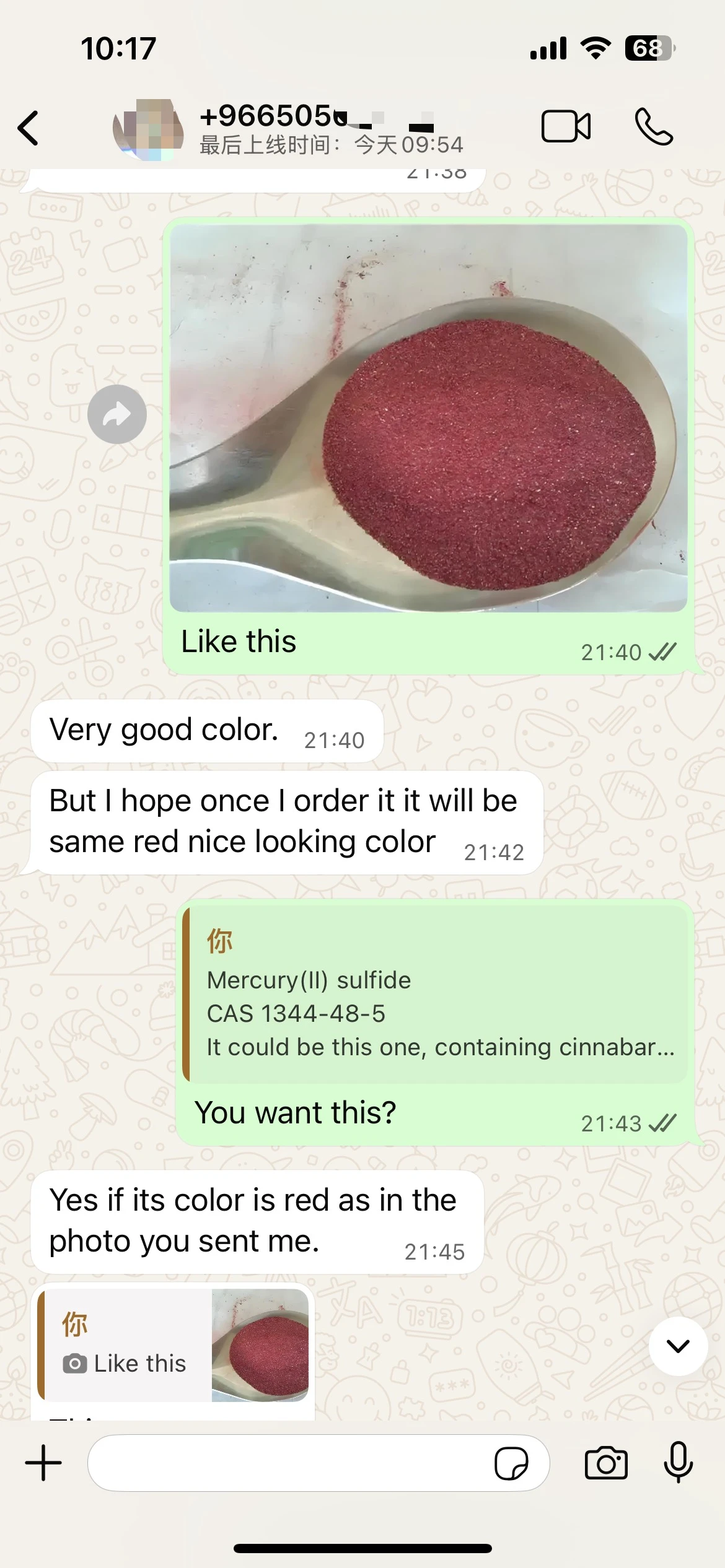
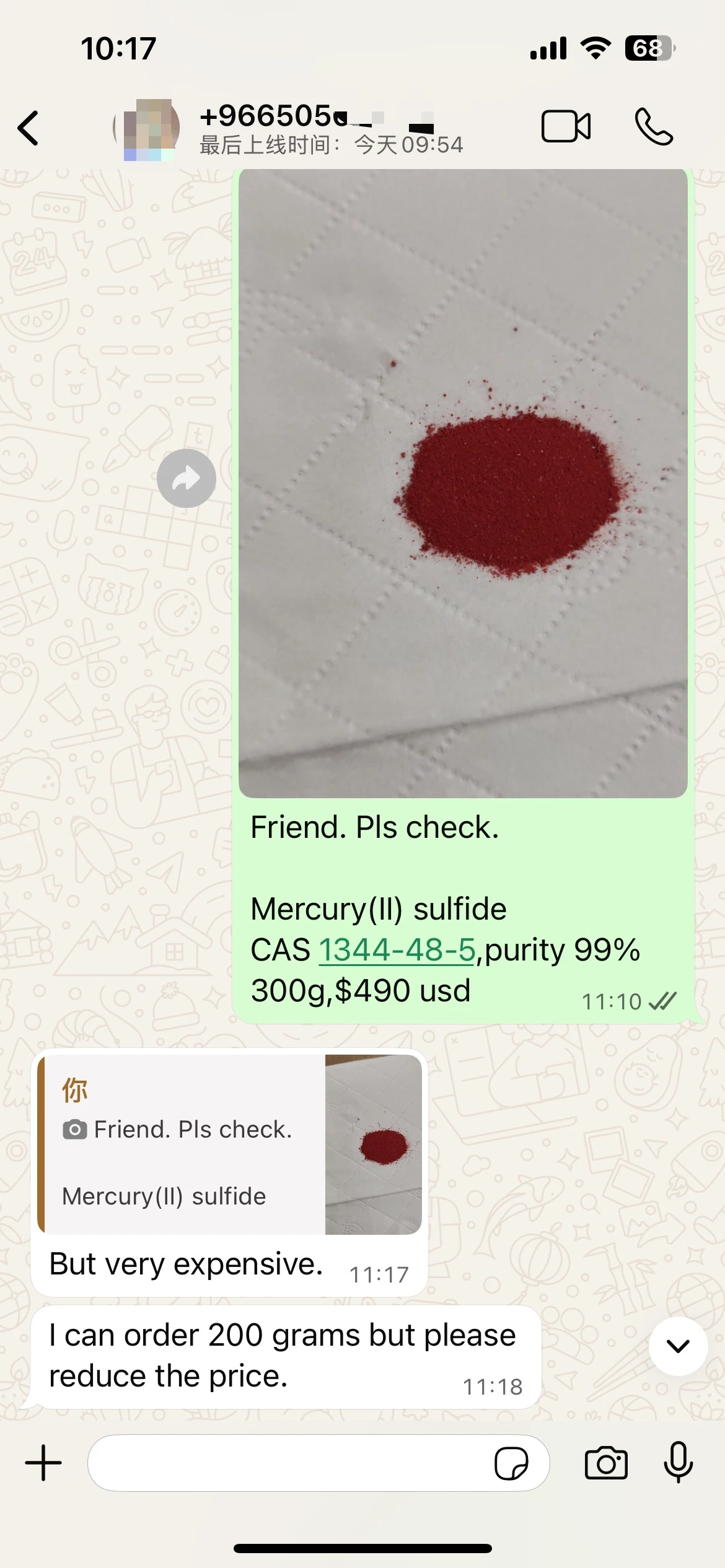
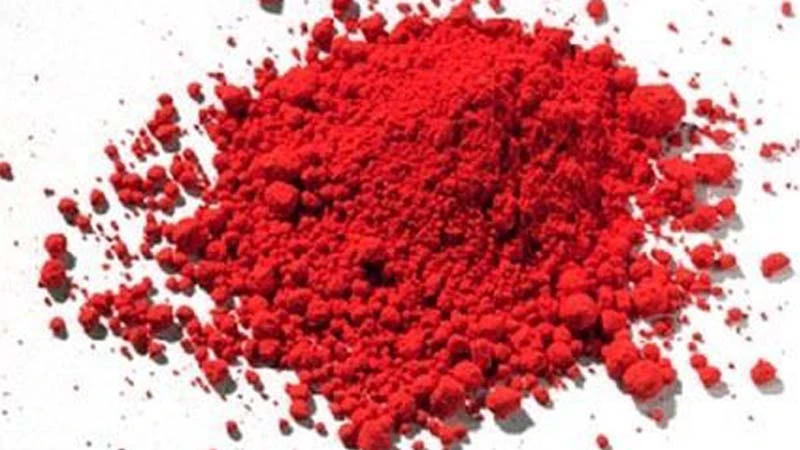
The two variants of Mercury(II) sulfide have significantly different appearances: α-HgS presents a vivid red color and is often used as a pigment; β-HgS is black powder and has more extensive industrial applications. The color difference stems from the arrangement of Hg-S bonds in the crystal structure: in α-HgS, the Hg-S bonds are arranged in a helical manner, resulting in selective absorption of visible light; while in β-HgS, the cubic structure allows its absorption spectrum to cover a wider range.
Density and Melting Point
The density of HgS is 8.10 g/cm³, belonging to a high-density compound. Its melting point is 583.5℃, but it will first decompose before melting, generating mercury vapor and sulfur vapor. This characteristic requires special protective measures during high-temperature processing to prevent mercury vapor leakage.
Solubility
Mercury(II) sulfide is almost insoluble in water (with a solubility of only 0.00001 g/L) and also difficult to dissolve in most organic solvents. However, it can dissolve in aqua regia (a mixture of concentrated hydrochloric acid and concentrated nitric acid), generating soluble mercury salts and sulfur oxidation products. This solubility characteristic is of great significance in mercury pollution treatment, for example, through chemical precipitation to convert mercury ions into HgS precipitate to reduce toxicity.
Preparation Methods
Direct Synthesis Method
Mixing elemental mercury with sulfur powder in a 1:1 molar ratio and reacting under heating conditions directly produces HgS. To accelerate the reaction process, zinc powder can be added as a catalyst. This method is simple to operate, but strict control of the reaction temperature is required to avoid mercury vapor volatilization.
Precipitation Method
Passing hydrogen sulfide gas into a mercury salt solution (such as nitric mercury solution) generates black β-HgS precipitate. This method can adjust the particle size and morphology of the product by controlling reaction conditions (such as pH value, temperature), and is suitable for small-scale laboratory preparation.
Natural Mineral Purification
Extracting HgS from cinnabar ore is the main industrial production method. Through beneficiation, grinding, and flotation processes, high-purity HgS pigments or chemical raw materials can be obtained. China's Hunan and Guizhou provinces are major producers of cinnabar, and their purification technology has reached international advanced levels.
Application Areas

Traditional Pigments and Coatings
α-HgS, due to its vivid red color and excellent weather resistance, is widely used in oil paints, ceramic glazes, and wood coatings. For instance, the "cinnabar red" used by Renaissance painters originated from realgar. However, due to the toxicity of mercury, its pigment application has gradually been replaced by organic pigments or non-mercury inorganic pigments (such as iron oxide red).
Traditional Medicine
In traditional Chinese medicine and Indian Ayurvedic medicine, realgar is used as an anesthetic and detoxifying agent. For example, "Jade Red Pill" is mainly composed of HgS. However, modern toxicological studies have confirmed that mercury compounds can cause mercury poisoning through skin absorption or ingestion of the digestive tract. Therefore, drugs containing HgS have been strictly restricted or prohibited for use.


Industrial Catalysis and Materials Science
β-HgS, due to its unique crystal structure and semiconductor properties, is explored for catalytic reactions and photonic devices. For instance, it can be used as a photocatalyst to decompose water for hydrogen production, or as a sensitive layer material for infrared detectors. However, its application is still limited by the toxicity of mercury and environmental risks.
Mercury Pollution Control
HgS is the final stable form of mercury disposal. By converting mercury ions in wastewater into HgS precipitates through chemical precipitation, the toxicity and mobility of mercury can be significantly reduced. Additionally, HgS can be used to fix mercury pollution in soil, preventing it from leaching into groundwater through rainwater.

Safety Risks and Environmental Measures
Mercury(II) sulfide is a highly toxic compound, with its toxicity mainly coming from the release of mercury ions (Hg²⁺). Inhalation of mercury vapor or ingestion of HgS powder can lead to acute or chronic mercury poisoning, with symptoms including neurological damage, kidney failure, and respiratory failure. The International Agency for Research on Cancer (IARC) classifies mercury and its compounds as Group 2B carcinogens (possibly carcinogenic to humans).
HgS is difficult to degrade in the environment and can accumulate through the food chain, causing long-term harm to the ecosystem. For example, HgS in water bodies can be converted by microorganisms into methylmercury (CH₃Hg⁺), which has stronger biological toxicity and neurotoxicity and can enter the human body through fish.
When handling HgS, protective masks, gloves, and goggles should be worn to avoid direct contact. Waste should be packaged and disposed of in accordance with hazardous waste management regulations, such as through high-temperature incineration or chemical stabilization to reduce mercury release. Environmental protection regulations of various countries (such as the European Union's Restriction of Hazardous Substances Directive RoHS) have set strict limits on the use and emissions of HgS.