


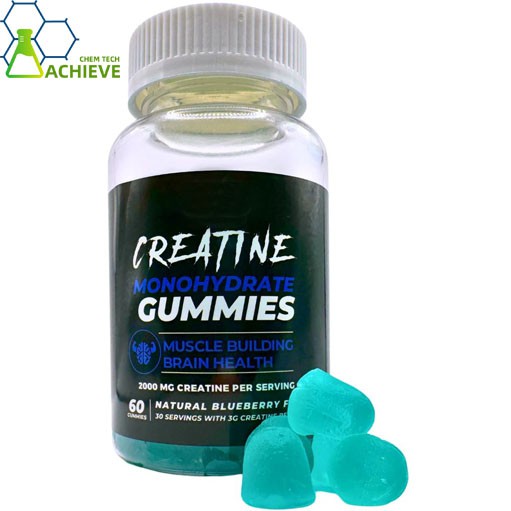
Shaanxi BLOOM Tech Co., Ltd. is one of the most experienced manufacturers and suppliers of creatine monohydrate gummies in China. Welcome to wholesale bulk high quality creatine monohydrate gummies for sale here from our factory. Good service and reasonable price are available.
Creatine Monohydrate Gummies is a nutritional supplement that combines Creatine Monohydrate with the form of gummies. It aims to provide a convenient and delicious way of intake for people who need to supplement creatine. This product is a convenient and delicious form of creatine supplementation, suitable for those who wish to enhance their athletic performance, increase muscle mass and strength. It is particularly suitable for those who do not like the texture of traditional creatine powder or need a more convenient way to supplement it. However, no matter which form of creatine is chosen, it should be combined with a scientific training plan and a reasonable diet to achieve the best effect.
The gummy form of this product offers a more flexible option for creatine supplementation through convenience, optimized taste and consumption experience, making it especially suitable for those who pursue convenience and taste. However, when making a choice, users should pay attention to the ingredient list, dosage and additional additives, and use them reasonably in combination with their own needs (such as budget, health goals). For professional athletes or those undergoing high-intensity training, it is still necessary to ensure the scientific and systematic nature of creatine supplementation to maximize its effectiveness.
|
|
|



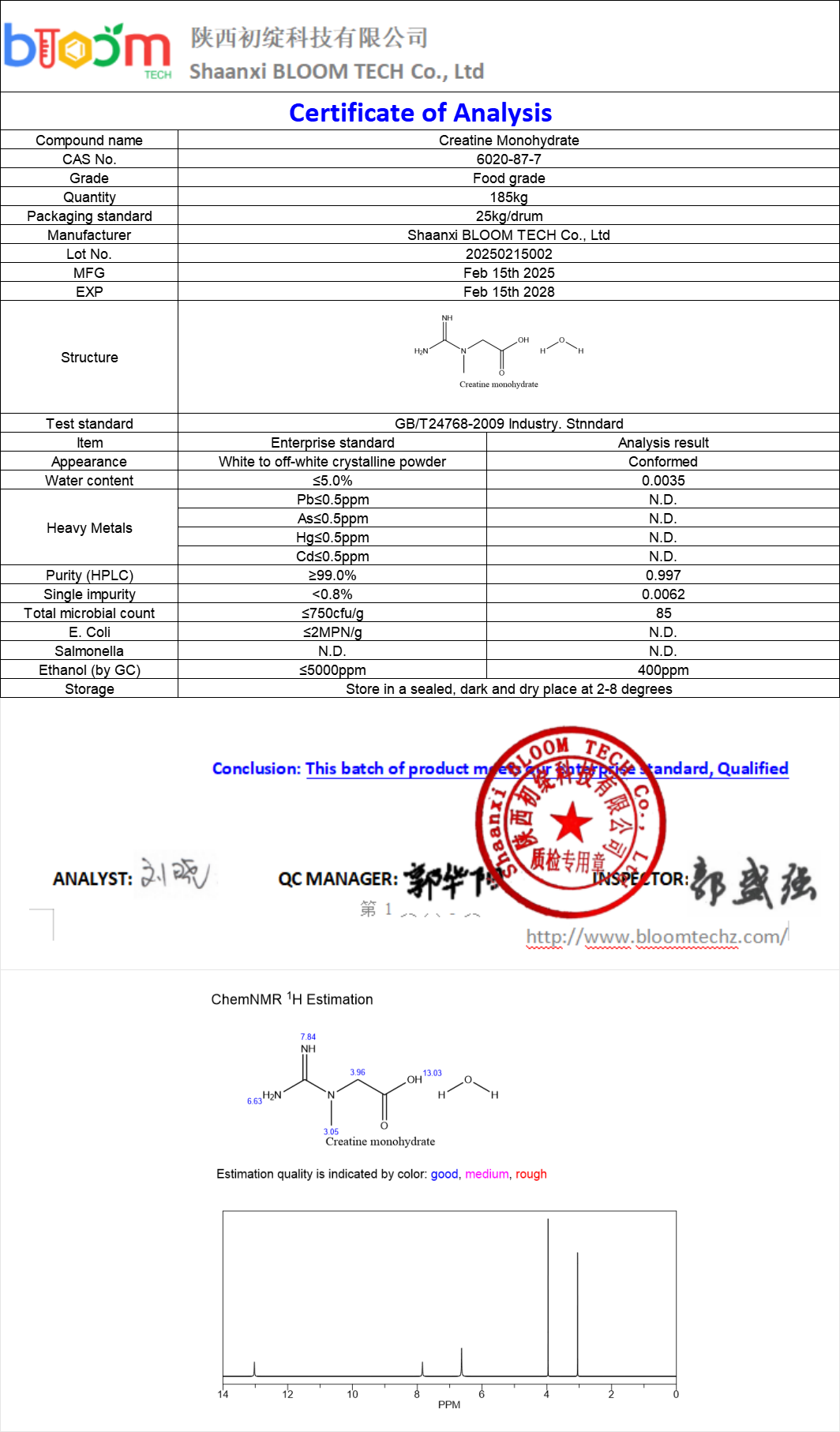
Creatine Monohydrate powder COA
The characteristics of gummy candy form
The characteristics of the form of Creatine Monohydrate Gummies are mainly reflected in the following aspects:


Convenient to carry and take:
Portability: The gummy form is small in size and light in weight, making it easy to put in a pocket, fitness bag or suitcase. It is suitable for replenishment at any time before and after training, during work breaks or when going out.
No need to prepare: Compared with creatine powder which needs to be dissolved in water, gummy candies can be chewed and eaten directly, eliminating the need for tools and waiting for dissolution.
Fixed dosage: Each gummy candy usually contains a fixed dose of creatine (such as 1 gram or 2.5 grams), so users do not need to weigh it, avoiding dosage errors.
Better taste:
Masking the bitterness of creatine: Creatine monohydrate itself has a slightly bitter taste, while gummies significantly improve the texture by adding natural or artificial flavors (such as fruit flavor, berry flavor, etc.) and sweeteners, making the replenishment process more enjoyable.
Similar to snack experience: The texture and taste of gummy candies are close to those of ordinary candies, making them more acceptable to users, especially suitable for those who are sensitive to the taste of traditional creatine powder.
Easy to persist in the long term:
Improving compliance: Due to its good taste and convenient administration, users are more willing to consistently supplement creatine for a long time, thereby better exerting its effect of enhancing athletic performance and promoting muscle recovery.
Reduce psychological burden: Compared with swallowing capsules or dissolving powder, the gummy form is more relaxing, reducing users' resistance to "taking medicine".
Potential nutritional fortification:
Compound formula: Some gummy products may add additional vitamins (such as B vitamins), electrolytes or other sports nutrients to provide more comprehensive nutritional support.
Low-sugar or sugar-free options: To meet the need for blood sugar control, some brands have launched low-sugar or sugar-free formulas, suitable for users who are sensitive to sugar intake.
Suitable for specific groups of people:
For child or adolescent athletes: Gummy candies are more acceptable, but attention should be paid to the dosage and suitability (it is recommended to use them under professional guidance).
For those with difficulty swallowing: Compared with capsules or pills, gummy candies are easier to chew and swallow.
Office workers who seek convenience: Suitable for quickly replenishing creatine in the office or when busy.
Potential precautions:
Additional additives: Gummy candies may contain colorants, preservatives or artificial sweeteners. Long-term intake should be monitored for their impact on health.
Calories and sugar: Some gummy candies have a relatively high sugar content. Excessive intake may lead to an excess of calories, so it is necessary to pay attention to controlling the total calorie intake.
Higher price: Compared with creatine powder, the unit price of gummy candies is usually higher, which may increase the cost of long-term supplementation.
Calories and sugar
Creatine Monohydrate Gummies, as a new type of sports nutrition supplement, combines creatine monohydrate with gummies. While providing the convenience of creatine supplementation, it also introduces the problems of calories and sugar. The following is an in-depth analysis of its calorie and sugar content from multiple dimensions.
Source and Content of Calories
The calorie contribution of the basic components
Creatine monohydrate: As a core ingredient, creatine monohydrate itself provides almost no calories (about 4 kilocalories per gram, but the supplement is usually 3-5 grams per day, and the calorie contribution can be ignored).
The base of gummy candies: The calories mainly come from the base components of gummy candies, including sugars, gum bases, flavoring agents, etc. The calorie density of gummy candies is usually high. The calorie content of each candy (about 2-3 grams) may range from 10 to 20 kilocalories, depending on the recipe.
Calorie data of common products
Market product comparison: Some brands of creatine soft candies contain approximately 15 kilocalories per piece (for example, products weighing 3 grams per piece). If 3 to 5 pieces are consumed daily, the total calorie intake can reach 45 to 75 kilocalories.
Compared with creatine powder: Traditional creatine powder has almost no calories, while the gummy form has significantly increased calories due to the addition of a base material.
The influence of calories on fitness goals
Muscle-building period: Calorie intake has a relatively small impact on muscle-building individuals and can even assist in maintaining a calorie surplus.
During the fat loss period, an additional daily intake of 50 to 70 kilocalories may affect the efficiency of fat loss and needs to be balanced through dietary adjustments
Types and Contents of Sugar

The main source of sugar
Added sugar: Some gummy candies use traditional sugars such as sucrose and glucose syrup, which have a relatively high sugar content.
Sugar substitutes: Some products use sugar substitutes such as erythritol and maltitol, which significantly reduce calorie content and glycemic index.
Mixed formula: Some products combine a small amount of added sugar and artificial sugar to balance the taste and calories.
Sugar data of common products
Added sugar products: Each gummy candy can contain 2 to 4 grams of sugar. Consuming 3 to 5 candies daily means taking in 6 to 20 grams of added sugar, which is close to or exceeds the daily upper limit recommended by the World Health Organization (25 grams).
Sugar substitute products: The sugar content per piece can be as low as less than 0.5 grams, and the main calories come from the polysaccharides or starch in the gummy base.


The influence of sugar on health
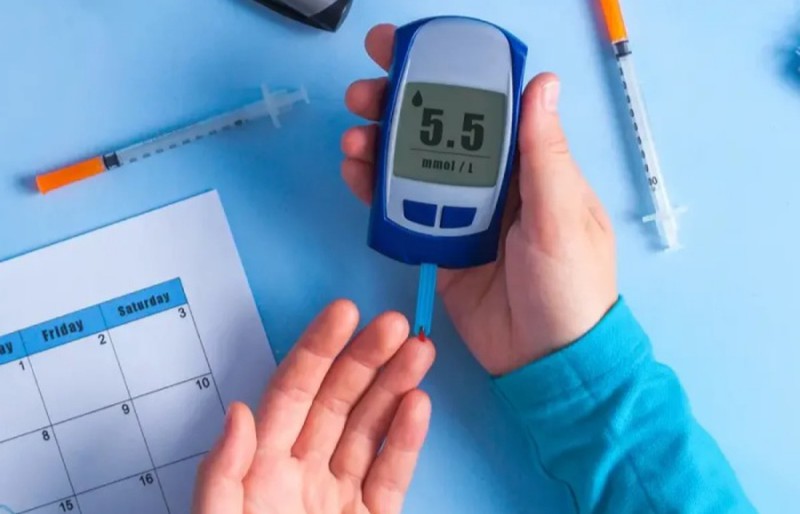
Blood sugar fluctuations: High-added sugar products may cause a rapid increase in blood sugar, which is not beneficial for people with prediabetes or metabolic syndrome.
Risk of dental caries: Frequent intake of sugary gummy candies may increase the risk of dental caries, especially for those with poor oral hygiene.
Advantages of sugar substitutes: The use of sugar substitutes such as erythritol can significantly reduce the risks of dental caries and blood sugar fluctuations.
Comparison of Calories and Sugar Content in Different Formulas
Traditional high-sugar formula
Ingredients: Sucrose, glucose syrup, gelatin, creatine, etc.
Calories and sugar content: Each piece contains approximately 20 kilocalories and 3 to 4 grams of sugar.
Applicable population: People who are not in the fat loss period and have no need for blood sugar control.
Limitations: High in calories and sugar, long-term use may affect fat loss results or increase the risk of tooth decay.
Low-sugar artificial sweetener formula
Ingredients: Erythritol, maltitol, gelatin, creatine, etc.
Calories and sugar content: Each piece has approximately 10 kilocalories and a sugar content of less than 0.5 grams.
Applicable population: People in the fat loss period, diabetic patients, and those at high risk of dental caries.
Advantages: Significantly reduced calories and sugar content, better meeting health needs.
Sugar-free formula
Ingredients: Artificial sweeteners (such as sucralose, aspartame), gelatin, creatine, etc.
Calories and sugar content: Each piece has less than 5 kilocalories and 0 grams of sugar.
Applicable population: People who strictly control their sugar intake and those on a low-carbohydrate diet.
Controversy: The safety of some artificial sweeteners is controversial, and their long-term effects still need further research.
The Impact of Calories and Sugar on Health

Weight management
Calorie surplus: Consuming an additional 50 to 75 kilocalories daily may lead to weight gain in the long run.
Fat loss advice: People in the fat loss period should choose low-sugar or sugar-free products, or burn extra calories through exercise.
Blood sugar control
Risks of high-sugar products: Gummy candies with a high sugar content may cause fluctuations in blood sugar and increase the risk of diabetes.
Advantages of sugar substitute products: Sugar substitute products have a relatively small impact on blood sugar levels and are suitable for people with diabetes or metabolic syndrome.

Dental health
Risk of dental caries: Frequent intake of sugary gummy candies may increase the risk of dental caries, especially for those with poor oral hygiene.
Preventive measures: Choose sugar substitute products, reduce the frequency of intake, and enhance oral hygiene.
Long-term health impact
Metabolic burden: Long-term high sugar intake may increase the risk of metabolic syndrome.
Safety of artificial sweeteners: Some artificial sweeteners (such as erythritol) are relatively safe, but artificial sweeteners should be used with caution.

Selection Suggestions and Precautions
Choose products according to your needs:
Muscle-building period: High-sugar products are acceptable, but attention should be paid to the total calorie intake.
During the fat loss period: Prioritize low-sugar or sugar-free products.
Diabetic patients: They must choose sugar substitutes or sugar-free products and monitor changes in blood sugar levels.
Control the intake:
Daily dosage: It is recommended to take 3 to 5 capsules daily to avoid excessive intake of calories and sugar.
Alternative solution: Some gummy candies can be replaced with creatine powder to reduce calorie and sugar intake.
Combine diet with exercise:
Calorie balance: Burn extra calories by adjusting your diet or increasing physical activity.
Nutritional balance: Avoid using gummy candies as the sole source of nutrition. It is necessary to ensure a balanced intake of protein, carbohydrates and fat.
Pay attention to the product labels:
Ingredient list: Carefully check the source of sugar (added sugar/artificial sugar) and its content.
Nutrition information: Pay attention to the calorie, protein, fat and other nutrition information of each gummy candy.
Summary
The calories and sugar content of Creatine Monohydrate Gummies mainly depend on its formula design. Traditional high-sugar formulas have high calories and sugar content, which may affect fat loss results or increase health risks. Low-sugar or sugar-free formulas, by using artificial sweeteners or sugar substitutes, significantly reduce calorie and sugar intake, making them more suitable for people with special needs. Users should choose appropriate products based on their own health goals (such as muscle building, fat loss, blood sugar control, etc.) and reasonably control the intake. At the same time, combining a balanced diet with moderate exercise can maximize the benefits of creatine soft candies while minimizing their potential risks.
Frequently Asked Questions
What's the difference between creatine and creatine gummies?
+
-
Creatine gummies bring convenience and flavor, while traditional powder offers flexibility and cost savings. Choose based on your lifestyle, budget and fitness goals. Both forms provide the same muscle performance benefits when used consistently. Whichever you choose, consistency is key to seeing results.
Who should not take creatine?
+
-
Because of these unknown risks, children and adolescents younger than 18 years and pregnant or nursing women should never take creatine supplements. People with kidney problems also should never take creatine supplements.
What is the best time to take creatine gummies?
+
-
On workout days, research shows that it may be better to take creatine shortly before or after you exercise, rather than long before or after. On rest days, it may be beneficial to take it with food, but the timing is probably not as important as on exercise days.
Hot Tags: creatine monohydrate gummies, suppliers, manufacturers, factory, wholesale, buy, price, bulk, for sale