




Shaanxi BLOOM Tech Co., Ltd. is one of the most experienced manufacturers and suppliers of abarelix acetate in China. Welcome to wholesale bulk high quality abarelix acetate for sale here from our factory. Good service and reasonable price are available.
Abarelix acetate, also known as abarelix in Chinese, has the molecular formula C72H95ClN14O14 and CAS 183552-38-7. It is a synthetic peptide compound that belongs to the class of gonadotropin-releasing hormone (GnRH) antagonists and hormone anticancer agents. It is used clinically as an anti-tumor drug, specifically classified as LHRH inhibitors, with ATC code L02BX01.

Abarelix Acetate COA
 |
||
| Certificate of Analysis | ||
| Compound name | Abarelix acetate | |
| Grade | Pharmaceutical grade | |
| CAS No. | 183552-38-7 | |
| Quantity | 53g | |
| Packaging standard | PE bag+Al foil bag | |
| Manufacturer | Shaanxi BLOOM TECH Co., Ltd | |
| Lot No. | 202601090056 | |
| MFG | Jan 9th 2026 | |
| EXP | Jan 8th 2029 | |
| Structure |
|
|
| Item | Enterprise standard | Analysis result |
| Appearance | White or almost white powder | Conformed |
| Water content | ≤5.0% | 0.31% |
| Loss on drying | ≤1.0% | 0.62% |
| Heavy Metals | Pb≤0.5ppm | N.D. |
| As≤0.5ppm | N.D. | |
| Hg≤0.5ppm | N.D. | |
| Cd≤0.5ppm | N.D. | |
| Purity (HPLC) | ≥99.0% | 99.80% |
| Single impurity | <0.8% | 0.44% |
| Total microbial count | ≤750cfu/g | 209 |
| E. Coli | ≤2MPN/g | N.D. |
| Salmonella | N.D. | N.D. |
| Ethanol (by GC) | ≤5000ppm | 512ppm |
| Storage | Store in a sealed, dark, and dry place below 2-8°C | |
|
|
||
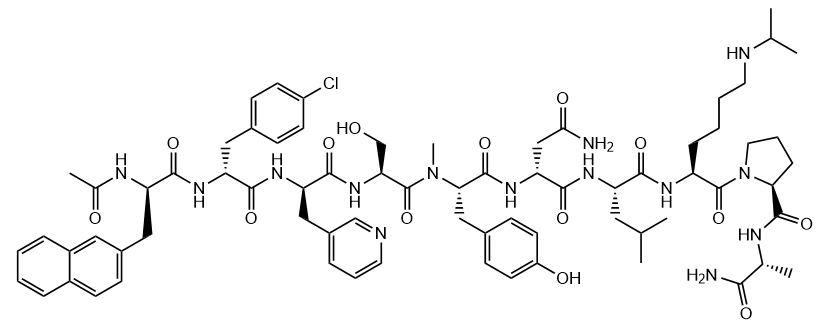
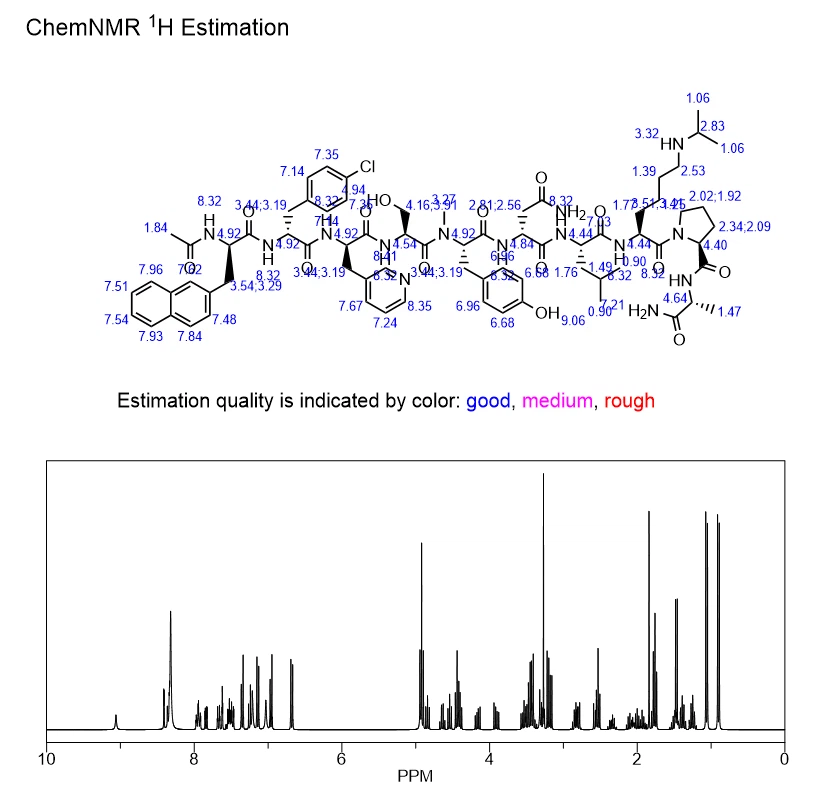

| Chemical Formula: | C72H95ClN14O14 |
| Exact Mass: | 1415 |
| Molecular Weight: | 1416 |
| m/z: | 1415 (100.0%), 1416 (77.9%), 1417 (32.0%), 1417 (29.9%), 1418 (24.9%), 1419 (9.6%), 1418 (7.5%), 1416 (4.8%), 1417 (4.0%), 1417 (2.9%), 1418 (2.2%), 1420 (2.2%), 1418 (1.7%), 1418 (1.4%), 1419 (1.2%), 1419 (1.1%), 1416 (1.1%) |
| Elemental Analysis: | C, 61.07; H, 6.76; Cl, 2.50; N, 13.85; O, 15.82 |
Abarelix acetate is a synthetic peptide with strong antagonistic activity, belonging to the class of gonadotropin-releasing hormone (GnRH) antagonists, which plays an important role in the treatment of prostate cancer.

Basic characteristics of Abarik
Abarik is an artificially synthesized peptide compound with the molecular formula C ₇₂ H ₉₅ ClN ₁₄ O ₁₄, and a molecular weight of 1416.08. It appears as a white to off white powder with a purity of 95% to 99%, and can be analyzed by HPLC-DAD method. Abarek has a high plasma protein binding rate (96%~99%) and is widely distributed in the body, with a terminal apparent distribution volume of 4040 ± 1607L. Its metabolism is mainly carried out through peptide bond hydrolysis, and there is no evidence to suggest that cytochrome P450 is involved in its metabolic process.
After intramuscular injection in the human body, about 13% of the prototype drug is excreted with urine, and no other metabolites are detected in the urine. The renal clearance rate of 100mg injection is 14.4L/d (or 10mL/min). These characteristics provide the basis for the pharmacological effects and metabolic clearance of Abarik in the body.

Source: Chemicalbook (Booker Chemical Network), Pharmaceutical Online.

Inhibition of LH and FSH secretion
Due to its binding to the GnRH acceptor, which blocks the signal transduction of GnRH, the secretion of LH and FSH by the anterior pituitary gland is inhibited. The decreased secretion of LH and FSH directly affects the function of the gonads. In males, the testicles are the main gonads, and LH is a key hormone that stimulates testicular interstitial cells to secrete testosterone.
When LH secretion decreases, the ability of testicular interstitial cells to synthesize and secrete testosterone decreases, leading to a decrease in plasma testosterone concentration. Similarly, FSH also has a significant impact on the spermatogenic function of the testes. Reduced FSH secretion can affect sperm production, but in the treatment of prostate cancer, the main focus is on reducing testosterone levels.

Source: ChemicalBook (Booker Chemical Network), China Pharmaceutical Information Query Platform

The therapeutic effect of reducing testosterone levels on prostate cancer
Prostate cancer is an androgen dependent tumor, and testosterone and other androgens play an important promoting role in the occurrence, development, and progression of prostate cancer. Testosterone can activate a series of signaling pathways by binding to androgen acceptors inside prostate cancer cells, promoting cancer cell proliferation, survival, and metastasis. Therefore, reducing testosterone levels in the body is one of the important strategies for treating prostate cancer.
Abarek effectively reduces the ability of the testes to secrete testosterone by inhibiting the secretion of LH and FSH, resulting in a significant decrease in plasma testosterone concentration. This effect of reducing testosterone levels is called castration, similar to surgical removal of the testicles (surgical castration) or the use of drugs to inhibit testicular function (drug castration). Compared with traditional GnRH agonists, it has unique advantages.


Traditional GnRH agonists can cause a brief increase in LH and FSH levels during initial use, leading to an initial increase followed by a decrease in testosterone levels, a process known as rebound. During the stage of elevated testosterone levels, it may stimulate the growth and spread of prostate cancer cells, leading to a brief deterioration of the condition. As a GnRH antagonist, it directly inhibits LH secretion without causing a rebound in testosterone levels, and can rapidly reduce testosterone levels, thereby more effectively controlling the progression of prostate cancer.
Source: Chemicalbook, Xiaohe Health, Pharmaceutical Online
Relieve symptoms: In patients with advanced prostate cancer, a series of serious symptoms often occur due to tumor metastasis and invasion, such as severe bone pain caused by tumor bone metastasis, ureteral or bladder outlet obstruction caused by local invasion or metastatic diseases, and possible neurological hazards caused by tumor metastasis. By reducing testosterone levels and inhibiting the growth and spread of prostate cancer cells, these symptoms can be effectively alleviated.


For example, in a clinical study of patients with advanced symptomatic prostate cancer, 15 patients with bone metastases experienced pain relief after 12 weeks of treatment, and the efficacy, dosage, and frequency of using anesthetic analgesics decreased; Thirteen patients who had bladder outlet obstruction and had bladder drainage tubes inserted, 10 of whom had their drainage tubes removed after 12 weeks; Among the 8 patients with spinal or epidural metastases but no neurological symptoms, no one showed neurological damage symptoms.
Palliative treatment: mainly used for the palliative treatment of advanced symptomatic prostate cancer (PCA) that is not suitable for receiving luteinizing hormone releasing hormone (LHRH) agonist therapy and refuses surgical resection, and has one or more of the above conditions. The purpose of palliative care is to alleviate the pain of patients, improve their quality of life, and prolong survival by effectively controlling the progression of prostate cancer, providing an important treatment option for these patients.


Avoiding surgical risks: For some patients who are not suitable for surgery or refuse surgery, abarelix acetate provides a non-surgical method of castration. Compared with surgical castration, drug castration has the advantages of non invasiveness and reversibility, which can reduce the pain and risk of complications caused by surgery and improve the quality of life of patients
Source: ChemicalBook, China Pharmaceutical Information Query Platform, Xiaohe Health.
Chemical Structure
Abarek is a decapeptide with an amino acid sequence consisting of a single letter sequence: Ac - DNal - DpClPhe - D3Pal - Ser - Asn - Tyr - DLys - Leu - Arg - Pro - DAla - NH ₂; Three letter sequence: Ac - D - Nal - D - pCl - Phe - D - 3Pal - Ser - Asn - Tyr - D - Lys - Leu - Arg - Pro - D - Ala - NH ₂.
From the perspective of structural characteristics:
Its N-terminus is acetylated (Ac -), which increases the stability of the polypeptide and prevents degradation by enzymes such as aminopeptidases. The structure contains multiple D-configured amino acids, such as D-Nal (D-naphthylalanine), D-pClPhe (D-p-chlorophenylalanine), D-3Pal (D-3-pyridylanine), D-Lys (D-lysine), and D-Ala (D-alanine). Compared with common L-configuration amino acids, D-configuration amino acids alter the spatial conformation of peptides, enabling them to specifically bind to gonadotropin-releasing hormone (GnRH) acceptors with stronger binding affinity and less likely to be replaced by endogenous GnRH competition.
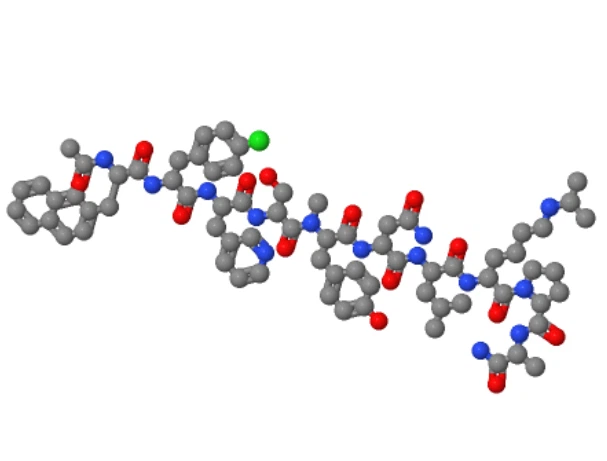
Meanwhile, the phenolic hydroxyl group of Tyr (tyrosine) residues may participate in the formation of hydrogen bonds between molecules, affecting their folding and activity. The presence of Pro (proline) residues in peptide chains causes specific bending, which is crucial for maintaining the overall spatial conformation of the substance and its affinity and specificity for binding to acceptors.
R&D and market situation
Abarelix acetate was developed by Praecis Pharmaceuticals in the United States. On January 30, 2004, it was first listed in the United States. In the same year, its rights to treat prostate cancer in Australia, Europe, the Middle East, New Zealand, Russia, and South Africa were transferred to Shilling Company. However, due to its high rate of hypersensitivity reactions caused by histamine release, it was withdrawn from the US market by the FDA in 2005.
Hot Tags: abarelix acetate, suppliers, manufacturers, factory, wholesale, buy, price, bulk, for sale