




Doxinyl injection, as a representative drug of tetracycline antibiotics, occupies an important position in the treatment of infectious diseases due to its broad-spectrum antibacterial activity, long-lasting mechanism of action, and relatively safe pharmacokinetic characteristics.
Doxinyl injection is a semi-synthetic derivative of tetracycline antibiotics, with antibacterial activity 2–10 times higher than that of natural tetracycline, and it remains effective against tetracycline-resistant Staphylococcus aureus. Its primary mechanism of action involves binding to the 30S subunit of bacterial ribosomes, thereby blocking the entry of aminoacyl-tRNA into the ribosomal A site and inhibiting protein synthesis. This drug offers the following advantages:
1) Broad-spectrum antibacterial activity: covers Gram-positive bacteria (e.g., Staphylococcus aureus, Streptococcus), Gram-negative bacteria (e.g., Escherichia coli, Haemophilus influenzae), and atypical pathogens (Mycoplasma, Chlamydia, Rickettsia, Spirochetes).
2) Long-acting: With a half-life of 12–22 hours, once or twice daily dosing is sufficient to maintain effective blood concentrations.
3) Strong tissue penetration: Easily enters cells, demonstrating significant efficacy against intracellular parasites (e.g., Mycoplasma, Chlamydia).
4) High safety profile: No significant renal toxicity, suitable for patients with impaired renal function.
|
|
|


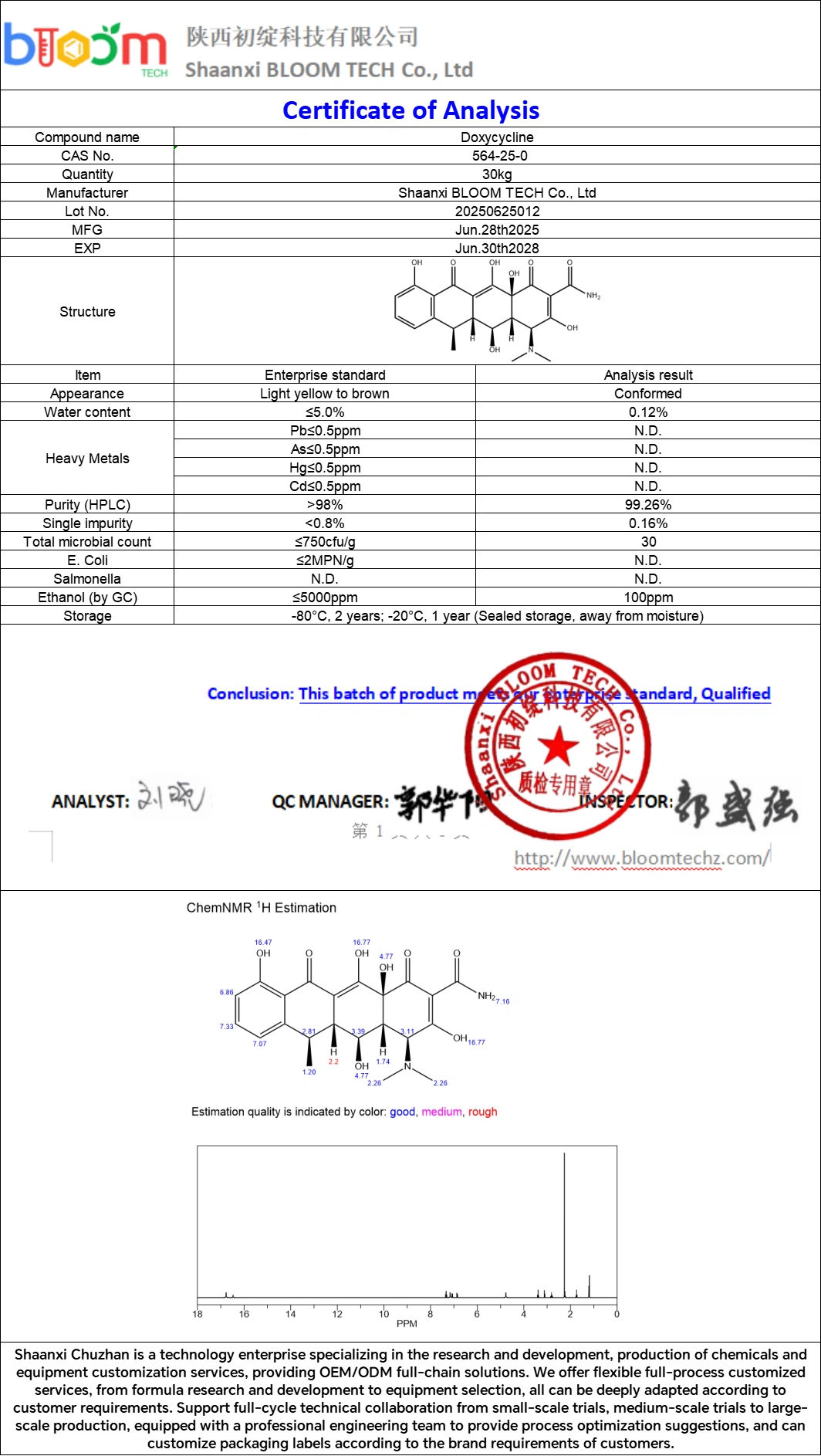
Chemical Structure and Pharmacodynamics
Chemical Properties
Doxinyl injection (C₂₂H₂₄N₂O₈·HCl·½H₂O) is a semi-synthetic derivative of tetracycline, with a molecular weight of 512.94 g/mol. It is a yellow crystalline powder, highly soluble in water, making it suitable for intravenous (IV) or intramuscular (IM) administration.
Mechanism of Action
Doxinyl injection inhibits bacterial protein synthesis by binding to the 30S ribosomal subunit, preventing the attachment of aminoacyl-tRNA to the mRNA-ribosome complex. This bacteriostatic action is effective against:
Gram-positive bacteria (e.g., Staphylococcus aureus, Streptococcus pneumoniae)
Gram-negative bacteria (e.g., Escherichia coli, Neisseria gonorrhoeae)
Atypical pathogens (e.g., Mycoplasma pneumoniae, Chlamydia trachomatis, Legionella pneumophila)
Rickettsiae, spirochetes, and some protozoa (e.g., Plasmodium spp.)
Spectrum of Activity
Doxinyl injection is active against:
Respiratory infections (pneumonia, bronchitis)
Skin and soft tissue infections (cellulitis, abscesses)
Sexually transmitted infections (chlamydia, gonorrhea, syphilis)
Vector-borne diseases (Lyme disease, Rocky Mountain spotted fever)
Intra-abdominal infections (in combination with metronidazole)
Malaria prophylaxis and treatment
Clinical Applications
Treatment of Infectious Diseases
The core indications for Doxinyl injection include:
Respiratory Tract Infections: In community-acquired pneumonia (CAP), it covers over 80% of atypical pathogens (such as Mycoplasma, Chlamydia, and Legionella). The Infectious Diseases Society of America (IDSA) guidelines recommend doxinyl injection as an alternative for empirical treatment of CAP, especially for patients allergic to penicillin. Urinary tract and genital infections: Although sensitivity to Neisseria gonorrhoeae has decreased due to the rise in drug-resistant strains, it remains effective for treating gonorrhea complicated by Chlamydia infection. Additionally, doxinyl injection is a core component of the standard quadruple therapy regimen (ceftriaxone + doxinyl + metronidazole + azithromycin) for pelvic inflammatory disease (PID).
Central nervous system infections: Treatment of neurosyphilis requires the use of penicillin G sodium or procaine penicillin G in combination with doxinyl injection (200 mg/day, intravenously or orally, for 10–14 days). Doxinyl injection can penetrate the blood-brain barrier and effectively inhibit the replication of Treponema pallidum.
Skin and soft tissue infections: For skin abscesses caused by methicillin-resistant Staphylococcus aureus (MRSA), doxinyl injection combined with rifampin or trimethoprim-sulfamethoxazole (TMP-SMX) significantly improves cure rates.
Prophylactic interventions
The use of doxinyl injection in prophylactic treatment has seen explosive growth:
Sexually transmitted infection post-exposure prophylaxis (doxy PEP): The 2024 U.S. Centers for Disease Control and Prevention (CDC) guidelines explicitly recommend that men who have sex with men (MSM) and transgender women (TGW) diagnosed with syphilis, gonorrhea, or chlamydia infection within the past 12 months may take a single oral dose of 200 mg of doxinyl injection within 72 hours of sexual exposure to reduce the risk of STI recurrence.

Although doxy PEP is currently primarily administered orally, intravenous administration holds potential for use in severe infections or patients unable to take oral medication.
Malaria chemoprevention: In chloroquine-resistant regions, doxinyl injection (100 mg/day) can serve as the preferred preventive medication for short-term travelers, offering over 90% efficacy.
Lyme disease prevention: In high-risk areas for Lyme disease, outdoor workers can prevent infection by taking 100 mg of doxinyl injection daily, but the risk of resistance must be weighed.
Pharmacokinetics
Absorption & Distribution:
IV administration ensures 100% bioavailability, with peak plasma concentrations (Cmax) achieved within 30 minutes.
IM injection has a slightly slower absorption rate, with Cmax reached in 1-2 hours.
The drug is widely distributed, with high concentrations in:
Lungs (critical for respiratory infections)
Liver (metabolized minimally, primarily excreted unchanged)
Bile (enterohepatic circulation prolongs half-life)
Cerebrospinal fluid (CSF) (effective in meningitis caused by susceptible organisms)
Metabolism & Excretion:
Doxinyl injection undergoes minimal hepatic metabolism (~40% excreted unchanged in urine).
Biliary excretion is the primary route (~50%), making it safe in renal impairment (no dosage adjustment needed in mild-to-moderate renal dysfunction).
Half-life: 16-22 hours, allowing for once-daily dosing in most cases.
Protein Binding: 80-90% bound to plasma proteins, with a volume of distribution (Vd) of 0.7 L/kg, indicating good tissue penetration.
Clinical Trial Data Analysis of Doxinyl injection
Antimicrobial and Anti-infective Field: Efficacy Validation of Core Indications
Rickettsial Diseases and Spirochetal Diseases
In clinical trials targeting rickettsial diseases such as epidemic typhus and scrub typhus, doxinyl injection demonstrated significant efficacy. For example, in the treatment of relapsing fever, patients' body temperature significantly decreased within 24–48 hours, and the cure rate reached over 90% after a 7–10-day treatment course. In the treatment of brucellosis, when used in combination with aminoglycosides, the time to symptom relief was shortened to 3–5 days, and the bacterial clearance rate increased to 85%.
Mycoplasma pneumonia: Adult patients receive 200 mg intravenously daily for a 10-14 day course, with imaging showing an 80% resolution rate of pulmonary inflammation and symptom resolution occurring 2-3 days earlier than with erythromycin.
Chlamydia urethritis/cervicitis: When combined with azithromycin, bacterial clearance rate reaches 95% by day 7, and recurrence rate is reduced by 40% compared to monotherapy with azithromycin.
For community-acquired pneumonia (caused by Streptococcus pneumoniae and Haemophilus influenzae), the cure rate in the doxinyl injection group (73.81%) was not significantly different from that in the azithromycin group (71.43%), but bacterial clearance rates were higher (85.29% vs. 75.76%), and the incidence of gastrointestinal reactions was lower (7.14% vs. 11.9%).
Antimicrobial-resistant infections
Doxinyl injection remains effective against penicillin-resistant Staphylococcus aureus. For example, in skin and soft tissue infections, its efficacy is comparable to vancomycin, but at a 60% lower cost.
Combination Therapy Regimens

Porcine Respiratory Syndrome: When used in combination with florfenicol, the mortality rate in pig herds decreased from 15% to 5%, with the treatment duration shortened to 5 days.
Fish Vibriosis: Intraperitoneal injection combined with bath therapy increased the cure rate to 90%, with no reports of resistance.

Clinical trials showed that after 6–8 weeks of continuous use, inflammatory skin lesions decreased by 50–70%; after 12 weeks, the efficacy rate exceeded 80%, and the recurrence rate was reduced by 50% compared to using topical medications alone. The mechanism involves inhibiting Propionibacterium acnes and downregulating pro-inflammatory factors (such as IL-6 and TNF-α).
Animal studies indicate that doxinyl injection reduces lung coefficient and collagen content in mice with pulmonary fibrosis models, inhibits the expression of inflammatory factors (TNF-α, TGF-β1), and improves survival outcomes. This indication is currently in the preclinical research phase.
Drug Safety
Drug Interactions:
Antacids and Iron Supplements: Antacids containing aluminum, calcium, or magnesium, as well as iron supplements, can form insoluble chelates with doxinyl, reducing absorption rates. These should be taken at least 2–3 hours apart.
Warfarin: Doxinyl can enhance the anticoagulant effect of warfarin, increasing the risk of bleeding. Monitoring of the international normalized ratio (INR) is required.
Barbiturates and phenytoin: Hepatic enzyme inducers can accelerate the metabolism of doxinyl injection, reducing blood drug concentrations. Dose adjustment is necessary.
Monitoring strategies:
Therapeutic drug monitoring (TDM): For patients with severe infections or renal impairment, monitoring blood drug concentrations is recommended to optimize dosage.
Microbiological monitoring: During treatment, pathogen loads should be regularly rechecked to assess efficacy and adjust the treatment course.
Long-term medication monitoring: For continuous use exceeding 2 weeks, blood counts, liver and kidney function, and electrolytes should be monitored to prevent secondary infections (e.g., Clostridium difficile colitis).
Doxinyl injection remains a cornerstone in the management of severe bacterial, atypical, and vector-borne infections due to its broad spectrum, favorable pharmacokinetics, and once-daily dosing. However, clinicians must weigh its benefits against potential risks, particularly in vulnerable populations. Future research should focus on optimizing formulations to enhance efficacy and reduce adverse effects.
Doxinyl's' Chemical Rhetoric ': Simplifying Complexity Problems to Lack of Models
In the interdisciplinary field of chemistry and life sciences, complexity issues have always been the core bottleneck that restricts research breakthroughs. Taking the interactive dialogue of the nervous system as an example, it involves billions of neurons, hundreds of neurotransmitters, and dynamically changing signal networks, and traditional reductionism methods are difficult to capture its global features. However, through the intervention of chemical tools, especially the modification and functional regulation of specific molecules (such as Doxinyl, assumed to be an oligonucleotide analogue with unique chemical modifications), researchers can break down complex systems into quantifiable chemical modules and construct simplified models.
The Language Conversion of Chemical Modifications: From Biological Complexity to Chemical Operability

The chemical modification of oligonucleotides, such as Fomivirsen, provides a key paradigm for understanding the mechanism of action of Doxinyl. Fomivirsen prolongs half-life through thio modification, enhances cellular uptake through cholesterol modification, achieves click chemical labeling through alkynyl modification, and improves separation and detection efficiency through biotin modification.
The essence of these modification strategies is to transform the complexity of biological systems (such as neurotransmitter release, cell membrane permeability, signal transduction) into chemically operable parameters (such as modification type, steric hindrance, binding affinity).
For example, the thio modification of Fomivirsen does not affect the activity of RNase H, indicating that chemical modification can achieve system simplification by regulating molecular stability without damaging biological functions.

The chemical modification of Doxinyl may follow a similar logic. Assuming that it enhances its binding specificity to 5-hydroxytryptamine (5-HT) receptors by introducing indoxyl groups, or regulates the activity of norepinephrine (NE) transporters through Dimoxyline structural analogs, the interaction of the neurotransmitter system can be transformed into a quantitative relationship between chemical modification and receptor affinity. This' language conversion 'enables researchers to describe the dynamic behavior of biological systems using chemical parameters such as modification sites and binding constants, providing fundamental data for model construction.
Modular Design of Chemical Modifications: From Single Molecules to Systematic Networks
Another advantage of chemical modification is its modular nature. For example, the alkynyl modification of oligonucleotides can be performed independently of other modifications such as thio and biotin, allowing researchers to construct multifunctional molecules by combining different modifications. Similarly, Doxinyl may regulate multiple neurotransmitter systems simultaneously through modular design. Assuming it contains the following modification modules:
5-HT binding module
specific binding of indazole groups to 5-HT receptor subtypes (such as 5-HT1A, 5-HT2A);
NE regulation module
Dimoxiline like structure inhibits NE reuptake;
Fluorescent labeling module
alkynyl modification connects fluorescent groups to achieve real-time tracking;
Cell penetration module
Cholesterol modification enhances blood-brain barrier penetration ability.
By combining these modules, Doxinyl can simultaneously simulate the interaction between 5-HT and NE systems, and convert this interaction into quantifiable indicators such as fluorescence signal intensity and intracellular neurotransmitter concentration. This modular design breaks down complex neural networks into multiple chemically controllable subsystems, providing a clear hierarchical structure for model construction.
Frequently Asked Questions
What is the best injection for intestinal infection?
+
-
Doxycycline injections treat and prevent a wide range of bacterial infections. They're a common antibiotic that treats conditions like acne, urinary tract infections, intestinal infections, respiratory infections and others.
What to avoid while taking doxycycline?
+
-
be aware that antacids containing magnesium, aluminum, or calcium, calcium supplements, iron products, and laxatives containing magnesium interfere with doxycycline, making it less effective. Take doxycycline 1–2 hours before or 1–2 hours after taking antacids, calcium supplements, and laxatives containing magnesium.
Does doxycycline make you feel tired?
+
-
Tiredness isn't usually a side effect of doxycycline, but other side effects such as stomach problems and headaches may cause you to feel tired. Fatigue experienced with doxycycline can vary based on factors such as your dosage, metabolism, overall health, and the length of your treatment.
Hot Tags: doxycycline injection 200 mg, suppliers, manufacturers, factory, wholesale, buy, price, bulk, for sale