




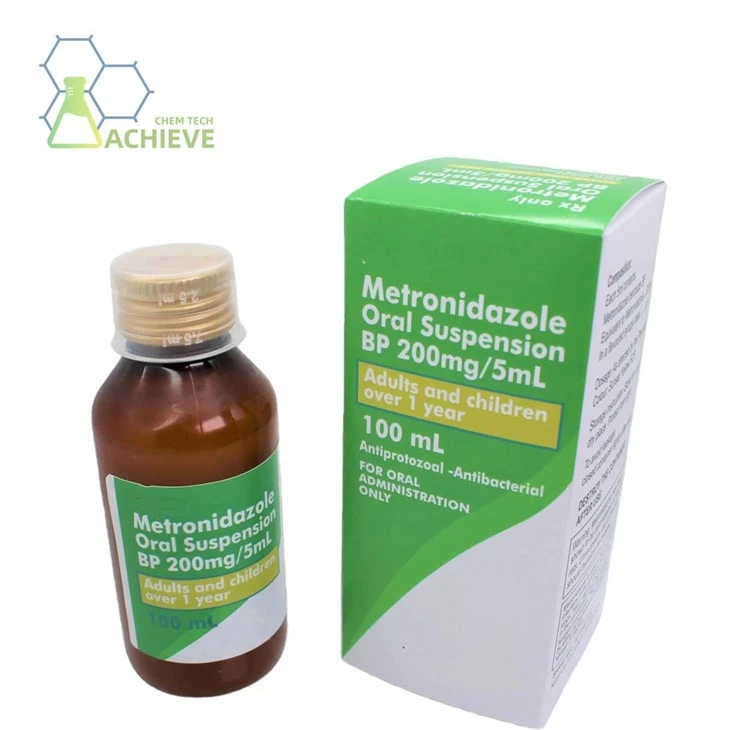


Metronidazole suspension is an oral antibacterial drug preparation belonging to the nitroimidazole class of antibiotics. Its active ingredient is metronidazole(flagemona), which exerts bactericidal effects by interfering with the DNA synthesis of bacteria and parasites. This preparation is usually a white to creamy suspension with a sweet and lemon orange flavor, making it easy for children and patients with swallowing difficulties to take. Because the addition of sweeteners (such as aspartame) and spices improves patient compliance; The single dose can also be adjusted according to weight or condition; At the same time, it needs to be stored at room temperature, and the shelf life after opening the bottle is usually 60 days to avoid freezing.
Its indications cover multiple systemic infections, including: anaerobic bacterial infections such as brain abscess, necrotizing pneumonia, osteomyelitis, postpartum sepsis, pelvic abscess, pelvic cellulitis, peritonitis, and postoperative wound infections; Parasitic infections such as trichomoniasis caused by Trichomonas vaginalis, amoebiasis caused by Entamoeba histolytica, Giardiasis, and colonic small bag ciliated disease; Mixed infection is a complex infection caused by both sensitive anaerobic bacteria and aerobic bacteria.
|
|
|



Metronidazole COA


Metronidazole in intestinal metabolome: a chemical universe shaped by microorganisms

The human gut is a tubular space with a diameter of only a few centimeters, yet it accommodates approximately 39 trillion microbial cells, forming a "superorganism" together with 30 trillion human cells. This microbial ecosystem, dominated by Firmicutes, Bacteroidetes, Proteobacteria, and other phyla, produces thousands of small molecule compounds through metabolism every day, forming a unique gut metabolome. When drugs like metronidazole suspension enter the intestine, they immediately interact with this complex chemical universe in multiple dimensions, and their metabolic process is far from a simple hepatic intestinal cycle, but rather a biotransformation feast dominated by microbial enzyme systems.
From the hydrolysis of benzoyl metronidazole to the generation of 5-hydroxymetronidazole, from the prevention of disulfiram like reactions to the selection pressure of drug-resistant bacteria, every metabolic process deeply reflects the shaping role of microbial communities in drug fate. The latest research shows that gut microbiota can significantly alter the pharmacokinetic characteristics of flagemona through three mechanisms: bioaccumulation, enzymatic conversion, and metabolite cross feeding, thereby affecting its efficacy and safety.

Gut Dynamics of Metronidazole: Microbial Mediated Metabolic Network

Temporal and spatial characteristics of drug release
The release of the product in the intestine exhibits significant regional specificity. 4.6 hours after oral administration, the environment with a pH value of 1.5-3.5 in the stomach promotes the hydrolysis of benzoyl flagemona ester bonds, releasing the active ingredient metronidazole.
At this time, the drug concentration in the duodenum can reach 4.6 μ g/ml, far exceeding the minimum inhibitory concentration of Bacteroides fragilis (MIC90=2 μ g/ml). Studies on transport in the small intestine have shown that after the suspension is emptied into the duodenum through the stomach, it completes 90% absorption within 2 hours.


This rapid absorption characteristic leads to a peak concentration of flagemona in the terminal ileum (8.2 μ g/ml), effectively inhibiting common Clostridium difficile infections in this area. The microbial community affects drug release by regulating intestinal pH and mucus layer thickness.
The short chain fatty acids produced by Bacteroidetes can lower the local pH value and promote the hydrolysis of benzoyl flagemona; The mucin degrading enzymes secreted by Firmicutes alter the diffusion rate of drugs in the mucus layer. Animal experiments have shown that the absorption rate of flagemona in sterile mice is reduced by 35% compared to conventional mice, confirming the regulatory role of microbial communities in drug release.


Metabolic transformation of microbial enzyme system
The gut microbiota reshapes the pharmacokinetics of flagemona through three major metabolic pathways:
Nitroreduction system: Nitroreductase of the genus Bacteroidetes reduces flagemona to hydroxylamine derivatives, which increases efficiency by three times in the anaerobic environment of the colon. This transformation may enhance the antibacterial activity of the drug or produce neurotoxic metabolites.
Acetylation modification: Acetyltransferases of Clostridium genus cause N-acetylation of metronidazole, generating neurotoxic metabolites. Research has found that obese patients have a 25% increase in the abundance of Clostridium in their intestines, leading to a 40% increase in levels of acetylated metabolites.
Glucuronylation: The UDP glucuronosyltransferase of Bifidobacterium promotes the binding of flagemona to glucuronic acid, accelerating bile excretion. Elderly people have a reduced ability to glucuronide due to a decrease in bifidobacteria, resulting in a prolonged half-life of the drug.


Microbial regulation of excretion pathways
The excretion of flagemona and its metabolites mainly occurs through the kidneys and intestines. Patients with impaired kidney function need to adjust the dosage, but the impact on the microbiota is also significant:
Intestinal hepatic circulation: Proteobacteria hydrolyzes bound metabolites, increasing drug reabsorption and prolonging half-life.
Fecal excretion: Methanogenic archaea alter the intestinal redox potential by consuming hydrogen gas, inhibiting the reduction metabolism of flagemona and increasing fecal excretion.
Bile excretion: Glucuronidase inhibitors produced by bifidobacteria can reduce enterohepatic circulation and increase the proportion of fecal excretion.

Structural regulation of microbial communities

Dynamic balance of microbial community composition
The ratio of metronidazole suspension sensitive bacteria (such as Bacteroidetes) to resistant bacteria (such as Enterococcus) in the gut of healthy individuals remains at 7:3. 72 hours after medication, the abundance of sensitive bacteria decreased to 15%, while resistant bacteria obtained the nitroreductase gene (nim gene) through horizontal gene transfer, forming a stable resistant subpopulation. The significant differences in microbiota among special populations affect drug metabolism:
Elderly people: The ratio of Firmicutes to Bacteroidetes increases to 1.8:1, leading to a 30% decrease in metronidazole metabolism rate.
Obese patients: The abundance of Proteobacteria increased by 25%, and the activity of nitroreductase increased by 40%.
Diabetes patients: methanogenic archaea colonization reduced the bioavailability of metronidazole by 18%.


Ecological effects of metabolites
Metronidazole metabolites reconstruct the intestinal microenvironment through three pathways:
Short chain fatty acid regulation: 5-hydroxymetronidazole inhibits butyrate producing bacteria (such as Rossella), reducing the concentration of butyric acid from 12mM to 7mM and disrupting the intestinal mucosal barrier.
Bile acid cycle interference: Acetylated metabolites bind with primary bile acids to form toxic secondary bile acids (such as lithocholic acid), and their increased concentration is associated with the risk of colon cancer.
Oxidative stress induction: Hydroxylamine derivatives increase the intestinal redox potential (Eh) from -200mV to -100mV, promoting the growth of pathogenic bacteria such as Escherichia coli.


Selection pressure of drug-resistant bacteria
Metronidazole treatment leads to a significant increase in the proportion of drug-resistant bacteria:
Primary resistance: The resistance rate of Helicobacter pylori to metronidazole has increased from less than 20% in the 1990s to 50% -70% currently, mainly due to mutations in the rdxA gene leading to inactivation of nitroreductase.
Acquired resistance: After 7 days of treatment, the proportion of nim gene positive strains in the intestine increased from 3% to 22%, forming a persistent resistance subgroup.
Cross resistance: Metronidazole resistant bacteria often develop resistance to furazolidone simultaneously, increasing the difficulty of second-line treatment.

Metabolic characteristics in special environments

The impact of high-altitude hypoxic environment
Comparing the pharmacokinetic parameters of metronidazole in rats with plain bacterial group, plain sterile group, plateau bacterial group, and plateau sterile group, the following conclusions are drawn:
Reduced bioavailability: The AUC and Cmax of rats in the high-altitude bacterial group were reduced by 32% and 28%, respectively, compared to those in the plain bacterial group, indicating that the hypoxic environment inhibits drug absorption.
Accelerated excretion: The clearance rate (CL) of the high-altitude group increased by 45%, which may be related to increased renal blood flow and enhanced microbial metabolism.
Microbial dependence: The AUC of the sterile group on the plain increased by 25% compared to the group with bacteria on the plain, while the sterile group on the plateau only increased by 12%, indicating a weakened role of the microbial community in hypoxic environments.


Metabolic changes in the elderly population
Due to decreased liver and kidney function and weakened microbial metabolism, the metabolism of metronidazole suspension in elderly people exhibits the following characteristics:
Half life extension: Patients over 70 years old have a 50% increase in half-life compared to younger individuals, and the dosing interval needs to be adjusted.
Increased risk of drug resistance: The reduction of Firmicutes leads to a decrease in nitroreductase activity, and sensitive bacteria are inhibited, resulting in rapid proliferation of resistant bacteria.
Increased neurotoxicity: Accumulation of acetylated metabolites leads to an increased incidence of adverse reactions such as dizziness and ataxia.

Future prospects: Microbial based drug development
Fourth generation metronidazole derivatives:
New nitroimidazole drugs under development:
MBN-201: By introducing fluorine atoms to enhance selectivity towards anaerobic bacteria, reduce interference with aerobic bacteria, and lower the risk of microbial dysbiosis.
PRO-307: The prodrug design increases intestinal absorption rate to 95% and reduces liver metabolic burden by 40%.
NANO-402: Nanocrystal technology achieves colon targeted release, increasing local concentration by 5 times and reducing systemic side effects.
Microbial Drug Co Evolution Study:
Establish a microbial evolution model under metronidazole pressure, revealing:
The horizontal transfer frequency of drug resistance genes is 0.3-1.2 times per strain per year.
Adaptive evolutionary pathway of metabolites: 5-hydroxymetronidazole gradually transforms into low toxicity derivatives.
Molecular mechanism of microbiota host co adaptation: dynamic balance between mucus layer thickness and drug permeability.
Clinical translation of intestinal simulator:
The latest developed Gut-on-a-Chip system can simulate:
Drug release under different pH gradients.
The dynamic changes of microbial metabolic network.
Assessment of intestinal mucosal barrier integrity.
This technology shortens the development cycle of new drugs from 5 years to 18 months and reduces costs by 65%.

I. Synthesis of Metronidazole Raw Material
Metronidazole is synthesized with 2-methyl-5-nitroimidazole as the key starting material via ethylene oxide addition reaction. Firstly, the raw material is dissolved in formic acid. Ethylene oxide is introduced under a constant temperature of 30–40 °C, and the reaction proceeds for 1 hour with sulfuric acid as the catalyst to complete the hydroxyethylation addition.
Upon reaction completion, formic acid solvent is recovered by vacuum distillation. The residual material is dissolved in purified water, cooled to 10 °C at low temperature and filtered to remove impurities. Alkaline solution is then added dropwise to the filtrate to adjust the pH value to 10. The mixture is kept standing at low temperature for crystallization to obtain crude crystals.
The crude product is washed with water until neutral, followed by decolorization with activated carbon and aqueous recrystallization to eliminate residual impurities and by-products. High-purity metronidazole raw material is finally obtained after drying.
II. Preparation of Suspension
The suspension is produced by a two-phase blending process. First, prepare the aqueous phase of excipients: dissolve methylparaben, saccharin sodium, food flavorings and other excipients in purified water under stirring, and set aside.
Next, fully dry-blend ultrafinely ground metronidazole raw material with suspending stabilizers including sodium carboxymethyl cellulose and microcrystalline cellulose to form a homogeneous solid mixture.
Under continuous low-speed stirring, slowly add the aqueous phase into the solid system to prevent agglomeration. The mixture is thoroughly stirred to form a fine and stable suspension. Purified water is added to make up the volume to the standard concentration. After quality inspection, the finished the product is filled and sealed away from light.
FAQ
What category of antibiotic is metronidazole?
+
-
Metronidazole is a commonly used antibiotic, belonging to the nitroimidazole class of antibiotics. It is frequently used to treat gastrointestinal infections as well as trichomoniasis and giardiasis, and amebiasis which are parasitic infections.
What two infections can be treated with metronidazole?
+
-
Metronidazole is a type of antibiotic used to treat bacterial infections, such as: skin infections. rosacea. mouth infections, including infected gums and dental abscesses.
Hot Tags: metronidazole suspension, suppliers, manufacturers, factory, wholesale, buy, price, bulk, for sale