




Shaanxi BLOOM Tech Co., Ltd. is one of the most experienced manufacturers and suppliers of metformin solution in China. Welcome to wholesale bulk high quality metformin solution for sale here from our factory. Good service and reasonable price are available.
Metformin Solution (Metformin Hydrochloride Oral Solution) is a liquid preparation mainly composed of metformin hydrochloride, which is mainly used to treat type 2 diabetes. Compared with traditional tablet or capsule formulations, oral solutions have advantages such as flexible dosage adjustment and convenient swallowing, especially suitable for children, the elderly, and patients with swallowing difficulties. Its core component, metformin hydrochloride, achieves hypoglycemic effects by inhibiting liver glucose production, reducing intestinal glucose absorption, and increasing peripheral tissue sensitivity to insulin.



Additional information of chemical compound:

|
|
|


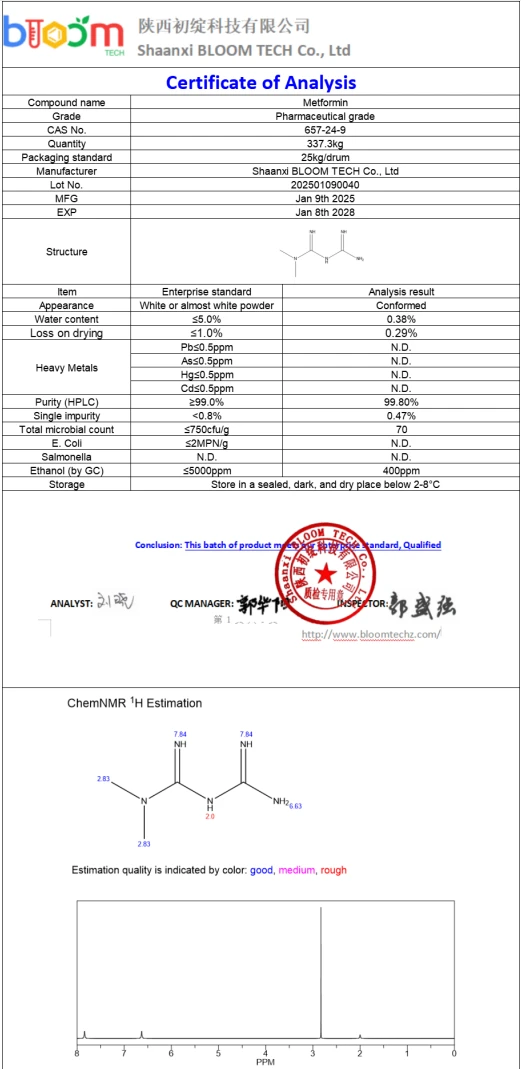
Metformin COA
The role of Metformin Solution in two-dimensional cell culture

Two dimensional (2D) cell culture technology, as a core tool in cell biology research, has long dominated fields such as drug development, disease mechanism analysis, and toxicity assessment due to its ease of operation, low cost, and high-throughput screening compatibility. However, the planar structure of traditional 2D culture leads to loss of cell polarity, simplification of intercellular interactions, and loss of extracellular matrix (ECM) signals, making it difficult to accurately simulate the complex microenvironment in vivo.
In recent years, Metformin Solution has been discovered as a classic hypoglycemic drug, with its mechanism of action ranging from inhibition of mitochondrial complex I to regulation of gut microbiota at multiple levels. This has led to a reevaluation of its potential in the treatment of cancer, anti-aging, and metabolic diseases.The oral solution formulation can achieve individualized dosage (such as calculating dosage based on children's body weight) by adjusting the volume of a single dose, while avoiding the risk of tablets or capsules getting stuck in the throat and improving patient compliance. At the same time, liquid formulations are evenly dispersed in the gastrointestinal tract and may be absorbed faster than solid formulations.
Technical characteristics and limitations of 2D cell culture
Core advantages of 2D cultivation
2D cell culture involves seeding cells onto a flat substrate (such as culture dishes or porous plates) to form single-layer or multi-layer cell structures. Its technical advantages are reflected in:
Standardized operation: The cultivation process is highly unified, with high experimental reproducibility, suitable for large-scale drug screening.
Microscopic imaging compatibility: Cell morphology and dynamic changes are easy to observe, making it convenient to combine fluorescence labeling technology for real-time tracking.
High throughput adaptability: seamlessly integrated with automated liquid processing systems, microfluidic chips, and CRISPR gene editing technology to accelerate functional genomics research.


Physiological limitations of 2D culture
Although 2D models are indispensable in basic research, their structural defects lead to significant differences in cell behavior compared to the in vivo environment
Cell polarity loss: The planar matrix restricts the three-dimensional morphological development of cells, such as liver cells being unable to form bile duct like structures, and intestinal epithelial cells losing their villi and microvilli.
Simplification of intercellular interactions: Lack of dynamic dialogue among fibroblasts, immune cells, and endothelial cells in the tumor microenvironment (TME) affects drug sensitivity assessment.
Mechanical signal deficiency: The two-dimensional matrix hardness (usually 0.1-10 kPa) is much lower than that of in vivo tissues (such as skeletal muscle 10-20 kPa, brain tissue 0.1-1 kPa), resulting in distorted cellular mechanical response.
Comparison of 2D and 3D Cultivation
Three dimensional (3D) culture reconstructs cell cell and cell ECM interaction networks through hydrogel scaffold, suspended sphere or organ chip technology. For example, in colorectal cancer research, 3D sphere models showed that Metformin Solution had a 30% increased inhibitory effect on cancer cell proliferation compared to 2D models, and induced cell apoptosis earlier. However, 3D cultivation faces challenges such as high cost, complex operation, and low imaging resolution, and cannot completely replace 2D models in the short term.

Therefore, optimizing 2D culture conditions (such as substrate coatings and co culture systems) has become a key strategy for balancing physiological relevance and experimental feasibility.
The core mechanism of Metformin Solution

Regulation of SHIP2 phosphatase and enhancement of insulin signaling
SHIP2 (inositol phosphatase 2 containing SH2 domain) hydrolyzes PI (3,4,5) P3 to PI (3,4) P2, negatively regulating the insulin receptor substrate (IRS) - PI3K Akt pathway. It directly binds to the catalytic domain of SHIP2, reducing its enzymatic activity and enhancing insulin signaling. In 2D cultured skeletal muscle cells (C2C12), it (100 μ M) treatment increased Akt phosphorylation level by 1.8 times and glucose uptake rate by 60%, providing molecular targets for the treatment of diabetes.
Metabolites of gut microbiota and host microbe interactions
Although 2D culture cannot directly simulate gut microbiota, the regulatory effect of it can be indirectly studied by supplementing metabolites of the microbiota, such as short chain fatty acids. For example, in 2D cultured intestinal epithelial cells (Caco-2), pretreatment with butyric acid (5 mM) significantly enhanced the activation effect of it on AMPK, indicating the importance of the microbiota host metabolic axis in drug response.

Metabolic regulation of Metformin Solution in 2D culture

Bidirectional regulation of glucose metabolism
Inhibition of hepatic glucose output: In 2D cultured primary liver cells, it (1 mM) reduced glucose production by 55% by decreasing PEPCK and G6Pase gene expression, showing a dose-dependent relationship with clinical hypoglycemic effects (fasting blood glucose decreased by 1.5-2.0 mmol/L).
Promoting peripheral tissue uptake: It (200 μ M) activates GLUT4 translocation to the cell membrane in 2D cultured adipocytes (3T3-L1), increasing glucose uptake by 2.1 times while inhibiting lipolysis and reducing free fatty acid release.
Improvement effect of lipid metabolism
Metformin Solution downregulates the expression of fatty acid synthase (FASN) and acetyl CoA carboxylase (ACC) by inhibiting the SREBP-1c transcription factor. After 48 hours of treatment with it (0.5 mM) in 2D cultured liver cells, triglyceride accumulation decreased by 40%, while promoting the expression of fatty acid oxidation related genes (CPT1A, PPAR α) and improving lipid metabolism disorders.


Reprogramming of Amino Acid Metabolism
Recent studies have revealed that It can regulate the metabolism of branched chain amino acids (BCAAs). In 2D cultured skeletal muscle cells, it (100 μ M) enhances autophagy by activating BCAA transaminase (BCAT), reducing intracellular leucine concentration, and inhibiting the mTORC1 signaling pathway. This mechanism provides a new perspective for the treatment of metabolic syndrome.
The synergistic effect and new applications of Metformin Solution
Synergistic effects with natural compounds
Resveratrol:It (50 μ M) combined with resveratrol (10 μ M) in 2D cultured endothelial cells enhances mitochondrial biogenesis and reduces oxidative stress damage by activating the SIRT1-AMPK pathway.
Curcumin: In 2D cultured liver cancer cells (Huh7), it (10 mM) synergistically induced ferroptosis with curcumin (20 μ M), resulting in a 3-fold increase in lipid peroxide accumulation and a 65% increase in cell mortality rate.
Optimization of Nano Delivery System
To improve the cellular uptake efficiency of it, researchers have developed it encapsulated in poly (lactic acid glycolic acid) copolymer (PLGA) nanoparticles. In 2D cultured breast cancer cells (MCF-7), the nano delivery system increased the drug intracellular concentration by five times, and the IC50 value decreased from 15 mM to 3 mM, significantly enhancing the anti-cancer activity.
2D Models Assisted by 3D Printing Technology
By using 3D printing technology to construct micro patterned matrices, cell polarity can be simulated in 2D culture. For example, inoculating liver cells onto a printed striped matrix (width 10 μ m) can form a bile duct like structure. After treatment with it (50 μ M), the expression of bile acid synthesis related genes (CYP7A1, CYP8B1) is upregulated by 2 times, closer to the physiological state in vivo.
Multidimensional verification and challenges of the mechanism of action of Metformin Solution
Analysis of the Mechanism Driven by Gene Editing Technology
The CRISPR-Cas9 technology provides a precise tool for validating Metformin Solution targets. For example, after knocking out AMPK α 1/α 2 subunits in 2D cultured HEK293T cells, the promoting effect of it (1 mM) on glucose uptake completely disappeared, confirming that AMPK is its core effector molecule.

Similarly, the sensitivity of SHIP2 gene knockout cells to it was significantly reduced (IC50 value increased from 5 mM to 15 mM), further supporting the hypothesis of SHIP2 as a direct target.However, gene editing may trigger compensatory signaling pathway activation (such as compensatory elevation of mTORC1 activity after AMPK deficiency), which requires comprehensive analysis in combination with chemogenetics or double knockout models.

Verification of complementarity between organoids and 2D culture
Although 3D organoids can better simulate tissue architecture, their cultivation cycle is long (usually 2-4 weeks), high cost, and low imaging resolution. Therefore, 2D culture is often used as a pre experimental platform for organoid research.
For example, in colorectal cancer organoids, the synergistic effect of Metformin Solution (10 mM) combined with 5-FU needs to be screened for the optimal dose ratio (1:5) through 2D cultured HCT116 cells before being applied for organoid validation.In addition, 2D cultured cell lines can be used for high-throughput drug screening (such as 384 well plates) to quickly identify synergistic combinations of it with other compounds (such as EGFR inhibitors, HDAC inhibitors), while organoids are used to validate the effectiveness of these combinations in complex tissues.
Dose and time-dependent challenges in clinical translation
In clinical studies, the hypoglycemic effect of the product usually requires continuous medication for several weeks to months, while in 2D culture, cell responses often manifest within 24-72 hours. This difference in time scale may lead to mechanism interpretation bias. For example, in 2D cultured liver cells, the product (1 mM) treatment for 24 hours can inhibit the expression of gluconeogenesis related genes, but long-term treatment (7 days) may weaken the effect due to metabolic adaptation (such as AMPK desensitization).

Therefore, it is necessary to establish a dynamic culture system (such as microfluidic perfusion device) to simulate the continuous exposure and metabolic clearance process of drugs in vivo, in order to more accurately predict clinical efficacy.

The product uses metformin hydrochloride as the active pharmaceutical ingredient (API) and is manufactured via liquid formulation technology. Its core process includes four stages: API synthesis, formulation preparation, filtration and sterilization, and filling and packaging, all conducted in strict compliance with GMP regulations.
API Synthesis
Using aqueous dimethylamine and dicyandiamide as starting materials, crude it is produced through salt formation and condensation. The crude product is then purified by recrystallization, drying, and refining to yield an API with a purity of ≥99.5%. The mainstream process achieves a yield of over 90%.
Formulation and Preparation
The common strength is 100 mg/mL. The formulation consists of it, purified water, pH adjusters (hydrochloric acid/potassium bicarbonate), preservatives (potassium sorbate/sodium benzoate), flavoring agents (xylitol, sucralose, strawberry flavor), and a suspending agent (xanthan gum).During preparation, the API and excipients are added to purified water and stirred to dissolve, with the temperature controlled at ≤30 °C. The pH is then adjusted to 4.6–4.9 with dilute hydrochloric acid, and the solution is made up to volume and homogenized.
Filtration and Sterilization
The solution is clarified through 0.45 μm microporous membrane filtration to remove impurities, followed by moist heat sterilization at 115 °C for 30 minutes to ensure sterility and pyrogen compliance.
Filling and Packaging
Filling is performed under aseptic conditions into light‑resistant, child‑resistant amber glass bottles, equipped with an oral dosing cup or syringe. After sealing and labeling, the finished product is stored in a cool and dry place.
FAQ
What is the use of the product?
+
-
Metformin is a biguanide antihyperglycemic used in conjunction with diet and exercise for glycemic control in type 2 diabetes mellitus. It is also used off-label for insulin resistance in polycystic ovary syndrome (PCOS).
Is there a liquid form of metformin?
+
-
Your doctor or pharmacist will explain what type of metformin tablets you're on and how to take them. Metformin is also available as a liquid and sachets, for children and people who find it difficult to swallow tablets.
What is 500mg 5ml it?
+
-
Upon reconstitution, the final concentration is 500 mg/5 mL. The recommended starting dose is 5 mL (500 mg) orally once daily with the evening meal. The dose can be increased in 5-mL increments weekly up to a maximum dose of 20 mL (2,000 mg) once daily with the evening meal.
What is it used for?
+
-
Metformin is a medicine used to treat type 2 diabetes and gestational diabetes. It's also used to help prevent type 2 diabetes if you're at high risk of developing it. Type 2 diabetes is a condition where the body does not make enough insulin, or the insulin that it makes does not work properly.
Hot Tags: metformin solution, suppliers, manufacturers, factory, wholesale, buy, price, bulk, for sale