


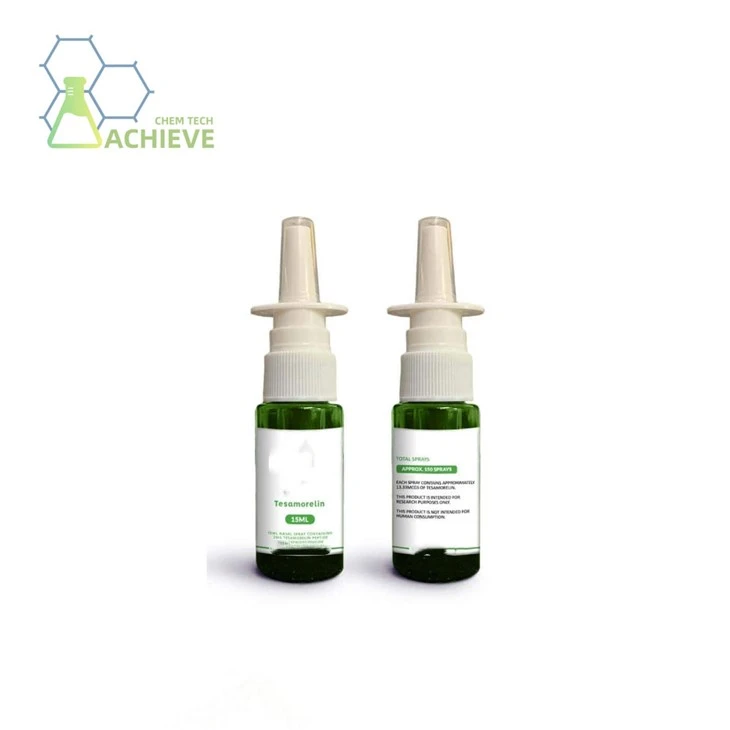


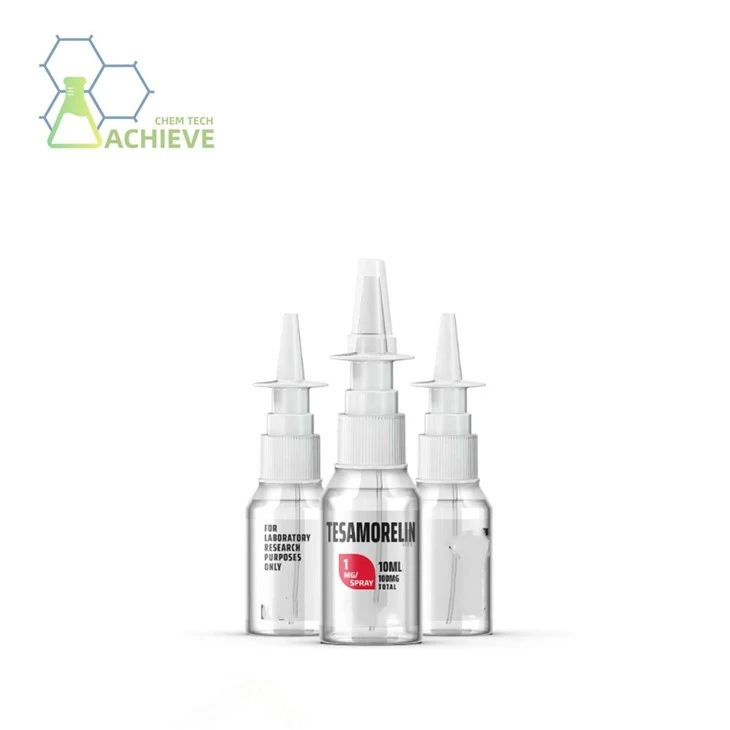

Tesamorelin is an artificially synthesized growth hormone releasing factor (GHRH) analogue. GHRH is a polypeptide hormone secreted by the hypothalamus, which can stimulate the anterior pituitary gland to secrete growth hormone (GH). Tesamorelin Spray uses spray administration, which has significant convenience advantages compared with traditional injection administration. The patient does not need to carry out complicated injection operations, just aim the spray device at the mouth or nasal cavity, and press the nozzle to complete the administration, greatly simplifying the administration process. For patients who need to use medication for a long time, especially those who have a fear of injections or have difficulty operating them, this can significantly improve patient compliance, ensure that patients use medication on time and in the right amount, and thus improve treatment effectiveness. Spray administration can make drugs directly sprayed on the mucosal surface in the form of small particles, increasing the contact area between drugs and mucosa, which is conducive to rapid absorption of drugs. Compared with oral administration, it avoids the first pass effect of drugs in the gastrointestinal tract, reduces the degradation and absorption barriers of drugs in the gastrointestinal tract, and enables drugs to enter the bloodstream faster, exerting therapeutic effects.
Our products


Tesamorelin COA

Degradation of Tesamorelin Spray by Nasal Enzymes (such as Aminopeptidase)
The choice of administration route is crucial in drug development and clinical application. Nasal administration is receiving increasing attention due to its advantages of non invasiveness, fast onset, and relatively high bioavailability. Tesamorelin Spray, as a nasal delivery formulation, has potential application value in the treatment of certain diseases. However, there is a rich enzyme system on the surface of the nasal mucosa, which may degrade drugs administered through the nasal cavity, thereby affecting the stability and efficacy of the drugs. Among them, aminopeptidase is an important type of enzyme in nasal cavity, and its degradation effect on Tesamorelin Spray is particularly significant.
Basic information
Tesamorelin is an artificially synthesized growth hormone releasing factor (GHRH) analogue. It is composed of 44 amino acids, and its chemical structure has been carefully designed and modified to mimic the active site of natural GHRH, allowing it to specifically bind to GHRH receptors and stimulate the secretion of growth hormone from the anterior pituitary gland. Tesamorelin has specific spatial conformation and chemical groups, which determine its biological activity and stability. Under physiological conditions, Tesamorelin needs to maintain its intact structure in order to exert its regulatory effect on growth hormone secretion.
Tesamorelin Spray is a spray preparation made of Tesamorelin suitable for nasal administration. This form of preparation has many advantages, such as convenient administration, high patient compliance, and the ability to avoid first pass effects in the liver. In order to enable Tesamorelin to be effectively absorbed on the nasal mucosa, some excipients, such as stabilizers and penetration enhancers, are usually added to spray preparations. Stabilizers can prevent the degradation of Tesamorelin during storage and use, maintaining the integrity of its chemical structure; Penetration enhancers can increase the permeability of nasal mucosa to drugs and improve the absorption efficiency of drugs.
Tesamorelin Spray is mainly used to treat diseases related to growth hormone deficiency, such as HIV related lipid metabolism disorders. In these diseases, patients have abnormal levels of growth hormone in their bodies, leading to disrupted fat metabolism and symptoms such as abdominal fat accumulation. Tesamorelin Spray can effectively reduce abdominal fat mass and improve patients' physical condition and quality of life by stimulating the secretion of growth hormone and regulating fat metabolism. Due to its convenient nasal administration, Tesamorelin Spray has broad prospects in clinical applications.
Types, distribution, and functions of nasal enzymes
Types of nasal enzymes
There are various enzymes on the surface of nasal mucosa, which can be classified into different types such as hydrolytic enzymes, oxidoreductases, and transferases. Among them, hydrolytic enzymes dominate in nasal enzymes, mainly including aminopeptidase, carboxypeptidase, esterase, protease, etc. These enzymes have different substrate specificity and catalytic activity, and can degrade and metabolize various substances entering the nasal cavity.


Distribution of nasal enzymes
Nasal enzymes are mainly distributed on the surface of the nasal mucosa and in the mucus layer. The nasal mucosa is composed of epithelial cells, goblet cells, and basal cells, which can secrete various enzymes and mucus. The mucus layer covers the surface of the nasal mucosa, forming a physical barrier and containing abundant enzymes that can preliminarily degrade and remove microorganisms, particles, and chemicals in the inhaled air. The distribution of nasal enzymes is uneven, and there may be differences in the types and activities of nasal mucosal enzymes in different parts.
Function of nasal enzymes
Nasal enzymes play an important role in the physiological functions of the nasal cavity. Firstly, they can participate in the defense mechanism of the nasal mucosa, degrade and remove harmful substances inhaled, and protect the nasal cavity and lower respiratory tract from infection and damage. Secondly, nasal enzymes can also metabolize and inactivate certain drugs, affecting their absorption and efficacy. In addition, nasal enzymes also participate in the normal metabolism and renewal process of nasal mucosa, maintaining the structural and functional integrity of nasal mucosa.

The special position of aminopeptidase in the nasal cavity
Aminopeptidases are a type of enzyme that can hydrolyze amino acids one by one from the N-terminus of peptide chains. According to its mechanism of action and structural characteristics, aminopeptidases can be classified into various types, such as leucine aminopeptidase, alanine aminopeptidase, etc. Aminopeptidases typically have specific active centers and substrate binding sites, which can specifically recognize and bind to the N-terminal amino acids of peptide chains, and hydrolyze them.
Aminopeptidase is widely distributed in the nasal mucosa, especially in the mucous layer and epithelial cells of the nasal cavity where its content is relatively high. The aminopeptidase in nasal mucus mainly comes from the secretion of nasal mucosal cells, and its content is influenced by various factors such as age, gender, health status, etc. Research has shown that in certain disease states, such as rhinitis, sinusitis, etc., the content and activity of aminopeptidase in nasal mucosa may change.
In the physiological process of nasal cavity, aminopeptidase participates in the metabolism and renewal of nasal mucus, helping to remove foreign objects and pathogens in the nasal cavity. Meanwhile, aminopeptidase also plays an important role in immune regulation of nasal mucosa, which can affect the activity and function of immune cells. In the pathological process of nasal cavity, abnormal expression and activity changes of aminopeptidase may be closely related to the occurrence and development of certain diseases. For example, in patients with rhinitis, the activity of aminopeptidase in the nasal mucosa may increase, leading to damage to the nasal mucosa and exacerbation of inflammatory reactions.
Degradation process of Tesamorelin Spray by nasal enzymes
Recognition and binding of Tesamorelin by aminopeptidase
Tesamorelin is a peptide drug with a specific amino acid sequence at its N-terminus. Aminopeptidase can specifically recognize the N-terminal amino acid of Tesamorelin and bind to it through its substrate binding site. This binding is the first step in the degradation of Tesamorelin by aminopeptidase, providing a foundation for subsequent catalytic reactions.


Aminopeptidase catalyzed hydrolysis of Tesamorelin
Once aminopeptidase binds to Tesamorelin, its active center catalyzes the hydrolysis reaction of the N-terminal amino acid of Tesamorelin. Aminopeptidases provide a suitable microenvironment and catalytic groups to reduce the activation energy of hydrolysis reactions, causing the peptide bonds of Tesamorelin to break and release N-terminal amino acids. This process will continue to repeat, causing the peptide chain of Tesamorelin to gradually shorten and ultimately lose its biological activity.
Synergistic degradation of other nasal enzymes
In addition to aminopeptidase, other enzymes in the nasal cavity, such as carboxypeptidase and protease, may also participate in the degradation process of Tesamorelin. Carboxypeptidase can hydrolyze amino acids from the C-terminus of peptide chains and degrade Tesamorelin from both ends with aminopeptidase, accelerating drug inactivation. Proteases can randomly hydrolyze peptide bonds in the Tesamorelin peptide chain, further disrupting the structure of the drug. The synergistic effect of these enzymes enables rapid degradation of Tesamorelin in the nasal environment.

Method and results of HPLC detection of half-life of Tesamorelin Spray
High performance liquid chromatography (HPLC) is a commonly used separation and analysis technique that can be used to determine the concentration and changes of drugs in biological samples. In this study, HPLC was used to detect the degradation of Tesamorelin Spray in nasal simulation solution. Firstly, prepare a certain concentration of Tesamorelin standard solution and nasal simulation solution, which contains components and enzyme systems similar to nasal mucus. Then, spray Tesamorelin Spray into the nasal simulation fluid and take samples at different time points. Pre treat the sample, such as centrifugation, filtration, etc., to remove impurities. Finally, inject the processed sample into the HPLC system for separation and detection, and calculate the concentration of Tesamorelin based on peak area or peak height.
Through HPLC detection, it was found that the half-life of Tesamorelin Spray in nasal simulation solution is only 25 minutes. This result indicates that Tesamorelin is highly susceptible to degradation by nasal enzymes in the nasal environment, leading to a rapid decrease in drug concentration. Short half-life means that the drug has a short residence time in the nasal cavity, limited effective action time, and may affect the efficacy of the drug. Further analysis revealed that aminopeptidase is one of the main enzymes causing rapid degradation of Tesamorelin, and its degradation effect significantly reduces the concentration of the drug in a short period of time.
Frequently Asked Questions
What does tesamorelin do?
+
-
TESAMORELIN (TES a moe REL in) reduces excess fat in the stomach area in people with HIV and lipodystrophy. It works by increasing levels of growth hormone in the body. This reduces the amount of fat stored in the stomach area.
Why was tesamorelin banned?
+
-
The FDA's letter highlighted issues primarily related to chemistry, manufacturing and controls. Its inquiries focused on the microbiology, assays, impurities and stability of the lyophilised product and the final reconstituted drug.
Is tesamorelin similar to Ozempic?
+
-
But chances are that you recognize the names Ozempic, Wegovy, and even insulin. They're all peptides. Tesamorelin is also a peptide, but it belongs to a different class and has the potential to treat a host of concerns.
Hot Tags: tesamorelin spray, suppliers, manufacturers, factory, wholesale, buy, price, bulk, for sale