




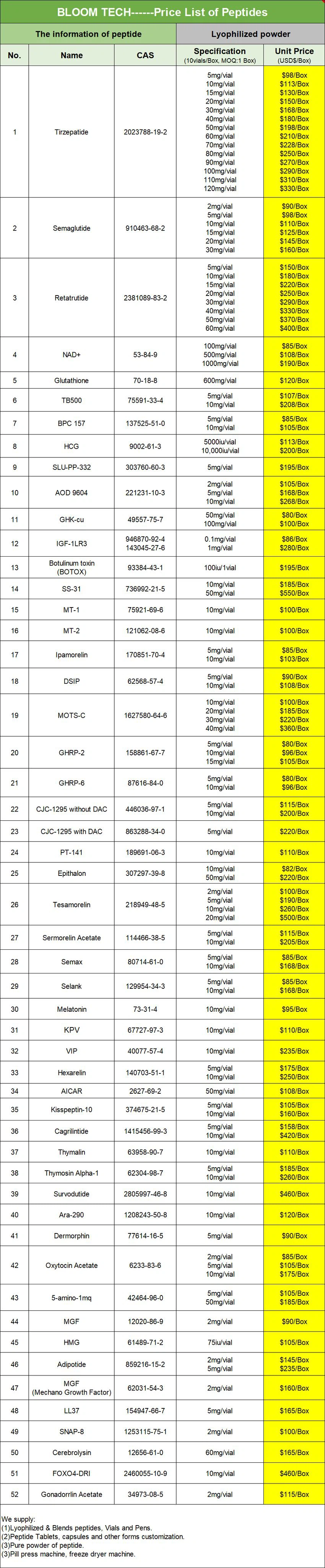
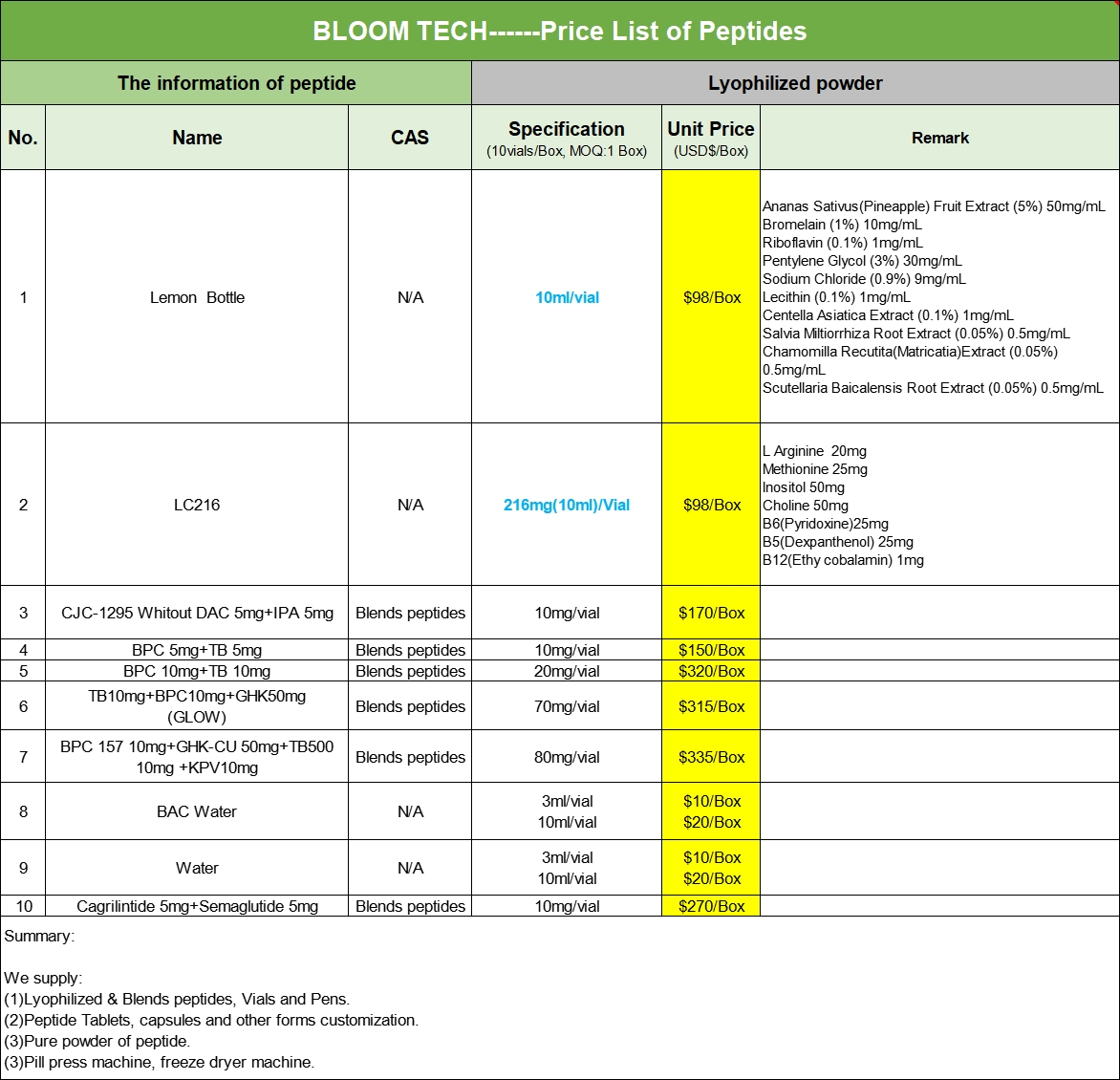
Shaanxi BLOOM Tech Co., Ltd. is one of the most experienced manufacturers and suppliers of exenatide tablets in China. Welcome to wholesale bulk high quality exenatide tablets for sale here from our factory. Good service and reasonable price are available.
Exenatide Tablets promote insulin secretion by activating GLP-1 receptors on the surface of pancreatic beta cells, but only work when blood sugar is elevated, thereby reducing the risk of hypoglycemia. It can reduce liver glucose output and further control fasting blood sugar. Thereby slowing down the absorption rate of carbohydrates and reducing postprandial blood sugar fluctuations.
It regulates appetite through the central nervous system, reduces energy intake, and may improve peripheral tissue sensitivity to insulin. Oral tablets protect peptides from degradation by gastric acid through osmotic pump technology, and are released and absorbed in specific areas of the small intestine. The plasma protein binding rate is low, the distribution volume is small, and it mainly acts on target organs (pancreas, gastrointestinal tract, central nervous system). It is cleared through renal metabolism with a half-life of approximately 2-4 hours (injectable form), while oral formulations may be extended to 12-24 hours due to technological improvements.
Our Products Form



Exenatide/Exenatide acetate COA

Exenatide Tablets, as a classic GLP-1 receptor agonist, has become a cross disciplinary research hotspot for its neuroprotective effects in addition to its core hypoglycemic effect. GLP-1 receptor is widely expressed in the central and peripheral nervous system. After activation of the receptor by Exenatide, it plays multiple neuroprotective roles such as inhibiting neuroinflammation, anti neuronal apoptosis, improving mitochondrial function, promoting neurogenesis, reducing toxic protein aggregation, repairing nerve damage, etc. through regulating the core signal network (cAMP-PKA, PI3K-Akt, AMPK, PPAR δ), and has potential therapeutic value for diabetes neuropathy, Parkinson's disease, Alzheimer's disease, ischemic stroke, spinal cord injury and other neurological diseases.
Structure and receptor basis of neuroprotection
Exenatide is a GLP-1 analogue isolated from the saliva of the Gila lizard. It contains 39 amino acids and shares 53% homology with natural GLP-1. The second glycine replaces alanine and can resist DPP-4 degradation. Its half-life is extended to 2.4 hours. The key prerequisite for its neuroprotection is the ability to penetrate the blood-brain barrier (BBB): Exenatide is a small molecule peptide with moderate lipid solubility, which can penetrate the BBB through a dual pathway of passive diffusion and active transport mediated by GLP-1 receptors.


The concentration of drugs in the brain can reach 15% to 20% of peripheral blood drug concentration, which is sufficient to activate GLP-1 receptors in the central nervous system. Compared with natural GLP-1, Exenatide has a 3-4 fold increase in BBB penetration efficiency and is not easily degraded by DPP-4 in the brain, allowing it to continue to function in the central nervous system.
GLP-1 receptor (GLP-1 R) belongs to the G protein coupled receptor B family and is widely expressed in the central nervous system (CNS) and peripheral nervous system (PNS). It is the core target of Exenatide neuroprotection
Central distribution: Highly expressed in the hippocampus (CA1/CA3 area), cerebral cortex, substantia nigra pars compacta, striatum, hypothalamus, cerebellum, and other regions, mainly distributed on the surface of neurons, microglia, and astrocytes. Neuronal surface GLP-1R directly mediates anti apoptotic and nutritional support effects; Glial GLP-1R regulates neuroinflammation; Astrocytes GLP-1R promote the secretion of neurotrophic factors.


Peripheral distribution: It is expressed in dorsal root ganglion, sympathetic/parasympathetic ganglion, retinal ganglion cells, and peripheral nerve myelin sheath cells, and mediates the protection of diabetes peripheral neuropathy.
Receptor function: After activation of GLP-1R in the nervous system, it initiates signaling pathways homologous to peripheral target cells (cAMP PKA, PI3K Akt, etc.), but with neural tissue specificity - preferentially regulating genes related to apoptosis, inflammation, mitochondrial function, and neuroplasticity, rather than metabolic genes.
The binding of Exenatide to neural GLP-1R exhibits high affinity, specificity, and long-lasting effects
The affinity (Kd ≈ 0.3nM) is significantly higher than that of natural GLP-1 (Kd ≈ 1.0nM), and the binding is more stable;
Only specifically binds to GLP-1R, does not cross react with glucagon receptors and GIP receptors, and avoids off target effects;
After binding, it induces conformational changes in the receptor, continuously activates downstream signals, and maintains neuroprotective effects within its half-life.

Reference information source:
- Molecular mechanism study of Exenatide regulating liver circadian rhythm. Chinese Pharmacological Bulletin, 2024
- The GLP-1 receptor agonist, Exenatide, Administration Time Differentially Affects Circadian Rhythms in Diabetic db/db Mice. University of Kentucky College of Medicine, 2024
- The regulatory effect and clinical significance of GLP-1 receptor agonists on liver circadian rhythm. Chinese Journal of Endocrinology and Metabolism, 2024
The core molecular mechanism of neuroprotection
Core pathway one: cAMP PKA CREB pathway - neuronal survival and nutritional support

CAMP PKA CREB is the core initiating pathway of Exenatide Tablets neuroprotection, mediating neuronal anti apoptosis, neurotrophication, and synaptic plasticity regulation, and is the basis for maintaining neuronal survival.
Pathway activation mechanism: Exenatide binds to neural GLP-1R → activates Gs protein → G α s-GTP dissociates → activates adenylate cyclase (AC) → intracellular cAMP concentration increases by 2-3 times → cAMP binds to PKA regulatory subunit → PKA catalytic subunit dissociates and merges into the nucleus.
Neuroprotective effect:
Anti neuronal apoptosis: PKA phosphorylates CREB (Ser133 site) → activated CREB binds to the target gene CRE element → upregulates the expression of anti apoptotic proteins Bcl-2 and Bcl xL, inhibits the expression of pro apoptotic proteins Bax and Caspase-3/9, and blocks the mitochondrial apoptosis pathway.
Promote the secretion of neurotrophic factors: CREB activates the transcription of BDNF (brain-derived neurotrophic factor) and NGF (nerve growth factor) genes, and the BDNF/TrkB pathway further enhances neuronal survival, promotes synaptic growth and repair.


Improving synaptic plasticity: Upregulating the expression of synaptophysin and PSD-95, enhancing synaptic connectivity stability, and improving cognitive and motor function.
Pathological model validation: In the cognitive impairment model of diabetes, Exenatide increased the expression of BDNF in hippocampus by 60%, reduced the neuronal apoptosis rate by 50%, and significantly improved cognitive function through cAMP-PKA-CREB pathway.
PI3K Akt PPAR δ is the core effector pathway of Exenatide neuroprotection, mediating inhibition of neuroinflammation, neuronal resistance to apoptosis, and mitochondrial functional repair, and is key to blocking the progression of nerve injury.
Pathway activation mechanism: Exenatide activates GLP-1R → G β - γ dimer dissociation → activates PI3K → PIP2 is converted to PIP3 → recruits Akt to the cell membrane → PDK1/mTORC2 dual phosphorylation activates Akt → Akt activates PPAR δ (Ser112 site).


Neuroprotective effect:
Inhibition of neuroinflammation (core): The Akt PPAR δ pathway inhibits M1 polarization of microglia (pro-inflammatory phenotype), promotes M2 polarization (anti-inflammatory phenotype), reduces the release of pro-inflammatory factors such as TNF - α, IL-1 β, IL-6, iNOS, and increases the secretion of anti-inflammatory factors such as IL-10 and TGF - β. Simultaneously inhibiting the NF - κ B signaling pathway and blocking the inflammatory cascade reaction.
Anti neuronal pyroptosis: PPAR δ activation inhibits NLRP3 inflammasome and Caspase-1 activation, reduces IL-1 β and IL-18 release, blocks neuronal pyroptosis (inflammatory apoptosis), and is particularly effective in ischemic and high glucose injury models.
Mitochondrial protection: Akt PPAR δ upregulates UCP2, Nrf1, and SOD2 expression, enhances mitochondrial oxidative phosphorylation, reduces ROS generation, stabilizes mitochondrial membrane potential, inhibits cytochrome c release, and blocks neuronal death mediated by mitochondrial damage.


Improve insulin resistance: Akt activation improves insulin signal in the brain, reduces insulin resistance mediated nerve damage, and has dual protection for diabetes with neuropathy.
Pathological model validation: In the spinal cord injury model, Exenatide increases M2 microglia in the injury area by three times through this pathway, reduces pro-inflammatory cytokine levels by 70%, and increases motor function recovery rate by 50%.
AMPK is the neural energy sensing pathway of Exenatide, mediating neuronal energy metabolism repair, autophagy activation, and toxic protein clearance, and is key to maintaining neuronal homeostasis.
Pathway activation mechanism: Exenatide activates AMPK (Thr172 phosphorylation) through a dual pathway of G β - γ and cAMP PKA - directly activating by reducing the intracellular ATP/AMP ratio; PKA phosphorylation indirectly activates LKB1.
Neuroprotective effect:


Repair energy metabolism: AMPK activation promotes neuronal glucose uptake, mitochondrial fatty acid oxidation, restores ATP supply under ischemic, high glucose, and aging conditions, and avoids neuronal death caused by energy depletion.
Enhancing autophagy and clearing toxic proteins: AMPK activates ULK1 complex, initiating neuronal autophagy, clearing toxic aggregates such as alpha synuclein (Parkinson's disease), beta amyloid protein, phosphorylated tau protein (Alzheimer's disease), and reducing protein toxicity damage.
Regulating the neural biological clock: AMPK phosphorylates BMAL1 (Thr447 site), activates SIRT1 deacetylase, stabilizes the neural biological clock rhythm, and improves nerve damage mediated by rhythm disorders.
Pathological model validation: In the Parkinson's disease model, Exenatide Tablets increases the autophagy activity of dopaminergic neurons in the substantia nigra by 2 times through the AMPK pathway, reduces alpha synuclein aggregation by 60%, and increases neuronal survival rate by 40%.

Reference information source:
- Molecular mechanism study of Exenatide regulating liver circadian rhythm. Chinese Pharmacological Bulletin, 2024
- The mechanism by which exenatide inhibits pyroptosis and improves hepatic insulin resistance through PPAR δ inhibition. BioTech, 2026
- Exenatide Attenuates Non-Alcoholic Steatohepatitis by Inhibiting the Pyroptosis Signaling Pathway. Frontiers in Endocrinology, 2021
- The regulatory effect and clinical significance of GLP-1 receptor agonists on liver circadian rhythm. Chinese Journal of Endocrinology and Metabolism, 2024
Frequently Asked Questions
Q: Why can exenatide cause a false decrease in blood triglyceride test results?
+
-
A: Exenatide strongly slows gastric emptying and inhibits intestinal fat absorption. It can reduce postprandial chylomicron output in a short period, leading to abnormally low triglyceride readings that do not reflect true baseline lipid metabolism.
Q: Does exenatide have any effect on heart rate variability independent of blood glucose?
+
-
A: Yes. By activating central GLP‑1 receptors, exenatide can moderately increase parasympathetic tone and improve heart rate variability. This mild cardioprotective effect is independent of glucose lowering and weight loss.
Q: Why is exenatide less likely to cause gallstone‑related events compared with semaglutide and liraglutide?
+
-
A: Exenatide has a weaker effect on inhibiting gallbladder contraction. Its shorter half‑life and lower receptor activation intensity lead to less bile stasis, so the risk of gallstone formation is significantly lower in clinical data.
Hot Tags: exenatide tablets, suppliers, manufacturers, factory, wholesale, buy, price, bulk, for sale