




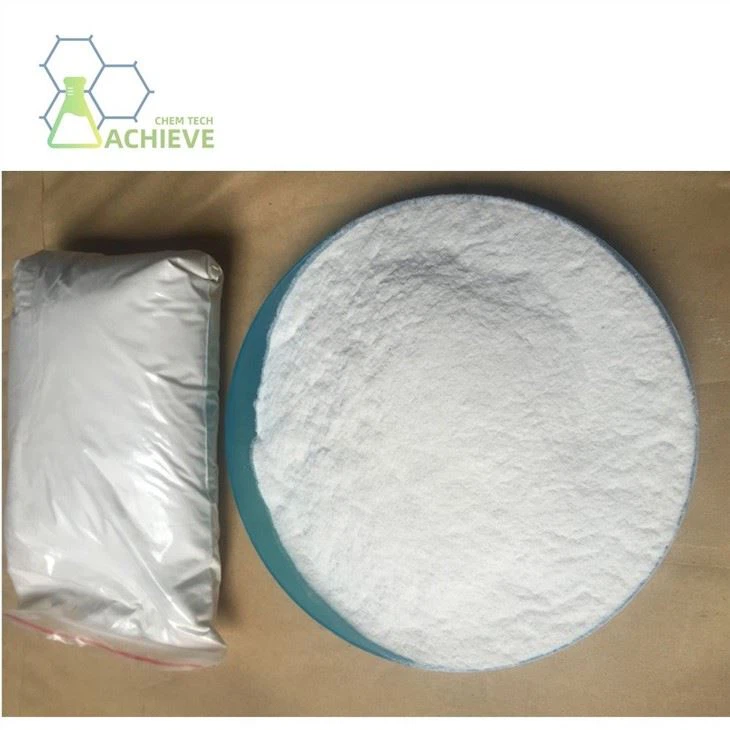

Shaanxi BLOOM Tech Co., Ltd. is one of the most experienced manufacturers and suppliers of l-lysine powder cas 56-87-1 in China. Welcome to wholesale bulk high quality l-lysine powder cas 56-87-1 for sale here from our factory. Good service and reasonable price are available.
L-lysine powder, white or nearly white free flowing crystalline powder; Almost odorless. Molecular formula C6H14N2O2, CAS 56-87-1. It is hygroscopic. Very soluble in water, slightly soluble in ethanol, almost insoluble in ether. L-lysine is an essential amino acid for human body. It plays an important role in the synthesis of connective tissue and carnitine, energy production, growth of children and maintenance of immune function. It is mainly used as feed additive, food fortifier and pharmacy.

|
Chemical Formula |
C6H14N2O2 |
|
Exact Mass |
204 |
|
Molecular Weight |
204 |
|
m/z |
146 (100.0%), 147 (6.5%) |
|
Elemental Analysis |
C, 49.30; H, 9.65; N, 19.16; O, 21.89 |
|
|
|


L-lysine powder, as an essential alkaline amino acid for the human body, has shown wide application value in various fields such as medicine, food, feed, agriculture, industry, and cosmetics due to its unique chemical structure and physiological functions.

Medical field: versatile from basic nutrition to disease treatment
1. Nutritional support and metabolic regulation
L-lysine is an essential amino acid that the human body cannot synthesize on its own and needs to be consumed through diet or supplements. Its core functions include:
Protein synthesis: As a component of skeletal muscle, enzymes, serum proteins, and peptide hormones, it participates in cell repair and tissue regeneration. For example, postoperative supplementation of L-lysine can accelerate wound healing in patients.
Energy metabolism optimization: As a precursor substance for carnitine synthesis, it promotes fatty acid beta oxidation and provides energy for tissues such as the heart and muscles.
Clinical studies have shown that supplementing with L-lysine can improve exercise endurance in patients with chronic fatigue syndrome.
Mineral absorption enhancement: By chelating minerals such as calcium and iron to form soluble complexes, the bioavailability is improved. For example, synergistic effects with vitamin D can significantly increase bone density in children and prevent rickets.
2. Disease treatment and adjuvant intervention
Antiviral and immune regulation: L-lysine inhibits the arginine metabolism pathway and blocks the enzyme activity required for herpes simplex virus (HSV) replication.


Multiple double-blind trials have confirmed that daily oral administration of 1000-3000mg L-lysine can shorten the duration of herpes outbreaks and reduce the recurrence rate.
Cardiovascular protection: combined with methionine can reduce the plasma homocysteine level and reduce the risk of atherosclerosis. Animal experiments have shown that L-lysine can inhibit the activity of angiotensin-converting enzyme (ACE), thereby exerting a hypotensive effect.
Anemia treatment: As an iron absorption enhancer, L-lysine can enhance the efficiency of hemoglobin synthesis. When combined with ferrous compounds to treat iron deficiency anemia, its bioavailability is increased by more than 40% compared to traditional iron supplements.
Drug Enhancement: Adding L-lysine to tetracycline antibiotics can reduce gastrointestinal irritation and enhance antibacterial activity by forming stable complexes. In addition, L-lysine can also be used as a diuretic to assist in the treatment of lead poisoning and promote chloride excretion.
3. Formula foods for special medical purposes
For patients with metabolic disorders such as phenylketonuria (PKU), L-lysine, as a key component of a low phenylalanine diet, can provide essential amino acid support without triggering metabolic crises. In parenteral nutrition preparations, the composite amino acid infusion has the advantages of high purity and low allergy risk compared to hydrolyzed protein infusion.


Food Industry: Innovators in Nutritional Fortification and Functional Improvement
1. Basic nutritional reinforcement
Improvement of cereal products: In response to the problem of L-lysine deficiency (the first limiting amino acid) in grains such as wheat and rice, adding 0.1-0.5g/kg can increase protein bioavailability (BV) by 30%. For example, the lysine fortified rice developed in Thailand increased children's protein intake by 22%.
Dairy product upgrade: Adding L-lysine to infant formula can simulate the amino acid profile of breast milk and promote the development of the infant's immune system.
Research has shown that infants fed with this type of formula have serum IgA levels that are 18% higher than those fed with regular formula.
2. Development of functional foods
Sports nutrition: As a co agent of branched chain amino acids (BCAAs), L-lysine can reduce muscle protein breakdown after exercise. Sports drinks on the market often add 500-1000mg/bottle to accelerate recovery.
Elderly nutrition: In response to the decline in protein synthesis ability in the elderly, the combination of L-lysine and vitamin B12 can improve muscle mass and reduce the risk of falls. The L-lysine content in the elderly specific nutritional powder developed in Japan reaches 2g/100g.


3. Food preservation and flavor improvement
Deodorization of canned food: L-lysine inhibits lipid oxidation by chelating metal ions, extending the shelf life of canned meat. Experiments have shown that adding 0.3% can extend the shelf life of canned fish by 6 months.
Seasoning development: As a substitute for monosodium glutamate, L-lysine can enhance the umami perception threshold. In low sodium salt formulations, its combination with potassium chloride can mask metallic flavors and enhance palatability.
Feed Industry: Biocatalysts for Animal Growth
1. Nutritional enhancement for monogastric animals
Application of pig feed: Adding 0.1-0.2% L-lysine to corn soybean meal diets can increase daily weight gain of piglets by 12-15% and improve feed conversion rate by 8-10%. Its mechanism of action includes:
Stimulate the secretion of gastric protease and improve protein digestion rate
Promote the secretion of insulin-like growth factor-1 (IGF-1)
Regulate amino acid balance and reduce nitrogen excretion


Poultry feed optimization: Adding L-lysine to broiler feed can significantly improve breast muscle percentage. Research has shown that a 0.15% addition increases chest muscle production by 9% while reducing abdominal fat deposition.
2. Nutritional regulation of ruminants
The rumen protected L-lysine prepared through rumen protection technology can bypass the degradation of rumen microorganisms and be directly absorbed by the small intestine.
Adding 30g/day to the diet of dairy cows can increase milk production by 2.5kg/day and increase milk protein content by 0.15 percentage points.
3. Innovation in aquatic feed
Adding 0.3% L-lysine to the feed of South American white shrimp can significantly improve specific growth rate (SGR) and feed efficiency (FE). It enhances the expression of immune related genes, thereby increasing the ability of shrimp to resist WSSV virus by 40%.


Agricultural field: Biostimulants for green planting
1. Plant growth regulation
Nitrogen utilization optimization: L-lysine, as a nitrification inhibitor, can slow down the conversion of ammonium nitrogen to nitrate nitrogen in soil and improve nitrogen fertilizer utilization efficiency by 15-20%. In rice fields, its combination with urea can increase yield by 8%.
Enhanced stress resistance: By inducing proline synthesis, L-lysine can enhance plant drought resistance.
After treatment with 0.5mM, the survival rate of tomato seedlings under drought stress increased by 35%.
2. Development of biopesticides
L-lysine powder derivatives (such as copper lysine) exhibit broad-spectrum antibacterial activity, with inhibition rates of over 70% against pathogens such as cucumber downy mildew and rice blast disease. Its mechanism of action includes disrupting cell membrane integrity and inhibiting spore germination.


Industrial applications: cornerstone molecules of biomanufacturing
1. Synthesis of amino acid derivatives
L-ornithine production: L-ornithine can be efficiently synthesized using L-lysine as a precursor through the fermentation method of Corynebacterium glutamicum, for the treatment of hepatic encephalopathy.
Preparation of ε - Polylysine: As a natural food preservative, ε - Polylysine is produced by fermentation of Streptomyces, and its antibacterial spectrum covers Gram positive/negative bacteria and molds.
It can extend the shelf life by three times in bread preservation.
2. Development of biomaterials
The hydrogel prepared by cross-linking L-lysine and sodium alginate has pH responsive drug release characteristics. In diabetes wound dressing, it can continuously release insulin for 72 hours to accelerate healing.


Cosmetics Science: Active Factors for Skin Repair
1. Anti aging mechanism
L-lysine promotes type I collagen synthesis by activating the TGF - β/Smad signaling pathway in dermal fibroblasts. Clinical tests showed that after 8 weeks of use of the essence containing 2% L-lysine, the depth of eye wrinkles decreased by 23%.
2. As a tyrosinase inhibitor, L-lysine can block the melanin synthesis pathway for whitening and enhancing efficacy. The formula formulated with niacinamide increased skin brightness by 1.5 color steps in Asian population testing.

Preparation of L-lysine:
Materials of Metric Roller Chain Sprocket
Report 1:
Add purified water (deionized water) to L ‑ lysine hydrochloride. The weight ratio of L ‑ lysine hydrochloride to purified water is 1 ∶ 1. Mix well and dissolve completely. Place it for future use;
Upper column adsorption
Add the solution obtained in step (1) into the ion exchange column with cation exchange resin at a flow rate of 13L/min until the resin cation exchange resin fully adsorbs lysine and the effluent of the column does not contain lysine, then wash it with purified water through the resin in the exchange column until there is no Cl ‑ in the effluent of the column (at this time, the pH of the effluent is 7);
Elution
Then use 2mol/L NH4OH (ammonia water) to wash off L-lysine powder. NH4OH flows through the ion exchange column at a flow rate of 13L/min. When the pH value of the effluent from the ion exchange column rises to 8.0, the effluent starts to have ninhydrin reaction, that is, L-lysine starts to flow out, and the effluent is collected; When the pH value of the effluent of the ion-exchange column rises to 9.0~12, the ninhydrin reaction color is dark, and the content of L-lysine is high at this time. The collection can be stopped when the effluent is eluted until there is no ninhydrin reaction;
Vacuum concentration
Concentrate the collected solution at 0.2Mpa and 60 ~ 62 ℃ under reduced pressure to drive ammonia. When it is concentrated to 1/3 of the volume of the original collected solution, add 3.5% of the weight of the concentrated solution at this time to decolorize, filter, cool and crystallize, and then obtain L-lysine.
The purity of the product measured and calculated by potentiometric titrator is 98.5%.
Report 2:
Preparation of free L-lysine solid:
Weigh 1.00 kg of L-lysine hydrochloride and add it to 5.0 liters of purified water for stirring, dissolution, and clarification. Then add the solution to 7.20 kg of activated strong acid cation exchange resin column and slowly clean the resin column;
After cleaning for 2-3 hours, continue to clean with pure water until neutral and free of chloride ions (0.1mol/L silver nitrate monitoring and a large amount of pH test paper).
Add 11.1kg5% v/v ammonia to the resin column and slowly rinse the resin column for about 2-3 hours. When the pH value is greater than 10, start collecting the alkaline eluent until the pH value drops to about 10. Concentrate the collected solution under reduced pressure to 60 ° C (-0.10~-0.08Mpa).
Concentrate water and ammonia until no liquid drips out. Continue to concentrate into a white solid.
Add 8 liters of absolute ethanol to the system. Continue to strike and crystallize for 3 hours. Settle all solids. Centrifuge and filter the solid until no liquid drips out.
Place the filter cake on an enamel tray, vacuum dry (60 ± 5 ° C, -0.08~-0.1Mpa) for 8 hours, cool to room temperature, store in a sealed bag, and store in a cool place to obtain 776 grams of free L-lysine solid with a yield of 96.95% and a purity of 99.62%.
HNMR (D2O): 3.223-3.188 (China), 2.848-2.794 (2H/CH2N), 1.542-1.523, and 1.276 (- CH2CH2CH2CH2-). LCMS(M+1):147.1127.
Report 3:
The fermentation method of L-lysine includes three steps: lysine primary seed culture, lysine secondary seed culture and lysine fermentation culture. The specific operations of each step are as follows:
Prepare lysine primary seed culture medium. In this example, the lysine primary seed culture medium includes 20g/L sucrose, 0.5g/L magnesium sulfate, 1.5g/L potassium dihydrogen phosphate, 9g/L ammonium sulfate, 5g/L yeast extract, 0.5g/L threonine, 0.5g/L methionine, 7g/L monosodium glutamate, 0.5g/L sodium pyruvate, and 1g/L calcium acetate.
Adjust the prepared lysine primary seed culture medium to pH 6.0 with 20% (volume ratio) potassium hydroxide solution, heat the medium to 121 ℃ with steam, sterilize it for 20min, and open circulating water to cool it to 36 ℃ and keep it constant. Stir for 300 rpm, inject sterile air according to the ventilation ratio of 1:0.4, adjust the tank pressure to 0.05 Mpa, adjust the pH to 6.7 with ammonia water and keep it constant, and calibrate 100% dissolved oxygen.
The L-lysine producing Escherichia coli shake flask seed was received into the L-lysine primary seed culture medium according to 1 ‰ of the volume of the L-lysine powder primary seed culture medium for culture. During the culture process, 30-50% dissolved oxygen was controlled by adjusting the rotation speed, air volume and tank pressure. After 10 hours of culture, samples were taken every 2 hours for microscopic inspection and total sugar was measured. When the microscopic inspection of the cell morphology was normal and the total sugar dropped to 10 g/L, the culture was stopped to obtain the lysine mature primary seed liquid.

2. Secondary seed culture of lysine
Prepare lysine secondary seed culture medium. In this example, the lysine secondary seed culture medium includes glucose 70g/L, magnesium sulfate 1g/L, potassium dihydrogen phosphate 1g/L, ammonium sulfate 10g/L, corn starch hydrolysate 1g/L, hair hydrolysate 1g/L, beet molasses 10ml/L, threonine 0.4g/L, methionine 0.4g/L, calcium acetate 2g/L.
Adjust the pH value of the prepared lysine secondary culture medium to 6.2 with ammonia water, heat it to 121 ° C with steam, disinfect for 20 minutes, and then turn on the circulating water to cool it to 37 ° C and maintain it constant.
Open the mixing valve at 300 revolutions per minute, inject sterile air according to the ventilation ratio of 1:0.4, adjust the tank pressure to 0.05 Mpa, adjust the pH value to 6.6 with ammonia water and maintain it constant, and calibrate the dissolved oxygen to 100%.
The mature lysine primary seed solution obtained in step (1) is fed into the lysine secondary seed culture medium for cultivation at a volume of 2% of the lysine secondary seed culture medium. During the cultivation process, 30% -50% dissolved oxygen is controlled by adjusting the rotation speed, air volume, and tank pressure.
After 10 hours of cultivation, samples were collected every 2 hours for microscopic examination and measurement of reducing sugars. When the cell morphology is normal under the microscope and the reducing sugar level drops to 8 g/L, stop culturing to obtain mature lysine secondary seed solution.
3. Lysine fermentation culture
Prepare lysine fermentation medium. In this example, the lysine fermentation medium includes glucose 20 g/L, magnesium sulfate 0.5 g/L, phosphoric acid 0.3 g/L, ammonium sulfate 9 g/L, corn starch hydrolysate 0.5 g/L, hair hydrolysate 0.5 g/L, beet molasses 10 ml/L, betaine 0.5 g/L, calcium acetate 1 g/L.
Then turn on the circulating water to cool down to 36 ° C and maintain it constant. Starting from 400 revolutions per minute, inject sterile air at a ventilation ratio of 1:0.3, adjust the tank pressure to 0.07 Mpa, adjust the pH value to 6.7 with ammonia water and maintain it constant, and calibrate the dissolved oxygen to 100%.
The mature lysine secondary seed liquid obtained in step (2) is added to the lysine fermentation medium at 10% of the volume of L-lysine powder fermentation medium for cultivation.
During the cultivation process, dissolved oxygen can be controlled at 25-40% by adjusting the speed, air volume, and tank pressure.
During the cultivation process, samples are taken every 2 hours to measure the concentration of reducing sugars and ammonia nitrogen in the fermentation broth.
When the concentration of reducing sugar in the fermentation broth drops to 4g/L, start adding 60% (m/v) glucose solution and maintain the concentration of reducing sugar in the fermentation broth at about 4g/L. When the ammonia nitrogen concentration in the fermentation broth drops to 1g/L, start adding 40% (m/v) ammonium sulfate solution and maintain the ammonia nitrogen concentration in the fermentation broth at about 1g/L.
FAQ
What is L-Lysine used to treat?
Many people consider lysine supplements to support calcium absorption, collagen formation, muscle recovery, wound healing, and stress management.
Will L-Lysine help with belly fat?
Currently, no evidence suggests L-lysine causes weight loss in humans. Some researchers have linked L-lysine to weight loss in older research in rats. In these studies, rats that had a diet low in L-lysine lost less weight than rats on diets that were low in different amino acids.
Is it good to take L-Lysine every day?
Some experts suggest that lysine is safe at dosages up to 6,000 mg (6 g) daily. But most research recommends a maximum of 3 g per day. And you should only take it for a short period of time during active outbreaks. Instructions for over-the-counter (OTC) lysine cream suggest applying it as often as every 2 hours.
What is the downside of taking L-Lysine?
One of the most commonly reported side effects of L-Lysine hydrochloride is gastrointestinal discomfort. Some individuals may experience symptoms such as nausea, diarrhea, and abdominal pain. These symptoms are usually mild and tend to resolve on their own after the body adjusts to the supplement.
Hot Tags: l-lysine powder cas 56-87-1, suppliers, manufacturers, factory, wholesale, buy, price, bulk, for sale, Sclareolide CAS 564 20 5, Pure Talc Powder CAS 14807 96 6, coenzyme q10 powder, D Tetrandrine CAS 518 34 3, s allyl l cysteine, Pamoic acid