




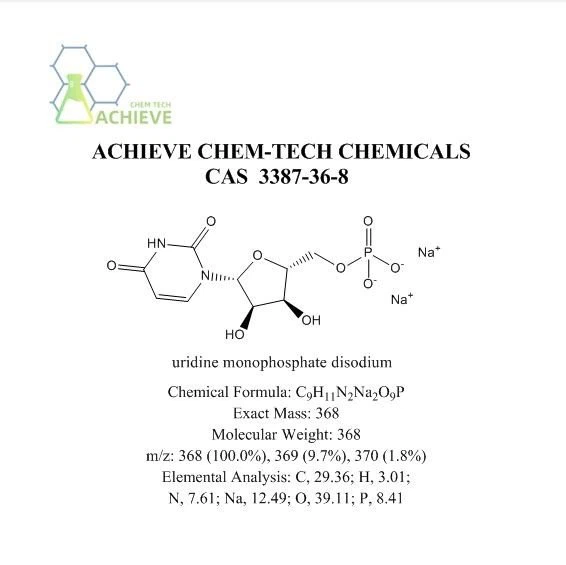
Shaanxi BLOOM Tech Co., Ltd. is one of the most experienced manufacturers and suppliers of uridine monophosphate disodium cas 3387-36-8 in China. Welcome to wholesale bulk high quality uridine monophosphate disodium cas 3387-36-8 for sale here from our factory. Good service and reasonable price are available.
Uridine monophosphate disodium, which is the basic structural unit of RNA (ribonucleic acid), a crucial genetic and energy molecule in living organisms. This white or off-white crystalline powder is significantly enhanced in water solubility and stability by the introduction of two sodium atoms, making it easily absorbed and utilized by living organisms. As a core member of the nucleotide family, it directly participates in the biosynthesis of RNA within cells, thereby influencing protein translation and expression, and is the cornerstone for maintaining cell normal functions, promoting tissue growth and repair. Beyond its fundamental role in genetics, it also plays a key role in the body's energy metabolism, serving as the direct precursor for triphosphate uridine (UTP), which is an activating substrate and energy carrier for various biochemical reactions such as glycogen synthesis and phospholipid metabolism.

|
Chemical Formula |
C9H11N2Na2O9P |
|
Exact Mass |
368 |
|
Molecular Weight |
368 |
|
m/z |
368, m/z: 368 (100.0%), 369 (9.7%), 370 (1.8%) |
|
Elemental Analysis |
C, 29.36; H, 3.01; N, 7.61; Na, 12.49; O, 39.11; P, 8.41 |
|
|
|


Based on these core biological functions, uridine diphosphate is widely used in the pharmaceutical, health supplement, and special medical purpose formula food industries, often used to improve liver function, assist in the treatment of liver diseases, promote postoperative recovery, and as a nutritional enhancer to support the development of the brain and nervous system in infants. In the food industry, it is also an efficient flavor enhancer, capable of working synergistically with sodium glutamate to produce a rich umami flavor, commonly found in soy sauce, soup stocks, and other seasonings. In summary, uridine diphosphate is an important bioactive molecule that combines as a basic life component, a regulator of cellular energy metabolism, and a practical food additive. It plays an indispensable role from the microscopic cellular activities to the macroscopic industrial applications.

Uridine 5′- monophosphate disodium salt (Uridine Monophosphate Disodium) is an important nucleotide, which plays a variety of roles in organisms. The following are some main uses of ump-na2:

Raw materials for RNA synthesis&Food and beverage additives&Flavoring agent
UMP-na2 is an important raw material for RNA synthesis in cells. RNA is composed of a series of nucleotides in series, and uridine is one of the four main nucleotides. In the RNA chain, ump-na2 is involved in the formation of information codes required for transcriptional information and protein synthesis. By using ump-na2 as the raw material for RNA synthesis, the length and sequence of RNA can be controlled, which further affects protein synthesis and gene expression.
This application makes ump-na2 of great significance in the field of life science research and bioengineering.
UMP-na2 has special meat flavor and can be used as food and beverage additives. By adjusting its dosage, the flavor and taste of food can be improved, making it more in line with the taste needs of consumers. Adding ump-na2 to infant formula milk powder and other infant foods can increase the amount of nucleoside acid, make the product closer to the composition of breast milk, and enhance the resistance of infants.


In addition, ump-na2 is often used as flavor enhancer and nutritional enhancer in functional foods and beverages.
UUp-na2 can also be used as a flavoring agent in addition to being used as an additive in food and beverages. Because of its special meat flavor, it can be used to produce condiments such as broth and gravy, providing a taste and taste similar to natural meat.
Improve stability&Other biological activities
Ump-na2 has good stability and is not easy to decompose under normal temperature and pressure. This feature enables ump-na2 to maintain relatively stable properties during storage and processing, thereby improving the quality and use effect of the product. For example, in the production of enzyme preparations, vitamins and other bioactive substances, the addition of ump-na2 can improve the stability of the product and maintain better performance during storage and use.
In addition to the above uses, ump-na2 also has certain biological activities.


For example, it can be used as an intermediate for the synthesis of other nucleotides, bases and other compounds, and participate in various synthetic reactions in organisms. In addition, ump-na2 also has antioxidant, anti-inflammatory and other biological activities, and plays a role in maintaining health. Studies have shown that ump-na2 can inhibit the replication and transmission of some viruses, which provides a potential strategy for antiviral therapy. In addition, ump-na2 has also been used to study the role of pyrimidine synthesis inhibitor 5-azacytidine in cholesterol and lipid metabolism, as well as the effect of nucleotides on the growth of specific intestinal bacteria.

Disodium pump, also known as uridine monophosphate disodium salt, can be used as an important intermediate in the production of nucleic acid drugs, health food and biochemical reagents. It is also used in the manufacture of uridine diphosphate glucose, uridine triphosphate, polyadenyluridine and other drugs. It plays an important role in the treatment of various major diseases.

The crude disodium 5'- urea acid is prepared into an aqueous solution with a mass concentration of 2-4% and a pH of 16-1.7; 5 '- Disodium urate crude solution was first treated with cation exchange resin column, and then with anion exchange resin column; Use mixed eluent to elute, collect eluent, and the concentration of eluent is 70-80g/L; Adjust the pH of eluent to 7.0-7.5, crystallize, filter, rinse and dry with organic solvent. The 5'- uridine disodium solution of the invention does not need to be concentrated, and the product has high purity and high yield.
Install exhaust gas absorption device, mechanical mixing device, and material dripping device in a dry 1000ml four necked bottle.
Add 50 grams of oxalic acid and 150 milliliters of deionized water, stir and dissolve.
Add 50 grams of sodium nitrite, stir and dissolve. Start reducing hydrochloric acid and add a total of 50 milliliters of hydrochloric acid.
After adding hydrochloric acid dropwise, the reaction lasts for 2 hours, and the temperature throughout the process is controlled below 50 ° C. The residual rate of CMP in the sample is 0.27% of HPLC.
Adjust the pH of the reaction solution to 6.4-7.2 with liquid alkali, add twice the amount of 95% ethanol, crystallize and filter to obtain 5 '- disodium uridine.
Add an appropriate amount of water to the crude oil product to dissolve it, adjust the pH of the reaction solution to 7.0-8.5 with liquid alkali, then recrystallize with twice the amount of ethanol, filter and dry to obtain pentauridine disodium salt.
High performance liquid chromatography: 99.9%, ultraviolet: 98.0%.

Uridine monophosphate disodium (also known as 5 '- UMP Na ₂) is an important intermediate in nucleic acid metabolism and has wide application value in fields such as biochemistry, medicine, and food industry. The discovery of 5 '- UMP Na ₂ is closely related to nucleic acid research.
At the end of the 19th century, Swiss biochemist Friedrich Fischer first isolated "nuclides" (later known as nucleic acids) from pus cells, marking the beginning of nucleic acid chemistry research.
In 1909, Fibus Levin discovered four basic components while studying yeast nucleic acid, including pyrimidine substances, which laid the foundation for the later discovery of uridine.
In 1919, Levin's research team first isolated pyrimidine nucleotides from yeast nucleic acid hydrolysates, which were then known as "yeast nucleotides". Through elemental analysis and preliminary chemical characterization, they determined that the substance contains uracil, ribose, and phosphate groups, but its structure and phosphate bond position have not been accurately determined.
In 1929, British chemist Alexander Todd began systematically studying the structure of nucleotides. Through improved hydrolysis and separation techniques, Todd successfully obtained relatively pure uridine acid samples from yeast nucleic acid. He used the emerging electrophoresis technology at that time to demonstrate that the substance moved towards the anode in an electric field, indicating that it was negatively charged and consistent with the characteristics of phosphate monoesters.
In the mid-1930s, with the development of chromatographic technology, German chemists Kossel and Neuburg established a nucleotide separation method based on activated carbon adsorption. Using this technology, they effectively separated uridine from other nucleotides such as adenosine and guanosine for the first time, and preliminarily determined its molecular weight to be 368.2 (anhydrous free acid form). The core issue in studying the structure of 5-UMP Na ₂ is to determine the connection position of the phosphate group on the ribose.
In 1936, Levin and Harris conducted a chemical degradation experiment, converting the ribose portion produced by the hydrolysis of uridine into a known compound, proving that the phosphate group was bound to the 5 'carbon atom of ribose. This discovery clarifies for the first time the basic structure of uridine-5 '- monophosphate (5' - UMP).
In 1947, American chemists Gurland and Smith successfully separated three isomers using newly developed ion exchange chromatography technology: 2 ', 3', and 5 '- UMP. By comparing their physical and chemical properties, especially optical rotation and electrophoretic mobility, it was ultimately confirmed that naturally occurring uridylic acid mainly exists in the form of 5 '- phosphate esters.
In the early 1950s, with the development of X-ray crystallography technology, scientists began to study the crystal structure of nucleotide metal salts.
In 1953, the team of British crystallographer Dorothy Crawford Hodgkin (known for analyzing the structure of vitamin B12 and penicillin) obtained the first crystal diffraction data of 5-UMP disodium salt. They found that two sodium ions coordinated with the phosphate and carbonyl oxygen atoms on the urea ring to form a stable hydrate structure.
At the same time, American chemists Lipscomb and Rich conducted pH titration studies and systematically determined the dissociation constants of 5 '- UMP under different pH conditions, elucidating the dissociation behavior of its acidic groups. These works provide a theoretical basis for understanding the morphology and stability of 5-UMP-Na ₂ in solution.
Frequently Asked Questions
What are the benefits of uridine 5 monophosphate disodium salt?
+
-
Uridine Monophosphate Benefits
Studies have shown that uridine monophosphate may promote improved learning and memory abilities by increasing the production of acetylcholine, a prominent neurotransmitter. UMP may also increase the formation of new neural synapses, which may point to greater mental capacity.
What is disodium uridine 5 monophosphate?
+
-
Uridine 5-monophosphate disodium salt, from yeast, >=99%
It has been used to study the effect of nucleotides on growth of specific intestinal bacteria. General description. Uridine 5′-monophosphate is a pyrimidine mononucleotide. It is formed by decarboxylation of orotidine 5';-monophosphate.
Hot Tags: uridine monophosphate disodium cas 3387-36-8, suppliers, manufacturers, factory, wholesale, buy, price, bulk, for sale, Sodium N cyclohexylsulfamate CAS 139 05 9, Natural Phytol, Pamoic acid, coenzyme q10 powder, Sodium Salicylate Powder CAS 54 21 7, 5 hydroxymethylfurfural synthesis