




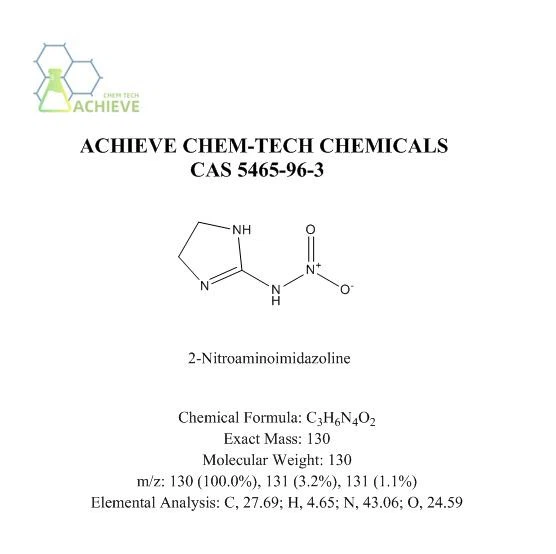
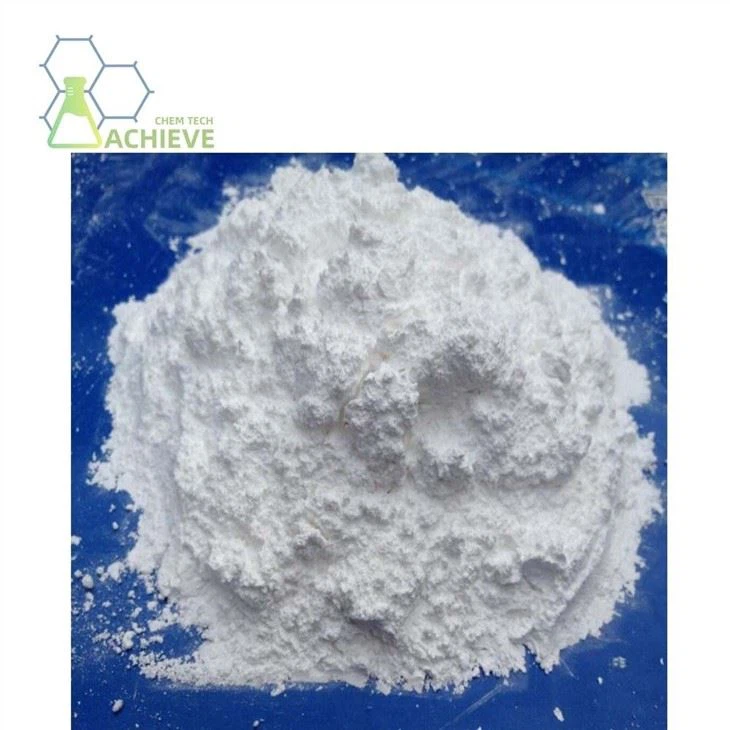


2-Nitrosaminoimidazolidine, pure imidazolidine is white crystal, industrial product is white or light yellow powder, content ≥ 98.0%, slightly soluble in cold water, easily soluble in hot water. 2-Nitrosaminoimidazolidine, also known as a precursor to imidacloprid, is a chemical compound that exists in both pure and industrial forms. In its pure state, it is a white crystal, while the industrial product appears as a white or light yellow powder with a high purity level of at least 98.0%. This compound exhibits varying solubility in water, being slightly soluble in cold water but easily soluble in hot water. N-nitroiminoimidazolidine is an intermediate of imidacloprid. Imidacloprid is a new type of highly effective internal absorption insecticide of chloronicotine, which was jointly developed by German Bayer Company and Japanese Special Pesticide Company in the mid-1980s and put on the market in 1991. Now imidacloprid has been used on 60 crops in more than 80 countries, with a wide range of applications and a large sales market.

|
Chemical Formula |
C3H6N4O2 |
|
Exact Mass |
130 |
|
Molecular Weight |
130 |
|
m/z |
130 (100.0%), 131 (3.2%), 131 (1.1%) |
|
Elemental Analysis |
C, 27.69; H, 4.65; N, 43.06; O, 24.59 |


2-Nitrosaminoimidazolidine (CAS number: 5346-72-6) is a nitrogen-containing heterocyclic compound with the molecular formula C ∝ H ₇ N ∝ O and a molecular weight of 101.11 g/mol. Its structure is composed of a nitrosamine (- N-NO) introduced into the 2-position of the imidazolidine skeleton, forming a unique electron distribution and reaction activity.
As a key intermediate for the synthesis of indole kinase inhibitors, 2-Nitrosaminoimidazolidine generates amino derivatives through the reduction reaction of nitro groups, which are further coupled with indole rings to construct a core skeleton. For example, in the synthesis of CDK4/6 inhibitors (such as Palbiclib), 2-Nitrosaminoimidazolidine and chloroindole generate intermediates through nucleophilic substitution reaction, and nitroso is reduced to amino groups through catalytic hydrogenation. The final product's IC value for breast cancer cells reaches nanomolar level. Participate in the synthesis of imidazolidine antibiotics, and nitroso groups oxidize reductases (such as nitroreductase) in bacteria to generate reactive oxygen species (ROS), which disrupt cell membrane structure. For example, the minimum inhibitory concentration (MIC) of 2-Nitrosaminoimidazolidine derivatives against Staphylococcus aureus is 2 μ g/mL, which is 3-5 times higher than traditional imidazole antibiotics such as metronidazole. In the synthesis of 5-HT receptor modulators, 2-Nitrosaminoimidazolidine is used as a precursor to generate hydroxylamine derivatives through the hydrolysis of nitroso groups, optimizing the drug's selectivity towards receptors. For example, in the synthesis of the 5-HT ∝ receptor antagonist Ondansetron, 2-Nitrosaminoimidazolidine and benzimidazole ring undergo condensation reaction to construct a key structure, and the product has significant preventive and therapeutic effects on chemotherapy-induced nausea and vomiting.

Pesticide intermediates

Used for the synthesis of new nicotine insecticides (such as thiamethoxam), 2-Nitrosaminoimidazolidine is reduced to chloroimidazolidine through nitroso groups, and further condensed with nitroguanidine to form active molecules. Field experiments have shown that insecticides containing 2-Nitrosaminoimidazolidine structure have a 95% efficacy against rice planthoppers, with a duration of 7-10 days longer than traditional pesticides. Participate in the synthesis of imidazolinone herbicides (such as imidacloprid), and nitroso destroys the acetyl lactate synthase (ALS) of weeds through oxidation, inhibiting the synthesis of branched chain amino acids. For example, the LC ₅₀ of 2-Nitrosaminoimidazolidine derivatives against barnyard grass is 0.5 μ g/mL, and they have high safety for rice (selectivity index>10).
Derivatives of 2-Nitrosaminoimidazolidine (such as N, N '- diethyl-2-nitrosamine imidazolidine) can be used as metal corrosion inhibitors, forming coordination bonds with the oxide film on the metal surface through nitroso groups to inhibit the penetration of corrosive media (such as Cl ⁻). Electrochemical tests showed that in 1 M HCl solution, the corrosion rate of the corrosion inhibitor on carbon steel decreased by 90%, and the corrosion inhibition efficiency reached 95%. As a precursor of photochromic compounds, 2-Nitrosaminoimidazolidine generates an open-loop structure through the photolysis of nitro groups, achieving reversible color changes. For example, its polymer derivatives change from colorless to blue under ultraviolet light irradiation, restore their original color after visible light irradiation, and have a cycle life of more than 10 ⁴ times, which can be used for smart windows or optical storage materials.

Expansion of application in segmented fields

Derivatives of 2-Nitrosaminoimidazolidine, such as 2-Nitrosaminoimidazolidine-1-carboxylic acid, can be used as fluorescent probes to enhance fluorescence intensity through coordination between nitroso groups and metal ions (such as Hg ² ⁺, Pb ² ⁺). For example, the detection limit for Hg ² ⁺ is up to 10 ⁻⁹ mol/L, and it has strong anti-interference ability (interference from other metal ions is less than 5%). Used for preparing chiral chromatography columns and separating enantiomers through π - π interactions of imidazolidine rings. For example, the silica gel column modified with 2-Nitrosaminoimidazolidine has a separation factor of 1.8 for ibuprofen enantiomers and a separation degree (Rs) greater than 1.5.
As a flame retardant for polyamide (PA), 2-Nitrosaminoimidazolidine generates nitrogen (N ₂) and carbon dioxide (CO ₂) through the decomposition of nitro groups, diluting the concentration of combustible gases. Thermogravimetric analysis (TGA) showed that the residual carbon rate of PA material with 5% of the flame retardant added reached 30% at 800 ℃, and the oxygen index (LOI) increased from 21% to 28%. Doping agent involved in the synthesis of polypyrrole (PPy), nitroso regulates the conductivity of the polymer through charge transfer. For example, the conductivity of PPy thin films doped with 2-Nitrosaminoimidazolidine reaches 10 S/cm, which is two orders of magnitude higher than the undoped sample.


2-Nitrosaminoimidazolidine (hereinafter referred to as imidazolidine) is an important intermediate of imidacloprid. At present, nitroguanidine and ethylenediamine are widely used to synthesize imidazolidine. However, this method is fast, and the high explosive nitroguanidine directly participates in the reaction, which greatly reduces the safety factor of synthesis. More importantly, the yield of this process is low, only about 40%. In order to improve the yield of imidazoline and reduce the cost of imidacloprid, the synthesis process of imidazoline was reformed in this study, and the yield was increased to more than 78%.
Three common synthesis methods of 2-Nitrosaminoimidazolidine
Condensation reaction between MNBA and Ep
The condensation reaction between MNBA and Ep is one of the earliest synthetic methods of NAIM.
In this reaction, MNBA and Ep undergo a condensation reaction in the presence of methanol, in which NAIM is formed. The main problem of this reaction is that the final product of MNBA is four isomers, one of which is NAIM, which only accounts for 25%, and the other three isomers are other condensation products.
Condensation reaction between MNBA and Ep catalyzed by sodium hydroxide
The condensation reaction between MNBA and Ep catalyzed by sodium hydroxide can increase the yield of NAIM and reduce the formation of other condensation products. In this reaction, MNBA reacts with Ep under the catalysis of sodium hydroxide. In this treatment, the yield of NAIM reached 56.1%.
Preparation of NAIM by reverse reaction of carbamic acid
Carbamic acid reverse reaction is a highly selective and high yield method for the preparation of NAIM. In the reaction, MNBA reacts with nitronitroformate (NONOate) under the dependence of carbamic acid (AFM) to generate NAIM. The NAIM prepared by this method has high selectivity and high yield, and the preparation process cost is also low.
Summarize:
Among the three methods, the condensation reaction of MNBA and Ep under the catalysis of sodium hydroxide and the reverse reaction of carbamic acid to prepare NAIM have higher selectivity and yield, but the reaction conditions are relatively harsh, while the condensation reaction of MNBA and Ep has higher selectivity and yield. Simpler but with lower selectivity and yield. Therefore, in practical applications, choosing a method suitable for your own research to prepare NAIM requires further consideration.

N-nitroiminoimidazolidine plays a crucial role as an intermediate in the production of imidacloprid, a highly effective insecticide belonging to the chloronicotine class. Imidacloprid was jointly developed by the German Bayer Company and the Japanese Special Pesticide Company in the mid-1980s and was introduced into the market in 1991. Since then, it has gained widespread adoption due to its broad-spectrum efficacy and has been used on over 60 crop types in more than 80 countries worldwide.
Imidacloprid is characterized by its internal absorption mechanism, which allows it to be effectively absorbed by plants through their roots, stems, leaves, and even seeds. Once absorbed, it is transported throughout the plant, providing systemic protection against a wide range of insect pests. This insecticide is particularly effective against sucking insects such as aphids, whiteflies, and thrips, as well as certain soil-borne pests.


The widespread adoption of imidacloprid can be attributed to its numerous advantages, including its high efficacy, low toxicity to mammals and birds, and environmental friendliness. Additionally, it has a long residual effect, providing long-lasting protection to crops. As a result, imidacloprid has become a staple in modern agriculture, with a significant market share and a growing demand globally.
2-Nitrosaminoimidazolidine is a chemical compound of significant concern due to its carcinogenic, mutagenic, and toxic properties. While its industrial applications are limited, its presence as a byproduct or contaminant poses risks to human health and the environment. Strict regulations, safe handling practices, and the development of alternatives are essential for mitigating these risks. As research continues to uncover the full extent of NAI's effects, proactive measures will be crucial in protecting public health and ecosystems.
By understanding the chemistry, toxicity, and regulatory landscape of 2-Nitrosaminoimidazolidine, stakeholders can make informed decisions to minimize exposure and promote safety across industries.
Frequently Asked Questions
What are the nitrosamine impurities in propranolol?
+
-
Propranolol is a beta-adrenergic receptor antagonist. The propranolol molecule contains a secondary amine which could form a nitrosamine drug substance-related impurity (NDSRI) when reacted with nitrite under acidic conditions.
What is the Ich guideline for nitrosamine impurity?
+
-
ICH M7(R2) recommends control of any known mutagenic carcinogen, such as nitroso-compounds, at or below a level such that there would be a negligible human cancer risk associated with the exposure to the compound.
How to remove nitrosamine impurities?
+
-
The addition is made so that the additive is homogeneously mixed with the dinitroaniline and the nitrosamine impurity therein. This can be done by heating the mixture to a melt and thoroughly stirring. Alternatively, the dinitroaniline can be dis~olved in a ~olvent and the additive thoroughly blended with the solution.
What foods are high in nitrosamine?
+
-
Nitrosamines have been found in a wide variety of different foods ranging from cheeses, soybean oil, canned fruit, meat products, cured or smoked meats, fish and fish products, spices used for meat curing, beer, and other alcoholic beverages. Beer, meat products, and fish are considered the main sources of exposure.
What is the daily limit for nitrosamine?
+
-
2 100 The recommended AI limit of 100 ng/day is representative of two potent, robustly tested nitrosamines, N-nitrosodimethylamine (NDMA) and 4-(methylnitrosamino)- 1-(3-pyridyl)-1-(butanone) (NNK), which have recommended AI limits of 96 ng/day and 100 ng/day, respectively.
Hot Tags: 2-nitroaminoimidazoline cas 5465-96-3, suppliers, manufacturers, factory, wholesale, buy, price, bulk, for sale, larocaine hydrochloride, Tetrahydrobiopterin BH4 Powder, Peptide, tetramisole hydrochloride powder, API Researching Only , iptg powder