


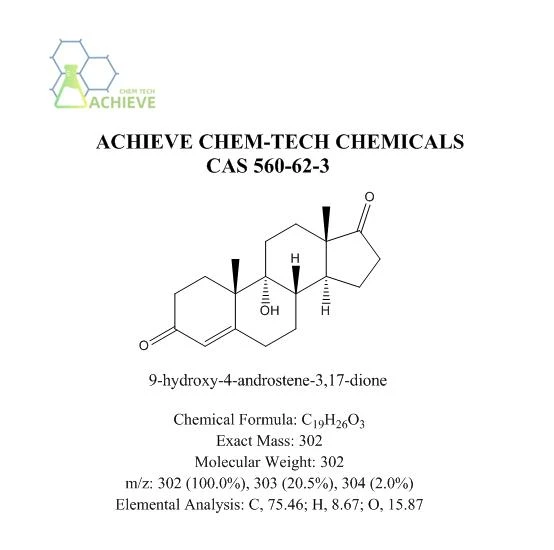


Shaanxi BLOOM Tech Co., Ltd. is one of the most experienced manufacturers and suppliers of 9-hydroxy-4-androstene-3,17-dione cas 560-62-3 in China. Welcome to wholesale bulk high quality 9-hydroxy-4-androstene-3,17-dione cas 560-62-3 for sale here from our factory. Good service and reasonable price are available.
9-hydroxy-4-androstene-3,17-dione, also known as 4-OHA, has a molecular formula of C19H26O3 and a molecular weight of 302.41 g/mol. It is an androsterone inducer, a naturally occurring steroid substance. Appearance is white to light yellow powder, in the form of crystals or crystals. It is easily soluble in organic solvents such as ethanol, acetone, chloroform, ether and benzene, but insoluble in water. There are two main absorption peaks in the ultraviolet region, one at 227 nm and the other at 274 nm. The infrared spectrum has relatively obvious absorption peaks, mainly including the vibration of OH bond (3440 cm^-1), the vibration of ketone group (1732 cm^-1), and the vibration of propane group and aromatic hydrocarbon group, etc. Nuclear magnetic resonance spectra include carbon-13 NMR and hydrogen-1 NMR. In Hydrogen-1 NMR, it has a double-bonded benzene ring moiety, and due to its position, 10 different peaks appear, while in Carbon-13 NMR, 6 peaks appear. It can be converted into androgens or estrogens in the body, and has effects on the reproductive system and metabolism. It has broad application prospects and research value. The researchers of Shaanxi Achieve chem-tech Co.,Ltd are exploring its molecular structure, biological activity and pharmacological mechanism, and are expected to develop more safe and effective drugs and health products to serve human health and quality of life.

|
|
|


|
Chemical Formula |
C19H26O3 |
|
Exact Mass |
302 |
|
Molecular Weight |
302 |
|
m/z |
302 (100.0%), 303 (20.5%), 304 (2.0%) |
|
Elemental Analysis |
C, 75.46; H, 8.67; O, 15.87 |

It is obtained by the oxidation of phytosterols. Phytosterols are the raw materials of commonly used steroids, and phytosterol intermediates are the key intermediates of a variety of steroids, including androstenedione, etc. Therefore, a simple, high-yield and high-purity phytosterol intermediate preparation method is a problem that researchers need to solve.
In the current preparation methods of phytosterol intermediates, phytosterol is generally used as the starting material, aluminum isopropoxide as the oxidant, in toluene or xylene solvent, in the presence of acetone, at about 80 ℃. The reaction temperature is high and the yield is about 80%. This method requires high temperature, which will produce tar and cause trouble in post-treatment.

The preparation method of 9-hydroxy-4-androstene-3,17-dione includes the following steps,
1) Plant sterol, dichloromethane and tetramethylpiperidine nitrogen oxide are mixed and stirred to obtain the raw material system; The control temperature is 1020 ℃, and the aqueous solution of the mixture of sodium bromide and sodium bicarbonate is added to the above raw material system. After dropping, the sodium hypochlorite solution is added. After the reaction is complete, the reaction is terminated and treated to obtain the phytosterol intermediate; The phytosterol is rapeseed sterol, rapeseed sterol, stigmasterol or β Sitosterol,
2) The phytosterol intermediate was biotransformed under the action of Mycobacterium sp.nrrl b3805 to obtain androstenedione; The invention can speed up the biological transformation speed and improve the economic benefit.

9-hydroxy-4-androstene-3,17-dione (4-OHA for short) is a steroid compound. Because its molecular structure has multiple functional groups and stereoisomers, it has a wide range of biological activities and pharmacological effects.

Androgen
4-OHA is an important androgen precursor. It is converted into testosterone, dihydrotestosterone and other male hormones through the catalysis of multiple enzymes. These hormones have important physiological roles in both men and women, including maintaining normal reproduction and sexual characteristics, promoting muscle growth and bone density, and regulating lipid metabolism.
Physical Enhancer
Due to its biological activity similar to testosterone, 4-OHA is widely used by athletes and bodybuilders as a performance enhancer. Some studies show that supplementing with 4-OHA can improve muscle strength, endurance and body weight, and promote muscle growth. However, this use is currently limited by dosage and controls to avoid adverse health effects.


Dehydrogenase inhibitors
4-OHA is a potent dehydrogenase inhibitor. Dehydrogenase is an important enzyme family involved in a variety of metabolic and reaction processes. Inhibiting dehydrogenase activity blocks hormone synthesis and metabolic pathways, resulting in a variety of pharmacological effects. For example, inhibiting estrogen metabolism can reduce the incidence of female diseases such as breast cancer and endometrial cancer; inhibiting testosterone metabolism can treat testosterone deficiency and related male reproductive problems.
Antiestrogens
4-OHA can be used as an anti-estrogen in cancer treatment. Estrogen is one of the important causes of many cancers, including breast cancer, ovarian cancer, endometrial cancer, etc. By inhibiting estrogen synthesis and metabolism, its effects at the cellular level can be reduced, thereby controlling the development of cancer. 4-OHA has been shown to have good antiestrogenic activity and has been used to treat various types of estrogen-dependent cancers.


Reproductive health supplements
4-OHA is also widely used in reproductive health supplements. It can improve reproductive health in both men and women by promoting testosterone synthesis, reducing testosterone metabolism, and improving other reproductive functions. For example, 4-OHA is thought to increase sperm quantity and quality, improve erectile function, and reduce menstrual irregularities, among other problems.
Food additives
4-OHA can also be used as a food additive. Because it has a variety of biological activities and nutritional effects, including promoting protein synthesis, maintaining bone density, regulating lipid metabolism, etc., it is often added to sports nutrition products, health foods, beverages, etc. to help people improve their physical fitness and maintain healthy.


Other purposes
In addition to the above uses, 9-hydroxy-4-androstene-3,17-dione also has other potential applications. For example, it is believed that it may be used to treat chronic diseases such as arthritis, diabetes, and cardiovascular disease; it can also be used as an anti-stress agent, antioxidant, immunomodulator, etc. to enhance the body's immunity and coping capabilities.
The application of 9-hydroxy-4-androstene-3,17-dione in reproduction is mainly related to its role as an intermediate of steroid hormone raw materials, rather than directly as a reproductive treatment drug or supplement. The following is an overview of its possible reproductive applications:
Intermediate of steroid hormone synthesis
9-hydroxy-4-androstene-3,17-dione is an important intermediate in the synthesis of various steroid hormones. Steroid hormones have a wide range of physiological effects in organisms, including regulation of reproduction, metabolism, immunity and other aspects. Therefore, by synthesizing steroid hormones containing 9-hydroxy-4-androstene-3,17-dione, the function and regulation of the reproductive system can be indirectly affected.
Potential research value
Although 9-hydroxy-4-androstene-3,17-dione itself is not directly used for reproductive treatment, its key role in steroid hormone synthesis makes it an important object of reproductive medical research. Scientists can explore new reproductive treatment methods or drug targets by studying its transformation pathways, biological activities and interactions with other molecules.
Since 9-hydroxy-4-androstene-3,17-dione is mainly used in scientific research and drug synthesis, its safety and effectiveness cannot be used directly on humans without sufficient research and supervision.
In summary, the application of 9-hydroxy-4-androstene-3,17-dione in reproduction is mainly reflected in its role as an intermediate in the synthesis of steroid hormones, which indirectly affects the function and regulation of the reproductive system by synthesizing steroid hormones containing this intermediate.

The CAS number of 9-hydroxyandrostenedione is 560-62-3, with a molecular weight of approximately 302.41. Its structural feature is the introduction of a hydroxyl (- OH) functional group on the 9th carbon atom of androstenedione, which endows 9-hydroxyandrostenedione with unique biological activity and chemical properties.
Biosynthetic pathway
The biosynthesis of 9-hydroxyandrostenedione mainly relies on microbial fermentation processes. 9-Hydroxyandrostenedione can be produced through the biodegradation and transformation of plant sterols (such as stigmasterol, sitosterol, etc.) by specific microorganisms (such as Actinobacteria sporadically). During this process, plant sterols first undergo beta oxidation of their side chains to remove two carbon atoms, resulting in the formation of C17 ketosteroids with a four ring structure. Further conversion yields 9-hydroxyandrostenedione.
Mechanism of action
(1) Corticosteroid synthesis intermediates:
9-Hydroxyandrostenedione is a key intermediate in the synthesis of various corticosteroids. Corticosteroids are a class of steroid hormones with a wide range of biological activities, including cortisone, prednisone, etc. They play important roles in anti-inflammatory and immune regulation. Through chemical synthesis or biotransformation, 9-hydroxyandrostenedione can be further converted into these corticosteroids for the treatment of various diseases.
(2) Synthesis of bile acid and deoxycholic acid:
9-Hydroxyandrostenedione also participates in the synthesis of bile acid and deoxycholic acid. Cholic acid and deoxycholic acid are the main components of bile acids, which play a crucial role in fat digestion and absorption. Through specific enzymatic reactions, 9-hydroxyandrostenedione can be converted into bile acid and deoxycholic acid, thereby maintaining normal fat metabolism and bile acid circulation in the human body.
(3) Steroid hormone raw materials:
As an intermediate of steroid hormone raw materials, 9-hydroxyandrostenedione also plays an important role in the production of steroid hormone drugs. Steroid hormone drugs are a class of drugs with wide clinical application value, including sex hormones, adrenal cortex hormones, etc. 9-Hydroxyandrostenedione can be converted into these steroid hormone drugs through chemical synthesis or biotransformation, providing strong support for the treatment of various diseases.
Frequently Asked Questions
As a hydroxylated derivative of androstenedione, which key "crossroads" does it occupy in the steroid metabolism network?
+
-
It is located at the intersection of the three major synthetic pathways of androgens, estrogens, and corticosteroids. Its 9-hydroxyl group is not only a modification site, but also affects its molecular conformation and subsequent enzyme recognition.
How can the introduction of its 9-hydroxyl group potentially alter the interaction mode between the parent nucleus and classical steroid receptors?
+
-
9-hydroxy significantly increases the polarity and steric hindrance of the molecule, which may make it difficult to bind to the active pocket of androgen receptors or aromatase, thereby altering its potential excitatory, antagonistic, or inhibitory properties.
Why could it become a unique "suicidal substrate" type aromatase inhibitor?
+
-
Due to its retention of the basic androstenedione skeleton recognized by aromatase, it may be bound by enzymes and initiate hydroxylation. However, the presence of 9-hydroxyl may interfere with subsequent catalytic steps, causing the intermediate to covalently bind to the active center of the enzyme, irreversibly "shutting down" the enzyme.
What unusual chemical possibilities does the 9-hydroxyl functional group provide for subsequent derivatization in synthetic chemistry?
+
-
This hydroxyl group can serve as a "handle" for oxidation to carbonyl, formation of esters or ethers, or participation in intramolecular cyclization reactions. For example, it can be oxidized to 9-carbonyl to obtain an active probe molecule with a 9-fluoro-substituted structure similar to synthetic glucocorticoids such as triamcinolone acetonide.
Are there any marketed or investigational drugs that use it as a key intermediate or final active molecule?
+
-
There are currently no well-known drugs on the market. It is more regarded as an advanced synthetic intermediate or chemical probe for studying the biosynthesis, metabolism, and structure-activity relationship of steroid hormones, and its biological activity spectrum is not yet clear.
Hot Tags: 9-hydroxy-4-androstene-3,17-dione cas 560-62-3, suppliers, manufacturers, factory, wholesale, buy, price, bulk, for sale, 4 BROMO 1 BUTYNE CAS 38771 21 0, tetravisc, Pyrantel Pamoate Powder CAS 22204 24 6, colchicine powder, Peptide, Meprednisone Hemisuccinate CAS 27303 92 0