




Shaanxi BLOOM Tech Co., Ltd. is one of the most experienced manufacturers and suppliers of amprolium powder in China. Welcome to wholesale bulk high quality amprolium powder for sale here from our factory. Good service and reasonable price are available.
Amprolium powder, also known as 1- [[4-Amino-2-propyl-5-pyrimidinyl] methyl] -2-picolinium-chlorodihydrochloride in English, and its Chinese alias is aminoproline hydrochloride with the chemical formula C14H19ClN4, CAS 121-25-5. Its appearance is white or off white powder; Odorless or almost odorless. It is soluble in water, slightly soluble in ethanol, extremely soluble in ether, and insoluble in chloroform. It is an anti coccidiosis drug mainly used for the prevention and treatment of coccidiosis in poultry and calves. Its chemical structure is similar to that of thiamine, and it is a traditional anti coccidian drug with good anti coccidial effects, widely used in countries around the world.

Amprolum, with a chemical structure highly similar to thiamine (vitamin B ₁), competitively inhibits the uptake of thiamine by nematodes, interferes with their sugar metabolism process, and thus suppresses the development of nematodes. As one of its main dosage forms, powder has the advantages of easy solubility in water, stable properties, low toxicity, wide safety range, low residue, and no need to stop medication period. It plays an important role in the prevention and control of coccidiosis in various livestock and poultry such as poultry and ruminants.
At the same time, our company not only provides amproline stromectol injection and powders. If needed, please feel free to contact us at any time.
Our product




Additional information of chemical compound:

|
|
|

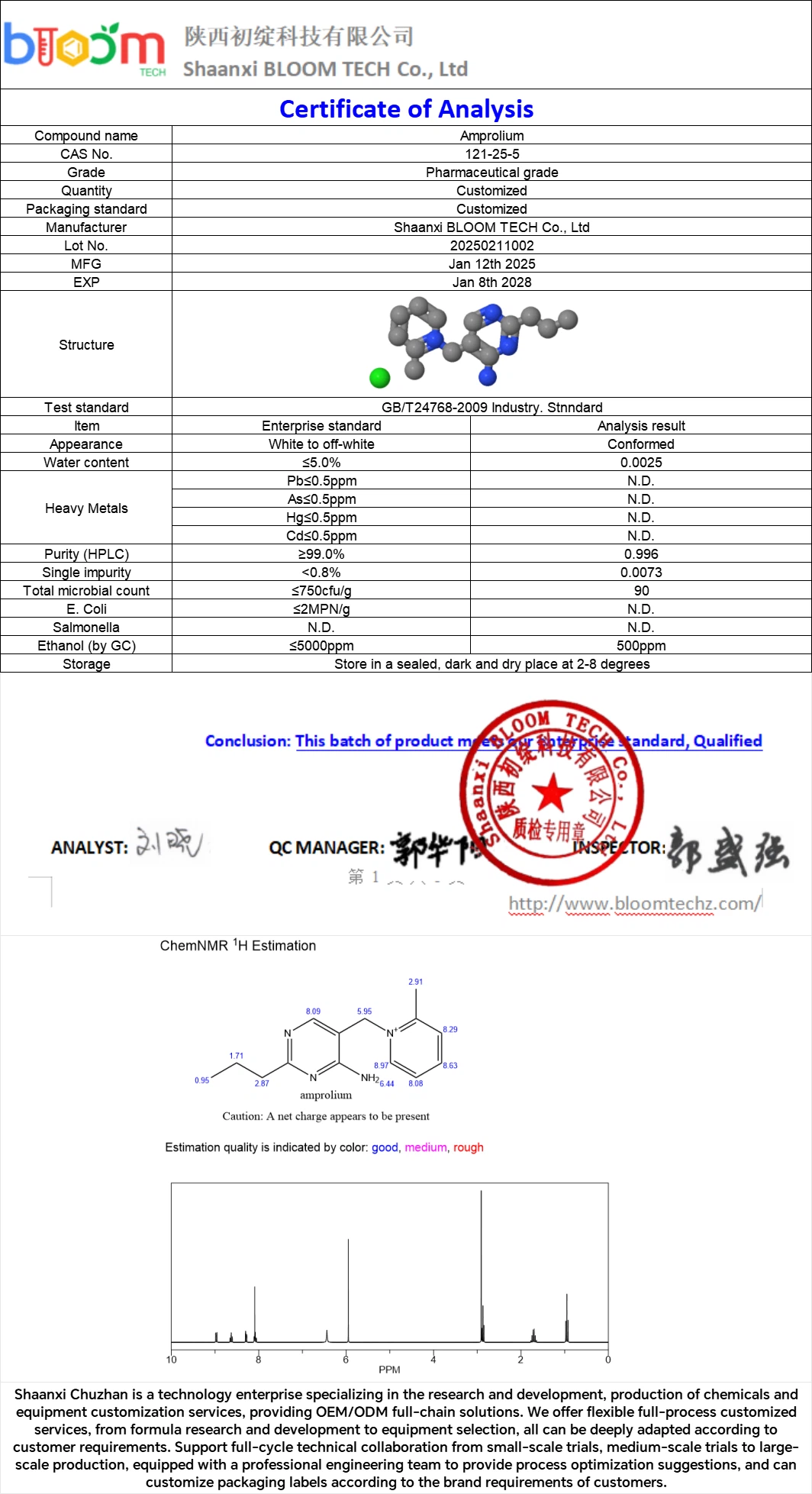
Amprolium+. COA

Amprolium powder, also known as ampicillin hydrochloride, is a classic thiamine based anti coccidiosis dug. Since its first application in livestock and poultry farming in the 1960s, it has become an important tool for preventing and treating coccidiosis worldwide. Its chemical structure is highly similar to thiamine (vitamin B ₁), which competitively inhibits the uptake of thiamine by nematodes, interferes with their sugar metabolism process, and thus inhibits the development of nematodes. Amprolin powder, as one of its main dosage forms, has the advantages of easy solubility in water, stable properties, low toxicity, wide safety range, low residue, and no need for dug withdrawal period. It plays an important role in the prevention and control of coccidiosis in various livestock and poultry such as poultry, ruminants, and minks.

Preventive effect
Reduce infection rate
Intestinal mucosal protection: Regular use of ampicillin for preventive administration can significantly reduce the infection rate of livestock and poultry coccidiosis. By inhibiting the reproduction and spread of nematodes in the intestine, the damage of nematodes to the intestinal mucosa is reduced.
Improve production performance
Growth promotion: Infection with coccidiosis can lead to delayed growth and reduced feed conversion rates in livestock and poultry. The use of Amprolin for prevention can effectively prevent these problems from occurring, improve the production performance and economic value of livestock and poultry.

Amprolium powder, also known as ampicillin hydrochloride, is a widely used anti coccidiosis dug in livestock and poultry farming. Its chemical properties are unique and highly similar to thiamine (vitamin B1). It competitively inhibits the uptake of thiamine by nematodes, interferes with their sugar metabolism process, and thus achieves anti coccidian effects.
Physical and chemical properties
Solubility
Amprolin is soluble in water, which is an important basis for its use as a drinking water administration agent. In livestock and poultry farming, drinking water for dug administration is a convenient, fast, and easy to control method of administration. The solubility of Amprolin in water allows it to quickly dissolve in drinking water, ensuring that livestock and poultry can fully consume the dug during the drinking process, thereby achieving the expected therapeutic effect. In addition, Amprolin is slightly soluble in ethanol, extremely soluble in ether, and insoluble in chloroform. These solubility characteristics provide reference for its formulation and use in different solvents.
Stability
Amprolin showed good stability after being stored at room temperature and below 40 ℃ for 5 years without significant changes. This stability makes Amprolin less prone to degradation or deterioration during storage and transportation, ensuring the quality and efficacy of the dug. Meanwhile, Amprolin has good stability against light, heat, and common oxidants, but it is still necessary to avoid coexisting with strong acids and bases during storage and use to prevent chemical reactions that may reduce efficacy or produce harmful substances.
PH dependence
The pH value of Amprolin aqueous solution is weakly acidic, and this pH dependence requires special attention to the pH value of the solution during the preparation and use of Amprolin. Both acidic and alkaline environments may affect the stability and solubility of Amprolin, thereby affecting its therapeutic efficacy. Therefore, when preparing Amprolin solution, it is necessary to strictly follow the instructions to ensure that the pH value of the solution is within the appropriate range.

The influence of chemical properties on drug application
The chemical properties of Amprolin have had a profound impact on its applications in animals.
(1) Diversity of administration methods
Due to its solubility in water, Amprolin can be administered through drinking water. This administration method is convenient and fast, easy to control the dosage and administration time of drg, and suitable for large-scale livestock and poultry breeding. In addition, Amprolin can also be made into premix or water-soluble powder forms, which can be administered through mixed feeding or drinking water, further enriching the selection of administration methods.
(2) Stability of drug efficacy
The good stability of Amprolin ensures that it is not easily degraded or deteriorated during storage and use, thereby ensuring the efficacy of the drg. This stability has led to the widespread use of Amprolin in livestock and poultry farming, and has become one of the important drg for preventing and controlling coccidiosis.
(3) Ensuring drug safety
Amprolin has low toxicity and a wide safet range. When used at the recommended dosage, it has no significant toxic side effects on livestock and poultry. This safet guarantee has enabled Amprolin to be widely used in livestock and poultry farming, and has gained the trust of farmers. At the same time, Amprolin is metabolized rapidly in livestock and poultry products, with minimal residue and meeting international food safet standards, further ensuring the safet of livestock and poultry products.
(4) Flexibility of drug compatibility
Amprolin can be used in combination with other drg to expand the spectrum of anti coccidiosis or enhance efficacy. For example, when used in combination with ethoxylated benzyl ester, sulfaquinoxaline, etc., the synergistic effect of different targets can be achieved to improve the anti coccidiosis effect. The flexibility of this drg combination enables Amprolin to better adapt to different conditions and breeding environments in livestock and poultry farming.

Amprolium powder, also known as ampicillin hydrochloride, is an important anti coccidioid drg that has gone through multiple stages of development, from basic research to widespread application, from process optimization to market expansion.
Early exploration and basic research stage (before the mid-20th century)
(1) The prominent harm of coccidiosis and the demand for anti coccidiosis
At the beginning of the 20th century, with the large-scale development of animal husbandry, the harm of coccidiosis to animal husbandry became increasingly prominent. Coccidia mainly parasitizes in the intestines of livestock and poultry, damaging the intestinal mucosa and affecting the absorption of nutrients, leading to slow growth, reduced feed conversion rate, and even death in severe cases. This hazard has prompted researchers to explore methods for preventing and treating coccidiosis. In the early days, measures such as improving the breeding environment and strengthening feeding management were mainly relied on to prevent the occurrence of coccidiosis, but these methods can only reduce the risk of infection to a certain extent and cannot fundamentally solve the problem. Therefore, the development of effective anti coccidiosis drg has become an urgent issue to be addressed.
(2) Research on the metabolic mechanism of thiamine and drug design ideas
In the mid-20th century, with the deepening of physiological and biochemical research on nematodes, researchers found that nematodes need to consume thiamine (vitamin B ₁) to maintain normal metabolic activity during their growth and reproduction process. Thiamine is synthesized into thiamine pyrophosphate in the body of nematodes, which participates in the oxidative decarboxylation of α - ketoacids during sugar metabolism and is a coenzyme in the α - ketoacid dehydrogenase system. Based on this discovery, researchers speculate that if a compound with a similar structure to thiamine can be found to competitively inhibit the uptake of thiamine by nematodes, it may interfere with the normal metabolism of nematodes and achieve anti coccidian effects. This metabolic mechanism based drg design approach has laid a theoretical foundation for the development of amprolin.
Drug development and synthesis process optimization stage (mid-20th century to late 20th century)
Discovery of Lead Compounds and Design of Synthesis Routes
After clarifying the drg design concept, researchers designed and synthesized a series of compounds with similar structures based on the chemical structure of thiamine. Through in vitro and in vivo screening of these compounds for their anti coccidial activity, it was ultimately discovered that a compound called Amprolin has significant anti coccidial effects. The chemical name of Amprolin is 1- [[4-amino-2-propyl-5-pyrimidinyl] methyl] -2-methylpyridine chloride hydrochloride, and its molecular structure is highly similar to that of thiamine. It can competitively bind to thiamine binding sites in the body of nematodes, thereby preventing thiamine uptake and utilization.
Adverse reactions
The main component of Amprolium Powder, aminophylline, is a type of thiamine drug. Its mechanism of action is to inhibit the absorption and utilization of thiamine by nematodes, interfere with their carbohydrate metabolism, and thus inhibit their growth and reproduction. During the growth process, nematodes require thiamine to maintain their normal physiological functions. Aminopyrine has a similar structure to thiamine and can competitively bind to the thiamine carrier in the body of nematodes, preventing them from obtaining sufficient thiamine and leading to energy metabolism disorders and ultimately death.
Neurological adverse reactions
Symptoms of thiamine deficiency
Long term or excessive use of Amprolium may lead to thiamine deficiency in poultry due to its competitive binding with thiamine. Thiamine is an essential vitamin for the normal functioning of the nervous system, and a deficiency of thiamine can cause neurological symptoms such as multiple neuropathy. Poultry may experience symptoms such as ataxia, movement disorders, and head tremors, manifested as unstable walking, drooping wings, inability to stand and fly normally.
The impact on the central nervous system
In some cases, Amprolium may have direct or indirect effects on the central nervous system of poultry. Poultry may exhibit symptoms such as excitement, restlessness, convulsions, and in severe cases, even coma and death. This may be related to the regulatory effect of drugs on neurotransmitters or their toxic effects on nerve cells.
Other adverse reactions
Stunted growth and development
Due to the potential for appetite loss and digestive disorders caused by Amprolium, long-term use may lead to stunted growth and development in poultry. Poultry have slow weight gain, poor feather growth, and decreased production performance, such as decreased egg production rate and poor meat quality.
Effects on the reproductive system
Excessive use of Amprolium in female poultry may have adverse effects on the reproductive system. May cause damage to the ovarian function of female poultry, affecting the development and ovulation of follicles, thereby reducing egg production rate.
Hot Tags: amprolium powder, suppliers, manufacturers, factory, wholesale, buy, price, bulk, for sale, Sapropterin Hydrochloride, Daidzin, Phenothiazine Powder, pontocaine, Articaine Hcl powder, IPTG reagent