




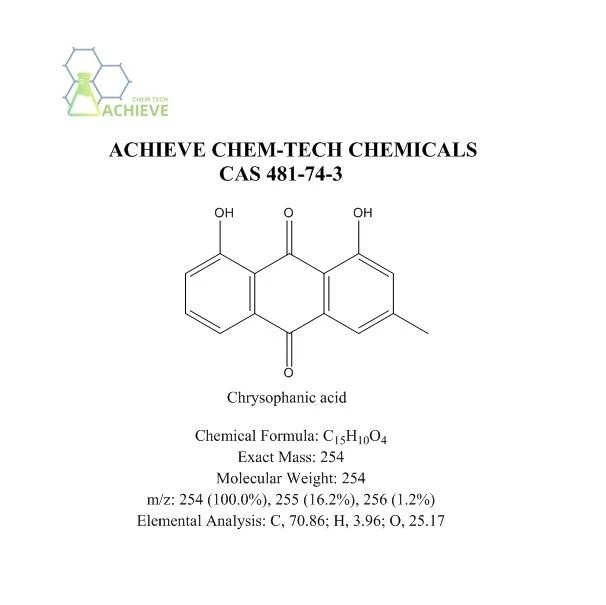
Chrysophanic Acid is a naturally occurring anthraquinone organic compound, mainly extracted from the roots and stems of plants such as rhubarb and silybum marianum. It has a long history in traditional medicine and is renowned for its mild purgative effect, which alleviates constipation by stimulating colonic peristalsis. Modern pharmacological studies have further revealed its broader biological activities, including significant antifungal (especially against dermatophytes), antibacterial, anti-inflammatory, and certain immunomodulatory and anti-proliferative effects. Therefore, its application is no longer limited to laxative use. Current research and development are more focused on the dermatology field, such as exploring it as an active ingredient in topical medications for conditions like psoriasis, eczema, and ringworm. However, this compound is irritating. Oral use may cause abdominal cramps and severe diarrhea, and long-term use can lead to electrolyte imbalance or colon melanosis. External use may cause skin burning, redness, and other reactions. When using it, one should strictly follow the doctor's instructions. Avoid long-term or excessive use. Pregnant women, lactating women, and those with poor intestinal function should use it with caution.
 .
|
Chemical Formula |
C15H10O4 |
|
Exact Mass |
254 |
|
Molecular Weight |
254 |
|
m/z |
254 (100.0%), 255 (16.2%), 256 (1.2%) |
|
Elemental Analysis |
C, 70.86; H, 3.96; O, 25.17 |
|
|
|


Chrysophanic acid, as an organic compound with rich biological activity and pharmacological effects, has a wide and diverse range of uses. The following is a detailed description of the main uses of emodin:
1. Antibacterial effect
Rhubarb phenol has significant antibacterial effects on various bacteria, which is one of its most important uses. These bacteria include but are not limited to Streptococcus pneumoniae, pneumococcus, influenza bacilli, and cocci. By inhibiting the growth and reproduction of these bacteria, emodin can effectively control infections caused by them, thus playing an important role in the treatment of related diseases. For example, in the treatment of respiratory tract infections, urinary system infections, digestive system infections and other diseases, emodin can be used as an effective antibacterial agent. This antibacterial effect makes emodin have a wide range of application prospects in the pharmaceutical field.


2. Cough and asthma relief
Rhubarb phenol also has the effect of relieving cough and asthma. It can alleviate respiratory inflammation, alleviate cough symptoms, and help improve respiratory function. This effect makes emodin have certain application value in the treatment of respiratory diseases such as colds, bronchitis, asthma, etc. By inhibiting the inflammatory response of respiratory mucosa, reducing the secretion of sputum and triggering cough, emodin can effectively alleviate patients' symptoms and improve their quality of life.
3. Promote intestinal motility
Rhubarb phenol has a significant promoting effect on intestinal motility. It can enhance the peristalsis function of the intestine, promote the secretion of digestive juices and the digestion and absorption of food. This effect is of great significance in improving intestinal problems such as constipation and bloating. By promoting intestinal emptying and the elimination of harmful substances, emodin helps maintain a healthy balance in the intestines and prevent the occurrence of intestinal diseases.


A preparation method for wall-breaking extraction of chrysophanic acid, the steps of which are as follows:
1) It depends on the drying and crushing of cassia seed, sieving through 40 mesh, soaking the powder in ethanol, adding the soaked material into the ultra-high pressure extractor, and extracting chrysophanol from cassia seed by ultra-high pressure and impinging stream technology;
2) The extracted chrysophanol is eluted with chloroform ‑ methanol solution with a volume ratio of 20:1 by macroporous adsorption resin, and the eluate is collected and concentrated under reduced pressure to obtain the concentrate;
3) The concentrate is separated and purified by high-speed countercurrent chromatography, using chloroform ‑ methanol ‑ water as the two-phase solvent system, taking the upper phase as the stationary phase and the lower phase as the mobile phase, with the main engine rotating speed of 800 ‑ 1000rpm and the flow rate of 2 ‑ 3mL/min, collecting the target stream, recovering the reagent, and drying to obtain the product. The method has the advantages of less sample loss, good separation effect and low cost, and can obtain chrysophanol with high content and good quality.
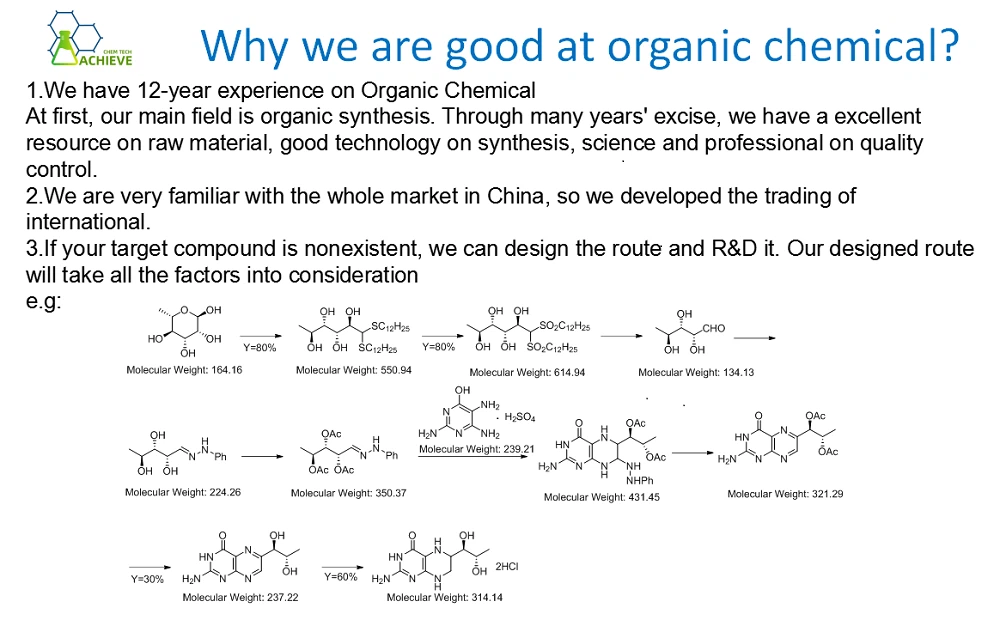
The synthesis of chrysophanol usually starts from a certain organic precursor and undergoes a series of chemical reactions, such as acylation, reduction, diazotization, hydrolysis, cyclization, etc., to finally obtain the target product chrysophanol. Taking 3-nitrophthalic acid as the starting material, the synthesis route involves multiple key steps and reactions.
Detailed synthesis steps and chemical equations
|
|
|
|


Step description:
Starting from 3-nitrophthalic acid, the first step is the Friedel Crafts acylation reaction. The Friedel Crafts acylation reaction is an electrophilic substitution reaction between aromatic hydrocarbons and acylating reagents (such as acyl chlorides, anhydrides, etc.) in the presence of a catalyst, resulting in the formation of aromatic ketones. In this step, 3-nitrophthalic acid reacts with an appropriate acylation reagent to generate the corresponding acylation product.
Due to the lack of specific reaction conditions and reagents, it is not possible to directly write the chemical equation. But the general form can be expressed as:
3-nitrophthalic acid+acylation reagent → acylation product
Step description: The acylation product is then subjected to a reduction reaction, reducing the nitro group to an amino group. This step is usually carried out using reducing agents (such as hydrogen, metal catalysts, etc.) under appropriate conditions. After the reduction reaction, an intermediate containing an amino group is obtained.
Chemical equation: Similarly, due to the lack of specific reaction conditions and reagents, chemical equations cannot be directly written. But the general form can be expressed as:
Acylation product → amino containing intermediate
Step description: The intermediate containing amino groups is further subjected to diazotization reaction. The diazotization reaction is a reaction between amino compounds and nitrous acid (or its salts) under acidic conditions, resulting in the formation of diazonium salts. Diazonium salts are unstable compounds commonly used in subsequent hydrolysis or cyclization reactions.
Chemical equation: Intermediate containing amino group+nitrous acid → diazonium salt
Step description: Diazonium salts undergo hydrolysis reactions under acidic or alkaline conditions to generate corresponding phenolic compounds. This step is one of the key steps in forming the structure of emodin.
Chemical equation: diazonium salt → phenolic intermediate
Step description: Phenolic intermediates undergo further cyclization reactions to form the skeletal structure of emodin. The cyclization reaction usually needs to be carried out under appropriate catalysts and conditions to ensure the efficiency of the reaction and the purity of the product.
Chemical equation: Phenolic intermediate → C15H10O4
Subsequent processing and purification
After obtaining crude emodin, subsequent processing and purification are usually required to improve the purity and yield of the product. This includes methods such as solvent extraction, crystallization, and column chromatography. The choice of specific method depends on the characteristics of the synthesis route and the properties of the product.

As an ingredient with anti-aging properties, rhubarb phenol has really attracted attention for its application in skin care and health care products.


Application in skin care products
Addition to anti-aging creams
Skincare manufacturers can add rhubarb phenol as an active ingredient to anti-aging creams. Such creams are able to penetrate deep into the skin, inhibit lipid peroxidation and reduce the content of malondialdehyde (MDA), thereby protecting skin cells from oxidative damage.
Long-term use of creams containing rhubarb phenol significantly improves the skin's elasticity and radiance, reduces the appearance of wrinkles and fine lines, and makes the skin look younger and healthier.
Add to Serums
Serums are highly concentrated active ingredient products in skincare. Adding rhubarb phenol to serums allows it to be better absorbed into the skin and exert more powerful anti-aging effects.
Serum containing rhubarb phenol can deeply nourish the skin, improve the skin's antioxidant capacity, remove free radicals and prevent skin aging.
the application of health care product
Anti-aging capsules
Health product manufacturers can use rhubarb phenol as a core ingredient, combined with other ingredients with anti-aging effects (such as vitamin E, vitamin C, etc.) to make anti-aging capsules.
Such capsules can be convenient for people to take on a daily basis to help improve the body's antioxidant capacity and reduce the damage caused by oxidative stress to the body, thus slowing down the aging process.
Add to Serums
Serums are highly concentrated active ingredient products in skincare. Adding rhubarb phenol to serums allows it to be better absorbed into the skin and exert more powerful anti-aging effects.
Serum containing rhubarb phenol can deeply nourish the skin, improve the skin's antioxidant capacity, remove free radicals and prevent skin aging.
Specific Cases
A well-known skincare brand launched an anti-aging cream containing rhubarb phenol. The cream underwent rigorous safety and efficacy tests and was proven to significantly improve skin elasticity and radiance, and reduce the appearance of wrinkles and fine lines. Consumers have reported firmer and smoother skin that looks younger after use.
A nutraceutical company has launched an anti-aging capsule containing rhubarb phenol. The capsule has received widespread attention and favorable reviews in the market. Consumers reported that after taking the capsule, their body's antioxidant capacity was significantly improved and they felt more energetic and younger.
In summary, the application of rhubarb phenol in skin care and health care products has a broad prospect and potential. By scientifically and rationally adding it to related products, its anti-aging effects can be fully utilized to help people stay young and healthy.
FAQ
1. What is Chrysophanic Acid?
It is mainly a kind of anthraquinone-based natural compound extracted from plants such as rhubarb and senna, and it has definite biological activity.
2. What are its main functions and uses?
Traditionally, it has been used due to its laxative, antibacterial (especially antifungal) and anti-inflammatory properties. Modern research also focuses on its potential applications in skin diseases (such as psoriasis, ringworm), and in regulating cell proliferation.
3. Is it safe to use? What are the possible side effects?
As a potent ingredient, improper use may cause irritation. Oral use may lead to abdominal pain, severe diarrhea and electrolyte imbalance; external use may cause skin burning and redness. It must be used under professional guidance.
4. What are the important precautions?
Pregnant women, lactating women, children and those with sensitive intestines should avoid using it. Do not take it for a long time or in large doses to prevent dependence or damage to intestinal function. Consult a doctor or pharmacist before use.
Hot Tags: chrysophanic acid cas 481-74-3, suppliers, manufacturers, factory, wholesale, buy, price, bulk, for sale, cholesterol powder, Best Phenibut powder, Ethacridine Lactate Monohydrate CAS 6402 23 9, tetracaine powder, Peptide, pontocaine