


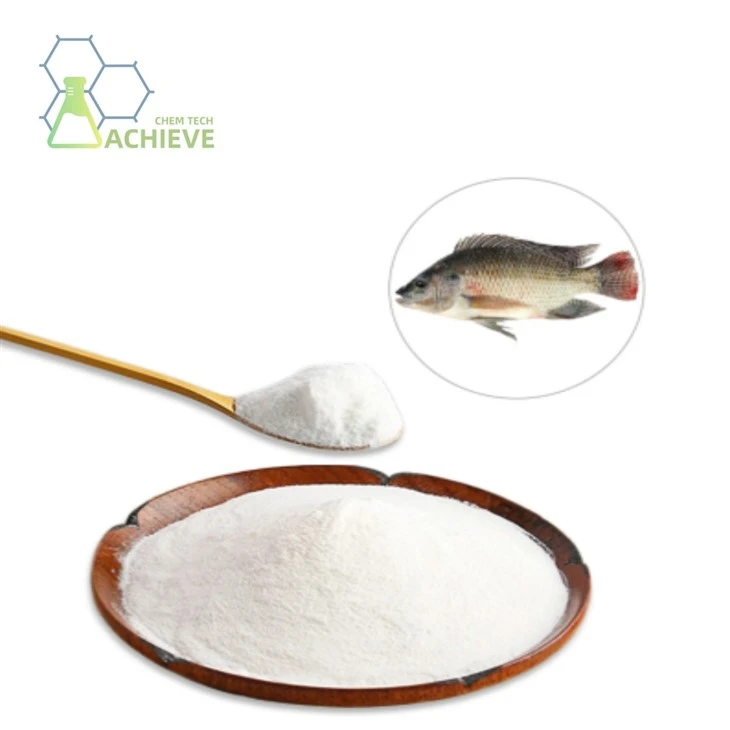


Shaanxi BLOOM Tech Co., Ltd. is one of the most experienced manufacturers and suppliers of fish collagen tripeptide in China. Welcome to wholesale bulk high quality fish collagen tripeptide for sale here from our factory. Good service and reasonable price are available.
Fish collagen tripeptide is a small molecule active peptide complex prepared by directed low-temperature enzymatic hydrolysis and refined purification process based on the epidermal connective tissue of deep-sea aquatic organisms. Its characteristic peptide chain is composed of glycine proline hydroxyproline as the core skeleton, and the monomer molecular weight is stable between 189-280 Da, breaking through the limitations of conventional collagenous protein macromolecules that are difficult to penetrate biological barriers. It has the physical and chemical characteristics of direct penetration of intestinal mucosa, no digestive loss, and targeted enrichment of specific tissues.
This active peptide, with its unique biological adaptability, has solid theoretical support and clinical empirical value in the intervention of osteoarthritis, synergistic nutrition enhancement with ascorbic acid, and nourishment and repair of surface keratinous accessory tissues. It is a high-quality component in the field of dietary active nutrition that is suitable for repairing human connective tissue.
Products Overview


Fish collagen tripeptide COA
 |
||
| Certificate of Analysis | ||
| Compound name | Fish collagen tripeptide | |
| Grade | Pharmaceutical grade | |
| CAS No. | N/A | |
| Quantity | Customized | |
| Packaging standard | Customized | |
| Manufacturer | Shaanxi BLOOM TECH Co., Ltd | |
| Lot No. | 202501090043 | |
| MFG | Jan 9th 2026 | |
| EXP | Jan 8th 2029 | |
| Structure | N/A | |
| Item | Enterprise standard | Analysis result |
| Appearance | White or almost white powder | Conformed |
| Water content | ≤5.0% | 0.54% |
| Loss on drying | ≤1.0% | 0.42% |
| Heavy Metals | Pb≤0.5ppm | N.D. |
| As≤0.5ppm | N.D. | |
| Hg≤0.5ppm | N.D. | |
| Cd≤0.5ppm | N.D. | |
| Purity (HPLC) | ≥99.0% | 99.98% |
| Single impurity | <0.8% | 0.52% |
| Total microbial count | ≤750cfu/g | 95 |
| E. Coli | ≤2MPN/g | N.D. |
| Salmonella | N.D. | N.D. |
| Ethanol (by GC) | ≤5000ppm | 500ppm |
| Storage | Store in a sealed, dark, and dry place, 2-8°C | |
|
|
||


Fish collagen price & its mechanism of intervention, repair and clinical improvement on osteoarthritis
The essence of osteoarthritis is the degenerative loss of extracellular matrix in articular cartilage and functional degeneration caused by local chronic low-grade inflammation. Fish collagenous protein can regulate the joint microenvironment through multiple pathways, reverse mild cartilage damage, and alleviate pathological pain. The clinical improvement effect of twelve week continuous intervention is particularly prominent.
Blocking the cascade reaction of joint inflammation
During the process of joint degeneration, pro-inflammatory and pro catabolic factors such as interleukin-1 β and matrix metalloproteinases will continue to erode cartilage collagenous protein fibers and proteoglycans, causing cartilage thickness attenuation, synovial edema, and increased joint movement pain. Fish collagen tripeptides can specifically antagonize the gene expression of pro-inflammatory factors, inhibit the activity of matrix degrading enzymes, block the sustained degradation and loss of cartilage matrix, stabilize the internal homeostasis of joints, and fundamentally delay the degenerative process of bone joints.


Reshaping the microstructure of cartilage matrix
The elasticity and compressive capacity of articular cartilage rely entirely on the ordered arrangement of type II collagenous protein fibers and the filling degree of matrix polysaccharides. As the body's metabolic capacity declines, the endogenous collagenous protein synthesis rate significantly decreases, and the cartilage buffering function continues to decline. This small molecule tripeptide can target and activate the proliferation activity of chondrocytes, promote the synthesis and accumulation of core matrix components such as type II collagenous protein and aggrecan, repair damaged cartilage fiber networks, and restore joint buffering, compression resistance, and flexibility.
The pain improvement logic of the twelve week clinical intervention
The WOMAC bone and joint function scoring system is an internationally recognized quantitative evaluation standard for osteoarthritis, covering three core dimensions: pain perception, joint stiffness, and daily activity ability. Multiple randomized controlled clinical trials have shown that in individuals with mild to moderate osteoarthritis who regularly consume fish collagenous protein for twelve weeks.


The average reduction in WOMAC pain dimension score can reach 40%. The improvement effect is not instantaneous analgesia, but a long-term relief of pathological pain achieved through cartilage structure repair and the disappearance of inflammatory microenvironment. At the same time, it can significantly improve typical discomforts such as joint stiffness and limited walking flexion and extension in the morning, effectively enhancing the basic function of bone and joint.
Fish collagen for sale: Biological synergistic gain mechanism of vitamin C and fish collagenous protein
There are natural limitations in the endogenous transformation and bioavailability of fish collagen tripeptides, while vitamin C (ascorbic acid) can form a complementary gain effect with collagenous protein tripeptides through a triple mechanism of biochemical coenzyme empowerment, oxidative stress regulation, and absorption pathway optimization, greatly amplifying its tissue repair efficacy.
Mature collagenous protein with biological activity in the human body requires hydroxylation modification with proline and lysine to form a stable helical fiber structure.
Vitamin C is an exclusive functional coenzyme for hydroxylation reactions, which can activate the biological activity of proline hydroxylase and lysine hydroxylase. Simply supplementing fish collagenous protein can only provide exogenous peptide chain substrates.


Continuous oxidative stress in the body produces reactive oxygen species, which directly attack and degrade newly formed collagenous protein fibers and externally ingested active peptides, greatly weakening the repair effect.
Vitamin C, as a water-soluble and highly efficient antioxidant medium, can efficiently eliminate excess reactive oxygen species in cells, block oxidative damage pathways.And protect newly formed collagenous protein fibers from oxidative degradation, preserving collagen reserves in the body; On the other hand, it maintains the molecular activity of fish collagenous protein, avoiding their inactivation during metabolism and forming a bidirectional gain pattern of "incremental synthesis+reduced loss".


The oxidative barrier and metabolic resistance of the intestinal mucosa are key factors that restrict the absorption and utilization of small molecule peptides. Vitamin C can regulate the redox status of intestinal mucosa, weaken the barrier interception effect,

Nourishing and strengthening effects of fish collagenous protein on keratinous accessory tissues
Hair and nails belong to the human body's keratinized accessory tissues, with a core structure composed of interwoven alpha keratin and collagenous protein fibers. Their toughness and integrity rely entirely on the normal metabolism of keratin and the stability of fiber structure. Fish collagen tripeptides can regulate keratin metabolism and repair tissue structure, achieving long-term maintenance of hair and nails.

Activation of endogenous synthesis and metabolism of keratin
The core cause of fine and soft hair loss, brittle and cracked nails is the low metabolism of keratinocytes and insufficient keratin synthesis flux. Fish collagenous protein can target and regulate the cellular metabolic pathways of skin accessory tissues, activate the expression of target genes related to keratin synthesis, continuously provide synthetic substrates for hair follicle matrix and nail matrix cells, increase the accumulation of alpha keratin synthesis, consolidate the structural material basis of hair and nails, and reduce non pathological hair loss and nail breakage problems from the root.
Repairing the surface barrier structure of hair
Daily external stimuli and chemical damage can cause the hair scale layer to curl, fall off, and not fully close, leading to hair loss of moisture and nutrient deficiency, ultimately resulting in dryness, frizz, split ends, and other problems. Fish collagenous protein can fill the gaps between hair scales, repair damaged hair surface barriers, reshape the dense closed structure of scale layers, lock in moisture and nutrients inside hair strands, improve the dry, split, rough and dull state of hair, and enhance hair fiber toughness, reducing hair breakage caused by external pulling.


Dense nail cuticle fiber structure
Nail layering, splitting, and easy breakage are essentially caused by disordered arrangement and loose structure of collagenous protein fibers and keratin fibers in the nail bed. This active peptide can promote the orderly arrangement of collagenous protein fibers and keratin fibers in the nail bed, increase the density of the nail cuticle layer, strengthen the mechanical strength and structural stability of the nail body, improve the defects of nail fragility, delamination, and easy breakage, and achieve long-term improvement of nail toughness.
References
Journal of Nutrition, 2024, 46 (2): 189-195 Molecular Mechanism Study on the Enhancement of Active Collagen Peptide Synthesis Mediated by Ascorbic Acid
Journal of Cosmetic Dermatology, 2023, 22(8): 5612-5620. Marine collagenous protein tripeptide regulates keratin metabolism and improves nail and hair structural stability
China Food Additives, 2023, (11): 78-85 Evaluation of the 12 week clinical intervention effect of small molecule fish collagenous protein tripeptide on mild to moderate osteoarthritis
Fish Collagen: Extraction, Characterization, and Applications for Biomaterials Engineering (https://pmc.ncbi.nlm.nih.gov/articles/PMC7601392/)
Unlocking the Potential of Marine Sidestreams in the Blue Economy: Lessons Learned from the EcoeFISHent Project on Fish Collagen (https://pmc.ncbi.nlm.nih.gov/articles/PMC11906597/)
FAQ
The clinical improvement effect is mainly targeted at individuals with mild to moderate primary degenerative osteoarthritis. For individuals with severe joint cartilage wear, joint deformities, traumatic arthritis, or rheumatic joint disease, relying solely on dietary supplementation cannot achieve the same improvement effect and requires professional medical intervention. Individual differences in metabolic rate, daily joint load, and sleep habits can also slightly affect the final extent of pain improvement.
There is no need to deliberately supplement high doses of vitamin C. The natural ascorbic acid contained in fruits and vegetables in daily diet, or the standard dose of conventional dietary supplements, can fully activate the coenzyme pathway of collagenous protein synthesis and exert antioxidant synergistic effects. Excessive intake of vitamin C cannot further enhance the synergistic effect, but may instead increase the metabolic burden on the human body. Maintaining regular balanced intake can meet the maintenance needs.
The cellular metabolic cycle of hair and nails is relatively long and belongs to a slow repair process. Regular supplementation for 6 to 8 weeks can lead to slight changes in hair loss reduction, difficulty in splitting nails, and alleviation of frizzy hair; Persisting for 12 weeks or more can significantly improve problems such as dry and split hair, weak nail layering, etc. Long term intake can stably maintain the health status of keratin tissue.
Hot Tags: fish collagen tripeptide, suppliers, manufacturers, factory, wholesale, buy, price, bulk, for sale, 3-Hydroxytyramine, 4 BROMO 1 BUTYNE CAS 38771 21 0, Baclofen Powder CAS 1134 47 0, cholesterol powder, Loperamide Hydrochloride Powder CAS 34552 83 5, pure procaine powder