






Shaanxi BLOOM Tech Co., Ltd. is one of the most experienced manufacturers and suppliers of linoleic acid liquid cas 60-33-3 in China. Welcome to wholesale bulk high quality linoleic acid liquid cas 60-33-3 for sale here from our factory. Good service and reasonable price are available.
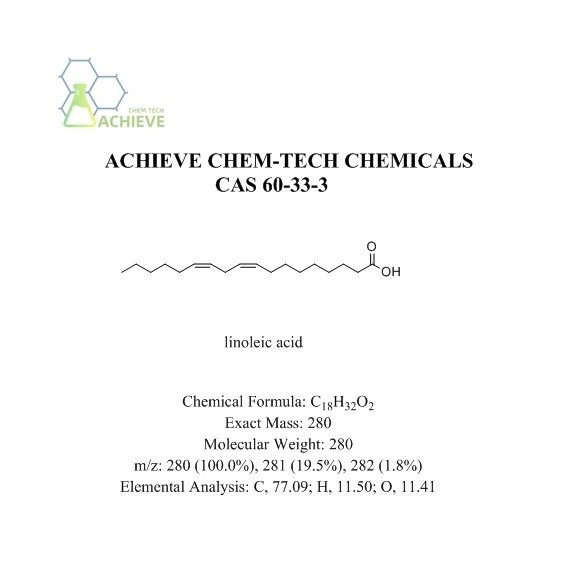
Linoleic acid liquid, with the molecular formula CH3 (CH2) 4CH=CHCH2CH=CH (CH2) 7COOH, CAS 60-33-3, is a type of unsaturated fatty acid. The main components of dry and semi dry oils such as flaxseed oil and cottonseed oil, which are composed of glycerides. Several types of vegetable oils have a high content, accounting for 76% -83% of the total fatty acids in safflower seed oil, 40-60% of the total fatty acids in walnut oil, cottonseed oil, sunflower seed oil, and sesame oil, and about 25% of the total fatty acids in peanut oil and olive oil. The content in animal fats is generally low, such as butter at 1.8% and lard at 6%. Because it is prone to oxidation and hardening in the air, it is also known as dry acid, and oils containing more dry acid are also called dry oils. When treated with selenium at 200 ℃ or nitrogen oxides, it transforms into trans linoleic acid. During hydrogenation, it is first converted into 12 octadecanoic acid and oleic acid, and further hydrogenated into stearic acid. It is an essential fatty acid in human and animal nutrition. The sodium or potassium salt of linoleic acid is one of the components of soap and can be used as a surfactant such as emulsifier. It can be used in medicine to treat diseases such as hyperlipidemia and arteriosclerosis. Its aluminum salt can be used to manufacture paints, coatings, etc.

|
|
|
|


|
Chemical Formula |
C18H32O2 |
|
Exact Mass |
280 |
|
Molecular Weight |
280 |
|
m/z |
280 (100.0%), 281 (19.5%), 282 (1.8%) |
|
Elemental Analysis |
C, 77.09; H, 11.50; O, 11.41 |

Linoleic acid liquid, as an important unsaturated fatty acid, has a wide and far-reaching range of applications. It not only plays an important role in the field of health care, but also demonstrates unique application value in various fields such as industry and medicine.

In Depth Application In The Field Of Medicine
1. Treat specific skin diseases
The application in the field of dermatology is gradually receiving attention. Due to its anti-inflammatory and cell regeneration promoting properties, it is used to treat some difficult to treat skin diseases such as psoriasis, eczema, etc. These diseases are often accompanied by impaired skin barrier function and intensified inflammatory response, which can be alleviated by enhancing lipid synthesis in skin cells, restoring skin barrier function, and inhibiting inflammatory response.
2. Adjuvant cancer treatment
In recent years, research has found that it has certain potential in cancer treatment. Although research in this field is still in its early stages, there is evidence to suggest that it can affect the metabolic pathways of cancer cells, inhibit their proliferation and spread. In addition, it can enhance the sensitivity of chemotherapy drugs and improve treatment efficacy. Although these findings have not yet been translated into widespread clinical applications, they provide new ideas for future cancer treatments.


Special Applications In The Industrial Sector
1. Preparation of high-performance materials
It can be used as one of the raw materials for preparing high-performance materials in industry. For example, through chemical modification, it can be transformed into polymers or composite materials with special properties. These materials have broad application prospects in fields such as aerospace, automotive manufacturing, and electronic communication. For example, the biobased polyester materials prepared using it not only have excellent mechanical properties, but also have good biocompatibility and degradability, making it an important research direction for environmentally friendly materials.
2. Development of environmentally friendly coatings
With the increasing awareness of environmental protection, the development of low VOC (volatile organic compound) coatings has become an industry trend. This substance and its derivatives are used as additives or main components in environmentally friendly coatings due to their natural sources and environmental characteristics. This type of coating not only reduces the emission of harmful substances, but also improves the weather resistance and corrosion resistance of the coating, extending its service life. In addition, linoleic acid based coatings have good wetting and adhesion properties, making them suitable for coating various substrates.


Innovative Applications Of Cosmetics And Personal Care Products
1. Anti aging skincare products
Due to its antioxidant properties, it is widely used in anti-aging skincare products. It can neutralize free radicals in the body, reduce cellular oxidative damage, and thus delay the process of skin aging. Many high-end skincare brands use Linoleic acid liquid as one of their core ingredients and have launched a series of anti-aging products. These products not only improve issues such as fine lines and sagging on the skin, but also enhance the overall health of the skin.
2. Enhancers for sunscreen products
It also has a certain ability to absorb ultraviolet rays, so it can be used as an enhancer for sunscreen products. By compounding with other sunscreen ingredients, the SPF value (sun protection index) of sunscreen products can be increased, while reducing the damage of ultraviolet rays to the skin. In addition, it can promote the recovery and enhancement of skin barrier function, and improve the skin's resistance to ultraviolet radiation.


Auxiliary Applications In Agriculture And Food Processing
1. Improve crop stress resistance
In the field of agriculture, this substance or its derivatives are used as plant growth regulators or additives for foliar fertilizers. By promoting the activity of antioxidant enzymes in plants, crop stress resistance (such as drought resistance, cold resistance, disease resistance, etc.) can be enhanced, and crop yield and quality can be improved. In addition, it can promote the absorption and utilization of nutrients by crops and improve the soil environment.
2. Improve food quality
In the field of food processing, it is widely used as a natural food additive in areas such as oil processing and baked goods. It can not only improve the taste and flavor of food, but also extend the shelf life of food. For example, in oil processing, it can be compounded with other fatty acids to form more stable oil products; In baked goods, it can improve the softness and extensibility of the dough, making the baked product softer and more delicious.


Exploration And Application In The Fields Of Scientific Research And Education
1. Research in Biochemistry and Molecular Biology
Plays an important role in biochemical and molecular biology research. As one of the main components of the cell membrane, it participates in many cellular biological processes such as signal transduction and cell apoptosis. Therefore, researchers often use this substance as a model compound to study the molecular mechanisms of these processes. In addition, it is also used as a substrate or inhibitor for certain biological enzymes to study their catalytic mechanisms and physiological functions.
2. Life Science Education Materials
In the field of life science education, it is also used as one of the teaching materials. By introducing the chemical structure, physiological functions, and metabolic pathways of this substance in organisms, students can better understand the basic concepts and principles of life sciences such as lipid metabolism and cell membrane structure. Combining experimental teaching activities such as extracting vegetable oils and measuring their content can cultivate students' practical abilities and innovative thinking.


Corn oil, as a plant oil rich in Linoleic acid liquid, is an important raw material for extracting linoleic acid. Linoleic acid is an unsaturated fatty acid that has multiple benefits for human health, such as lowering cholesterol and preventing cardiovascular and cerebrovascular diseases. Therefore, extracting and synthesizing high-purity linoleic acid from corn oil has important application value.
Extraction method:
Squeezing method
Squeezing method is a method of using external mechanical pressure to squeeze and separate oil from oil materials. For the extraction of corn germ oil, pressing is a traditional oil making method. The specific steps include:
Cleaning:
Remove impurities and undesirable particles from corn germ.
01
Drying:
Dry the cleaned corn germ to remove excess moisture.
02
Softening:
Softening the embryo through appropriate heat treatment for subsequent processing.
03
Rolling embryo:
The softened embryo is subjected to rolling embryo treatment to control the thickness and moisture content of the billet.
04
Steaming and frying:
Steaming and frying the embryo after rolling at an appropriate temperature to improve oil yield and oil quality.
05
Oil extraction:
Use a press machine to press and separate the oil from the steamed and fried embryo.
06
Refining:
Refining the pressed oil to remove impurities and impurities, resulting in refined corn oil.
07
However, although the pressing method is simple and direct, the linoleic acid content in the obtained oil is relatively low and the purity is not high, requiring further processing and purification.
Leaching method
The leaching method is a method of extracting oil and fat from oil materials using the principle of solvent extraction. Compared with the pressing method, the extraction method can more fully extract linoleic acid from oil. The specific steps include:
Solvent selection:
Choose a suitable solvent (such as n-hexane, petroleum ether, etc.) for extraction.
01
Leaching:
Soak the pre treated corn germ in a solvent to dissolve the oil and form a mixed oil.
02
Evaporation and stripping:
Performing evaporation and stripping operations on mixed oil to vaporize the solvent and separate it from the oil.
03
Recycling solvent:
Condensing and cooling the evaporated solvent for reuse.
04
Refining:
Refining the obtained oil to remove residual solvents and other impurities.
05
The leaching method can significantly improve the extraction rate of oil and the content of linoleic acid, but attention should be paid to the selection of solvents and recovery treatment to ensure production safety and environmental friendliness.
Supercritical CO2 fluid extraction method
Supercritical CO2 fluid extraction is a new type of oil extraction technology. In supercritical state, the density and solubility of CO2 fluid are close to those of liquid, and it can selectively extract linoleic acid from oil. The specific steps include:
Prepare supercritical CO2 fluid:
Pressurize CO2 to a supercritical state (usually with a pressure greater than 7.38 MPa and a temperature higher than 31.1 ℃).
01
Extraction:
Contact supercritical CO2 fluid with pre treated corn germ to dissolve oil components such as linoleic acid in the fluid.
02
Separation and collection:
CO2 fluid is restored to a gaseous state by reducing pressure or increasing temperature, while dissolved oil is separated and collected.
03
Post processing:
Refine the collected oil and remove residual solvents and other impurities.
04
Supercritical CO2 fluid extraction method has the advantages of high efficiency, environmental protection, and no residue, but the equipment cost is high and the operating conditions are harsh.
Synthesis method
Although the oil extracted from corn oil contains linoleic acid, its content and purity often cannot meet specific requirements. Therefore, it is necessary to further synthesize high-purity linoleic acid through chemical or biological methods. The following is an example of synthesis based on chemical methods:
Mix refined corn oil with alkali (such as sodium hydroxide) solution and perform saponification reaction under heating conditions. The saponification reaction is a reaction in which fats and oils are hydrolyzed under alkaline conditions to produce fatty acid salts and glycerol. The specific reaction equation is as follows:
R1R2CH=CHR3R4COOH + 3NaOH → 3R1R2CH=CHR3R4COONa+glycerol
Among them, $R1, R2, R3, R4 $represent different hydrocarbon groups.
Acidify the fatty acid salts obtained from saponification reaction with acid (such as sulfuric acid) to convert them back into fatty acids. The specific reaction equation is as follows:
R1R2CH=CHR3R4COONa + H2SO4 → R1R2CH=CHR3R4COOH + Na2SO4
Among them, R1R2R3R4 represents hydrocarbon groups related to linoleic acid. It should be noted that the equation here is simplified, and in fact, corn oil contains multiple fatty acids, so the reaction product will be a mixture of multiple fatty acids. However, due to the relatively high content of linoleic acid in corn oil, it can be further isolated and purified through subsequent steps.
Separation and purification are key steps in extracting high-purity linoleic acid. Common methods include solvent extraction, distillation, crystallization, etc.
Solvent extraction:
Extracting by utilizing the difference in solubility of linoleic acid in different solvents. For example, a solvent with high solubility for linoleic acid and low solubility for other impurities can be selected for extraction, and crude linoleic acid can be obtained by evaporating the solvent.
Distillation:
Using the difference in boiling point between linoleic acid and other fatty acids for distillation separation. By controlling the distillation temperature and pressure, linoleic acid can be separated from the mixture. However, due to the easy oxidation and decomposition of linoleic acid at high temperatures, the distillation process requires strict control of conditions.
Crystallization:
Dissolve crude linoleic acid in an appropriate solvent, and then obtain high-purity linoleic acid crystals by cooling crystallization. During the crystallization process, linoleic acid molecules will arrange in a certain pattern to form a crystal structure, thereby separating from other impurities.
The purified Linoleic acid liquid needs to undergo a series of analytical tests to verify its purity and quality. Common analytical methods include gas chromatography (GC), liquid chromatography (LC), mass spectrometry (MS), etc. These analytical methods can accurately determine the content, purity, and possible impurities of linoleic acid.
Hot Tags: linoleic acid liquid cas 60-33-3, suppliers, manufacturers, factory, wholesale, buy, price, bulk, for sale, tetracaine hcl, 1 5 Dimethylhexylamine, Zidovudine powder, Octreotide Acetate Powder, Pramipexole Powder CAS 104632 26 0, 4 BROMO 1 BUTYNE CAS 38771 21 0