




Shaanxi BLOOM Tech Co., Ltd. is one of the most experienced manufacturers and suppliers of indocyanine green (icg) cas 3599-32-4 in China. Welcome to wholesale bulk high quality indocyanine green (icg) cas 3599-32-4 for sale here from our factory. Good service and reasonable price are available.
Indocyanine green (ICG) is a water-soluble, non-toxic, and fluorescent tricarbocyanine dye that has found widespread applications in medical diagnostics and research. Primarily used in the field of medicine, ICG is renowned for its unique optical properties, particularly its ability to absorb and emit light in the near-infrared (NIR) spectrum, which allows for deep tissue penetration and minimal autofluorescence interference from biological tissues.
In clinical settings, ICG is commonly employed as a contrast agent for various imaging modalities, including fluorescence angiography, which is invaluable in assessing blood flow dynamics and perfusion in real-time during surgical procedures. Surgeons utilize ICG-guided fluorescence imaging to visualize and identify vital anatomical structures, such as blood vessels and bile ducts, with exceptional clarity, enhancing surgical precision and minimizing the risk of complications.
Moreover, ICG's rapid clearance from the bloodstream and minimal systemic toxicity make it an ideal choice for both adults and pediatric patients. It is also used in hepatic function assessment, where the rate of ICG clearance by the liver serves as an indicator of its metabolic capacity.
Beyond surgical and diagnostic applications, researchers have explored the potential of ICG in tumor imaging, drug delivery systems, and photodynamic therapy, owing to its photochemical properties and ability to serve as a marker for cellular uptake and tracking. In summary, ICG's versatility and safety profile have established it as a cornerstone in modern medical imaging and diagnostics.

|
|
|


|
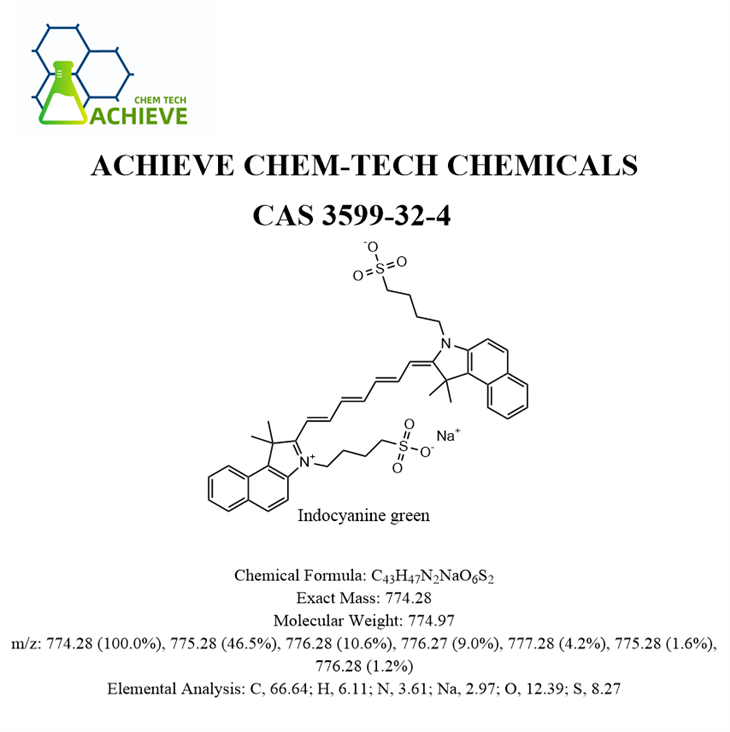
Chemical Formula |
C43H47N2NaO6S2 |
|
Exact Mass |
774.28 |
|
Molecular Weight |
774.97 |
|
m/z |
774.28 (100.0%), 775.28 (46.5%), 776.28 (10.6%), 776.27 (9.0%), 777.28 (4.2%), 775.28 (1.6%), 776.28 (1.2%) |
|
Elemental Analysis |
C, 66.64; H, 6.11; N, 3.61; Na, 2.97; O, 12.39; S, 8.27 |

Indocyanine Green (ICG), as a near-infrared fluorescent dye, has shown wide application value in medical diagnosis, treatment, and scientific research fields due to its unique physical and chemical properties and biocompatibility.
One of the core applications of ICG is the quantitative assessment of liver function. Its metabolic process is closely related to liver hemodynamics and cellular function: after intravenous injection, ICG binds to plasma albumin, enters the hepatic sinusoids with liver blood flow, is efficiently taken up by liver cells and secreted into bile, without enterohepatic circulation. By continuously measuring the concentration of ICG in the blood, a concentration time curve can be plotted to calculate the 15 minute retention rate (ICG-R15), which has become the "gold standard" for evaluating liver reserve function.


Diagnosis of Cirrhosis and Liver Fibrosis: Patients with cirrhosis experience significant reduction in ICG clearance due to abnormal liver lobular structure leading to intrahepatic shunting and sinusoidal capillary formation. ICG-R15>10% indicates insufficient liver function reserve and is positively correlated with surgical complications and mortality.
Liver resection surgery planning: The "Makuuchi criteria" proposed by Yamin Makuuchi uses ICG-R15 as the core indicator, combined with ascites and bilirubin levels, to quantify the tolerance range of liver resection, reducing perioperative mortality from 10% to 1.2%.
Drug and occupational toxic liver disease assessment: ICG clearance rate can sensitively reflect liver cell metabolic dysfunction, providing a basis for early diagnosis of toxic liver disease.
The application of ICG in the field of cancer has expanded from simple imaging to treatment guidance, forming a "diagnosis treatment monitoring" closed loop.
Intraoperative fluorescence navigation: ICG can be excited by 750-810nm near-infrared light and emit 850nm fluorescence. Normal liver tissue rapidly metabolizes ICG, while malignant tumors accumulate ICG due to poor metabolic capacity. By using a fluorescence imaging system, tumor boundaries can be identified in real time, improving the accuracy of resection for liver cancer and colorectal cancer liver metastases.


Sentinel lymph node biopsy: ICG angiography (ICGA) uses SPY Elite system in breast cancer, with a biopsy accuracy of 94%, which is superior to the traditional technetium-99 detection (false negative rate of 40%). In colon cancer research, ICGA has an accuracy rate of 96%, making it the third choice besides technetium-99 and methylene blue.
Photodynamic and photothermal synergistic therapy:
Photodynamic therapy (PDT): ICG produces reactive oxygen species (ROS) under near-infrared light, directly killing tumor cells. Clinical research shows that it can significantly improve the survival rate in the treatment of colorectal cancer, breast cancer and lung cancer.
Photothermal therapy (PTT): ICG absorbs light energy and converts it into heat energy, producing a local thermal therapy effect. In the treatment of liver cancer and pancreatic cancer, ICG-PTT combined with chemotherapy drugs (such as magnetic liposomes loaded with sesquiterpene lactones) can achieve targeted thermal ablation.
Nanocarrier enhanced therapeutic effect: In response to the poor stability of ICG aqueous solution, researchers have developed inorganic nanoparticles, liposomes, and hybrid cell membrane encapsulation technologies. For example, polymer encapsulated ICG nanoparticles are used for the treatment of cervical cancer, significantly improving tumor targeting and therapeutic efficacy.

Vascular and tissue perfusion monitoring

The fluorescence properties of ICG make it a "real-time probe" for evaluating tissue blood flow perfusion.
Myocardial perfusion monitoring: After intravenous injection of ICG, the myocardial blood supply is observed through fluorescence imaging to assist in the diagnosis of coronary artery disease and myocardial ischemia.
Assessment of anastomotic blood flow: In rectal surgery, ICGA can quantitatively evaluate anastomotic blood flow perfusion, predict postoperative fistula risk, and guide preventive fistula decision-making.
Microcirculation disorder detection: ICG clearance rate reflects the systemic microcirculation status and is used for hemodynamic monitoring of critical illnesses such as shock and septic shock.
The anatomy of the biliary system is complex, and there is a high risk of intraoperative injury. ICG fluorescence imaging technology uses preoperative intravenous injection to display real-time biliary structure and prevent complications of bile leakage.
Hepatobiliary surgery assistance: In laparoscopic or robotic surgery, ICG can clearly display the hepatic portal bile duct and liver resection plane, improving surgical safety.
Identification of variant anatomy: 80% of patients who cannot be visualized by traditional cholangiography can have their biliary tract course clearly determined by ICG fluorescence imaging.

Photodynamic and photothermal therapy: from basic to clinical

The core mechanisms of ICG in tumor treatment include:
ROS generation: In PDT, Indocyanine green (ICG) absorbs light energy and transfers it to oxygen molecules, producing singlet oxygen and other ROS that induce tumor cell apoptosis.
Thermal effect: In PTT, ICG converts light energy into heat energy, raising the local temperature to 42-48 ℃ and directly killing tumor cells.
Combination therapy strategy: ICG binds to anti epidermal growth factor receptor (EGFR) antibodies, which can inhibit EGFR overexpression in tumor cells. In vitro experiments have shown that the apoptosis rate of tumor cells can reach 90-100%.
ICG, as a fluorescent probe, promotes interdisciplinary research:
Nanomaterial design: Researchers develop ICG inorganic/polymer composite nanoparticles to enhance their photostability and tumor targeting properties. For example, the gold nanorod ICG composite can achieve both PDT and PTT simultaneously.
In vivo imaging technology: The near-infrared penetration of ICG (up to 1cm tissue) makes it an ideal tool for detecting lesions in live animals and is applied in tumor metastasis model research.
Photoacoustic imaging: ICG combines fluorescence and photoacoustic properties, enabling the construction of a fluorescence/photoacoustic dual-mode imaging system and improving tumor detection sensitivity.

Advantages of ICG in Cardiovascular Diagnosis
Real-Time Imaging
ICG-based imaging provides real-time visualization of blood flow, enabling prompt identification of abnormalities.
Minimal Invasiveness
Compared to traditional diagnostic methods, ICG-based angiography is less invasive and carries lower risks.
High Sensitivity and Specificity
ICG has been shown to have high sensitivity and specificity in detecting cardiovascular abnormalities, making it a reliable diagnostic tool.
Rapid Excretion
The rapid excretion of ICG minimizes the potential for adverse effects and ensures that patients can return to normal activities quickly.

precautions
Indocyanine green (ICG) is a versatile dye widely used in medical applications, particularly in the fields of ophthalmology, cardiology, and hepatology. Its near-infrared fluorescence properties make it ideal for visualizing blood flow and assessing organ function non-invasively. However, when using ICG, several precautions should be observed to ensure patient safety and accurate diagnostic outcomes.
- Firstly, allergic reactions must be considered, as with any foreign substance introduced into the body. A thorough allergy screening should be performed prior to administration, and emergency protocols should be in place to manage potential anaphylactic reactions.
- Secondly, dosage must be carefully calculated based on patient-specific factors such as weight, age, and underlying conditions. Excessive doses can lead to adverse effects, including skin discoloration and potential toxicity to the retina.
- Timing of administration is crucial, especially in surgical procedures where ICG is used to enhance visualization. It should be given at the appropriate stage to maximize its effectiveness without interfering with other surgical steps.
- Monitoring of vital signs during and after ICG administration is essential to detect any immediate or delayed adverse reactions. Special attention should be paid to changes in blood pressure, heart rate, and respiratory status.
- Furthermore, pregnancy status should be confirmed before administering ICG, as its safety in pregnant women has not been fully established. Similarly, caution is advised in patients with renal or hepatic impairment, as these conditions may affect ICG clearance and increase the risk of toxicity.
- Lastly, proper disposal of ICG and related materials is mandatory to prevent environmental contamination. Healthcare professionals should follow institutional guidelines for handling and disposing of hazardous waste.
In conclusion, while ICG offers significant advantages in medical diagnosis and surgery, its use requires strict adherence to safety protocols and careful consideration of patient-specific factors to ensure optimal outcomes.
Hot Tags: indocyanine green (icg) cas 3599-32-4, suppliers, manufacturers, factory, wholesale, buy, price, bulk, for sale, Procaine Hydrochloride, 3 4 5 Trimethoxy trans stilbene, 18 Glycyrrhetinic Acid CAS 471 53 4, Diphenhydramine Hydrochloride Powder CAS 147 24 0, Cyproheptadine hydrochloride sesquihydrate, epinephrine powder