




Shaanxi BLOOM Tech Co., Ltd. is one of the most experienced manufacturers and suppliers of pontocaine cas 94-24-6 in China. Welcome to wholesale bulk high quality pontocaine cas 94-24-6 for sale here from our factory. Good service and reasonable price are available.
Pentocaine, also known by its generic name tetracaine hydrochloride, is a long-acting ester-type local anesthetic. It mainly works by reversibly blocking voltage-gated sodium ion channels, thereby inhibiting the depolarization of nerve cell membranes and the generation of action potentials, thus interrupting the conduction of nerve impulses such as pain signals. Compared with amide-type local anesthetics like lidocaine, tetracaine hydrochloride has stronger anesthetic efficacy, with a slightly slower onset time (about 5-10 minutes), but its duration of action is significantly prolonged (up to 2-3 hours).
This drug has strong penetration ability through mucous membranes, and is therefore widely used in surface anesthesia (such as ophthalmic surgeries, ear-nose-throat examinations, bronchoscopy) and spinal anesthesia (lumbar anesthesia).

|
|
|
|
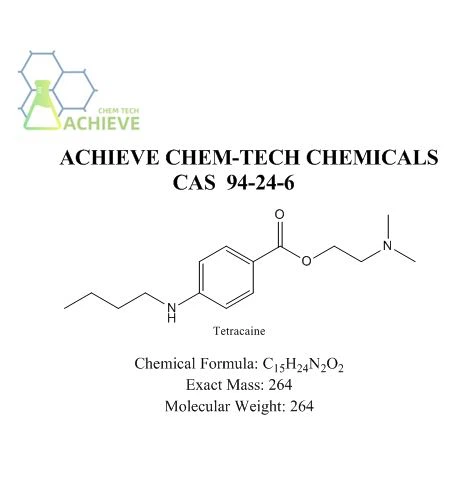
Chemical Formula |
C15H24N2O2 |
|
Exact Mass |
264 |
|
Molecular Weight |
264 |
|
m/z |
264 (100.0%), 265 (16.2%), 266 (1.2%) |
|
Melting point |
41.0 to 45.0 °C |
|
Boiling point |
407.59°C (rough estimate) |
|
Density |
1.0200 (rough estimate) |
Clinical Anesthetic Applications
Pentocaine is a novel long-acting ester-type local anesthetic. Owing to its superior nerve-blocking efficacy, mild pharmacological profile and prolonged duration of action, it occupies an important position in clinical anesthesia. Unlike traditional short-acting local anesthetics such as lidocaine and procaine, its core advantages include smooth onset of anesthesia, sustained duration, and minimal local irritation, making it suitable for minimally invasive and conventional surgical anesthesia across multiple clinical departments.


It is applicable to various minimally invasive procedures including corneal foreign body removal, conjunctival surgery, intraocular pressure measurement, and fundus laser therapy. The 0.3%–0.5% formulation penetrates the ocular surface mucosa rapidly and achieves anesthesia within 5–8 minutes, effectively alleviating stinging and foreign-body sensations during surgery. It does not alter intraocular pressure or pupillary function, with negligible postoperative dryness, stinging and other adverse reactions; its safety profile is markedly superior to conventional tetracaine.
In otorhinolaryngology, tetracaine hydrochloride is widely used for mucosal anesthesia of the nasal cavity, pharynx and auditory canal, matching procedures such as nasal polypectomy, turbinate plasty, pharyngeal biopsy and external auditory canal debridement.
Compared with traditional anesthetics, it possesses stronger mucosal permeability and requires no repeated dosing. A single spray delivers effective anesthesia lasting 1.5–2 hours, sufficiently meeting the demands of delicate otorhinolaryngologic surgery. It also suppresses intraoperative pharyngeal reflexes and nasal stress responses, reducing patient discomfort and surgical risks.
In dentistry, the drug is indicated for gingival repair, periodontal surgery, minimally invasive wisdom-tooth extraction and other interventions.


Targeting sensitive oral mucosa and small surgical wounds, it enables precise local nerve block with controllable anesthetic coverage, without interfering with basic physiological functions such as mastication and swallowing, and supports faster postoperative recovery.Beyond superficial mucosal anesthesia, tetracaine hydrochloride can be administered for clinical infiltration anesthesia and nerve block.
In minimally invasive operations including superficial tumor resection, subcutaneous cyst dissection and scar revision, subcutaneous infiltration of low-concentration tetracaine hydrochloride solution achieves precise local anesthesia with uniform drug diffusion and stable, durable effect that covers the entire surgical course and prevents unexpected intraoperative pain. In orthopedics and rehabilitation medicine, nerve block with tetracaine hydrochloride relieves chronic neuropathic pain such as sciatica, trigeminal neuralgia and intercostal neuralgia by blocking signal conduction in lesioned nerves to produce long-lasting analgesia. Combined with block therapy, it improves local tissue blood circulation and alleviates neurogenic inflammatory edema, delivering both anesthetic-analgesic and adjunctive therapeutic effects.

Wound Analgesia and Dermatological Care

Pentocaine demonstrates outstanding local analgesic, antipruritic and anti-inflammatory properties, coupled with favorable skin penetration and low irritancy, supporting broad use in cutaneous wound care and pain control as a routine clinical analgesic for wounds. For traumatic injuries such as burns, scalds, abrasions and lacerations, application of tetracaine hydrochloride cream or spray rapidly penetrates superficial wound tissue and blocks pain signal transmission from cutaneous nerve terminals, quickly relieving severe wound pain. It also inhibits histamine release at the wound site to reduce erythema, pruritus and burning, establishing a stable local microenvironment conducive to healing.
Compared with common analgesics, its effect persists for 3–4 hours, obviating frequent reapplication, minimizing repeated wound stimulation and lowering patient distress.
In dermatology, tetracaine hydrochloride serves as adjunctive symptomatic management for eczema, allergic dermatitis, herpes zoster and other cutaneous disorders. These conditions are often complicated by intense pruritus and neuropathic stinging; scratching increases infection risk. Topical tetracaine hydrochloride rapidly relieves pain and itching without antagonizing conventional dermatologic therapies, and is free of skin sensitization, pigmentation and similar side effects.


It is also widely adopted in minimally invasive aesthetic medicine, including laser freckle removal, photorejuvenation, microneedling and tattoo revision. Preoperative topical tetracaine hydrochloride cream produces uniform superficial skin anesthesia to eliminate procedural stinging, with controllable depth that avoids dermal injury and supports improved postoperative skin recovery, fitting a full spectrum of superficial aesthetic minimally invasive procedures.
tetracaine hydrochloride is also used for analgesic care in anorectal disorders.
For sensitive sites including hemorrhoids, anal fissures and postoperative perianal wounds, dedicated low-irritancy formulations provide gentle mucosal anesthesia, easing defecation pain, postoperative wound stinging and pruritus. The drug is mild and nonirritating to delicate perianal mucosa, effectively improving postoperative quality of life and accelerating wound healing; it is a common adjunct for conservative management and postoperative care of anorectal diseases.

Medical Adjunct and Special-Scenario Applications

Tetracaine hydrochloride functions as a vital adjunctive anesthetic in clinical examinations and interventional procedures, reducing patient discomfort during invasive maneuvers and improving examination success rates and workflow efficiency. For endoscopic examinations such as gastroscopy, colonoscopy and bronchoscopy, preoperative spraying or coating with tetracaine hydrochloride mucosal anesthetic anesthetizes pharyngeal and digestive tract mucosa, suppressing nausea, vomiting and foreign-body reflexes while reducing mechanical irritation and trauma during scope insertion. The procedure becomes smoother and more tolerable without disruption of basal gastrointestinal motility or interference with diagnostic interpretation.
In routine interventions such as urinary catheterization, puncture and intubation, local tetracaine hydrochloride relieves stinging and distension from instrument introduction, blunting stress responses and lowering complication risks.
In emergency medicine, tetracaine hydrochloride is suitable for rapid analgesia of acute trauma. It quickly controls acute pain caused by fresh lacerations, soft-tissue injuries and joint sprains, creating favorable conditions for subsequent debridement, suturing and immobilization. Its rapid onset, low toxicity and safety profile match the requirements of fast-track emergency care.


In pediatric practice, it's mild irritancy and low procedural pain confer better tolerability relative to traditional anesthetics. It can be used for pediatric superficial surgery, adjunctive analgesia during vaccination, and wound management, effectively mitigating fear and pain and improving pediatric patient cooperation.
It also sees limited use in biomedical research, frequently serving as a local anesthetic control for efficacy comparisons of novel anesthetic and analgesic formulations.
Its stable pharmacological activity and defined mechanism of action provide a standardized experimental reference for anesthetic development, pharmacology studies and clinical-drug comparisons, making it an indispensable basic research reagent. Its low toxicity and long duration also render it a common veterinary anesthetic, widely applied to superficial surgery, wound management and pain intervention in companion animals and small livestock across veterinary local-anesthesia scenarios.


Core Synthetic Principle and Raw Material Preparation
Chemically, pentocaine is 2-diethylaminoethyl 4-(pentylamino)benzoate, a canonical ester-type local anesthetic. Its synthesis relies primarily on esterification condensation and aminoalkylation. Aromatic carboxylic acid derivatives and aminoalcohols serve as key starting materials; stepwise assembly constructs the core molecular framework under mild conditions with few side reactions and high product purity, compatible with both industrial batch manufacturing and laboratory-scale fine preparation.
Key raw materials include 4-aminobenzoic acid, n-pentyl bromide, 2-diethylaminoethanol, anhydrous potassium carbonate, xylene, dilute hydrochloric acid and anhydrous ethanol. 4-aminobenzoic acid supplies the aromatic core; n-pentyl bromide enables N-pentyl substitution; 2-diethylaminoethanol provides the active side chain. Auxiliary materials support catalysis, dehydration, impurity removal and purification. Raw materials are readily available and cost-controllable, suitable for large-scale production.
Stepwise Synthetic Workflow
Step 1: N-pentylation to construct the core aromatic scaffold
Purified 4-aminobenzoic acid and anhydrous potassium carbonate are charged into a dry reactor, followed by anhydrous ethanol as solvent. After homogenization, n-pentyl bromide solution is added dropwise slowly, and the mixture is heated to 75–80 °C under reflux for 4 hours.
Anhydrous potassium carbonate acts as an acid scavenger, neutralizing hydrogen bromide byproduct to shift equilibrium toward product formation and preventing acid-mediated decomposition of starting materials.
After cooling to ambient temperature, ethanol is removed by vacuum distillation. Water is added, and filtration yields crude 4-(pentylamino)benzoic acid. Recrystallization delivers a high-purity intermediate to safeguard downstream reaction purity.
Step 2: Esterification condensation to form crude tetracaine hydrochloride
Purified 4-(pentylamino)benzoic acid and 2-diethylaminoethanol are dissolved in xylene. A small amount of concentrated sulfuric acid is added as catalyst, and the mixture is heated to 120–125 °C under reflux for esterification.
Continuous water separation via a Dean-Stark apparatus removes generated water, displacing equilibrium to drive conversion; total reaction time is controlled at 5–6 hours.
Heating is stopped and the mixture is cooled naturally to room temperature, yielding an organic mixture containing target product. Washing with water and dilute base removes residual catalyst and unreacted starting materials. The organic layer is separated, dried and concentrated to yield pale yellow oily crude tetracaine hydrochloride.
Product Purification and Final Formulation
Crude product is purified via hydrochloride salt formation and recrystallization to enhance purity and stability. Concentrated crude oil is dissolved in acetone. Under an ice-water bath, concentrated hydrochloric acid is added dropwise to adjust pH to 3.5–4.0, prompting tetracaine hydrochloride to precipitate as its hydrochloride salt.
Crystallization proceeds for 12 hours under low temperature. Crystals are isolated by centrifugal filtration, washed with cold acetone to remove surface impurities, and dried under vacuum at low temperature to yield white crystalline tetracaine hydrochloride hydrochloride powder.
The overall process achieves a yield exceeding 82% with product purity ≥99.2%, meeting pharmaceutical-grade raw-material specifications. The procedure is operationally straightforward and readily controlled for industrial scale-up. Byproducts can be recovered and processed, supporting favorable environmental performance.

Pontocaine, often confused with phonetically similar names such as Ponaxen or affected by minor spelling and translational variations, is primarily used to refer to Ponatinib, a highly effective targeted antitumor drug widely applied in clinical oncology. As an oral tyrosine kinase inhibitor, it features strong molecular targeting and significant inhibitory activity against abnormal kinase signaling, and has obtained official approval from the U.S. Food and Drug Administration (FDA) for the treatment of multiple refractory malignant tumors, mainly covering specific hematological tumors such as various leukemias and lymphomas, as well as pleural mesothelioma.
Its core mechanism of action lies in selectively binding and inhibiting the activity of abnormal tyrosine kinases, especially the Bcr-Abl fusion protein closely related to leukemia, thereby cutting off the abnormal signal transmission inside tumor cells, inhibiting abnormal cell proliferation and survival, and ultimately achieving the purpose of controlling tumor progression. In clinical trials and real-world applications, ponatinib has shown outstanding efficacy in patients with chronic myeloid leukemia (CML) and Philadelphia chromosome-positive acute lymphoblastic leukemia (Ph+ ALL), especially for those who are resistant to other targeted drugs, providing an important and previously difficult-to-replace treatment option.


However, due to its potent pharmacological effects, ponatinib may also induce a variety of adverse reactions during clinical use, including hypertension, skin rashes, gastrointestinal reactions such as diarrhea and abdominal pain, systemic fatigue, and hematological toxicity. These conditions require clinicians to conduct continuous monitoring and timely intervention. In conclusion, as a key drug in the field of targeted therapy for malignant tumors, ponatinib has significant clinical value, but its use must follow strict medical guidance, implement individualized medication plans, comprehensively evaluate the patient's disease type, physical tolerance and risk-benefit ratio, so as to maximize therapeutic effects while ensuring medication safety.
Hot Tags: pontocaine cas 94-24-6, suppliers, manufacturers, factory, wholesale, buy, price, bulk, for sale, pure aspirin powder, tetracaine powder, Iodomethane-d3, raloxifene powder, benzocaine 200mesh, Pramipexole Powder CAS 104632 26 0