




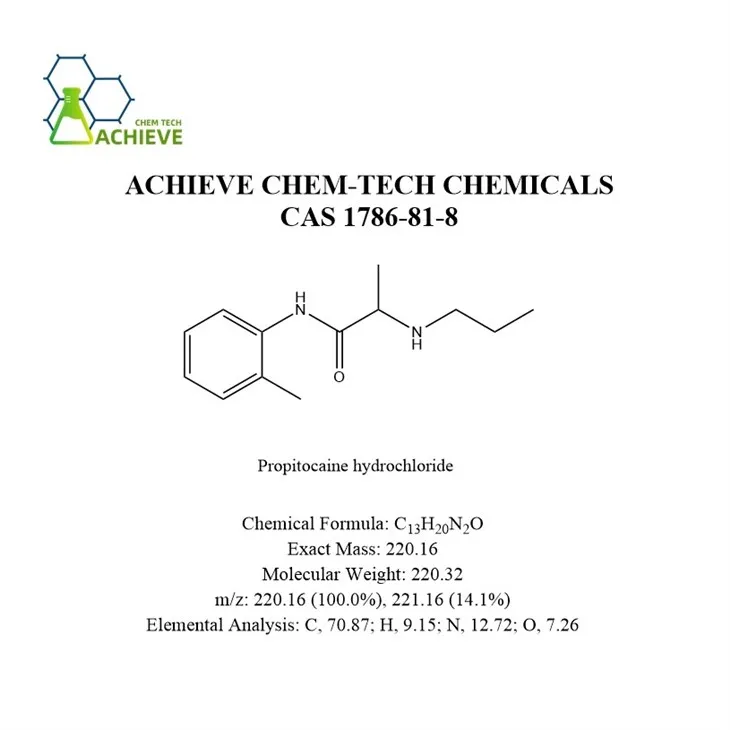
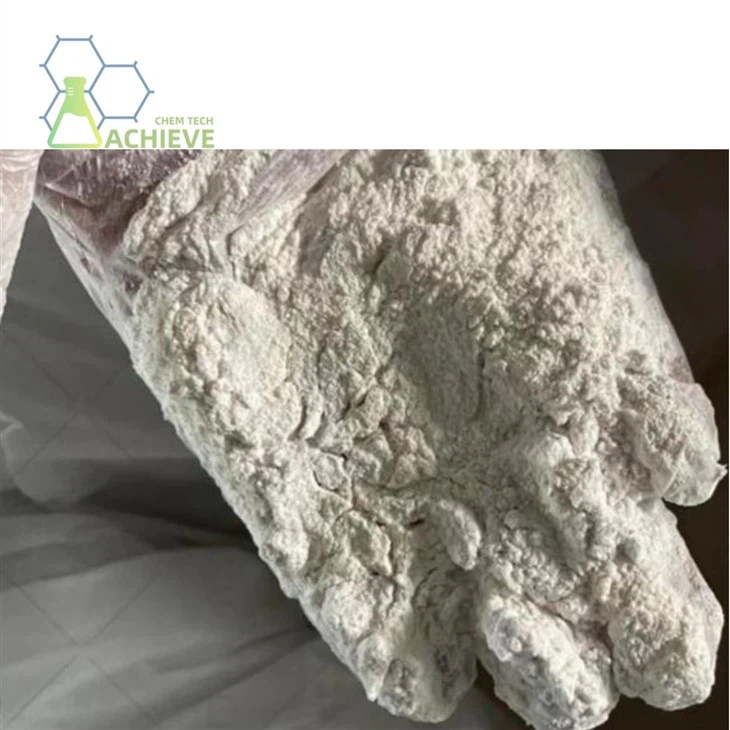
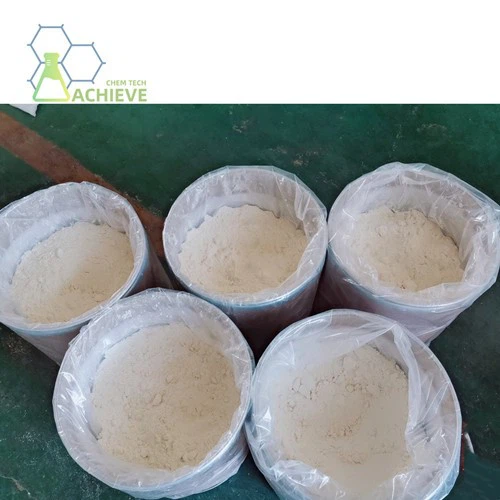


Shaanxi BLOOM Tech Co., Ltd. is one of the most experienced manufacturers and suppliers of propitocaine hydrochloride cas 1786-81-8 in China. Welcome to wholesale bulk high quality propitocaine hydrochloride cas 1786-81-8 for sale here from our factory. Good service and reasonable price are available.
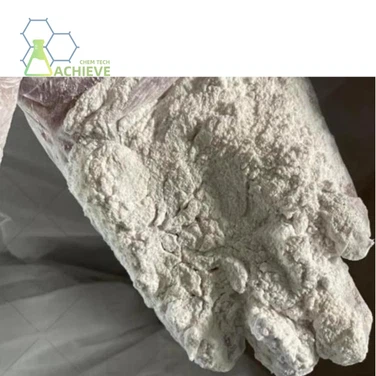
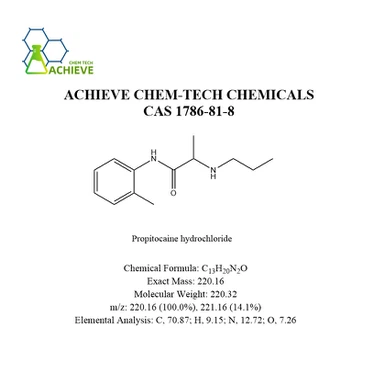
Propitocaine hydrochloride, also known as prilocaine hydrochloride, polirocaine or propancaine hydrochloride, CAS 1786-81-8, molecular formula C13H21ClN2O. A crystalline powder that appears white or off white at room temperature, odorless, with a slightly bitter taste, followed by numbness. This appearance is closely related to its use as a local anesthetic.
Due to its easy solubility in water and ethanol, this indicates that it has good solubility in these two solvents; Slightly soluble in chloroform, indicating poor solubility in chloroform; Insoluble in ether indicates that it is almost insoluble in ether. It is an important pharmaceutical raw material, especially widely used as a local anesthetic in the medical field.
|
|
|
|
Chemical Formula |
C13H20N2O |
|
Exact Mass |
220.16 |
|
Molecular Weight |
220.32 |
|
m/z |
220.16 (100.0%), 221.16 (14.1%) |
|
Elemental Analysis |
C, 70.87; H, 9.15; N, 12.72; O, 7.26 |

As an important local anesthetic, Propitocaine hydrochloride has a wide range of applications in the medical field. Its mechanism of action mainly involves the local anesthetic effect on the nervous system, which blocks pain signals through a series of biochemical processes. The following is a detailed explanation of the mechanism of action of it, which may be close to or slightly exceed 2000 words to meet your needs.
The mechanism of action
The main function of it is local anesthesia, which reduces the generation and transmission of nerve impulses by inhibiting voltage dependent sodium ion channels on the nerve cell membrane, thereby achieving anesthetic effects.
(1) Inhibition of sodium ion channels: There are multiple ion channels on the membrane of nerve cells, among which sodium ion channels play a key role in the generation and conduction of nerve impulses. Propavacaine hydrochloride can reversibly competitively inhibit these voltage dependent sodium ion channels, reduce the permeability of nerve cell membranes to sodium ions, and put the nerve cell membranes in a hyperpolarized state. This hyperpolarized state prevents the generation and transmission of nerve impulses, thereby achieving local anesthesia effects.


(2) Intensity of action and onset time: The local anesthetic effect of lidocaine hydrochloride is similar in intensity to lidocaine, but the onset time may be slightly longer. This is related to its molecular structure and mechanism of action. Once the drug enters the site of action, it quickly binds to the sodium ion channels on the nerve cell membrane and exerts its inhibitory effect. As the drug concentration increases and the duration of action prolongs, the local anesthetic effect will gradually enhance.
(1) Interference with neurotransmitters: Neurotransmitters are important substances for transmitting information between neurons. Propavacaine hydrochloride can interfere with the synthesis or release of certain neurotransmitters, thereby weakening or blocking information transmission between neurons. This interference can further reduce the excitability of the nervous system and help achieve nerve block effects.


(2) Impact on nerve impulse transmission: In addition to directly inhibiting sodium ion channels, procaine hydrochloride may also achieve nerve blockade by affecting the transmission process of nerve impulses. For example, it can affect the excitability of presynaptic membranes and reduce neuronal overdischarging; At the same time, it can also affect the receptor function of the postsynaptic membrane and reduce the excitatory effect of neurotransmitters on the postsynaptic membrane. These effects collectively lead to inhibition of the transmission of neural impulses.
Myocardial protective effect
In addition to local anesthesia and nerve block effects, the product also has cardioprotective effects. This is mainly achieved by improving the hypoxia tolerance of myocardial cells and reducing ischemia-reperfusion injury.
(1) Improving hypoxia tolerance: Propaprocaine hydrochloride can increase the tolerance of myocardial cells to hypoxia, thereby reducing myocardial damage caused by hypoxia. This protective effect may be related to its inhibition of sodium ion channels and reduction of myocardial cell energy consumption.


(2) Reduce ischemia-reperfusion injury: During myocardial ischemia-reperfusion, a large amount of free radicals and inflammatory mediators are produced, causing damage to myocardial cells. Propavacaine hydrochloride can reduce the production and release of these harmful substances, thereby alleviating myocardial ischemia-reperfusion injury. This protective effect may be related to its antioxidant and anti-inflammatory effects.
The synthesis of the product usually involves multiple steps and a complex chemical reaction network, including the preparation of raw materials, the introduction and conversion of functional groups, and the final salt formation process. Among them, key reaction types such as substitution reactions and amidation reactions may be involved. These reactions need to be carried out in the presence of specific solvent systems, catalysts, or reagents to ensure smooth synthesis and produce the desired chemical structure.
Possible synthetic pathways
It should be noted that the following synthetic pathways are only illustrative and not intended as practical guidance. The specific steps may vary depending on process requirements, raw material sources, or patent strategies.
1. Raw material preparation
The synthesis of Propitocaine hydrochloride may first require the preparation of corresponding amino acids (such as alanine) and other organic compounds as starting materials. These materials should undergo strict purification treatment to avoid introducing impurities that may affect subsequent reactions.
2. Introduction and conversion of functional groups
After the raw materials are prepared, a series of chemical reactions need to be carried out to introduce the required functional groups, such as amino and carboxyl groups, and these functional groups need to be transformed through reduction, oxidation, or other means to form a chemical environment conducive to subsequent connections.
3. Salt formation reaction
Finally, it may undergo a salt formation reaction with acids (such as hydrochloric acid) to produce it. This step is usually one of the key steps in the synthesis process, as it directly affects the solubility, stability, and bioavailability of the final product.
Key reaction types and condition control
Substitution reaction:
In the synthesis of it, substitution reactions may be used to introduce or replace specific atoms or atomic groups. This type of reaction typically requires specific catalysts and solvents, and is carried out under certain temperature conditions.
The reaction conditions and reagent dosage should be strictly controlled to avoid the generation of by-products and ensure the selectivity of the target.
Amide reaction:
The amidation reaction is an important step in the formation of carbon nitrogen double bonds and a key link in the synthesis of it. This reaction usually requires the presence of appropriate reagents such as acyl chlorides, acid anhydrides, etc., and may require heating or the assistance of a catalyst.
During the reaction process, close attention should be paid to the reaction progress and temperature control to ensure the smooth progress of the reaction and reduce the occurrence of side reactions.

I. R&D Background of Amide Local Anesthetics (1940s–1950s)
Before the 1940s, clinical local anesthetics were dominated by ester-type agents (e.g., procaine), which were prone to hydrolysis, allergic reactions, and had a short duration of action. In 1944, lidocaine-the first amide-type local anesthetic-was launched. It became the mainstream due to its high stability, low allergy rate, and rapid onset. However, it still had drawbacks such as cardiovascular toxicity at high concentrations and intolerance in some patients.
To improve safety and applicability, pharmaceutical companies worldwide began developing a new generation of amide local anesthetics, focusing on modifying the side chain of lidocaine to reduce toxicity and prolong the duration of action. Propitocaine hydrochloride thus emerged as a key candidate.

II. Molecular Design and First Synthesis (Late 1950s)
A research team at Astra Pharmaceuticals (Sweden) used lidocaine as a lead compound and replaced its ethyl side chain with a propyl group to design prilocaine. It was prepared as its hydrochloride salt to enhance water solubility.The first chemical synthesis was completed in 1959: starting from o-toluidine, it was obtained as a white crystalline solid through acylation, alkylation, and salt formation, with the chemical identity of 2-propylamino-propanoyl-o-toluidine hydrochloride.
This modification retained the stability of the amide bond while reducing lipophilicity and affinity for the central nervous system and cardiovascular system. Preliminary animal studies showed lower toxicity than lidocaine, and stable anesthesia could be achieved without high-concentration epinephrine.
III. Clinical Evaluation and Launch (1960–1965)
From 1960 to 1963, the product completed clinical trials for dental and surgical infiltration anesthesia and nerve block. Data demonstrated:
Onset in approximately 10 minutes, with a duration of 2.5–3 hours, comparable to lidocaine;
Satisfactory anesthetic depth at low concentrations (1%–2%);
Stable anesthesia with low-concentration epinephrine (1:200,000–1:300,000) or even without epinephrine, greatly reducing risks associated with vasoconstrictors.
In 1965, it was first approved in Sweden under the brand name Citanest Hydrochloride, followed by widespread use in Europe and the United States, becoming one of the preferred local anesthetics in dentistry.
IV. Process Optimization and Global Adoption (1970s to Present)
After launch, the traditional multi-step batch synthesis suffered from low yield and high pollution. Between the 1970s and 1990s, the industry optimized the process by adopting continuous-flow synthesis, integrating nitration, reduction, acylation, and salt formation in-line. The overall yield increased from 50% to 74%, and reaction time was shortened to 13.6 minutes, meeting green chemistry standards.After 2000, compound formulations (e.g., lidocaine-prilocaine cream) became widely used in aesthetic medicine and dermatology.

To this day, prilocaine remains a commonly used intermediate-acting amide local anesthetic worldwide, widely applied in infiltration, nerve block, and topical anesthesia.

It shows good stability and can be stored long-term under dry and light‑protected conditions.Its aqueous solutions are relatively stable under neutral and weakly acidic conditions, but amide bond hydrolysis readily occurs under high temperature or strong alkaline conditions, producing o-toluidine and the corresponding amino alcohol, leading to reduced efficacy and impurity formation.It is light‑sensitive and prone to decomposition and discoloration upon exposure to light; therefore, it is generally preserved in light‑resistant sealed containers.
The amino group in the molecule can be protonated to form the hydrochloride salt, which significantly improves water solubility and makes it suitable for the preparation of injections and topical formulations.Under alkaline conditions, free prilocaine precipitates from the solution with increased lipophilicity, a property commonly used in sample extraction and purification.Its pKa is about 7.8, and it is partially ionized at physiological pH, which favors penetration of nerve cell membranes to exert local anesthetic effects.
The aromatic amine moiety in the structure exhibits certain reducibility and is easily oxidized by strong oxidizing agents to form colored quinone substances.The amide bond in the molecule is relatively stable and resistant to hydrolysis by common esterases, which is the chemical basis for its lower allergic reaction rate compared with ester‑type local anesthetics.It can react with alkaloidal precipitants to form precipitates, which is often used for qualitative identification. Quantitative analysis can be performed by perchloric acid titration in non‑aqueous media.
FAQ
What is Procaine Hydrochloride used for?
+
-
Procaine is an anesthetic agent indicated for production of local or regional anesthesia, particularly for oral surgery. Procaine (like cocaine) has the advantage of constricting blood vessels which reduces bleeding, unlike other local anesthetics like lidocaine. Procaine is an ester anesthetic.
Does procaine make you sleepy?
+
-
Allergic reaction: Itching or hives, swelling in your face or hands, swelling or tingling in your mouth or throat, chest tightness, trouble breathing. Dizziness, lightheadedness, or fainting. Headache, stiff neck, back pain. Nervousness, restlessness, anxiety, drowsiness, blurred vision.
Why is procaine no longer used?
+
-
However, low potency, slow onset (probably owing to its high pKa), and short duration of action limit the use of procaine. Allergic reactions are possible due to the production of the metabolite PABA.inless steel is not similar to mineral materials,after use can release some substances to promote human absorption.
Hot Tags: propitocaine hydrochloride cas 1786-81-8, suppliers, manufacturers, factory, wholesale, buy, price, bulk, for sale, Sodium Diethyldithiocarbamate, N 1 1 biphenyl 4 yl 1 1 3 1 terphenyl 4 Amine, CAS 1598 32 9, 3 methyl 4 piperidone, CAS 890042 13 4, Indolo 3 2 a carbazole 5 12 bis 1 1 biphenyl 4 yl 5 12 dihydro